 In today’s rapidly evolving business landscape, agility and efficiency are crucial for staying competitive. To achieve this, businesses rely on rules engines to automate decision-making processes efficiently and consistently. However, traditional rules engines often face challenges like complexity, slow adaptability, and high maintenance costs, hindering businesses from unleashing their true potential.
Enter TigerGraph’s Graph Rules Engine, a revolutionary approach to rule-based operations that empowers businesses to break free from the limitations of traditional rules engines. In this blog post, we will explore how TigerGraph’s cutting-edge technology has transformed the way two Forbes top 20 businesses operate, paving the way for enhanced performance, substantial cost savings, and unparalleled agility.
The Challenge of Traditional Rules Engines:
Traditional rules engines have long been the backbone of critical decision-making processes in various industries. Whether it’s product customization, customer eligibility, or asset maintenance, rules engines have provided businesses with the means to streamline operations. However, as businesses grow and evolve, these rule sets become increasingly complex, leading to a multitude of challenges:
- Slow to Adapt: Modifying rule sets can be a cumbersome and time-consuming process, leading to delayed responses to market changes and shifting business priorities.
- Difficult to Explain: Complex rules raise concerns about the confidence in individual decisions and the ability to explain their functioning, posing potential organizational risks.
- Expensive to Maintain: Traditional rules engines require a team of experts to maintain and update them, resulting in significant operational costs.
The Power of Graph Databases:
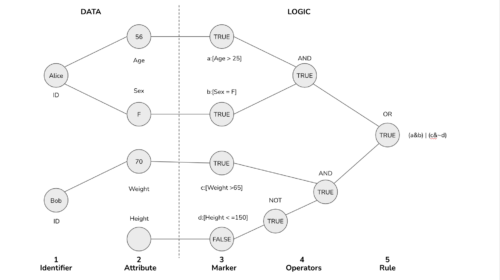
TigerGraph introduces a game-changing solution to these challenges by leveraging the potential of graph databases. Unlike traditional relational databases, a graph database structures information as networks of connected data points, allowing businesses to efficiently represent their products, customers, and operations. This unique approach enables a specialized network called a “tree of decisions,” wherein the rule tree connects seamlessly with the data graph as illustrated in this visual.
Key Benefits of TigerGraph’s Graph Rules Engine:
- Enhanced Manageability: By encoding logic as a graph, businesses gain a comprehensive overview of the interdependencies between various logical units. This visual representation simplifies the management of complex datasets and facilitates quick and confident decision-making.
- Rapid Adaptability: The graph-based approach allows for agile rule set modifications, enabling businesses to respond promptly to market changes and emerging edge cases.
- Cost-Effectiveness: With a simple, 30-line recursive program, TigerGraph’s Graph Rules Engine operates efficiently, reducing data transformation and minimizing system load. This results in improved data security, reduced latency, and cost savings in the maintenance process.
Success Stories:
TigerGraph’s Graph Rules Engine has already made a significant impact on two Forbes top 20 enterprises:
Global Top 5 Healthcare Insurer: By applying rules to determine the suitability of drugs for specific patients, the insurer saves millions of dollars by funding only the most cost-effective treatments.
Global Top 5 Technology Business: The company utilizes rules to ascertain product warranty coverage, leading to millions of dollars in savings through effective product repairs and improved aftermarket service.
TigerGraph’s Graph Rules Engine has revolutionized the way businesses approach rule-based operations. By leveraging the power of graph databases, businesses can overcome the limitations of traditional rules engines, achieving unmatched agility, cost-effectiveness, and operational efficiency. As demonstrated by two Forbes top 20 enterprises, TigerGraph’s innovative solution is a game-changer in today’s dynamic business environment. To experience the power of TigerGraph’s Graph Rules Engine, businesses can explore the options of cloud or on-premises deployment. Reach out to info@tigergraph.abstage.xyz to explore how your business can benefit.
In the ever-evolving landscape of technology, certain innovations emerge that have the potential to shape the future. One such innovation is the emergence of graph AI. As a marketer myself, I have been a passionate advocate of graph-based technologies for business for quite some time now. And it’s exciting to witness the significant uptake of graph technologies in the mainstream.
According to Gartner, by 2025, a staggering 80% of data and analytics innovations will involve the use of graph technologies. This statistic alone highlights the growing acceptance and benefits that graph AI brings to the table. In fact, most Fortune 500 companies have already embraced graph technologies and reported successful use cases. The impact of graph AI in facilitating rapid decision-making and unlocking valuable insights is undeniable.
Innovations in graph AI have driven profitability across a number of industries and use cases, including:
- Fraud detection
- Network optimization
- Pharmaceutical drug discovery
- Risk monitoring
- Recommendation engines
- Cybersecurity
- …and many more artificial intelligence solutions
Specifically in marketing, graphs offer several advantages, enabling marketing professionals to unlock valuable insights, improve customer targeting, and optimize marketing campaigns. Here are some ways in which graph databases are beneficial for marketing:
- Relationship Mapping: Graph databases excel at representing and analyzing complex relationships between entities. In marketing, this means being able to map connections between customers, products, behaviors, preferences, and interactions. By visualizing and understanding these relationships, marketers can identify influential customers, uncover hidden patterns, and personalize marketing efforts based on individual or group preferences.
- Personalization and Targeting: Graphs allow marketers to create highly targeted and personalized campaigns. By leveraging the interconnectedness of data, marketers can identify customers with similar attributes, interests, or behaviors and tailor messaging and offers to their specific needs. This level of personalization enhances customer engagement, drives conversion rates, and improves overall campaign effectiveness.
- Customer Journey Analysis: Understanding the customer journey is crucial for effective marketing. Graph databases provide a holistic view of the customer journey by capturing touchpoints across channels and tracking interactions over time. Marketers can analyze the customer journey graph to identify bottlenecks, optimize touchpoints, and deliver a seamless and personalized experience at each stage.
- Influencer Marketing and Advocacy: Graphs can identify key influencers and brand advocates within a network. By analyzing the relationships and interactions between individuals, marketers can identify influential customers who can amplify brand messaging, drive word-of-mouth marketing, and facilitate customer acquisition. Leveraging these influential relationships can significantly impact brand perception and reach.
- Customer Segmentation: Graphs enable advanced customer segmentation. Marketers can identify distinct customer segments based on shared characteristics, behaviors, or preferences. With this information, they can create targeted marketing campaigns tailored to each segment, delivering relevant messaging and offers. By understanding the nuances of different customer segments, marketers can optimize marketing efforts, improve customer acquisition, and increase customer loyalty.
- Campaign Optimization: Graph databases allow marketers to track and measure campaign performance in real-time. By capturing data on customer interactions, responses, and conversions, marketers can identify successful campaign elements and refine future efforts. Additionally, graph databases can facilitate A/B testing and experimentation, helping marketers optimize campaign components and improve overall ROI.
- Customer Retention and Cross-Selling: Graphs enable marketers to identify opportunities for customer retention and cross-selling. By analyzing customer behavior, preferences, and past interactions, marketers can identify cross-selling opportunities and personalize recommendations. Furthermore, by identifying customer churn patterns and potential churn risks, marketers can proactively engage customers and implement retention strategies.
These are just a few examples of how graph databases can benefit marketers. By leveraging the power of interconnected data, graph databases provide a comprehensive view of customers, enable personalization, optimize campaigns, and drive customer-centric marketing strategies. With their ability to uncover complex relationships and deliver actionable insights, graph databases are a valuable tool for modern marketers seeking to enhance their marketing efforts.
Stay tuned as we navigate this ever-evolving landscape, unlocking the full potential of graph AI and shaping the future of marketing. The possibilities are endless, and together, we can achieve remarkable results.
As always, reach out to info@tigergraph.abstage.xyz with any questions.