Summary
- LLMs automate entity and relationship extraction from unstructured text, but they do not store, validate, or reason over that data – that is the knowledge graph’s job.
- A production-ready knowledge graph with LLMs requires five stages: data ingestion, LLM-based extraction, entity resolution, graph ingestion with schema validation, and a GraphRAG retrieval layer.
- Schema design must happen before ingestion begins. Retrofitting a schema at enterprise scale requires full re-extraction and re-ingestion – a remediation effort that typically takes months.
- GraphRAG grounds LLM responses in verified, relationship-structured facts rather than statistical patterns, making enterprise AI systems accurate, explainable, and auditable.
Your AI system is only as reliable as the knowledge it reasons from. The problem most enterprises hit is not that their LLM is underpowered: their retrieval layer is too shallow. Vector search returns semantically similar text; it cannot follow a chain of relationships, enforce access controls, or explain why a result was returned. When the stakes are high (fraud detection, regulatory compliance, clinical decision support), that gap matters.
Knowledge graphs built on top of LLM extraction give enterprise AI a structured, verifiable source of truth to reason from. LLMs are now making it practical to build that knowledge layer at a fraction of the effort it once required, opening real opportunities for organizations ready to move beyond prototype-level thinking.
Most tutorials on this topic focus on small-scale developer demos: a Python notebook, a few hundred entities, and a simple extraction loop. What they skip is what an enterprise build actually requires: data quality controls, schema governance, scalability, and the integration architecture that makes the graph useful in production.
In this guide you will learn:
- What role the LLM and the knowledge graph each play in a production pipeline
- How to design a schema that holds up at enterprise scale
- What the five-stage reference architecture looks like end-to-end
- The best practices that separate a production-grade knowledge graph from a proof of concept
- How the finished graph powers enterprise AI through GraphRAG
What Is a Knowledge Graph?
A knowledge graph is a structured database that stores entities – people, organizations, products, events, concepts – and the relationships between them. Unlike a relational database, which records facts about individual entities in separate tables, a knowledge graph makes the connections between entities a first-class data element, enabling multi-step relationship queries across millions or billions of records.
The practical implication for enterprise AI is that a knowledge graph can answer questions that require context: not just “what is similar to X?” (the job of a vector database) but “how does X relate to Y, and what does that relationship tell us?” That is the capability that makes knowledge graphs essential infrastructure for entity resolution, fraud detection, regulatory explainability, and any other use case where the connection between facts is as important as the facts themselves.
What LLMs Actually Do in a Knowledge Graph Pipeline
It is easy to assume that an LLM and the knowledge graph are the same thing. They are not. Each plays a different role, and understanding what each does well is the key to building an AI system that meets your organization’s reliability requirements.
The LLM is the extraction and transformation layer. It reads unstructured text, including documents, reports, web content, and transcripts, and identifies entities, relationships, and attributes that can be structured into a graph. It performs three core tasks:
- Named entity recognition: Identifying people, organizations, products, locations, concepts, and other domain-relevant entities within the source text.
- Relationship extraction: Identifying how those entities are connected, such as “company A acquired company B” or “drug X treats condition Y.”
- Entity disambiguation: Resolving whether two differently named entities refer to the same real-world object. At enterprise scale, this step is critical for accuracy. Without it, the same customer, product, or concept can appear dozens of times under slightly different names.
What the LLM does not do is equally important. It extracts seemingly correct information based on statistical patterns, but it does not validate those extractions against existing data, enforce schema consistency, or reason over the graph. That is the graph database’s job.
The core design principle is this: the LLM populates the graph and makes it accessible through natural language queries, while the graph database handles storage, validation, and reasoning. Keeping these roles clearly separated ensures the system stays dependable and scalable as it grows, and it ensures that LLM hallucinations are caught before they enter the graph, not after they have already propagated through it.
Design the Graph Schema Before You Build
Schema design is the step some developer-focused tutorials skip entirely. Instead, they jump straight to code. That shortcut is manageable at demo scale. At enterprise scale, it is the most common reason knowledge graph projects fail to reach production.
A schema defined after ingestion is difficult to enforce retroactively. It creates inconsistency at merge time and typically has to be rebuilt as new use cases emerge. A healthcare organization that ingests clinical notes without first defining entity types like Patient, Diagnosis, Treatment, and Physician will find, on first query, that the same diagnosis appears under dozens of slightly different names and the same patient is represented by multiple disconnected records. Fixing that requires full re-extraction, re-ingestion, and re-deduplication: a remediation effort that can take months at enterprise data volumes.
A well-designed knowledge graph schema defines four things before a single record is ingested:
- Entity types: The categories of entities the graph will contain: Person, Organization, Product, Event, Policy.
- Relationship types: The categories of connections between those entities, including directionality and cardinality.
- Properties: The attributes each entity or relationship carries, and which are required versus optional.
- Domain ontology: The controlled vocabulary and hierarchy of concepts that govern how entities are classified and disambiguated throughout the graph.
Schema design also requires close collaboration between domain experts, data architects, and AI engineers, since the LLM cannot always determine which distinctions are most important within a specific domain. A financial services graph needs to distinguish between a beneficial owner and a nominee director in ways that general-purpose extraction will miss without explicit guidance.
The property graph model is the preferred choice for enterprise AI workloads. It excels at representing connections among data scattered across diverse data architectures and schemas, making it well-suited to the heterogeneous source environments most enterprise builds start from. The multi-hop query performance of property graphs can also be important for AI requiring fast responses.
The Enterprise AI Knowledge Graph Pipeline: Five Stages
A production enterprise AI knowledge graph pipeline has five distinct stages, each with its own quality and governance requirements. Every stage must be implemented correctly for the graph to be accurate, scalable, and useful for AI inference. Skipping any one of them is the most common reason enterprise knowledge graph projects fail to reach production.
Stage 1: Data ingestion and preprocessing. Raw unstructured sources , including documents, emails, transcripts, and APIs, are cleaned, chunked, and formatted for LLM processing. Data quality problems introduced at this stage compound through every subsequent step. An ingestion pipeline that passes malformed or duplicate source records to the LLM will produce malformed or duplicate entities in the graph, and those errors become progressively harder to correct as the graph grows.
Stage 2: LLM-based extraction. The LLM performs named entity recognition, relationship extraction, and entity disambiguation against the predefined schema. A validation layer between the LLM and the graph is essential: schema-aware verification is the only reliable way to prevent hallucinated extractions from entering and propagating through the graph. A financial services team that skips this step may find fabricated regulatory relationships in their compliance graph months after ingestion, at a point where the affected records are too numerous to correct manually.
Stage 3: Entity resolution and deduplication. Extracted entities are matched against existing graph records to determine whether they are new or references to known ones. This step prevents duplicate entities from corrupting path analysis and silently degrading AI outputs. Entity resolution is not optional at scale: it determines whether the graph reflects reality or accumulates compounding noise over time.
Stage 4: Graph ingestion and schema validation. Validated records are loaded into the graph database against the predefined schema. The graph engine enforces structural consistency, updates relationships in real time, and rejects malformed data. Without schema enforcement at this stage, data ingested outside the defined model accumulates as unresolvable exceptions that require lengthy manual remediation.
Stage 5: Retrieval and query layer (GraphRAG). GraphRAG uses the populated knowledge graph as its retrieval layer, so LLM responses are grounded in real, structured relationships, something vector retrieval cannot provide. Every response traces to a verified path through the graph, making enterprise AI systems built on this layer accurate, explainable, and auditable by design.
When to Build a Knowledge Graph with LLMs
A knowledge graph with LLM extraction is the right architecture when one or more of the following conditions apply to your organization:
- Your AI needs to answer questions about relationships, not just content. If your use case requires knowing how entities connect, not just what they are, vector retrieval cannot provide that. Knowledge graphs can.
- Your data is unstructured and your entity volume is too large for manual curation. LLM-based extraction makes it practical to build a production-grade knowledge graph from documents, transcripts, and reports at scale.
- Explainability is a regulatory or operational requirement. Healthcare, financial services, and government use cases where AI outputs must be auditable require a retrieval layer that can show the reasoning path. GraphRAG over a knowledge graph provides that; vector RAG does not.
- You are experiencing entity fragmentation across systems. If the same customer, counterparty, or asset appears differently across multiple data sources, a knowledge graph with entity resolution closes that gap in a way that relational or vector architectures cannot.
- You are building for production, not experimentation. Knowledge graphs built with LLM extraction at enterprise scale require schema governance, validation layers, and a graph database with the performance to support real-time queries across billions of relationships. If those requirements match your use case, the architecture described in this article is the path forward.
Best Practices for Building Enterprise AI Knowledge Graphs with LLMs
The difference between a knowledge graph that powers production AI and one that stalls in proof-of-concept comes down to decisions made early in the build.
Define the ontology before running the LLM. Prompting an LLM against an undefined schema produces inconsistent entity types that are expensive to normalize. A biotech team that skipped this step ended up with seventeen variations of “Phase III trial” as distinct entity types, none compatible with the others for cross-trial queries. Ontology first, extraction second.
Validate LLM output before ingestion. Implement a validation layer that checks extracted records against the schema and flags low-confidence extractions for human review. This is cheaper than remediating fabricated or malformed records after they have propagated through a production graph.
Prioritize entity resolution as a first-class step. Failure to deduplicate entities is the most common cause of silent data quality degradation at scale. Address it with graph-native algorithms; a fraud detection system with duplicate customer records will miss ring structures that span those duplicates entirely.
Design for continuous ingestion, not a one-time load. Updating a knowledge graph changes only the relevant records and connections. Build the ingestion pipeline for real-time updates from day one, not as a retrofit.
Keep the graph and the LLM in separate layers. The LLM extracts. The graph stores and reasons. Mixing these responsibilities creates architectures where hallucinations propagate into the graph and compound over time.
Build for GraphRAG from the start. The entity types and relationship paths you define at schema design time become the paths GraphRAG will follow at inference time. Designing them with retrieval in mind produces a graph that is useful for AI inference from the first query.
Build the Knowledge Graph Your Enterprise AI Actually Needs
Most enterprise AI projects do not fail in the model layer. They fail in the knowledge layer: unvalidated extractions that corrupt the graph, duplicate entities that degrade query results, retrieval architectures that cannot explain what they return. The five-stage pipeline in this article exists to prevent exactly those failures and the graph database at its center is what determines whether the architecture holds at production scale.
TigerGraph is built for that requirement. Its massively parallel, native graph and vector architecture handles the entity resolution, schema validation, and GraphRAG retrieval that enterprise AI demands at scale, without stitching together separate systems for each stage.
FAQs
What is a knowledge graph LLM?
A knowledge graph LLM is an AI architecture that combines a structured knowledge graph with a large language model. The graph supplies verified entities and relationships; the LLM makes them accessible through natural language queries. The result is an AI system that produces factually grounded responses because it is reasoning from real, validated data rather than statistical patterns alone.
Can LLMs build knowledge graphs automatically?
LLMs can automate the extraction phase (named entity recognition, relationship extraction, and entity disambiguation from unstructured text), but a production-ready knowledge graph also requires schema design, validation, entity resolution, and governance that cannot be fully automated. Human judgment is required at ontology design and post-ingestion validation, particularly in domains where category distinctions have significant downstream consequences.
What is an LLM graph transformer?
An LLM graph transformer converts unstructured text into structured records, each in the form of (entity1, relationship, entity2) ready for ingestion into a graph database. It is the component that bridges raw content and a queryable knowledge graph, and it is where schema-aware prompting and validation make the difference between accurate extraction and a graph full of inconsistent records.
What is the difference between RAG and GraphRAG for knowledge graphs?
RAG retrieves documents based on semantic similarity between the query and stored text chunks. GraphRAG follows relationship paths through a knowledge graph to retrieve structurally connected, factually verified information. GraphRAG produces more accurate and explainable responses because it is grounded in verified entity relationships rather than text similarity patterns, and every result can be traced back to a specific path in the graph.
Graph Keeps Agentic AI Systems Safe with Guardrails, Not Guesswork
In the world of autonomous AI, control is everything. And agentic systems, consisting of AI agents capable of setting goals, making decisions, and taking action, are quickly moving from experimental to enterprise. But as autonomy grows, so does the need for accountability. And that raises a critical question: what shouldn’t an agent do?
When agents act independently, they need more than instructions—they need boundaries. Business rules, ethical norms, risk thresholds, compliance constraints. These are non-negotiable in enterprise environments. But they can’t be bolted on after the fact, and they can’t be static. Agents operating in dynamic systems require guidance that adapts in real time, and that’s where traditional rule engines and hardcoded logic fall short.
Graph Provides a Better Foundation
Unlike rigid policy frameworks or black-box heuristics, graph technology encodes guardrails as contextual, adaptive relationships. It enables AI agents to reason not just about their goals, but about the environment, policies, and people they’re accountable to, before they act.
And with TigerGraph, that reasoning becomes fast, scalable, and transparent. It’s built directly into the agent’s decision logic from the start.
Why Guardrails Matter More Than Ever
Agentic AI has enormous potential, but that potential comes with risk. When AI agents are capable of acting on their own, even small blind spots can lead to outsized consequences. A customer service agent might escalate too quickly, or not at all. A digital assistant in a regulated industry might pull in outdated policies or make recommendations that don’t meet compliance standards. An engineering co-pilot might initiate actions based on an old version of a system spec.
And these missteps don’t stem from malice or malfunction. They happen because the agent didn’t know better, because it wasn’t grounded in the right context.
Large language models (LLMs) are generative, not judgmental. They can produce convincing outputs, but they lack built-in guardrails. They don’t retain long-term memory, track behavioral norms, or infer relationship dynamics across tasks and tools unless that structure is provided to them. In critical enterprise workflows, that’s not good enough.
You want a model that can produce language, but you need one that understands the environment in which it is operating. An agent that knows the difference between typical and risky, standard and exceptional, appropriate and potentially harmful.
Another concern is that GenAI works on statistical probabilities, not clearcut facts. The statistical nature is what enables it to produce fresh-sounding content, but it also means that once in a while, it will hallucinate and produce something that isn’t true.
That’s where graph comes in.
Graph technology models clear knowledge, principles, and their meaning. With a graph, you can encode business rules, behavior boundaries, relational norms, and access controls directly into the system. These become traversable, queryable structures that guide agents in real time.
Instead of relying on post hoc filtering or static prompt instructions, agents backed by graph can check their context before they act, ensuring decisions reflect your goals, policies, and risks at that moment. It’s the foundation for responsible autonomy.
Graph Is the Foundation for Responsible Autonomy
For agentic AI systems to operate responsibly, they need more than a list of rules. They need a living framework that reflects how your organization works.
Traditional systems often rely on brittle rules engines or hard-coded workflows to enforce business logic. But these approaches lack flexibility, adaptability, and context. They don’t evolve as the environment changes, and they don’t scale well across diverse use cases.
Graph offers a fundamentally different approach.
Instead of embedding rules in procedural code, graph technology allows you to model the logic of your system as part of the data itself. Relationships, policies, constraints, permissions, and behavioral norms all become part of the graph structure. They’re referenced, encoded, and enforced through the graph’s topology and traversal logic.
With TigerGraph, these embedded guardrails are:
- Persistent – They’re not tied to a single session or prompt. The logic lives within the graph and is accessible at any time, across agents, users, and tasks.
- Compositional – Guardrails can be linked to both entities and relationships, meaning your AI can reason not just about who someone is, but what they’re allowed to do, with whom, and under what conditions.
- Context-aware – As data updates in real time, so does the logic. If a user’s role changes, or a project’s risk status shifts, the graph reflects that immediately—no manual rewiring required.
This means when an agent queries TigerGraph, it’s not just pulling isolated facts. It’s operating within a connected, rule-informed environment—one that understands who can do what, when, and why.
That is real-time reasoning, powered by a structure that keeps autonomy aligned with accountability, moving the needle from manipulating data to recognizing constraints.
From Data to Constraints
TigerGraph’s platform is built for complex, real-time, multi-hop reasoning. It’s the exact kind of traversal needed to keep autonomous agents safe and aligned. Here’s how it works in practice:
- Behavioral Boundaries: Encode what “normal” looks like for an agent, user, or process. If an action deviates from expected behavior, the graph flags or blocks it.
- Access Control: Link permissions not just to users, but to roles, contexts, timeframes, and relationships. Agents can check, for example, whether a customer is eligible for a refund based on their purchase history, account status, and prior exceptions, without brittle if-then logic.
- Dependency Awareness: Agents can map dependencies between actions before executing them. If a task requires approvals or data from another workflow, the graph can enforce that sequence.
- Explainable Rejection: When an agent refuses to act, it can explain why, because the graph contains not just the data, but the logic and history behind the decision.
This isn’t about replacing LLMs. It’s about complementing them. Graph gives structure to autonomy.
Real-World Example: Agentic AI in Customer Service
Imagine an agentic AI system supporting a telecom provider. The system fields upgrade requests, troubleshoots issues, and offers new promotions.
A customer calls to request a plan downgrade. The LLM knows how to respond, but the graph determines what it’s allowed to offer based on:
- The customer’s tenure, usage, and history of plan changes
- Internal policies about downgrade limits
- The retention team’s intervention rules
The agent doesn’t guess. It checks. The result? A decision that’s fast, fair, and explainable.
From Black Box to Guardrails You Can Trust
Agentic AI isn’t just about autonomy—it’s about alignment. And that means building systems that not only generate actions but understand when not to act. Graph technology enables this by embedding policies, relationships, and constraints directly into the environment in which the agent operates, not as a layer added on top, but as part of the decision-making fabric itself.
TigerGraph makes this real, operational, and enterprise-ready. With real-time graph traversal, built-in algorithmic logic, and distributed performance, TigerGraph empowers agents to reason across context, roles, and history before executing a decision. It results in systems that adapt dynamically, explain themselves clearly, and stay aligned with your organizational values.
In a world where AI will increasingly act on our behalf, graph provides the connective structure that keeps agents grounded. And TigerGraph turns that structure into a scalable, intelligent foundation for responsible autonomy.
Try TigerGraph Savanna free today—the fastest way to build, scale, and run graph-powered AI applications in the cloud. https://tgcloud.io
Why Agentic AI Needs More Than Just Rules (It Needs Guardrails)
Traditional AI models often operate in rigid, rule-based environments, but real-world scenarios demand nuance. Agentic AI doesn’t just follow instructions—it interprets them, reasons through options, and makes choices based on perceived goals. To do that responsibly, it needs more than logic—it needs context.
Graphs provide this context.
Graph databases model not just data points but the relationships between them. A knowledge graph, for instance, can represent everything from company policies and domain-specific regulations to behavioral norms and ethical principles. This allows an agentic AI to reason through decisions in a more human-like, adaptable way.
Self-Driving Cars and Situational Awareness
Consider a self-driving car: Programming the legal rules of the road—speed limits, stop signs, right-of-way laws—is relatively straightforward. These are hard-coded, rule-based instructions. But driving isn’t just about following laws. It’s about reading the room.
Take the rule, “Yield to pedestrians.” It seems simple. But what happens when a pedestrian is near the curb, scrolling on their phone, making no eye contact? What if the crosswalk light is blinking and traffic is backing up? Is the person about to cross—or just waiting for an Uber?
These are not binary decisions—they require situational judgment. And that’s where traditional logic systems fall short. Behind the curtain, an autonomous vehicle needs to:
- Ingest real-time data from sensors (e.g., lidar, cameras, GPS) about nearby objects, speed, trajectory, and intent.
- Link this data to context: Is this a school zone during drop-off hours? Has the same pedestrian crossed here before? Is this behavior consistent with past crossing patterns?
- Weigh competing priorities: safety, legality, traffic flow, rider experience.
This is where graph comes in. A graph-based system connects these data points as a web of relationships:
- The pedestrian is a node, linked to attributes like direction of movement, gaze, phone usage.
- The location is a node tied to school zone status, time-based restrictions, or past accident history.
- The vehicle state (speed, path, braking time) is part of a larger dynamic network that influences and is influenced by all the above.
With this graph, the AI agent can reason through decisions—not just react. It can say, “I’ve seen this pattern before. In similar conditions, the pedestrian crossed late. There’s a history of near misses at this time. The safest move is to yield.”
That’s not just compliance—it’s judgment. And it’s made possible by a graph that models not just what is, but how everything relates.
In short, graphs give agentic AI the situational awareness to act more like a cautious, adaptive driver—not just one following the letter of the law, but one aligned with the spirit of it.
Building Responsible Autonomy with Graphs
As AI systems evolve from reactive models to autonomous agents, their ability to operate independently introduces new risks—and new responsibilities. Agentic AI doesn’t just follow a linear set of instructions; it makes decisions, adjusts strategies, and acts over time in dynamic environments. These systems need more than data and logic to ensure that autonomy is exercised responsibly. They need context, norms, and guardrails.
Graph technology provides this scaffolding by modeling relationships—not just between data points, but between rules, entities, behaviors, and outcomes. It’s the connective tissue that allows agentic systems to reason like humans do—not in isolation, but with situational awareness.
With graph-based infrastructure, autonomous systems can:
Align with Organizational Policies
A graph can represent internal structures such as reporting hierarchies, approval workflows, and business policies. When an AI agent evaluates a course of action—say, escalating a transaction or triggering an alert—it can traverse this graph to understand what’s allowed, who needs to be informed, and under what conditions exceptions apply. This is more than access control—it’s embedded operational intelligence.
Incorporate Domain-Specific Ethics
Legal boundaries, cultural expectations, and industry regulations vary across contexts. A healthcare AI should respect HIPAA privacy constraints. A financial advisor bot might need to avoid investments that conflict with ESG preferences. Graphs make it possible to encode these domain-specific norms as traversable relationships and dynamic rules—so that AI systems can reason through them, not just check boxes.
Adapt While Staying Accountable
One of the promises of Agentic AI is its ability to explore new strategies and learn from outcomes. However, this exploration must happen within well-understood limits in enterprise and regulated environments. Graphs provide those limits—not by halting adaptation, but by guiding it. Graphs are how you encode behavioral norms—not just what’s allowed, but what’s expected.
It’s important to note that not all graph systems can handle the scale, depth, or complexity of real-world autonomous decision-making. Agentic AI requires real-time feedback, deep multi-hop reasoning, and policy-aware traversal logic. This is where TigerGraph’s native parallel architecture makes that vision operational.
TigerGraph, for example, supports:
- Shared-variable logic – for efficient collaborative network exploration and analysis.
- Streaming graph updates – enabling the system to integrate fresh data without disruption.
- Native parallelism – meaning it can handle many decisions and data paths simultaneously.
In plain terms: TigerGraph helps agentic AI systems see relationships as they evolve, adapt decisions as new information comes in, and maintain alignment with human expectations at scale.
This is how you move from automation to alignment. From agents that execute code to agents that act with awareness.
The goal isn’t just to prevent catastrophic failure—it’s to build systems people can trust. Whether that’s a compliance officer reviewing a flagged transaction or a customer relying on AI for a financial decision, explainability and accountability are non-negotiable. And graphs—especially when engineered for real-time performance and complex traversals—are uniquely suited to deliver both.
By embedding policies, relationships, and behavioral expectations directly into the AI’s reasoning substrate, graph technology ensures that as autonomy grows, so too, does accountability. To truly empower AI systems with this level of structured, contextual awareness, you need more than a database—you need a knowledge graph.
What Is a Knowledge Graph—And Why Does Agentic AI Need One?
A knowledge graph is a special type of graph database that doesn’t just store data—it models meaning. It represents entities (like people, accounts, or policies) as nodes and encodes their relationships as edges. But what makes it a “knowledge” graph is how it captures the semantics, rules, and norms behind those connections.
Think of it as a living, contextual map of how your world works—one that:
- Reflects your organization’s policies, data sources, and workflows.
- Describes the context and history of key entities, evolving as situations change.
- Enables AI agents to reason in real-time with awareness of both structure and meaning.
For agentic AI, this is essential. A knowledge graph gives the agent a form of memory, policy guidance, and situational understanding. It can answer questions like: “What actions are typical for this scenario?” “Have we seen a pattern like this before?” and “Does this behavior violate any rules, norms, or expectations?”
When built on a platform like TigerGraph—which is purpose-built for deep reasoning, not just speed—this knowledge graph becomes a live, scalable decision layer.
Its architecture supports the full stack of requirements for explainable, policy-aware AI: from reusable logic (so agents can apply consistent rules across different situations), to streaming updates (so the system can respond to new information in real-time) to parallel traversal (so it can analyze complex relationships across billions of nodes and edges without slowing down).
In short, TigerGraph enables AI systems not only to act fast—but to act with understanding, consistency, and accountability.
Graphs as the Moral Compass of Machines?
As AI becomes more agentic—capable of reasoning, planning, and acting independently—the need for explainability, accountability, and contextual awareness only grows. Graphs offer a way forward. By structuring data around entities and their relationships, graph technology provides the contextual backbone that helps autonomous systems navigate complex environments while staying aligned with their intended goals.
This isn’t theoretical. Forward-looking organizations are already pairing knowledge graphs with real-time data and agentic models to build systems that are not only autonomous—but aligned. In financial services, for instance, AI agents must make decisions that comply with regulations, reflect organizational priorities, and stand up to audit—often in real-time.
TigerGraph distinguishes itself here. Unlike general-purpose graph databases, it is engineered specifically for complexity and enterprise-grade performance. Its ability to support deep reasoning, not just fast lookup, is critical when AI needs to explain why—not just what—it did.
Imagine a digital finance advisor that goes beyond optimizing returns to also consider ethical constraints, long-term goals, and shifting market conditions—all while explaining its choices. Or a healthcare assistant that dynamically adjusts recommendations based on clinical history, social context, and emerging research.
That’s not just decision-making—it’s responsible autonomy. And graphs make it possible.
The future of AI won’t be shaped by model size alone—it will be defined by structure, alignment, and trust. Graph provides the scaffolding, and TigerGraph enables it at enterprise scale.
Let’s build AI that doesn’t just act smart—but thinks responsibly. Reach out to learn more and see the next evolution of graph databases in action!
In today’s data-driven world, artificial intelligence (AI) is transforming industries by providing unprecedented capabilities in automation, prediction, and decision-making. However, as we integrate AI systems more deeply into our lives and businesses, the need for explainability, interpretability, and ethical responsibility becomes critical. This blog post explores how leveraging graph technology can enhance these aspects, creating a more reliable and ethical AI landscape.
Unique Partnership and Innovation
At the heart of this transformation is our unique partnership between TigerGraph and EBCONT. TigerGraph, with its best-of-breed graph database technology, excels in discovering deep insights from complex, connected data. TigerGraph’s platform stands out for its ability to handle massive datasets with exceptional speed and scalability, enabling real-time analytics and advanced machine learning applications. TigerGraph’s technology supports intricate data relationships, providing unparalleled performance for sophisticated analytics tasks.
At EBCONT, a global IT solutions provider, we integrate TigerGraph’s cutting-edge technology with our customers’ business vision and leverage modern data management practices. Our innovation team manages end-to-end solution delivery, encompassing a wide range of expertise, including custom business application development, UX/UI design, data integration, and advanced analytics. Together, with TigerGraph’s unparalleled graph technology and our expertise in creating comprehensive solutions, we are positioned to drive transformative changes across industries.
The Revolutionary Impact of Generative AI
Generative AI, particularly through the use of Large Language Models (LLMs), represents a significant leap forward in AI development. These models are capable of generating human-like text, making them valuable for a wide range of applications from chatbots to content creation. LLMs learn from vast amounts of data, allowing them to perform complex language tasks and provide sophisticated responses.
While generative AI offers immense potential, it also brings challenges, with privacy being a paramount concern. Instead of exposing sensitive data to public websites or external sources, companies must ensure their data remains within their own secure environments. When LLMs are trained on public environments, there is a risk that data could be used to inadvertently learn and memorize confidential information, potentially leading to privacy breaches. Ensuring data privacy and compliance with regulations becomes a complex issue, necessitating advanced solutions to safeguard sensitive information.
The Strengths and Limitations of Vector RAG Systems
Retrieval-Augmented Generation (RAG) systems have emerged as a robust and widely embraced solution for tackling the privacy concerns inherent in LLMs. These systems combine the power of LLMs with vector search capabilities, enhancing their ability to retrieve and generate relevant information quickly and securely. RAG systems can transform ingested images, documents, and audio into embeddings, which are then represented with dense vectors. These vectors can be efficiently compared with user queries through similarity measures, ensuring that private data is not directly exposed or memorized by the model. RAG systems excel in indexing and searching large datasets, making them powerful tools for information retrieval.
However, vector-only RAG systems face significant limitations. They often struggle with bias, lack of context understanding, and the potential for inaccuracies in their responses, commonly referred to as “hallucinations”, issues that were already inherent in LLMs. Bias arises because these models can perpetuate the biases present in their training data, leading to skewed outputs that reflect existing patterns rather than objective and deterministic calculations. Furthermore, vector-only RAG systems have difficulty grasping nuanced meanings beyond textual information alone, lacking the deeper contextual understanding required for more complex reasoning.
These challenges stem from the complexities of natural language processing and the limitations of current algorithms, which may not always represent the full context and underlying relationships accurately. While vector-only RAG systems mitigate privacy concerns, we still require advancements in contextual understanding and bias reduction to fully realize the Generative AI potential.
The Unique Strengths of Graph Technology
Graphs offer a compelling solution to the challenges faced by LLM-based and vector-only RAG systems. Unlike traditional data models, graphs excel at representing and consolidating heterogeneous and interconnected knowledge from diverse business domains.
A key strength of graphs is their ability to represent relationships between nodes – documents, concepts, entities – offering a holistic view of interconnected data points. This relationship structure allows for a more comprehensive understanding of the context and dependencies within the data, which is crucial for contextual reasoning and generating deterministic relevant responses.
Furthermore, leveraging graphs can significantly reduce bias, as they incorporate a broader context and a more nuanced understanding of the relationships between data points. This helps in providing more balanced and unbiased outputs compared to traditional vector-only approaches. Additionally, graphs enhance content relevance by ensuring that the information retrieved and used is contextually accurate and pertinent to the query. They also maintain privacy more effectively by structuring data in a way that minimizes the exposure of sensitive information.
By addressing the limitations of vector-only RAG systems, graphs offer a powerful framework for developing more transparent, interpretable, and responsible AI systems, ultimately leading to better decision-making and strategic planning.
A Graph as the Digital Business Intelligence Hub
A Graph serves as a perpetual hub of a business’s expertise digitized, seamlessly integrating domain-human knowledge with enterprise processes data. By representing these two pillars of organizational intelligence in a structured and interconnected manner, graphs become invaluable assets that can be leveraged across various business processes. This comprehensive digital blueprint of an organization allows businesses to:
- Preserve Expertise: Safeguard the specialized knowledge of experts, ensuring that critical information is not lost due to employee turnover or organizational changes.
- Enhance Decision-Making: Provide decision-makers with a holistic view of interconnected data points, enabling more informed and strategic choices.
- Optimize Processes: Streamline and improve business processes by integrating contextual knowledge into everyday operations, from customer service to product development.
- Support Innovation: Foster innovation by making it easier to identify patterns, correlations, and opportunities within the vast amounts of data that businesses generate.
By leveraging Graphs, businesses can ensure that their accumulated expertise and integrated data assets continue to drive value and innovation. This digital transformation not only enhances the efficiency and effectiveness of business operations but also ensures that the organization’s knowledge remains an enduring and dynamic asset.
Solving Real-World Problems with Graphs
Graphs are already making a tangible impact across various industries. By leveraging the unique strengths of graphs, organizations can address specific challenges with precision and reliability. Here are some key verticals where this technology is transforming operations:
Deepening Personalization
For customer-centric businesses, graphs enhance personalization and customer engagement by providing deeper insights into customer behavior and preferences. Applications in this vertical include:
- Product and Service Recommendations: Analyzing purchase patterns and user behavior to deliver highly personalized product and service recommendations, improving customer satisfaction and sales.
- Customer 360: Building comprehensive, 360-degree profiles of customers by integrating data from various touchpoints, enabling more personalized and effective customer interactions.
- Customer Insights: Gaining deeper insights into customer preferences and behaviors, allowing businesses to tailor their strategies and offerings to meet the unique needs of their customers.
Uncovering Hidden Networks
Graphs can uncover hidden networks and relationships that are crucial for detecting and preventing fraudulent activities. The applications include:
- Fraud Detection: By analyzing complex transaction networks, graphs can identify unusual patterns and suspicious activities, enhancing the accuracy of fraud detection systems.
- Entity Resolution: Graphs can consolidate data from various sources to resolve ambiguities and correctly identify entities, improving data quality and reliability.
- Know Your Customer (KYC): Enhancing KYC processes by integrating diverse data points to build comprehensive profiles of customers, ensuring compliance and reducing risk.
- Anti-Money Laundering (AML): Identifying and analyzing intricate financial networks to detect and prevent money laundering activities, ensuring regulatory compliance and safeguarding financial institutions.
Making Faster Decisions
Graphs enable more agile and informed decision-making by providing a comprehensive view of interdependencies and relationships. Key applications include:
- Supply Chain Management: Enhancing visibility across the supply chain by mapping out complex relationships between suppliers, manufacturers, and distributors, leading to more efficient and responsive supply chain operations.
- Inventory Management: Optimizing inventory levels and reducing waste by understanding the relationships and dependencies between different inventory items and their usage patterns.
- Digital Twins: Creating digital replicas of physical assets with detailed interdependencies, enabling better monitoring, simulation, and optimization of operations.
Augmented Intelligence: Combining Graphs with Generative AI
The integration of Graphs with Generative AI creates a powerful synergy, hereby defined as augmented intelligence. This approach enhances GenAI systems by providing contextualized business reasoning, leading to interpretable, explainable, and ethically responsible AI outcomes. Moreover, it democratizes access to data-driven insights, ensuring that the users can comprehend and leverage them effectively.
Graphs improve contextual understanding by capturing relationships between entities, which allows the AI systems to retrieve contextually relevant information from diverse knowledge sources. This enriched context enhances the relevance and accuracy of AI responses, making the systems more effective in handling complex queries and providing valuable insights and enabling users to ask direct queries and receive complete answers based on the enterprise data landscape. Drawing on verified and specialized knowledge sources, AI delivers more accurate and relevant information crucial for high-stakes decision-making processes where precision and reliability are paramount.
By combining the strengths of graphs with the generative power of LLMs, organizations can develop AI systems that not only perform exceptionally well but also adhere to high standards of transparency and ethical responsibility. This synergy supports better decision-making, strategic planning, and operational efficiency, ultimately leading to more informed and reliable outcomes.
Practical Enterprise-Ready Implementation
Implementing the advanced approach of combining graphs with generative AI involves a well-defined data governance pipeline. This process ensures that data is accurately integrated, contextually enriched, and ethically managed. The key components of this pipeline include:
- Data Integration from Domain Experts:
- Collection: Gather data from various sources, including databases, documents, and expert knowledge.
- Normalization: Standardize data formats to ensure consistency and compatibility.
- Validation: Verify the accuracy and reliability of the data through domain-experts review and automated checks.
- Annotation: Enrich the data with metadata and annotations that capture domain-specific knowledge and nuances.
- Graph Creation:
- Modeling: Design the schema of the Graph to represent entities, relationships, and attributes relevant to the domain.
- Population: Ingest data into the Graph, linking entities and establishing relationships based on the schema.
- Optimization: Optimize the Graph for performance, ensuring efficient querying and retrieval of information.
- Maintenance: Regularly update and refine the Graph to incorporate new data and improve accuracy.
- Vector Search Integration:
- Embedding Generation: Convert text, images, documents, and audio into high-dimensional vector embeddings using machine learning models.
- Indexing: Organize these embeddings in a vector database to enable fast and efficient similarity searches.
- Query Processing: Implement algorithms to compare user queries with the indexed embeddings, retrieving the most relevant information.
- Relevance Tuning: Continuously refine the search algorithms to improve the relevance and accuracy of search results.
- Application of Language Models:
- Model Selection: Choose appropriate LLMs that can interact with the Graph and vector search systems.
- Fine-Tuning: Customize the LLMs to align with the specific requirements and contexts of the enterprise.
- Integration: Seamlessly integrate the LLMs with the Graph and vector search to enable enriched and context-aware responses.
- Monitoring: Continuously monitor the performance of the models, ensuring they deliver accurate and reliable outputs.
- User Experience:
- Interface Design: Develop user-friendly interfaces that allow users to interact with the system easily and intuitively.
- Personalization: Implement features that personalize the user experience based on individual preferences and behavior.
- Feedback Mechanisms: Incorporate feedback loops that allow users to provide input on the system’s performance, which can be used to make ongoing improvements.
- Training and Support: Provide training and support to users to ensure they can effectively utilize the system and understand its capabilities.
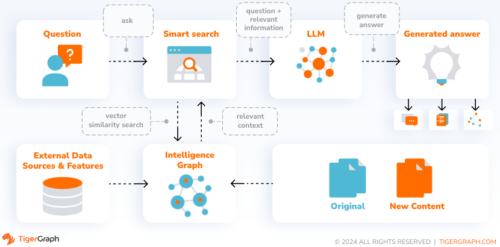
This image illustrates how these elements come together, providing a clear pathway from data ingestion to actionable insights. By structuring data governance in this manner, organizations can effectively manage their knowledge assets, ensuring accuracy, relevance, and ethical responsibility. This holistic approach not only enhances data quality and retrieval but also supports the creation of more transparent, interpretable, and responsible AI systems.
Conclusion
The integration of graph technology with generative AI represents a transformative step in AI development. By addressing critical challenges in privacy, bias, and contextual understanding, this approach enhances the transparency and responsibility of AI systems. As we advance, the continued focus on these principles will ensure that AI remains a force for positive and ethical progress in our data-driven world. The graph will be at the heart of this transformation, providing a stable foundation for leveraging human expertise in every aspect of business operations. This synergy of advanced AI and structured knowledge will pave the way for more reliable, responsible, and innovative solutions in the future.
In the rapidly evolving landscape of data analytics and artificial intelligence (AI), the recent talk by Dan McCreary, Head of AI at TigerGraph, at the NVIDIA GTC event stands out as a significant milestone. His presentation, titled “Enhanced Data Analytics: Integrating NVIDIA Rapids cuGraph with TigerGraph,” shed light on the critical importance of graph databases in AI and the groundbreaking work TigerGraph is doing in collaboration with NVIDIA. This blog dives into the key insights from Dan’s talk and the implications for the future of AI and data analytics.
The Critical Role of Graph Databases in AI
Dan McCreary kicked off his presentation by emphasizing the crucial role of graph databases in the realm of AI. Graph databases, unlike their relational and non-relational counterparts, are designed to handle highly interconnected data efficiently. This characteristic makes them particularly suited for applications that require the analysis of complex relationships between data points, such as fraud detection in banking—a field where TigerGraph has already marked its prowess with several successful implementations.
Drawing inspiration from Jeff Hawkins’ theories on the brain, as outlined in his books, Dan used a poignant quote to set the stage: “The key to artificial intelligence has always been the representation.” This statement highlights a fundamental challenge in AI: accurately modeling and representing the data in a way that machines can effectively process and learn from.
Navigating the Representation Problem in AI
Dan’s talk delved into the representation problem in AI, a crucial hurdle to achieving more advanced and efficient AI systems. He identified four key types of data representations used in AI today: images, sequences, tables, and graphs. Each of these representations has its domain of applicability and associated challenges, but Dan’s focus was on graph representations due to their ability to model complex relationships and dynamics.
One of the main challenges with graph data is its inherent sparsity and the difficulty of optimizing these representations for hardware. This is where the collaboration between TigerGraph and NVIDIA becomes pivotal. Dan walked the audience through the complexities of dense and sparse matrix representations and discussed the journey towards achieving a fully hardware-optimized graph system.
Leveraging NVIDIA’s RAPIDS cuGraph for Breakthroughs in Performance
The partnership between TigerGraph and NVIDIA has been instrumental in addressing the challenges of graph data analytics. Dan highlighted how TigerGraph is leveraging NVIDIA’s RAPIDS cuGraph libraries to tackle the problems associated with sparse matrix representations. The discussion touched upon the pros and cons of using Python for these tasks but underscored the substantial performance improvements enabled by NVIDIA’s RAPIDS libraries.
A highlight of Dan’s presentation was the demonstration of up to 100x speedups in performance when utilizing NVIDIA GPUs for algorithms like PageRank. This impressive achievement underscores the potential of graph analytics when combined with powerful hardware acceleration, offering a glimpse into the future of AI where graph representations play a central role.
The Synergy Between TigerGraph and NVIDIA: Pioneering the Future of AI Hardware
In closing, Dan McCreary expressed his gratitude towards NVIDIA for their partnership. This collaboration is not just about achieving short-term gains in performance but about jointly paving the way for the next generation of graph-optimized hardware. By combining TigerGraph’s expertise in graph database technology with NVIDIA’s leadership in GPU technology, the two companies are at the forefront of creating solutions that can handle the complexity and scale of tomorrow’s AI challenges.
The significance of Dan McCreary’s talk at NVIDIA GTC extends beyond the technical details of integrating cuGraph with TigerGraph. It represents a pivotal moment in the evolution of AI and data analytics, highlighting the shift towards graph representations as a key enabler of more sophisticated and effective AI systems. As companies increasingly migrate to graph representations to enhance their predictive capabilities, the work being done by TigerGraph and NVIDIA will undoubtedly play a crucial role in shaping the future of AI.
In an era where the ability to analyze and leverage complex relationships in data can provide a competitive edge, the advancements discussed in Dan’s presentation offer exciting possibilities. Whether in detecting banking fraud more accurately or in understanding customer behaviors and product dynamics, the integration of NVIDIA Rapids cuGraph with TigerGraph is setting new benchmarks for what is possible in AI and data analytics.
The journey towards a future where AI can more closely mimic the intricacies of human intelligence and decision-making is fraught with challenges. Yet, with visionaries like Dan McCreary leading the charge and fostering collaborations between industry giants like TigerGraph and NVIDIA, the path forward seems not only clearer but also significantly more promising. As we look ahead, the continued innovation in graph database technology and hardware optimization heralds a new era for AI—one that is more intelligent, efficient, and capable of understanding the complex web of relationships that define our world.
As the Head of Marketing at TigerGraph, I’m thrilled to extend a warm invitation to all enthusiasts, professionals, and curious minds to join us at the upcoming Graph + AI Summit 2024. This event is an absolute must for anyone interested in leveraging the transformative potential of graph technology and artificial intelligence. Here is why:
1. Exclusive Announcements and Sneak Peeks: As a participant of Graph + AI, you’ll be among the first to hear about our latest product announcements, updates, and future roadmap plans. Get exclusive access to sneak peeks, beta releases, and insider information straight from the source.
2. Great Networking Opportunities: At Graph + AI Summit, you’ll have the chance to connect with the industry leaders, innovators, and experts in the fields of graph databases and artificial intelligence. Rub virtual shoulders with professionals from organizations like Mastercard, KPMG, and JPMorgan Chase & Co, among others. Whether you’re a seasoned professional or just starting your journey, networking with like-minded individuals can open doors to collaborations, partnerships, and invaluable insights.
3. Cutting-Edge Insights and Case Studies: Our event will feature keynote speeches, panel discussions, and workshops led by top thought leaders and practitioners. Gain firsthand knowledge from real-world case studies showcasing how leading organizations are leveraging the synergy between graph databases and AI to drive innovation, solve complex problems, and unlock new opportunities.
4. Exclusive Insights from Industry Visionaries: We are honored to have Hamid Azzawe, TigerGraph’s CEO, to present at the event. With a wealth of experience from Meta, Amazon, Microsoft, Bloomberg, RBC, AMFAM, and IBM, Hamid brings a unique perspective to the table.
5. Hands-On Workshops and Demos: Explore the practical applications of graph technology and AI through interactive workshops and live demonstrations. Whether you’re interested in building recommendation systems, fraud detection algorithms, or knowledge graphs, our workshops will provide you with the tools, techniques, and best practices you need to succeed.
Graph + AI Summit isn’t just another event—it’s a gathering of passionate individuals united by a common goal: to unlock the full potential of graph technology and artificial intelligence. Join us on this exciting journey of discovery, collaboration, and innovation. We can’t wait to see you there!
Save the Date: May 1-2, 2024
Location: virtual
Many executives are pondering difficult decisions about making large investments in AI. For many of them, their lack of a technical background makes it difficult for them to visualize the impact of AI on their customers, their products, and their employees. To help executives make the right strategic decisions, we need powerful storytelling in terms they can understand and remember.
I have been creating a set of stories and metaphors to guide executives when they need to make strategic decisions about AI investment. After testing, my Jellyfish and Flatworm story has been remarkably effective at helping them guide their peers. I would appreciate feedback from my readers if this story is sticky enough to guide your leaders.
At the core, this story is about why Knowledge Representation (KR) must be the core of any cost-effective long-term AI strategy. We will see how Large-Language Models (LLMs), Knowledge Graphs (KGs), and Reference Frames (RFs) are moving us closer to general AI and how building hybrids of these three knowledge representation strategies is the best path.
At the end of this story, you can start to ask if your organization is more like a jellyfish or a flatworm. Clues about how much you need to invest in AI will be clear. Let’s begin our story.
The Evolution of Animal Intelligence
About 600 million years ago, animals evolved cells that helped them react to environmental changes. Let’s start with the elegant jellyfish. Jellyfish live in the open ocean, far away from complex structures. A jellyfish only needs simple rules to navigate its environment. Jellyfish might move to depths that allow them to capture more prey and avoid their predators. But they are not hunters. They depend on fish drifting into their tentacles.
Jellyfish live in a relatively simple environment and need to be efficient with their energy use. They really don’t need a complex centralized nervous system to help them navigate the ocean. If jellyfish had a big complex brain that required energy, they would quickly starve. To survive, they needed to keep things simple.
In contrast, on the ocean floor, things were getting much more complicated. To seek their prey and avoid predators, animals like flatworms started to develop muscles to help them move around. They also developed more cells on their skin that could process complex signals such as light, temperature, and smell. They used these sensory systems to get detailed information about their environment. And like the jellyfish, they also developed rules to survive. But not all the rules stayed simple. Knowing both what rules to follow and when to follow them became more complex.
Flatworms are thought to be the first hunters.
Movement and the Evolution of the Central Nervous System in Flatworms

Then something really interesting started to happen. Flatworms started to centralize where these rules were executed. Putting them all near their front-facing sensors made sense. We now call that the “head” of our animals. They started to evolve a complex network of centralized nerve cells, which we now call a centralized nervous system or CNS in their heads. These networks of communicating nerve cells evolved to become the brains of animals that move about in the world.
So why did they need to build such complex and energy-consuming cells? The key thing to understand is that movement makes executing rules complicated. Like an anemone, a plant sits in a single location on the ocean floor. It does not need to understand how things change if it moves. But any animal that moves needs to start to learn the structure of its environment. If it turns around 180 degrees, it needs to know that this helps it move away from predators. The bottom line is that we can’t really understand animal intelligence without having a deep appreciation for understanding how intelligence and models of our world are tied to motion and, importantly, maps and structure.
The Evolution World Models in Brains

Let’s explore why storing models of the world around it gave these flatworms a competitive advantage over their siblings. We ask, how can we have more precise ways to know what rules to execute and when to execute these rules in order to survive?
Imagine two flatworms. One that had a precise model of the world around them in their brain, and another that did not have a precise model. As these animals crawled out of their holes to seek their prey, those with a more precise model would remember where the best food was. They could also remember where predators threatened them. You can think of these models as internal maps of a flatworm’s surroundings. They used these models to give themselves a competitive advantage. They had more offspring, and these offspring also built more precise models of the world around them. We call these models “world models” because their structure represents the world around them.
The key point here is that these early nervous systems evolved into many other much more complex systems that have become our brains. Humans out-competed our extinct ancestors because we could model the world and predict how our actions could help us survive and out-compete our rivals. Modeling what is in our prey or predator’s brain can also be very helpful for survival. Does that mammoth think strategically about the consequences of being headed toward a cliff?
In summary, animals have brains that are predictive organs that must model their world and build mental maps of their world. These models advise us on what actions to take to help us survive. They also give us advice on the consequences of we don’t think strategically about the complex systems around us.
Let’s apply what we learned about jellyfish and flatworms to our organization.
Language Models Are *Not* World Models
Now, you might ask, “What does this all have to do with AI?” Much discussion has been about LLMs and how they are used to generate text. But these language models are fundamentally different from the world models in our brains. Let’s consider how they are different.
LLMs are used to predict the next word given a sequence of preceding words. They were never designed to store accurate models of the real world. Language is a collection of symbols we use to describe our world. When we need to communicate ideas between people, we generate sequences of words that fit within patterns called grammar and syntax. Although tools like ChatGPT and Llama 2 are incredibly useful, they were never designed to model the world and simulate the impact that our actions would have on the future states of our worlds.
Don’t get me wrong here. I love my GPT-4! But we must be clear. Modeling language is only a shadow of how we communicate about the world. It really is not a precise model of the world. It can be complemented with actual models of the world, but fundamentally, the knowledge representation distributed through billions of weights in a neural network has severe limitations with precision, reproducibility, truthfulness, performance, and explainability.
Knowledge Graphs *ARE* World Models
Many of my readers know that I have been deeply involved in building large-scale Enterprise Knowledge Graphs (EKGs) for the last six years. Before that, I wrote books on the tradeoffs of using various NoSQL databases. I am a person who can quickly visualize how knowledge is represented in computers, and my goal is to explain the tradeoffs of these alternative representations.
Knowledge graphs are the closest thing we have today to modeling our world in computers. Oh, and by the way, if you pick the right graph database, you can get it to scale out over hundreds of servers. Google, Amazon, LinkedIn (Microsoft), and even Pinterest have proven this for over ten years.
Just like the flatworm needed to model the structure of their environment by building precise maps, knowledge graphs are also the best way for us to manage structure. This can be the structure of our customers, our products, and our competition.
Animal Brains Use Reference Frames
Now, we come to the most interesting fact. Our brains don’t really store data like large-language models or knowledge graphs. We store knowledge in a form that evolved from building maps of our world. These are called Reference Frames and are described clearly in Jeff Hawkin’s book A Thousand Brains. Unlike an LLM, their knowledge can be continually updated. And just like scale-out distributed knowledge graphs, their processing is done in parallel. I won’t go into too much detail on reference frames here but look to innovative companies like Numenta to combine reference frames with LLMs to build new AI systems.
The take-home point is that reference frames can teach us many things about intelligence and how we need to use maps and structure to help us make better predictions. There will be more to come on this topic in future blog posts.
Measuring Complexity In Your Organization

So, should you be building a model of the world in your internal computer systems? Let’s take a look at what a simple company might be.
Imagine you supply a single specialized part to another manufacturer. You are good at what you do and get the same contract every year. You don’t really have any competition. I would describe this company as living in a simple environment, much like the jellyfish living in the open ocean. We can call this company a “jellyfish company.” You can probably model your organization using a spreadsheet or a relational database that uses flat file representation of the world with a few very slow JOIN operations if things get complicated. Your IT department doesn’t need a huge budget.
Now, let’s look at a more complex company. One that has many customers sells many products, and these products each have many competitors. Their structure might look like the following:
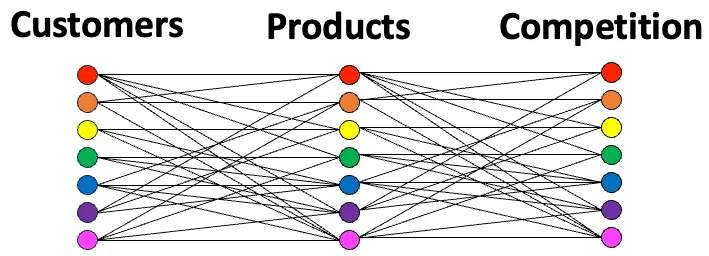
You can see that you need a complex model of your world to sell your products in a highly competitive landscape to many types of consumers. You are more like a flatworm company than a jellyfish company. You need complex models that include structure, relationships, precision, explainability, and the ability to add new complexity at will.
How you manufacture and market your products can be dauntingly complex. Can you simulate the impact of a price increase on one of your products? Are you modeling customer behavior? Can you predict the impact of a new marketing campaign? Can you explain why sales of some items are dropping off? If you can’t do this today, it might be that your model of the real world is too simple and too flat without structure. You might need to invest in using a combination of knowledge graphs and LLMs to accelerate your ability to predict the future.
Conclusion
Today, we are seeing unprecedented investments in artificial intelligence. The first wave is mostly investment in tools to make it easier for firms to build intelligent agents that help worker productivity. But all the agent software in the world might not help if your data is trapped in spreadsheets and siloed data. Knowledge needs to be centralized and connected.
Today, jellyfish companies are exceedingly rare. Most companies must deal with rapidly evolving complexity and make precise predictions that require accurate models of the world around them. Companies must focus on building the foundations that will power thousands of intelligent agents working together on centralized knowledge. And remember, going to the cloud will not save you if you have 1,000 silos.
Let me know if this story works for you. Can you tell this story to executives and ask them “are we a jellyfish or a flatworm company”? Ask them if a centralized knowledge graph would help them answer hard questions about their customer, products and competitors.
If you would like to hear how TigerGraph can help your organization build a centralized nervous system, contact us at info@tigergraph.abstage.xyz. re