Agentic GraphRAG Gives AI a Playbook for Smarter Retrieval
Large language models can generate language, recognize patterns, and summarize information, but they do not reason. They lack an internal model of how facts connect, how a task progresses, and what steps logically follow from the last.
Agentic AI is designed to close that gap. It plans, evaluates, and adjusts its actions. But to do so reliably, it must operate on data that reflects real relationships and an evolving understanding of the problem space.
A graph gives an agent a clear representation of entities, relationships, and the context surrounding a task. Semantic similarity provides a complementary dimension by measuring how closely two pieces of information relate in meaning, even when they do not share the same language or terminology.
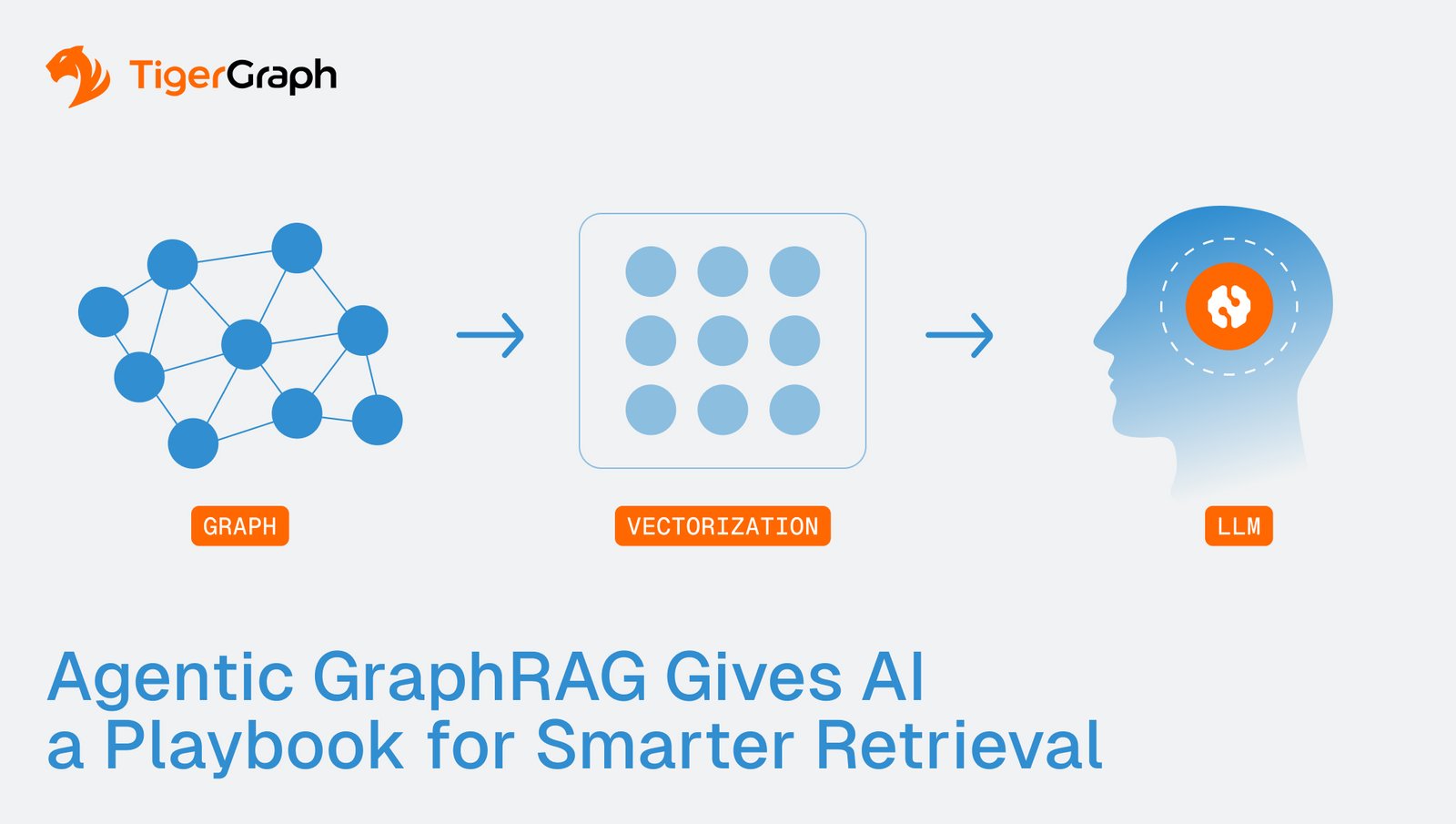
GraphRAG, a retrieval-augmented generation approach that integrates graph traversal with semantic search, combines these strengths. It enables an agent to retrieve information because it is connected through the graph, aligned in meaning through vector comparison, or supported by both signals at the same time.
With this combined context, the agent can determine which information is relevant, evaluate what it has already established, and reinforce each reasoning step with verifiable relationships.
Before examining how GraphRAG supports agentic workflows, it is important to understand why standalone models struggle with reasoning and why graphs supply the deductive foundation that agentic systems require.
Why Standalone AI Struggles with Reasoning?
Generative models excel at inductive pattern recognition. They analyze large bodies of text, detect correlations, and generate fluent language. But they do not independently validate facts or understand how pieces of information relate.
Without a representation of relationships, they default to probability rather than deduction.
This is why models hallucinate. They fill in gaps statistically, not logically. The issue is not a lack of intelligence; it is a lack of explicit structure.
Agentic systems handle a different class of problems. They must:
- reason through multi-step tasks
- evaluate intermediate results
- decide among multiple possible next actions
- and maintain awareness of progress
To do that, they require reliable context and a memory of what has happened so far. A graph supplies both.
How Graphs Support Agentic Reasoning?
A graph strengthens reasoning across three areas:
- Inductive + Deductive Reasoning Working Together
Inductive reasoning comes from the LLM. It recognizes patterns and suggests possibilities.
Deductive reasoning comes from the graph. It enforces relationships and verifies facts.
An agent can generate hypotheses using an LLM (induction), then test those hypotheses by traversing the graph (deduction). This closes the loop between “what seems likely” and “what is actually true.”
- Context and Awareness of Where the Agent Is
Agents must track where they are in a multi-step task. A graph gives them:
- knowledge of entities involved
- relationships between steps
- what has already been completed
- and what logically follows
This situational awareness lets an agent choose actions based on context rather than probability alone. It knows not just what information exists, but where it sits in the broader problem space.
- A Real-Time, Updatable Record of Progress
As an agent moves through a task, new information appears. A graph can absorb these updates instantly with new nodes, new relationships and new context.
This means the agent sees an evolving state rather than a frozen dataset. It can adjust its reasoning as the graph changes, creating a feedback loop between action, observation, and updated context.
Together, these capabilities give agents the ability to plan, evaluate, and reason with far greater precision than language models alone.
Where GraphRAG Fits
Traditional RAG retrieves semantically similar content using a fixed index. It is static, limited, and unaware of relationships. It compares embeddings in a fixed vector index and returns content that appear close in meaning.
This works well for summarization or question answering, but it has important limitations. The index does not understand how facts relate to each other, it cannot follow chains of connections, and it cannot adapt when new information appears.
GraphRAG removes these constraints.
Instead of relying only on semantic similarity, it retrieves information by following the relationships captured in a graph. It can trace dependencies, explore multi-hop paths, and surface context that would never be discovered through similarity search alone.
This is essential for tasks that depend on understanding how entities influence one another, how events propagate, or how multiple signals combine to form a pattern.
When an agent uses GraphRAG, three elements work together:
- The graph provides structure. It shows how entities connect, what paths exist between them, and where dependencies lie.
- The vector model represents complex semantic information as numeric weights. It can search for vectors with similar weights, which translates to information that is semantically similar.
- The agent selects the retrieval mode. It decides whether the task requires structured traversal, semantic matching, or a hybrid of both.
The graph does not make the system agentic. The agent is agentic because it controls the reasoning loop: selecting actions, evaluating intermediate results, and deciding what to do next.
GraphRAG strengthens that loop by giving the agent access to information that is both meaningful and structurally grounded. It ensures that every retrieval step is supported by relationships that can be traced and verified.
With the foundations of agentic workflow support established, the next step is understanding how reasoning actually occurs.
Reasoning That Mirrors Human Logic
Human decision-making relies on a combination of inductive and deductive reasoning. The former identifies patterns from observation, and the latter applies known rules to reach conclusions.
Most AI is inductive. It learns correlations across massive datasets and predicts what’s likely next. That’s useful for pattern recognition, but weak for validation.
Graphs supply the missing deductive logic. A graph database organizes data into entities and relationships. It lets AI follow chains of reasoning step by step.
Combine the two and you get explainable AI. One part detects the signal, the other proves it.
An inductive model might find that a set of transactions looks abnormal. A deductive graph can confirm those accounts share the same guarantor or device ID. One predicts, the other justifies.
That combination shifts AI from storyteller to an investigator.
That distinction matters in regulated industries. Every AI-assisted decision must be traceable, auditable, and explainable. And GraphRAG-powered agents make that possible by merging pattern recognition with provable logic. It bridges prediction and proof.
The Role of Agentic AI in Reasoning
Agentic AI is intelligence in action when reasoning is required. It plans, evaluates and adjusts its steps to reach a goal.
Graphs supply the structure that keeps this feedback loop grounded, with vectors providing the semantic understanding that keeps it adaptive.
GraphRAG gives agentic systems the context they need to reason, verify their logic, and act with precision, continuously and at scale. This level of reasoning requires infrastructure designed for it, which is where TigerGraph’s hybrid graph and vector architecture comes in.
Inside TigerGraph’s Hybrid Graph + Vector Architecture
Traditional systems separate meaning from structure. A vector database handles semantic similarity, while a graph database handles relationships. Moving data between them introduces latency and loses context. TigerGraph unifies both.
Vectors are stored as node properties inside the graph, so each entity carries both its relationships and its learned semantic meaning. When a GraphRAG-powered agent queries TigerGraph, the system:
- Converts it into an embedding vector representing intent.
- Checks semantic proximity (vectors) and graph relationships (connected entities).
- And then merges those insights into a single, context-rich response.
TigerGraph’s parallel processing engine executes graph algorithms in-database and links those results with vector similarity search in the same workflow. This lets agents perform hybrid reasoning in real-time, without context loss or pipeline switching.
Hybrid queries complete in milliseconds. This happens even at enterprise scale, where the platform processes billions of transactions daily and detects suspicious connections before they escalate.
This architecture delivers speed and explainability. It offers enterprises transparency, with an auditable AI.
Implementing GraphRAG-enabled Agents Responsibly
Deploying GraphRAG within an agent framework calls for disciplined data modeling and governance.
- Start with a clear ontology that defines entities and relationships explicitly.
- Embed intelligently. Tag data with vectors that complement graph structure, not compete with it.
- Validate continuously. Use graph queries to confirm that AI-generated claims align with recorded facts.
- Automate oversight with agents monitoring for drift and prompt retraining when accuracy declines.
- Secure access with graph-level role controls that maintain compliance and protect data integrity.
These steps ensure the system learns responsibly and scales sustainably.
Why TigerGraph Leads This Evolution?
TigerGraph is engineered from the ground up to handle both graph traversal and vector similarity natively. Its parallel processing engine supports real-time analytics and in-database graph algorithms. And it offers pre-built solution kits for fraud, AML, and customer intelligence.
TigerGraph enables AI agents that reason with context. It brings structure and understanding together for explainable results. It’s a distinction that separates AI experiments from operational AI outcomes across industries.
Summary
GraphRAG-powered agents mark the next step in AI’s evolution, as it moves from pattern recognition to reasoning. It connects the flexibility of LLMs with the structure of enterprise data to create transparent, explainable, and trustworthy intelligence.
TigerGraph’s hybrid graph-plus-vector architecture enables organizations to scale reasoning across data silos, improve decision quality, and empower AI systems that act with purpose rather than merely predict. By equipping agentic systems with both structure and meaning, TigerGraph helps enterprises bridge the gap between retrieval and reasoning.
Ready to Unlock Your Data’s Hidden Value? Reach out today to join thousands of developers and data scientists using TigerGraph’s leading graph analytics platform to solve complex problems with connected data. And start experimenting and prototyping at no cost, with a free TigerGraph Savanna.
Why Hybrid Graph Architecture Strengthens Agentic AI
Agentic AI systems plan, evaluate, and adjust their actions to achieve a goal. They do more than generate responses. They reason through multi-step tasks, maintain awareness of their progress, and decide how to proceed based on what they observe.
To operate this way, Agentic AI systems require context that is both meaningful and structurally grounded. And hybrid graph architecture provides this context.
It links two complementary views of information. The graph captures explicit relationships among entities, while vectors capture semantic similarity. When combined, these capabilities give an agent a way to understand where it is within a task, what information is relevant, and which actions make sense next.
This article outlines why hybrid graph systems support agentic AI more effectively than standalone vector search or traditional RAG (retrieval-augmented generation) pipelines.
Limitations of Traditional Retrieval and Standalone AI
Most language models do one thing very well. They spot patterns, make predictions and generate text that looks polished because they have absorbed so much material.
They work inductively, meaning they pull the next likely idea from statistical similarity rather than a grounded understanding of how information fits together. This is why they sound confident even when they misinterpret something.
The output flows, but it does not always hold up under scrutiny, especially when a task requires verification or slow, deliberate reasoning.
Retrieval-augmented generation (RAG) adds a layer of support by pulling material from a predefined index. It is helpful and it does reduce some of the guesswork. But the improvement is more surface than structural.
RAG still operates inside a closed, static box. It can retrieve what looks similar, but it cannot check relationships, track how a problem evolves, or understand how different pieces of information connect. As a result, even “enhanced” retrieval systems are constrained in three predictable ways:
- It retrieves based on semantic similarity alone.
- It cannot follow relationships or dependencies between entities.
- It operates on a static index that does not change as the agent learns.
This environment offers no way to validate how facts connect or how a task evolves.
Agentic systems require the opposite. They require visibility into relationships, evolving context, and the ability to verify intermediate steps.
A hybrid graph architecture provides these capabilities.
Why Agentic Systems Need Both Graphs and Vectors?
Agentic AI relies on two forms of intelligence:
- Inductive reasoning, supplied by the model, which identifies patterns and suggests possibilities.
- Deductive reasoning, supplied by the graph, which verifies relationships and maintains consistent structure.
Hybrid graph design integrates these two dimensions in a single environment. The combination gives an agent the ability to:
- Understand meaning through semantic similarity.
- Understand structure through graph relationships.
- Combine both signals when deciding how to search, what to retrieve, and what actions follow logically.
This dual view is essential when the agent must determine how entities influence each other, how events propagate, or how multiple signals combine to form a higher-level pattern. Each component fills gaps that the other cannot.
A vector alone cannot reveal any of this. A vector measures similarity in meaning, but meaning is not structure.
Two documents can look almost identical in meaning but have nothing to do with each other operationally. A customer complaint might sound just like another one, same tone, same phrasing, same frustration level, but that tells you nothing about whether those two customers share an account, a device, a merchant, or any kind of transactional trail.
Vectors will point you toward “hey, these things feel similar,” but they cannot show how (or whether) the pieces actually fit together.
And a graph on its own has blind spots too. It captures clear relationships and multi-hop connections, but only inside the boundaries the organization already modeled.
It has no way to pick up on nuance or realize two differently worded documents describe the same situation. A graph might tell you two entities are five hops apart, but it cannot tell you that the text about them is essentially talking about the same problem in different language.
Together, they provide the context an agent needs to reason rather than guess. The vector model highlights what is conceptually relevant. The graph model confirms what is structurally true.
This combination grounds every step of the reasoning loop in both meaning and verifiable connections, allowing an agent to move beyond pattern matching and engage in actual decision-making.
How Hybrid Graph Enhances the Agentic Loop?
Agentic AI operates through repeated cycles of observation, reasoning and action. A hybrid graph system strengthens each step of this loop.
- Observation: Selecting Relevant Information
Vectors identify which information is semantically related to the agent’s current goal.
Graphs identify which information is structurally connected.
By combining both, the agent retrieves information that is relevant because of its meaning, its relationships, or both.
- Reasoning: Evaluating What the Agent Has Learned
A graph provides explicit relationships and multi-hop pathways that clarify how entities connect.
The agent uses these connections to validate hypotheses, confirm assumptions, or rule out contradictions.
This ensures that each deduction is based on verifiable context rather than probabilistic inference alone.
- Action: Choosing What to Do Next
The agent maintains awareness of where it is within a task by referencing graph state.
As new information appears, the graph updates in real time with nodes, edges, or attributes that reflect the agent’s progress.
This evolving context allows the agent to adjust its next steps based on the current state rather than a static snapshot.
In this way, hybrid graph architecture supplies both the meaning and the structure needed to support the full reasoning cycle.
Why Hybrid Graph Outperforms Traditional RAG for Agentic Workloads?
Hybrid graph architecture resolves several constraints found in traditional RAG pipelines:
| Capability | Traditional RAG | Hybrid Graph (Graph + Vectors) |
|---|---|---|
| Understanding meaning | Semantic similarity only | Vectors embedded within graph context |
| Understanding structure | None | Multi-hop paths, explicit relationships |
| Reasoning support | Limited | Deductive verification through graph traversal |
| Adapting to new information | Requires re-indexing | Graph updates in real time |
| Agentic action selection | Limited | Context-aware task progression |
For agentic workflows, the difference is substantial. Traditional RAG retrieves isolated passages. Hybrid graph retrieves patterns, dependencies, and the evolving state of the task.
Why TigerGraph’s Architecture Is Designed for Agentic AI?
TigerGraph integrates graph traversal and vector similarity natively.
Vectors are stored as node properties within the graph. This allows agents to query a single system for both structural and semantic context.
Performance is supported through TigerGraph’s parallel computation engine. This executes multi-hop traversal and vector search within the same workflow.
This architecture gives you a few things at once:
• the same processing pipeline for both graph lookups and vector searches
• updates that land in real-time, so the agent always sees the latest step it took
• a clear schema that lets every result be traced back through explicit relationships
• enough horsepower to handle real enterprise traffic without melting down
• and multi-hop context so the agent can actually validate what it thinks it knows
Put together, these make an agent behave less like a guess-machine and more like something that can operate with some accuracy, transparency, and the ability to adjust when the situation shifts.
Summary
Agentic AI cannot run on pattern recognition alone. It needs structure, context, and a way to understand how pieces of information connect and change as it works. A hybrid graph setup supplies that by combining the strengths of graph relationships with the nuance of semantic similarity. The result is an agent that can pull relevant information, check its own reasoning, stay aware of where it is in a task, and update its understanding as it goes.
TigerGraph makes this possible with an architecture built to run both vector similarity and graph traversal in the same system, at the speed and scale enterprise environments actually require. This gives agentic AI a dependable foundation instead of a pile of disconnected guesses.
Frequently Asked Questions
1. How does hybrid graph architecture reduce hallucinations in agentic AI systems?
Hybrid graph systems ground every reasoning step in verifiable relationships, reducing reliance on probabilistic predictions alone. By validating connections through graph traversal, agents avoid fabricating links or assumptions that are not supported by the underlying data.
2. What makes hybrid graph architecture better suited for multi-step reasoning than vector search alone?
Vector search captures semantic similarity, but it cannot model dependencies, state progression, or entity relationships. Hybrid graph architecture adds structure, allowing agents to follow paths, validate assumptions, and maintain task awareness—essential components of multi-step reasoning.
3. Can hybrid graph systems improve the reliability of autonomous agents in regulated industries?
Yes. Hybrid graph architectures provide transparent relationship tracing, explainable retrieval paths, and real-time context updates. This makes agentic AI more auditable and compliant for industries such as finance, healthcare, and cybersecurity, where decisions must be verifiable.
4. How do hybrid graph systems help an agent adjust its actions based on new information?
Graphs update in real time, allowing agents to incorporate new nodes, edges, or attributes as they work. This dynamic context enables agents to revise plans, re-evaluate assumptions, and choose new actions based on the evolving state of a task — something static RAG pipelines cannot offer.
5. What role does TigerGraph play in enabling hybrid graph workflows for agentic AI?
TigerGraph unifies vector similarity and graph traversal in a single platform, enabling agents to query both semantic meaning and structural connections simultaneously. With parallel computation and real-time updates, TigerGraph delivers the scale, speed, and explainability required for enterprise-grade agentic AI.