Contact Us

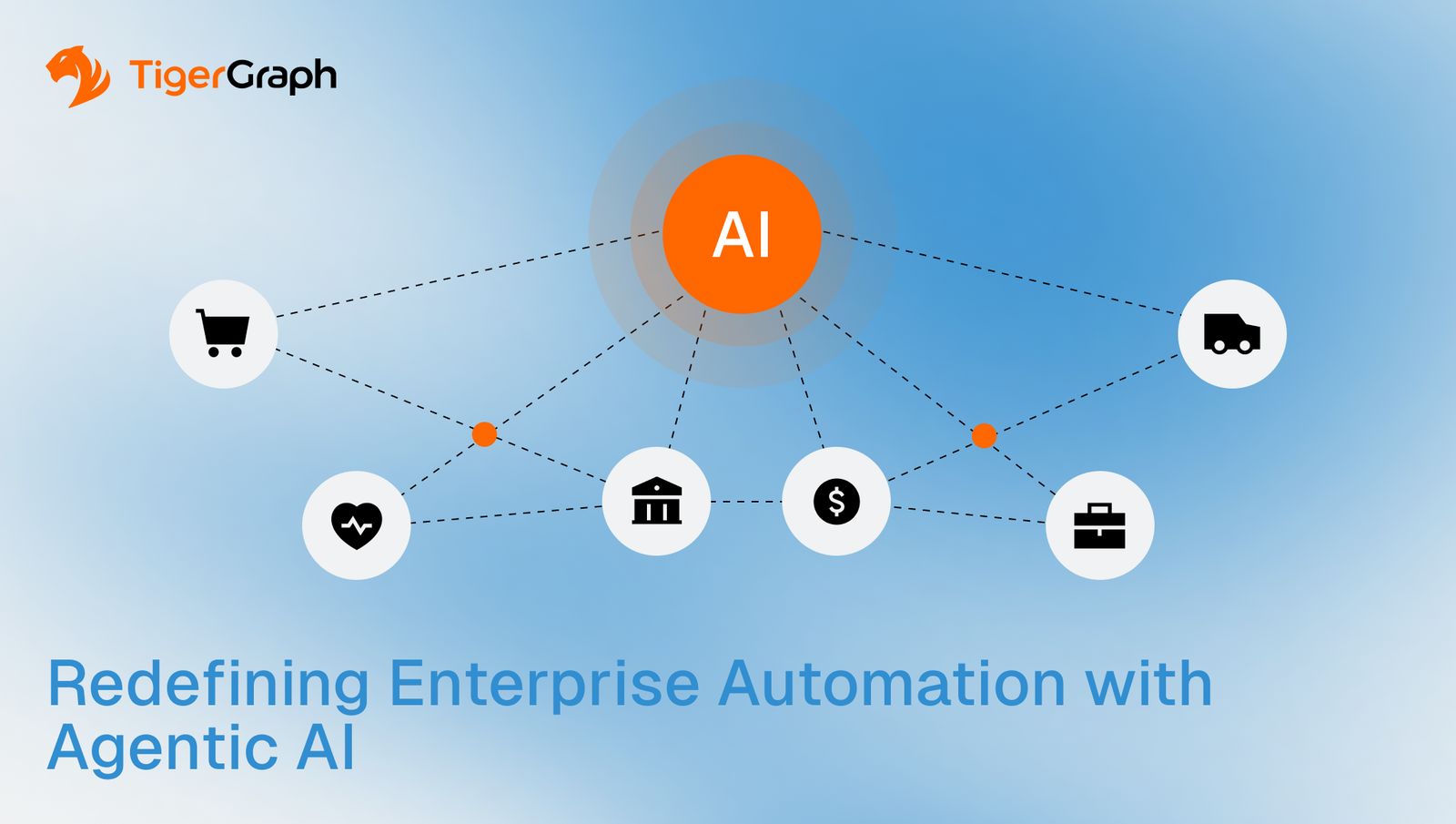
Redefining Enterprise Automation with Agentic AI

Enterprise automation is entering a new phase.

Organizations have moved from rule-based workflows to machine learning systems and, more recently, to large language models that assist with operational tasks. The latest shift is toward Agentic AI, systems capable of planning actions, coordinating workflows, and making decisions across multiple enterprise environments.

But there is a structural problem behind many early agent deployments. Most enterprise data systems were designed for reporting, not reasoning.

Data is stored as isolated records inside tables, optimized for queries and dashboards rather than understanding how entities connect. When AI agents operate on these flattened data views, they often lack the context needed to evaluate how decisions affect the broader system.

This is where graph technology becomes essential.

Graph data architectures model relationships directly, allowing automation systems to analyze how entities interact across accounts, transactions, devices, suppliers, and systems. Instead of operating on disconnected records, agents can reason over the structure of the enterprise itself.

That structural awareness is what separates basic automation from intelligent automation.

Key Takeaways

These principles become clearer when we examine how automation systems operate in real enterprise environments.

Automation Without Structure is Guesswork

A foundational principle of graph thinking is that connections define how systems behave.

Within an enterprise environment, entities rarely exist in isolation. Customers connect to accounts, and accounts generate transactions. Transactions link to devices, locations, and behavioral patterns. Vendors connect to suppliers, and suppliers support multiple downstream operations.

Despite this interconnected reality, many automation systems operate on flattened views of data. Agents are often given a prompt and a limited set of records from which they generate an action. If the system does not account for indirect relationships or downstream dependencies, the resulting decision may be incomplete.

Automation in this context becomes reactive rather than contextual. The system responds to visible signals while remaining blind to the structural relationships that shape outcomes.

Understanding this limitation helps explain why the emergence of agentic AI raises new requirements for enterprise data architecture. 

Why Agentic AI Changes the Stakes

Traditional workflow engines execute instructions that have already been defined by developers or analysts. Agentic AI systems operate differently. They evaluate situations dynamically and determine how to act based on the information available to them.

This shift significantly increases the importance of structural context.

If an AI agent is permitted to approve payments, escalate fraud investigations, reroute supply chain logistics, recommend operational actions, or modify system states, it must understand how those actions affect other parts of the enterprise.

Research on graph-powered machine learning demonstrates why relational context improves predictive models. Models trained on connected data often outperform those built solely on flat feature sets because they capture how behavior propagates across networks.

The same principle applies to agent-driven automation. Decisions made in isolation can easily miss indirect dependencies or hidden relationships. Systems that understand structure are better equipped to reason about the broader consequences of their actions.

To enable this kind of reasoning, enterprises need a data architecture that models relationships directly rather than reconstructing them through repeated joins or partial views during analysis.

What a Graph Spine Actually Provides

A graph data architecture acts as a connective layer for enterprise data. Instead of trying to reconstruct relationships during analysis, the graph stores those relationships directly as part of the data model.

This makes several things possible.

First, relationships between entities are explicit. Accounts, devices, suppliers, and systems are connected through modeled links that reflect how the organization actually operates. Analysts and automation systems do not need to rebuild those relationships every time they ask a question.

Second, graph systems support multi-hop context. Multi-hop simply means following several connections in sequence to understand how entities are indirectly related. Starting from one entity, an agent or analytical model can move outward across the network to uncover connections that would be difficult to see in traditional tables.

Third, graph analytics produces structural signals. Measures such as centrality, clustering, similarity, and path analysis reveal patterns in how entities interact within the network. These signals add context that raw attributes alone cannot provide.

Finally, graph traversal creates traceable decision paths. When an automated action occurs, the system can show the relationship chain that influenced the decision. Analysts can review that path to understand and audit how the outcome was reached.

Together, these capabilities give automation systems a connected view of enterprise data rather than a collection of isolated records.

The value of this connected view becomes clearer when we look at real automation scenarios.

Example: Fraud Automation

Fraud detection provides a clear example of how relational context changes automated decision making.

Consider an AI agent evaluating a financial transaction. If the system only has access to attributes such as transaction amount, location, and account age, the decision is based on limited context.

The analysis becomes far more informative when the system can evaluate relationships within the network. Shared devices across accounts, circular transaction patterns, connections to high-risk entities, and membership within known fraud clusters all provide signals that may indicate coordinated behavior.

Graph-enhanced models often outperform traditional approaches because they incorporate these neighborhood relationships into their predictions. The same principle applies to automation agents. When agents operate with relational context, their decisions reflect a more complete understanding of the system.

Fraud detection is only one example. The importance of structural reasoning becomes even more apparent in operational environments such as supply chains.

Example: Supply Chain Orchestration

Supply chains operate as complex networks in which disruptions can propagate across multiple tiers of suppliers and products.

Imagine an AI agent tasked with rerouting shipments after a supplier disruption. A traditional system might detect only that Vendor A is unavailable. While this information is useful, it does not reveal the broader consequences of the disruption.

A graph-based system can evaluate the structural relationships involved. Vendor A may supply components to several subassemblies, which in turn support multiple product lines. One of those products might serve a regulated market, while an alternative supplier may share ownership with an entity flagged for risk.

This type of multi-hop reasoning allows automation systems to evaluate indirect consequences before executing an action. Without relational structure, the agent cannot see these dependencies. With graph context, it can assess operational risk more effectively.

As automation expands into regulated and mission-critical environments, visibility into decision pathways becomes increasingly important.

Governance and Explainability

Responsible AI systems require transparent reasoning. When an automated agent blocks a transaction or escalates a vendor relationship, organizations must understand how that decision was reached.

Graph traversal provides this transparency by exposing the relationship paths involved in the analysis. A fraud investigation might reveal a path connecting a user to a known fraud cluster through shared devices and accounts. A vendor evaluation might trace ownership relationships that link a supplier to a sanctioned entity.

These relationship chains provide structural explanations that are easier to audit than opaque model outputs. For organizations operating in regulated industries, this form of explainability is essential for maintaining compliance and trust.

Taken together, these capabilities redefine what enterprise automation must deliver.

Redefining Enterprise Automation

Enterprise automation once focused primarily on efficiency and workflow acceleration. Today, it must support intelligent and accountable decision-making across interconnected systems.

Agentic AI will increasingly coordinate actions across financial platforms, supply chains, healthcare networks, and digital infrastructure. If those agents operate on disconnected views of enterprise data, their decisions will inevitably reflect incomplete information.

Graph technology provides the relational backbone that allows automation systems to reason over connected context instead of isolated records.

The transformation underway is not simply from manual processes to automation. It is a transition from disconnected systems toward structurally aware intelligence.

Connect with TigerGraph

Organizations exploring Agentic AI must ensure their automation systems operate on a connected data foundation rather than fragmented records.

TigerGraph enables enterprises to model relationships across complex systems and analyze those connections in real time. By providing a scalable graph architecture, TigerGraph supports context-aware automation, explainable AI decisions, and coordinated action across interconnected enterprise environments.

Connect with TigerGraph to learn how graph-powered data architectures can strengthen enterprise automation initiatives.

Frequently Asked Questions

1. What is Agentic AI and How does it Differ From Traditional Enterprise Automation?

Agentic AI systems can plan, decide, and act dynamically across workflows, unlike traditional automation which follows predefined rules and static logic.

2. Why do AI Agents Fail Without Access to Connected Data And Relationships?

AI agents fail because isolated data lacks context, preventing them from understanding dependencies, indirect impacts, and how decisions affect the broader system.

3. How does Graph Technology Enable Context-Aware Decision-Making in Automation Systems?

Graph technology enables context-aware decisions by modeling relationships directly, allowing agents to analyze multi-step connections and system-wide dependencies.

4. What Role does Relational Context Play in Improving Automated Decision Accuracy?

Relational context improves accuracy by incorporating how entities interact, revealing patterns and dependencies that flat data cannot capture.

5. How can Enterprises Ensure Transparency and Explainability in Automated AI Decisions?

Enterprises ensure transparency by using graph-based systems that trace decision paths through relationships, making outcomes auditable and easier to understand.

Using Graph to Ground Agent Reasoning in Real Time

Autonomous AI agents don’t just need instructions—they need context to reason. As AI systems grow more agentic, taking initiative, coordinating tasks, and acting independently, the question becomes not just what they’re doing, but how they decide what to do.

This context-grounded reasoning isn’t a bonus feature. It’s a necessity. 

Customer preferences shift, network behavior changes, and business rules evolve, and this means that rigid agents quickly become brittle. They follow yesterday’s logic into tomorrow’s mistakes.

What separates brittle agents from resilient ones is the richer, governed feedback loop. They need the ability to sense changes, understand ripple effects, and modify future behavior accordingly. And the architecture that powers this kind of feedback isn’t just more prompts or clever APIs. It’s graph.

TigerGraph makes adaptive intelligence operational by modeling relationships, behavioral signals, and evolving context in real time. This is where static agents become context-aware decision makers,and where graph becomes the control layer.

Why Agentic AI Needs Context, Not Just Feedback

Language models can generate responses and even self-critique with enough scaffolding. But ask them to recall the impact of a decision made five steps earlier or adjust based on shifting dynamics across a network and the limitations become clear. Without structured memory and situational awareness, their adaptation remains superficial.

To adapt wisely, agents need a feedback system grounded in context and continuity. That means understanding:

  1. Current State: What’s happening right now? What’s changed in the environment—among users, systems, or inputs?
  2. Historical Memory: What happened last time a similar scenario played out? What worked? What failed?
  3. Relational Feedback: How does a single action affect the web of connections around it—from user sentiment to inter-agent dependencies?

This trifecta of awareness, memory, and feedback isn’t something stateless LLMs can handle on their own. But it’s exactly what graph databases are designed to do.

And TigerGraph doesn’t just make it possible—it makes it performant, enabling agents to tap into these signals at enterprise scale and in real time.

How Graph Enables Contextual Reasoning for Agents

Imagine an agent responsible for customer outreach. One of its tasks is to send follow-up messages after product updates. It seems simple. But what if, after one outreach cycle, support tickets spike? What if users start disengaging, or sentiment drops on connected social accounts?

A traditional AI pipeline might never notice. It operates in silos with an endless “prompt in, action out” functionality. But with TigerGraph, modeling the relational context, those signals don’t disappear—they surface.

Using TigerGraph’s real-time graph traversal, the agent can:

These aren’t pre-programmed responses. They’re live decisions based on the changing structure of relationships and signals in the graph. This is what turns rigid prompt chains into adaptive systems.

Building Smarter, Safer Agents with Graph Feedback Loops

Let’s break down how a feedback loop actually works in a graph-powered environment:

  1. The agent takes an action, say, recommending a financial product to a user.
  2. The network responds, other users ask questions, support tickets rise, or conversion drops.
  3. The graph updates and new relationships are formed, weights shift, and alerts are triggered.
  4. The agent sees the new picture and adjusts their strategy, revising their messaging, escalating to a human, or pausing outreach entirely.

Now imagine that loop happening not every week or day, but every minute, across millions of nodes and edges, all updating in near real time.

That’s not just automation. That’s autonomous systems learning how to behave better. And it’s only possible when agents operate in a live, structured, relational context. In other words: a graph.

Why TigerGraph Is Built for This

While any graph database can model relationships, TigerGraph is purpose-built to turn those models into operational systems that support AI at scale.

What makes TigerGraph stand out?

Together, these features allow organizations to move beyond hardcoded logic and into systems that evolve safely, responsibly, and in alignment with business goals.

From Rules to Responsiveness: Building AI That Listens, Learns, and Evolves

Autonomous systems are being asked to make decisions, influence outcomes, and interact with real people; and static rules are no longer enough. Responsiveness grounded in context, history, and relational understanding is what defines whether agentic AI will succeed or spiral out of control.

To move from brittle automation to intelligent adaptation, we need more than smarter prompts or faster models. We need infrastructure that understands change as it happens, that retains memory across interactions, and that reasons through the ripple effects of every choice an agent makes.

Graph offers that infrastructure. It doesn’t just connect data—it reveals how actions flow through networks, how behavior unfolds over time, and how intent, influence, and outcome intersect in dynamic systems.

TigerGraph operationalizes this for real-time environments. But the broader shift is what matters most: a move away from reactive logic and toward systems that truly learn from their impact.

If you’re building agentic AI for the enterprise—systems that must evolve responsibly, reason transparently, and adapt to the world around them—this is the moment to embed the right foundation.

Not more rules, but smarter responsiveness. Not more control, but deeper awareness. And not just intelligence—relational intelligence.

The future of autonomy isn’t scripted. It’s situational. And that means it starts with graph. 

Your Agents Can’t Adapt Without Feedback

Scripted responses won’t cut it in dynamic environments. TigerGraph gives your AI agents the real-time context, behavioral feedback loops, and adaptive reasoning they need to evolve safely and intelligently.

Try TigerGraph Cloud for free and start building agents that learn as they go. https://tgcloud.io

Graph: The Nervous System for Agentic AI

Why agents need more than prompts—they need connected intelligence.

Agentic AI is evolving fast. We’ve moved beyond simple tools that complete tasks and entered an era where autonomous agents can plan, act, collaborate, and even adapt to their environment. But no matter how clever your prompts or how powerful your model, autonomy falls apart without connected context.

That’s why graph technology isn’t just useful, it’s foundational. In the same way a nervous system allows a living being to interpret signals, coordinate actions, and respond to change, graph acts as the operational nervous system of agentic AI. It connects the pieces, enables awareness, and turns agents from isolated actors into situated, intelligent systems.

And TigerGraph delivers that nervous system at enterprise scale.

From Prompted Output to Situated Intelligence

Most AI agents today operate like really smart assistants stuck in a loop. You give them a prompt—a task or a goal—and they respond. Maybe they follow a predefined script, maybe they chain together multiple steps with some clever reasoning. But behind the scenes, it’s still surprisingly shallow.

These agents don’t really understand where they are, what they’ve already done, or how their actions fit into a larger context. They can’t recall past interactions the way a human would. They can’t tell if two tasks conflict, or if a previous decision is shaping what’s happening now. They’re executing commands, not navigating a world.

That’s because the infrastructure powering most of these systems is still built on a foundation of flat memory, disconnected data sources, and stateless execution. It’s like trying to run a city using only sticky notes. Nothing is truly linked. Nothing is aware of cause and effect, or able to reason through messy real-world dynamics.

If we want agents to stop reacting and start reasoning, we need to give them structure.

Structure means:

Graph is that structure.

It gives AI agents a map, not just a memory. With a graph, agents can understand relationships, navigate context, and make informed decisions grounded in their surroundings, not just their last prompt. And that’s the difference between an assistant that answers and an intelligent agent that understands.

Why Graph Is the Nervous System and Not Just a Database

Your nervous system does far more than store information. It senses the world around you. It interprets signals in real-time, coordinates your movements, adapts to changes, and helps you respond appropriately—even under pressure. It keeps you aware, connected, and functional.

That’s exactly the kind of intelligence we need to build into AI agents. Not just recall, but real awareness. Not just output, but context-driven action. And that’s where graph technology comes in.

When it’s embedded into agentic systems, graph becomes more than just a data model. It acts as the nervous system of the entire architecture—the layer that makes agents truly responsive and situationally aware. Graph is the connective tissue between:

This isn’t some abstract concept. It’s the real-world difference between an LLM that spits out an answer and an agent that knows who it’s working for, why it’s taking that action, and how to adjust as conditions shift.

TigerGraph makes this real. It’s not just a backend. It’s the operational nervous system for next-generation agents enabling them to think in context, act with purpose, and function inside complex, multi-agent, multi-stakeholder ecosystems.

What the TigerGraph Graph Database Adds to the Nervous System

Many graph databases can model relationships, but few can support real-time, enterprise-grade intelligence for autonomous agents. Here’s where TigerGraph stands apart:

The result? Agents that know what they’re doing, why it matters, and what to do next.

Situational Intelligence That Adapts

Imagine a network of agentic systems managing vendor onboarding for a global enterprise. One agent vets documentation, another handles compliance checks, and a third sets up access credentials.

Now imagine:

This is not prompt chaining. It’s real-time, situational reasoning powered by graph.

TigerGraph enables these agents to share structured context, adapt to new inputs, and coordinate behavior across the system. And that’s not just intelligence, it is system-level awareness.

Build AI Agents That Understand the World They Work In

Autonomy without structure is fragility, and prompting without context is guesswork.

If you want your agents to be more than reactive tools and understand the environment they’re acting in, they must adapt to the dynamics around them, and work as intelligent components in a larger system. Accomplishing this requires more than LLMs—you need graph.

TigerGraph is a graph database and the nervous system for agentic AI, offering the infrastructure to build agents that observe, adapt, and align.

Build AI Agents That Think, Not Just React.

Your agentic AI doesn’t just need data—it needs awareness. TigerGraph provides the connective intelligence that turns inputs into understanding, and actions into informed outcomes.

Explore TigerGraph Cloud for free and bring your agents to life with graph-native situational intelligence. https://tgcloud.io

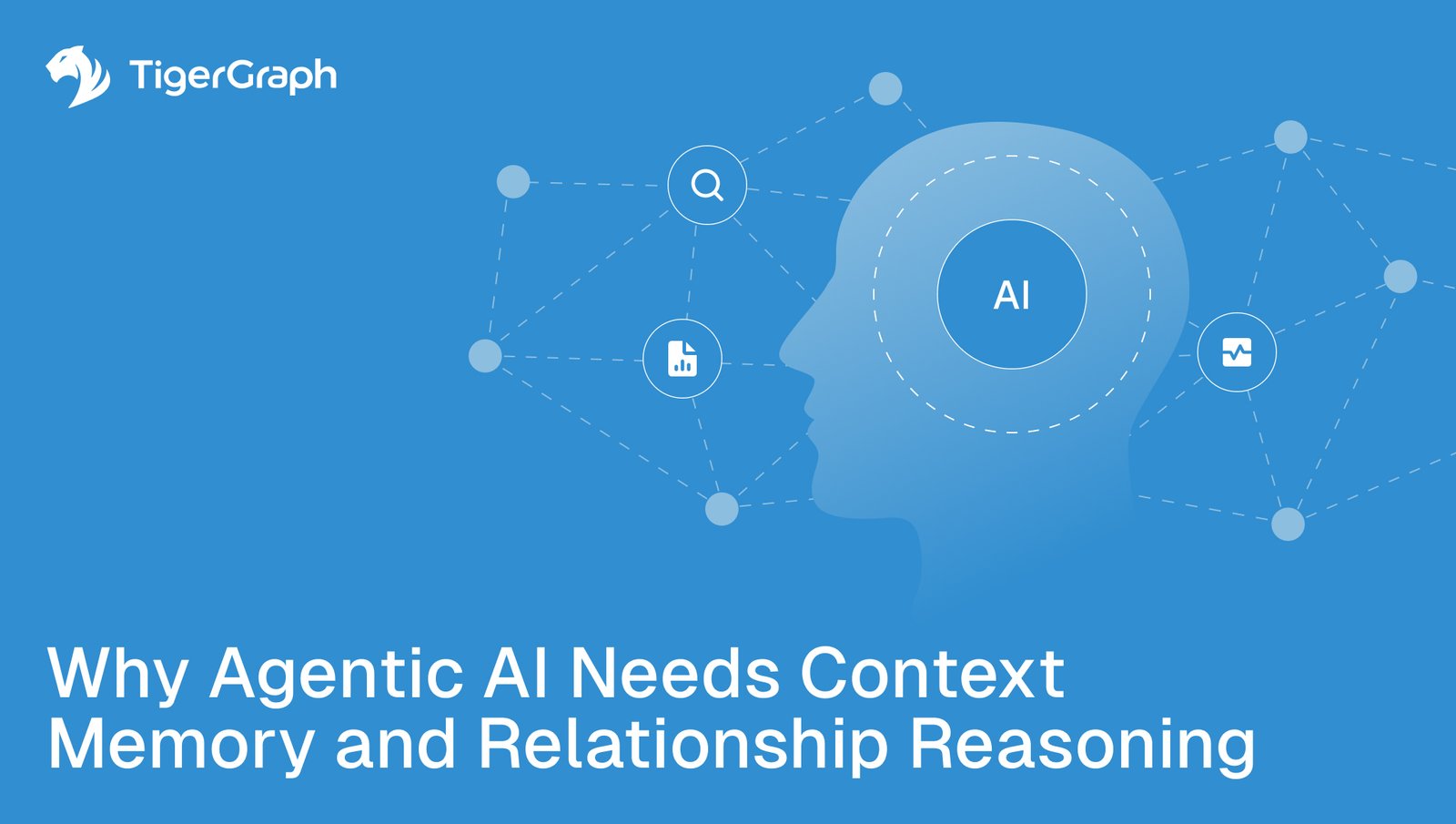
Why Agentic AI Needs Context Memory and Relationship Reasoning

Prompting isn’t enough. Autonomous AI agents are changing how we think about automation. No longer limited to single tasks, these agents can now initiate actions, chain together tools, learn from feedback, and adapt their behavior over time. But for all their capabilities, one thing remains true: An agent is only as good as its context.

LLMs (large language models) are powerful at generating responses, but their default mode is stateless. They don’t know what just happened unless you tell them. They don’t remember what they said five steps ago unless you add it to the prompt. And they don’t know whether an action makes sense unless you hard-code constraints or hope a plugin catches it.

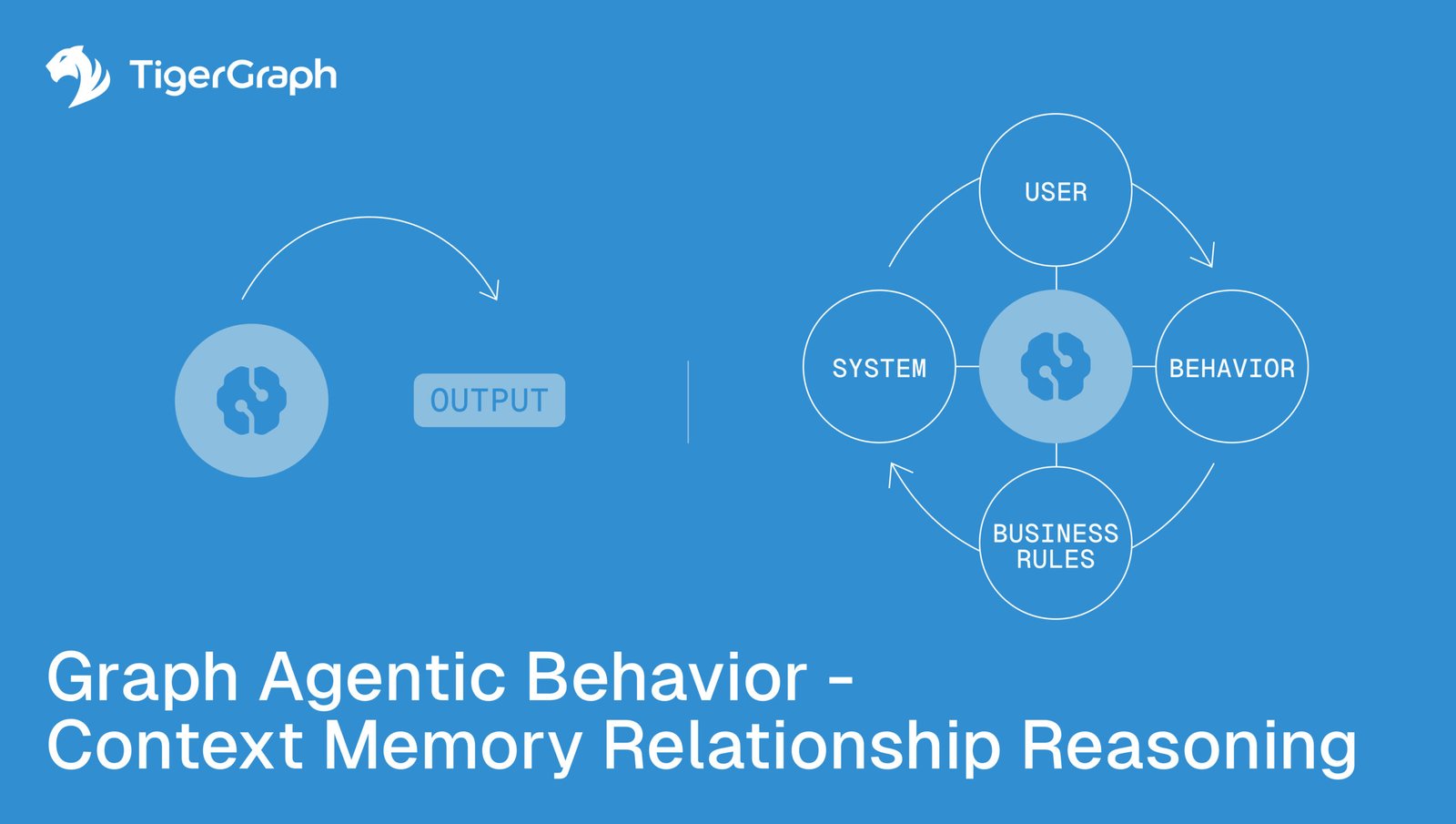
Without memory, awareness, or reasoning over relationships, agents are flying blind. They may complete a task, but they won’t know if it conflicts with previous steps, violates business rules, or contradicts behavioral norms. Agents need context persistence.

Graph Fills the Context Gap 

One of the most persistent challenges in building agentic AI is the lack of reliable context. While some sophisticated designs already address this, agents are often expected to act independently, reason across complex environments, and make decisions that align with organizational goals — all while relying on stateless prompts or fragmented memory. That’s not just inefficient, it’s risky.

This is exactly where graph technology steps in, and where TigerGraph helps bring that needed sophistication at scale.

TigerGraph doesn’t just store data — it models meaning through connection. It provides a living, queryable map of how everything in your system relates: users, actions, tools, policies, goals, and historical outcomes. Each of these elements becomes a node or a relationship in the graph, and that graph evolves as the system learns, adapts, and grows.

Think of it this way: instead of trying to cram all the relevant details into a single prompt, TigerGraph makes the context persistent, dynamic, and always available for traversal. This gives agents the structure they need to:

You don’t want an LLM that just says something. You want a system that knows why it said it, what came before, and what to do next.

That’s what graph provides — and what TigerGraph makes possible at scale. It’s not just about keeping agents informed. It’s about giving them a structured worldview: a dynamic memory of the environment they’re operating in and the relationships that give meaning to their decisions and baking it into the foundation of every agentic decision.

Long-Term Memory Built In 

One of the biggest weaknesses of today’s LLM-based agents is their inability to retain memory over long interactions.

TigerGraph provides agents with long-term, queryable memory. Rather than stuffing more text into the prompt and running into token limits or confusion, agents can query the graph to:

This persistent memory enables smarter decision-making, better task continuity, and significantly more coherent behavior across sessions.

Environmental Awareness in Real Time 

In addition to memory, agents need to understand what’s happening around them. Graph provides this awareness by modeling the agent’s operational environment:

With TigerGraph, agents don’t just react to instructions—they can assess the environment before acting. For example, an agent in a financial system might detect that two departments have overlapping approval authority or that a transaction deviates from past norms. Instead of executing blindly, it can ask for clarification or escalate accordingly.

Reasoning Over Relationships 

Relationship awareness is foundational. TigerGraph enables agents to reason over multi-hop relationships in real time. That means they can:

This is critical in enterprise and mission-critical environments where decisions must account for interdependencies, not just surface-level inputs.

A Shared Language for AI, Data, and Humans 

One of the overlooked benefits of graph is explainability. When an agent takes action based on a graph traversal, that decision path can be inspected, explained, and audited.

TigerGraph supports this through schema-first design, query transparency, and human-readable relationships. This isn’t just helpful for debugging—it’s essential for compliance, trust, and continuous improvement.

Graphs give agents the connective tissue they need to make sense of the world, not just text prompts, but real memory and real logic they can reason over. That’s how you go from reactive chatbots to intelligent collaborators.

Memory and Context Are Not Optional 

Agentic AI can’t succeed on prompt engineering alone. It needs structure, memory. It needs a sense of behavioral and relational context.

TigerGraph delivers that context as a living, evolving graph. It gives AI agents the ability to act with continuity, awareness, and judgment—qualities that are essential for trustworthy, scalable autonomy.

If you’re building agents to operate in real-world systems, don’t leave them guessing. Give them the context they need and start with graph. 

Give Your Agents More Than Prompts—Give Them Perspective.

Stateless LLMs can’t reason about what came before or why it matters. TigerGraph brings memory, context, and relationship reasoning to your agentic AI systems so they act with continuity, not guesswork.

Start building context-aware agents today with TigerGraph Cloud. It’s free to try.


Fortify Your System with Agentic AI—Why the Time Is Now

Cybersecurity has entered a new phase—defined less by perimeter breaches and more by behavioral complexity. Today’s threats don’t simply knock at the front door; they move laterally, escalate privileges quietly, and blend into the background noise of legitimate activity. These are not just attacks but adaptive, intelligent campaigns that unfold across time, systems, and roles.

To confront this evolving threat landscape, enterprises need more than faster alerts or broader coverage—they need systems that can reason. That’s where Agentic AI comes in—autonomous systems designed not just to react, but to observe, decide, and act based on live context. Unlike traditional automation or rule-based tools, agentic systems continuously assess their environment and adjust behavior toward defined goals, even as conditions shift.

But autonomy without understanding is a liability. To be effective and trustworthy, these AI agents must be grounded in structured, contextual knowledge. This is where graph technology becomes foundational. Graphs don’t just store data—they represent relationships, model causality, and provide a connected view of how people, systems, and actions intersect. That’s precisely the kind of structure agentic AI needs to make informed, accountable decisions.

And this is where TigerGraph stands apart. While graph databases offer modeling flexibility, TigerGraph adds enterprise-ready performance: a distributed, graph-native architecture with parallel traversal, in-graph analytics, and real-time pattern recognition. TigerGraph doesn’t just help agents identify anomalies—it empowers them to interpret intent, trace escalation paths, and act responsibly, at scale.

Cybersecurity today isn’t a speed game. It’s a reasoning game. And in a world where threat actors are already using AI to breach defenses, the only viable response is AI that thinks ahead. The time to build that capability—responsibly and at scale—is now.

From Reactive Defenses to Responsible Autonomy

Cybersecurity tools are often reactive by design. They wait for something to go wrong, then trigger alerts—sometimes too late, often without context. In an environment where attacks evolve in real time and threat actors increasingly leverage AI themselves, that’s no longer good enough. Static rule sets and siloed event logs can’t anticipate intent or adapt to new threat vectors. Defenders need systems that can think ahead.

Agentic AI offers a fundamentally different approach. These AI systems can act independently toward defined goals—identifying threats, assessing risk, and taking action without requiring step-by-step human intervention.

But autonomy must be coupled with care. To operate effectively in sensitive domains like cybersecurity, these systems must be grounded in context, aligned with policy, and capable of explaining their decisions.

That’s why responsibility must be baked into autonomy. Agentic systems must be equipped to act—and do so with accountability, traceability, and trust. They need a knowledge framework that can encode organizational norms, recognize deviations, and adjust behavior in real time.

And that’s precisely where graph technology becomes indispensable.

Why Graph Is the Bedrock of Responsible Agentic AI

Agentic AI systems are only as effective as the context they operate within. For cybersecurity applications, that context is incredibly complex: users, devices, roles, privileges, time-based behaviors, geographic constraints, data flows, and more. It’s not just the data points that matter—it’s how they’re connected. That’s why graph technology is foundational.

Graph databases are uniquely suited to model relationships, causality, and proximity at scale. They allow AI agents to move beyond isolated signals and instead analyze how entities interact across systems, over time, and within organizational norms. For example:

Relational databases struggle with multi-hop, real-time reasoning, especially across high-volume, complex event streams. Graphs are optimized for it. Still, not all graph databases can handle the operational demands of cybersecurity.

TigerGraph takes graphs’ modeling strengths and delivers them at scale. Its real-time, in-graph computation enables agents to assess risk and simulate scenarios before acting. Agents can forecast potential breaches, test containment paths, and take preventative steps—all while keeping their logic transparent and explainable.

Graph technology enables contextual reasoning and TigerGraph operationalizes it—at scale, in real time, and with built-in explainability.

Taking Steps Toward a Graph-Powered Cyber Agent

Building agentic AI for cybersecurity isn’t a plug-and-play process—it’s an architectural evolution. Enterprises must move deliberately, laying down a technical foundation that enables autonomy without sacrificing oversight. That starts with the graph.

Here’s how to take the first practical steps toward implementing agentic AI systems powered by graph technology:

  1. Equip Agents with Situational Awareness

Most AI systems can detect isolated anomalies, but few can explain their meaning in context. A graph-native platform enables AI agents to understand their environment by traversing real-time access histories, user-device relationships, and privilege hierarchies. TigerGraph’s parallel traversal engine allows exploring these multi-hop patterns without slowing down, even as the graph grows.

  1. Build Transparent, Traceable Reasoning

In cybersecurity, every decision needs to be explainable to regulators, executives, and the team on the ground. Explainability isn’t a bolt-on—it’s part of the system’s DNA. TigerGraph supports in-graph analytics, so decision logic lives inside the graph itself, not buried in external tools or black-box models. This enables agents to reason visibly—and justify every action they take.

  1. Model Norms, Not Just Rules

Rules are rigid and easy for attackers to step around. Norms are more powerful: they represent patterns of behavior that define “normal” in your organization. A knowledge graph encodes these norms as dynamic patterns and relationships, learned from examples and updated over time. Agentic AI systems can then reason by analogy, asking: Is this behavior consistent with what trusted users typically do? If not, intervene.

  1. Enable Human-AI Feedback Loops

Agentic AI is not a replacement for human decision-makers—it’s a collaborator. Graph-based systems create visibility into how decisions are made and where intervention may be needed. With TigerGraph, teams can inspect, refine, and retrain agentic behaviors using live graph data, enabling agents to evolve responsibly, guided by data and domain expertise.

Together, these steps form the core of a modern cybersecurity posture—autonomous, adaptive, and aligned with enterprise values. Graph technology makes this architecture possible. TigerGraph makes it real.

A Glimpse into the Future: Cyber Agents in Action

Imagine this: A user logs in from a new location, accesses a sensitive system, and issues a script. Traditional tools raise three disjointed alerts. But a graph-powered agent sees a pattern:

It suspends the session, notifies security, and provides an explainable path of reasoning behind the decision.

This isn’t far-future speculation. With TigerGraph, this kind of agentic decision-making is technically achievable today. And it comes as we approach the tipping point, as attackers are already using AI to probe weaknesses. Cybercriminals aren’t just scaling—they’re evolving. And if your defenses are static, you’ve already lost the arms race.

Responsible agentic AI offers a way forward: proactive defense powered by situational reasoning, explainable intelligence that builds trust with regulators and boards, and scalable systems that evolve as fast as the threats they face.

Building it requires more than plugging in an LLM. It requires a foundation of structured, connected knowledge—graph-powered cognition that doesn’t just react, but understands.

Engineer Trust, Build Resilience

Cybersecurity today demands more than detection—it demands judgment. The only defense in a world of autonomous threats is autonomous intelligence engineered responsibly.

With TigerGraph, organizations don’t just respond to threats—they understand them. They don’t just analyze patterns—they explain them. And they don’t just react—they reason.

The future is agentic, and the time to shore up your systems is now. Reach out and we’ll help you get started!


The Agentic AI/Graph Database Combo Powering Emerging Applications

Static AI models that provide insights on demand are no longer enough. Today’s enterprise needs systems that can dynamically adapt, make autonomous decisions, and optimize workflows in real time. Enter Agentic AI, a fast-evolving approach in artificial intelligence that’s gaining serious traction for its potential to enable systems that act with autonomy and intent. 

Agentic AI goes beyond pattern recognition to perception, reasoning, action, and learning in real-world environments. But to fully unlock its potential, Agentic AI needs the right data infrastructure—one that can handle complex relationships, adapt in real-time, and scale with ever-growing data demands. This is where graph databases come in, powering the next generation of agentic AI graph architectures, and where TigerGraph takes it even further.

Let’s start with the definitions.

Defining the Key Components

Agentic AI: AI That Acts, Not Just Reacts in Real Time

Agentic AI refers to AI systems that act independently to achieve a specific goal—for example, monitoring data in real-time and adapting its actions accordingly. To do this, an AI agent follows a structured process: it plans, executes, learns from outcomes, and adjusts based on changing conditions.

These capabilities make agentic AI a breakthrough for enterprise data management, continuously aligning insights with live operational data.

Relational Databases vs Graph Databases: Why Structure Matters

Most enterprise applications rely on relational databases, which work well for storing structured data in tables. However, they struggle with highly interconnected data. For instance, when analyzing multiple layers of connections (multi-hop relationships), such as tracing a product’s supply chain or detecting fraud across multiple accounts—relational databases rely on complex joins across multiple tables (combining data from two or more tables based on a shared key or common column). This approach becomes slow and inefficient as data complexity increases.

Additionally, relational databases aren’t built for real-time relationship analysis. They lack efficient graph traversal, meaning they can’t quickly follow connections between data points as they change. As businesses scale and data volumes grow into the billions, executing queries at high speed becomes increasingly difficult, leading to delays and performance bottlenecks.

Graph Databases: The Foundation for Agentic AI Applications

Graph databases are revolutionizing how businesses manage interconnected data. They are designed to overcome relational database limitations. 

Instead of rigid tables, they store data as nodes (entities) and edges (relationships), making it easier to connect, analyze, and traverse complex relationships. Unlike relational databases, graphs allow AI to retrieve insights in real-time, making them ideal for fraud detection, recommendation systems, supply chain optimization, and knowledge graphs.

This means AI can process relationships instantly, uncovering previously hidden patterns or too slow to analyze with traditional databases. Graph databases enable AI to make more informed decisions in real-time, as they represent knowledge with identifiable entities and rich, meaningful relationships.

TigerGraph: The Next Evolution in Enterprise Graph Databases

While graph databases provide a strong foundation, TigerGraph takes it to the next level. As a native parallel graph database, TigerGraph is designed for high-performance, enterprise-scale analytics.

It was specifically designed as a graph where managing and tracing relationships is its primary function (native), without resorting to table joins or any extra modeling layers. It breaks down complex graph queries into smaller tasks and processes them simultaneously across different parts of the system (parallel). This makes it ideal for high-performance, enterprise-scale analytics, where large amounts of interconnected data need to be analyzed in real-time.

TigerGraph stores entities as nodes and relationships as edges, mirroring real-world interactions while enabling high-speed multi-hop queries that AI agents can traverse in milliseconds, even across massive datasets. It supports real-time analytics and dynamic pattern discovery, helping AI systems detect changes and make decisions instantly. 

TigerGraph provides the dynamic relational awareness needed for intelligence agents to plan, reason and learn at scale. This makes TigerGraph uniquely positioned to make the most of Agentic AI.

Moving From Traditional AI to Agentic AI

Instead of static machine-learning models that rely on predefined rules and datasets, Agentic AI agents can plan, make decisions, act, and evolve in response to continuous input. This dynamic process defines an agentic workflow as a continuous loop of perception, reasoning, and adaptation that evolves with real-time data.

Thinking ahead and adapting makes Agentic AI more dynamic and capable than traditional AI models. Agentic AI can:

For context, large language models by themselves are reactive. They respond to queries but cannot self-direct. 

Agentic AI, on the other hand, has a goal in mind. It monitors its performance, makes decisions, and adjusts its workflow. This shift moves enterprises beyond automation. With knowledge graph agentic AI architectures, systems can anticipate change, reason across relationships, and optimize actions proactively.

By integrating Agentic AI with TigerGraph, enterprises unlock unprecedented capabilities in real-time decision-making, adaptive automation, and hyper-personalization. AI can understand and respond to complex relationships in real time, creating smarter, more autonomous enterprise applications. It empowers organizations to build context-aware AI models to navigate and infer insights from rich data networks. 

Integrating TigerGraph with agentic AI is straightforward, connecting facts, decisions, and workflows in a live network:

The graph would provide both foundational knowledge and rules of engagement for Agentic AI. It can encode decision-making logic, allowing AI to follow predefined pathways while adapting dynamically. Agentic AI constantly monitors conditions and optimizes performance, offering maximum real-time adaptability.

The impact on the enterprise would be transformative—it already is.

Transformative Impact on the Enterprise 

AI agents combined with graph databases can seamlessly navigate enterprise workflows, making autonomous, context-aware decisions without human input. By uncovering hidden patterns and deeper relationships within data, these advancements empower businesses to operate with greater intelligence, agility, and automation.

This foundation enables truly agentic AI data-driven decisions—insights that evolve continuously based on live context rather than static datasets.

For example, in logistics, an AI system monitoring shipping routes detects delays and automatically reroutes to minimize disruption. Supply chain optimization also benefits from AI-powered graph analytics, where real-time demand signals help dynamically adjust vendor orders and inventory management. In manufacturing, an energy management AI continuously assesses energy use, optimizes distribution, and adjusts dynamically to changing demands, ensuring operational efficiency.

In customer-facing applications, AI-driven personalization leverages graph-based insights to deliver hyper-personalized recommendations. By analyzing customer interactions across multiple touchpoints and understanding the relationships between purchases, interests, and user networks, AI can refine recommendations with greater accuracy. This capability enhances customer experience, leading to stronger engagement and increased sales.

In customer relationship management (CRM), AI can even predict customer needs by analyzing historical behavior and engagement patterns, allowing businesses to address concerns or offer tailored solutions proactively.

In cybersecurity and IT operations, agentic AI for data management and graph reasoning enable continuous transaction monitoring, user behavior, and access points, detecting anomalies that indicate fraudulent activity or potential system vulnerabilities. By dynamically adapting to evolving threats, AI strengthens enterprise security and reduces risks in real-time.

From logistics to personalization, supply chains to cybersecurity, integrating Agentic AI with graph databases revolutionizes business operations. It allows enterprises to anticipate challenges, optimize processes, and deliver smarter, data-driven decisions at scale.

It’s not without challenges, though. 

Challenges and Considerations

While integrating Agentic AI with graph databases offers significant advantages, it also presents challenges that enterprises must navigate.

One major concern is data privacy and compliance. As AI systems make increasingly autonomous decisions, ensuring that their recommendations align with regulations such as GDPR and industry-specific data protection laws becomes critical. Enterprises must implement strict data governance frameworks to maintain transparency and accountability in AI-driven processes. TigerGraph enhances security with fine-grained access controls, encryption mechanisms, and compliance-ready solutions to help organizations manage sensitive data within a graph database environment. 

Another challenge is system complexity. Managing large-scale graph search and reasoning processes requires sophisticated infrastructure to handle highly interconnected data. Managing agentic AI real-time data streams demands infrastructure that can process updates, context shifts, and model feedback with minimal latency.

As AI models grow in complexity, ensuring efficient query execution and maintaining system performance becomes increasingly difficult. As noted earlier, TigerGraph’s native parallel processing architecture delivers high-speed performance out of the box—so teams don’t need to jury-rig complex workarounds just to meet performance demands.

Scalability is also a key factor. Maintaining speed and accuracy without compromising system efficiency is a constant balancing act. TigerGraph’s distributed computing model ensures scalability by allowing enterprises to scale both vertically and horizontally. 

Beyond these technical challenges, enterprises must also ensure good data quality, eliminate hallucinations in AI decision-making, and properly define AI’s operational boundaries. 

AI-driven insights can become unreliable without robust validation mechanisms, leading to flawed decision-making. Addressing these concerns is crucial to ensuring that AI systems remain powerful, trustworthy, and effective in enterprise environments.

Future Outlook in Graph-powered Agentic AI 

As AI and graph technology continue to evolve, real-time AI-driven graph insights are becoming essential for detecting patterns and anomalies—and making instant decisions. AI agents can continuously analyze graph patterns to identify fraud, security threats, or operational inefficiencies as they emerge, allowing organizations to respond proactively rather than reactively.

Next-generation agentic analytics software with automated data storytelling will visualize these insights—using adaptive dashboards, or even an agentic AI chart, to narrate complex graph results in human-readable form.

Graph provides an understandable way to encode rules and policies for AI—helping balance transparency and control in Agentic AI. The future of AI is not just automation—it’s intelligent decision-making that continuously adapts to real-world conditions. Graph and Agentic AI together make that possible.

Frequently Asked Questions (FAQ)

  1. What is Agentic AI?
    Agentic AI is a form of artificial intelligence that perceives, reasons, acts, and learns continuously. It enables systems to make autonomous decisions and adapt to new information in real time.
  2. How do graph databases support Agentic AI?
    Graph databases provide the contextual framework Agentic AI needs to reason effectively. They store data as relationships, allowing AI to analyze connections and dependencies instantly.
  3. What are the main business benefits of combining Agentic AI and graph databases?
    Together, they enable faster, context-aware insights, dynamic decision-making, and self-optimizing workflows. These are essential for use cases like fraud detection, logistics, and customer personalization.
  4. Why is TigerGraph ideal for Agentic AI applications?
    TigerGraph’s native parallel architecture scales to billions of relationships, delivering the real-time analytics and reasoning power Agentic AI needs for enterprise-grade performance.

In Summary:

Enterprises that embrace graph-powered agentic AI will unlock new levels of efficiency, intelligence, and automation—driving the next generation of business applications and shaping the future of AI-driven innovation. Reach out to learn more!

Why Agentic AI Needs More Than Just Rules (It Needs Guardrails) 

Traditional AI models often operate in rigid, rule-based environments, but real-world scenarios demand nuance. Agentic AI doesn’t just follow instructions—it interprets them, reasons through options, and makes choices based on perceived goals. To do that responsibly, it needs more than logic—it needs context.

Graphs provide this context.

Graph databases model not just data points but the relationships between them. A knowledge graph, for instance, can represent everything from company policies and domain-specific regulations to behavioral norms and ethical principles. This allows an agentic AI to reason through decisions in a more human-like, adaptable way.

Self-Driving Cars and Situational Awareness 

Consider a self-driving car: Programming the legal rules of the road—speed limits, stop signs, right-of-way laws—is relatively straightforward. These are hard-coded, rule-based instructions. But driving isn’t just about following laws. It’s about reading the room.

Take the rule, “Yield to pedestrians.” It seems simple. But what happens when a pedestrian is near the curb, scrolling on their phone, making no eye contact? What if the crosswalk light is blinking and traffic is backing up? Is the person about to cross—or just waiting for an Uber?

These are not binary decisions—they require situational judgment. And that’s where traditional logic systems fall short. Behind the curtain, an autonomous vehicle needs to: 

This is where graph comes in. A graph-based system connects these data points as a web of relationships: 

With this graph, the AI agent can reason through decisions—not just react. It can say, “I’ve seen this pattern before. In similar conditions, the pedestrian crossed late. There’s a history of near misses at this time. The safest move is to yield.”

That’s not just compliance—it’s judgment. And it’s made possible by a graph that models not just what is, but how everything relates.

In short, graphs give agentic AI the situational awareness to act more like a cautious, adaptive driver—not just one following the letter of the law, but one aligned with the spirit of it.

Building Responsible Autonomy with Graphs 

As AI systems evolve from reactive models to autonomous agents, their ability to operate independently introduces new risks—and new responsibilities. Agentic AI doesn’t just follow a linear set of instructions; it makes decisions, adjusts strategies, and acts over time in dynamic environments. These systems need more than data and logic to ensure that autonomy is exercised responsibly. They need context, norms, and guardrails.

Graph technology provides this scaffolding by modeling relationships—not just between data points, but between rules, entities, behaviors, and outcomes. It’s the connective tissue that allows agentic systems to reason like humans do—not in isolation, but with situational awareness.

With graph-based infrastructure, autonomous systems can:

Align with Organizational Policies 

A graph can represent internal structures such as reporting hierarchies, approval workflows, and business policies. When an AI agent evaluates a course of action—say, escalating a transaction or triggering an alert—it can traverse this graph to understand what’s allowed, who needs to be informed, and under what conditions exceptions apply. This is more than access control—it’s embedded operational intelligence.

Incorporate Domain-Specific Ethics 

Legal boundaries, cultural expectations, and industry regulations vary across contexts. A healthcare AI should respect HIPAA privacy constraints. A financial advisor bot might need to avoid investments that conflict with ESG preferences. Graphs make it possible to encode these domain-specific norms as traversable relationships and dynamic rules—so that AI systems can reason through them, not just check boxes.

Adapt While Staying Accountable 

One of the promises of Agentic AI is its ability to explore new strategies and learn from outcomes. However, this exploration must happen within well-understood limits in enterprise and regulated environments. Graphs provide those limits—not by halting adaptation, but by guiding it. Graphs are how you encode behavioral norms—not just what’s allowed, but what’s expected.

It’s important to note that not all graph systems can handle the scale, depth, or complexity of real-world autonomous decision-making. Agentic AI requires real-time feedback, deep multi-hop reasoning, and policy-aware traversal logic. This is where TigerGraph’s native parallel architecture makes that vision operational.

TigerGraph, for example, supports: 

In plain terms: TigerGraph helps agentic AI systems see relationships as they evolve, adapt decisions as new information comes in, and maintain alignment with human expectations at scale.

This is how you move from automation to alignment. From agents that execute code to agents that act with awareness.

The goal isn’t just to prevent catastrophic failure—it’s to build systems people can trust. Whether that’s a compliance officer reviewing a flagged transaction or a customer relying on AI for a financial decision, explainability and accountability are non-negotiable. And graphs—especially when engineered for real-time performance and complex traversals—are uniquely suited to deliver both.

By embedding policies, relationships, and behavioral expectations directly into the AI’s reasoning substrate, graph technology ensures that as autonomy grows, so too, does accountability. To truly empower AI systems with this level of structured, contextual awareness, you need more than a database—you need a knowledge graph.

What Is a Knowledge Graph—And Why Does Agentic AI Need One? 

A knowledge graph is a special type of graph database that doesn’t just store data—it models meaning. It represents entities (like people, accounts, or policies) as nodes and encodes their relationships as edges. But what makes it a “knowledge” graph is how it captures the semantics, rules, and norms behind those connections.

Think of it as a living, contextual map of how your world works—one that: 

For agentic AI, this is essential. A knowledge graph gives the agent a form of memory, policy guidance, and situational understanding. It can answer questions like: “What actions are typical for this scenario?” “Have we seen a pattern like this before?” and “Does this behavior violate any rules, norms, or expectations?”

When built on a platform like TigerGraph—which is purpose-built for deep reasoning, not just speed—this knowledge graph becomes a live, scalable decision layer. 

Its architecture supports the full stack of requirements for explainable, policy-aware AI: from reusable logic (so agents can apply consistent rules across different situations), to streaming updates (so the system can respond to new information in real-time) to parallel traversal (so it can analyze complex relationships across billions of nodes and edges without slowing down). 

In short, TigerGraph enables AI systems not only to act fast—but to act with understanding, consistency, and accountability.

Graphs as the Moral Compass of Machines? 

As AI becomes more agentic—capable of reasoning, planning, and acting independently—the need for explainability, accountability, and contextual awareness only grows. Graphs offer a way forward. By structuring data around entities and their relationships, graph technology provides the contextual backbone that helps autonomous systems navigate complex environments while staying aligned with their intended goals.

This isn’t theoretical. Forward-looking organizations are already pairing knowledge graphs with real-time data and agentic models to build systems that are not only autonomous—but aligned. In financial services, for instance, AI agents must make decisions that comply with regulations, reflect organizational priorities, and stand up to audit—often in real-time.

TigerGraph distinguishes itself here. Unlike general-purpose graph databases, it is engineered specifically for complexity and enterprise-grade performance. Its ability to support deep reasoning, not just fast lookup, is critical when AI needs to explain why—not just what—it did.

Imagine a digital finance advisor that goes beyond optimizing returns to also consider ethical constraints, long-term goals, and shifting market conditions—all while explaining its choices. Or a healthcare assistant that dynamically adjusts recommendations based on clinical history, social context, and emerging research.

That’s not just decision-making—it’s responsible autonomy. And graphs make it possible.

The future of AI won’t be shaped by model size alone—it will be defined by structure, alignment, and trust. Graph provides the scaffolding, and TigerGraph enables it at enterprise scale.

Let’s build AI that doesn’t just act smart—but thinks responsibly. Reach out to learn more and see the next evolution of graph databases in action!