Contact Us

How to Make the CFO Business Case for Graph Database

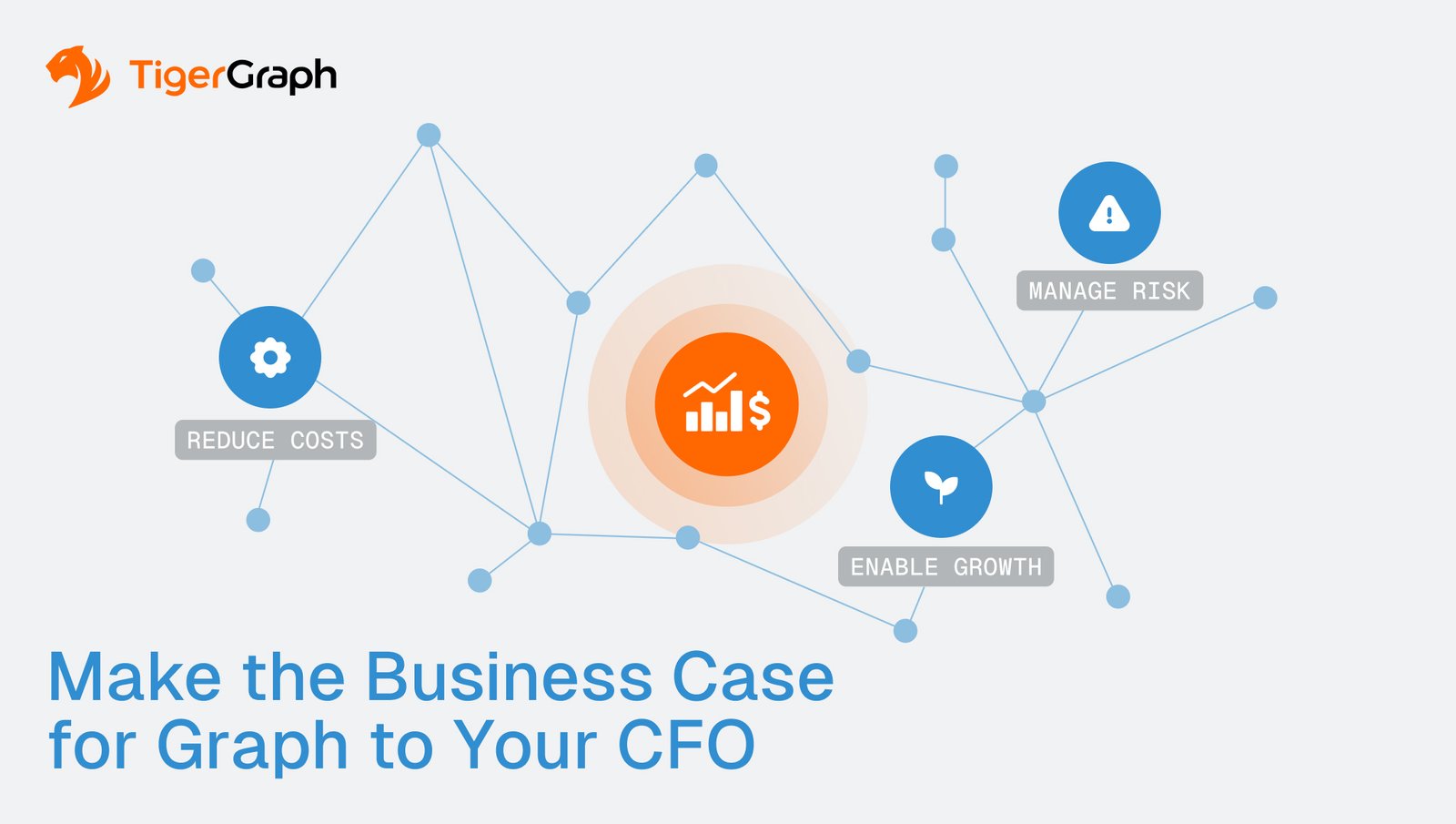
Every CFO is charged with balancing three imperatives: reduce costs, manage risk, and enable growth. In banking, those imperatives are under acute stress.

Financial crime is accelerating, with fraud losses projected to exceed $43 billion globally within five years. Regulators are levying record fines for AML/KYC failures, often in the hundreds of millions of dollars per action. At the same time, customers expect frictionless digital onboarding and zero tolerance for service disruptions.

This convergence means CFOs can no longer view fraud, compliance, and identity management purely as separate line items. Each may sit under its own function, but the risks overlap and the costs compound when handled in silos.

Boards increasingly expect CFOs to evaluate the business case for graph technology as a platform that connects risk data across functions and delivers measurable returns. Unlike legacy tools that analyze transactions or attributes in isolation, graph analytics for CFOs exposes relationships spanning fraud detection, AML compliance, and customer identity resolution.

For CFOs, that translates directly into measurable graph database ROI: fewer fraud losses, reduced compliance penalties, and stronger revenue protection through better customer experiences.

The Cost of Siloed Risk Management

Fragmentation is expensive. Traditional systems force fraud, AML, and compliance teams to monitor alerts in isolation. Analysts waste hours reconciling mismatched reports, while fraudsters exploit the gaps.

The financial toll is clear, yet banks relying only on rules-based tools plateau at around 60 percent detection accuracy. Compliance enforcement actions regularly exceed hundreds of millions of dollars, with some penalties topping $2B.

Most failures are not due to lack of data but to lack of context, as institutions cannot link related entities across silos. And investigators are overwhelmed by alerts, with up to 90 percent dismissed as false positives after manual review (Forrester TEI). Each dismissal represents wasted labor, higher audit costs, and slower onboarding of legitimate customers.

Siloed systems increase risk, as they multiply costs across fraud operations, compliance, and customer experience—making the CFO business case graph database stronger than ever.

Where the Business Case for Graph Technology Delivers Measurable ROI

The business case for graph technology rests on clear outcomes across three dimensions CFOs track most closely: cost savings with graph database in fraud detection, compliance ROI, and revenue protection.

These are fraud-focused examples, but they demonstrate how contextual graph analytics translates directly into measurable savings. It’s the same logic CFOs can apply to compliance and revenue protection.

Graph analytics for CFOs provides a direct lever to reduce losses. By linking accounts, devices, and transactions, banks expose mule networks, synthetic IDs, and collusive merchants before losses cascade.

One global institution processes more than 50 million transactions daily across a 30TB dataset. Legacy tools flagged anomalies but failed to reveal relationships across customers, devices, and merchants. With graph-powered fraud detection, the bank now generates more than 30 contextual features such as shortest paths, device reuse, and hidden ownership overlaps. This resulted in higher detection precision, significantly fewer false positives, and $50 million in annual cost savings with graph database—delivered at the scale the largest global banks require.

Nubank, Latin America’s largest digital bank, faced $1.8 million in monthly scam losses and recall rates as low as 28 percent. By integrating PageRank fraud detection and community detection, the bank boosted recall, cut false positives, and prevented millions in monthly scam losses, without adding headcount.

These examples demonstrate why the CFO business case graph database extends beyond fraud detection into broader operational and compliance savings.

Compliance becomes expensive when handled reactively. Regulators no longer accept “black-box” scores. They expect audit-ready lineage that shows why alerts were triggered.

A graph-powered entity resolution platform provides that lineage. Investigators can export regulator-ready evidence chains, including devices, IP addresses, ownership structures, and timestamps, in minutes instead of days.

This capability reduces the likelihood of fines, demonstrates resilience to auditors and boards, and reframes compliance as a measurable ROI driver rather than a sunk cost—strengthening the business case for graph technology.

False positives are a silent drain on revenue. Every legitimate customer wrongly flagged represents not only lost transactions but also lost trust and lifetime value.

Graph-powered customer identity resolution in banking reduces erroneous alerts by distinguishing genuine customers from fraudsters. That accelerates digital onboarding, lowers churn, and increases opportunities for cross-sell and upsell.

For CFOs, fewer false positives mean faster acquisition, stronger retention, and higher long-term customer value. This is why graph database ROI is as much about growth as it is about risk reduction.

Building The CFO Business Case Graph Database Step by Step

To secure board approval, CFOs expect a structured, numbers-driven case. The process should emphasize ROI at every step:

A clear, CFO-ready narrative reframes graph not as an IT experiment, but as a board-level business investment.

TigerGraph’s CFO advantage

TigerGraph is engineered for the scale and transparency CFOs demand. It handles millions of daily events with sub-second multi-hop queries, supports thousands of simultaneous fraud, AML, and KYC queries without bottlenecks, and continuously generates graph-native features such as centrality, PageRank, and community detection to feed fraud and AML models with higher recall and precision.

It also provides regulator-traceable lineage with timestamps, reducing compliance costs and satisfying audit expectations. Independent Forrester analysis reported 229 percent ROI over three years with a payback period under six months.

For CFOs, this means graph database ROI is already being delivered at the scale the largest global banks require. Fraud prevention delivers tens of millions in measurable annual savings. Compliance ROI comes from regulator-ready transparency that reduces fines and protects reputation. Revenue protection flows from faster onboarding and fewer false positives that safeguard long-term customer value.

The business case for graph technology is reinforced by proof points from global banks already in production, showing that enterprise graph adoption is not hypothetical—it is happening today.

Conclusion

CFOs evaluating new technology ask one simple question: Does it reduce cost, lower risk, and enable growth? With graph, the answer is clear.

Graph database ROI is delivered through measurable cost savings with graph database, proven compliance ROI, and revenue protection. Together, these outcomes form the backbone of the CFO business case for graph database adoption, making graph not just a technical upgrade, but a board-level strategy for measurable ROI.

Connect with TigerGraph to see how financial leaders are building CFO-ready business cases for graph technology. Review the Forrester TEI report for independent ROI validation, or schedule a strategy session to evaluate how enterprise graph adoption could deliver measurable savings for your institution.

Frequently Asked Questions

What is the CFO business case for adopting graph database technology in banking?

The CFO business case for graph technology centers on measurable ROI across three core imperatives: reducing cost, lowering risk, and enabling growth. Graph analytics connects siloed risk data—spanning fraud detection, AML compliance, and customer identity resolution—to deliver unified insight. Global banks using graph databases report $50M+ in annual fraud cost savings, 229% ROI over three years, and payback in under six months (Forrester TEI). For CFOs, graph technology transforms disconnected compliance and fraud processes into an integrated, cost-efficient intelligence platform.

How does a graph database reduce fraud losses and operational costs for financial institutions?

Graph databases analyze the relationships between accounts, devices, and transactions, revealing mule networks, synthetic IDs, and collusive merchants that traditional systems miss. By generating contextual features like shortest paths, device reuse, and hidden ownership overlaps, banks improve detection precision and reduce false positives. One global bank achieved $50 million in yearly savings, while Nubank cut monthly scam losses dramatically by combining PageRank and community detection for fraud analysis—without increasing headcount.

What compliance ROI can CFOs expect from implementing graph technology?

CFOs gain measurable compliance ROI when graph technology delivers regulator-ready transparency. Graph-powered entity resolution provides full audit lineage—linking customers, devices, IPs, and ownership structures in minutes. This traceability reduces regulatory fines and investigation time while strengthening resilience against audits. Graph reframes compliance from a cost center to a strategic ROI driver, helping CFOs demonstrate proactive governance and capital protection.

How does graph-powered identity resolution improve customer experience and revenue growth?

Graph databases enable contextual identity resolution, reducing false positives that block legitimate customers. By distinguishing genuine users from fraudsters, banks accelerate digital onboarding, reduce churn, and unlock cross-sell opportunities. For CFOs, this translates to faster acquisition, higher retention, and greater lifetime value—directly linking graph database ROI to top-line revenue protection as well as bottom-line efficiency.

Why should CFOs act now to evaluate graph technology for fraud, AML, and KYC operations?

Financial crime losses are projected to exceed $43B globally within five years, and regulators are imposing record AML/KYC fines exceeding $2B per case. Traditional, siloed systems plateau at 60% detection accuracy and generate up to 90% false positives. Boards now expect CFOs to assess graph technology as an enterprise platform that unifies risk, compliance, and identity data—driving measurable ROI, reducing exposure, and enabling sustainable growth. Graph isn’t experimental—it’s already delivering results at leading global banks.

What’s Missing from Your Identity Graph? Behavior.

Behavior is the missing layer in most identity graphs, especially when it comes to financial crime and AML/KYC programs. Although banks have unified names, addresses, and device IDs into consolidated profiles, what they often lack is the dynamic activity that exposes risk in real time.

Forward-thinking businesses are using graphs to perform identity resolution in banking, the customer record matching that is essential for customer 360, personalization, compliance, and fraud detection with identity graph analytics. Dynamic identity resolution has become the cornerstone of modern fraud detection, KYC, and AML programs. For banks, an identity graph in banking that includes behavior is critical for staying ahead of fraudsters. 

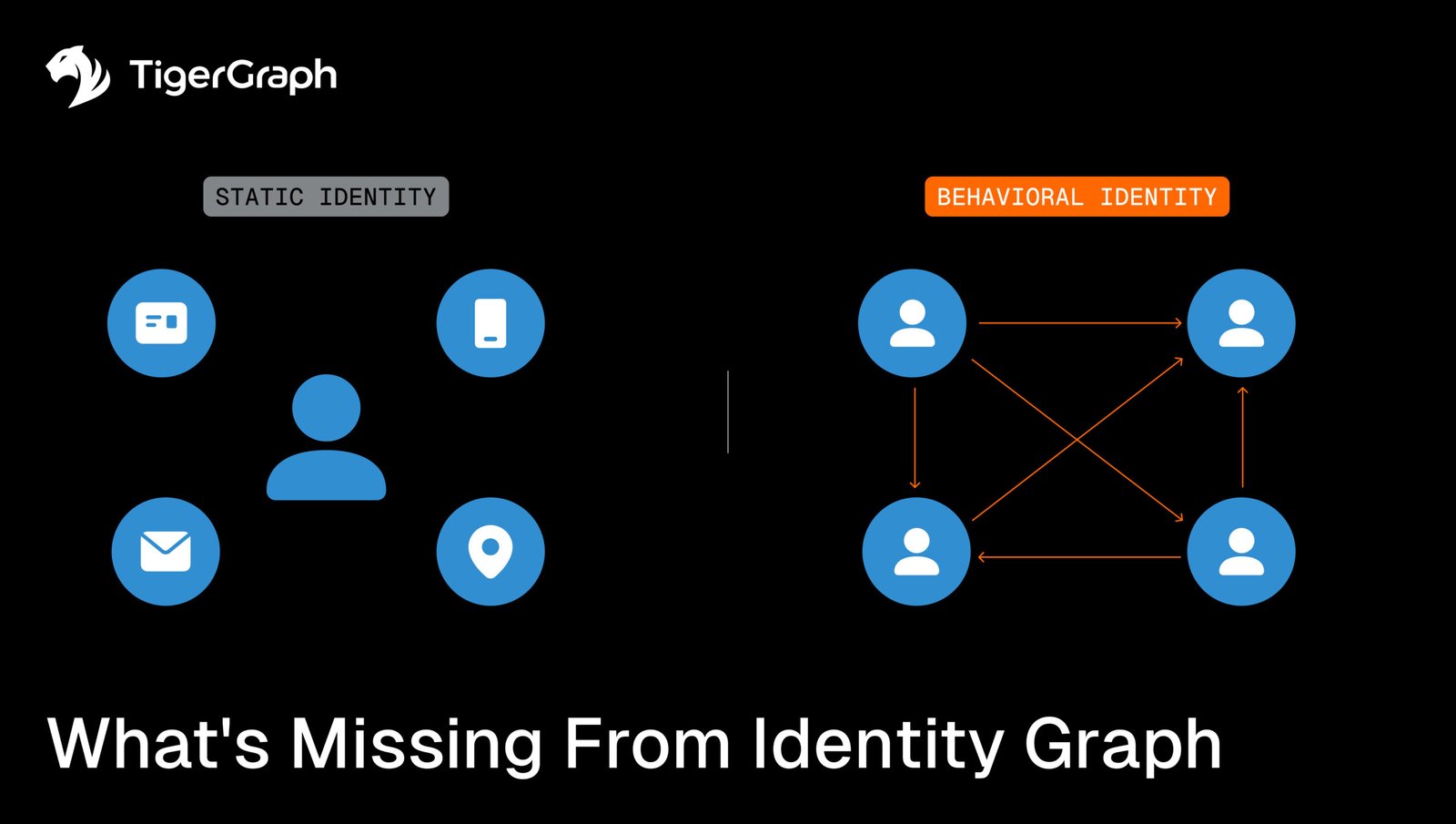
Banks have invested millions into building “identity graphs” that unify customer attributes, including names, addresses, emails, phone numbers, and device IDs, into a single profile. This consolidation was an essential step forward. It allowed institutions to collapse duplicate records, flag synthetic identities built from mismatched data, and reduce onboarding friction for legitimate customers.

But unfortunately, most identity graphs stop there. They unify static attributes, but they don’t capture the dynamic behaviors that reveal fraud as it unfolds. A mule account looks legitimate on paper. A synthetic ID passes the attribute check. A merchant onboarding request matches a plausible business address. The static data isn’t what makes them suspicious; it’s the patterns of activity and connections over time.

Without behavioral linking, an identity graph is essentially a frozen snapshot. It’s useful for cleaning up records, but blind to how fraud actually unfolds. The gaps fraudsters exploit are almost always revealed in movement and relationships:
• Accounts that transact with each other more often than chance would allow.
• Devices that log into multiple, seemingly unrelated profiles.
• Merchants that consistently appear at the center of chargeback clusters.
• IP addresses that bounce between identities in multiple jurisdictions.

These are exactly the blind spots regulators warn about. Without behavioral identity resolution banks remain vulnerable in AML and KYC compliance.

An attribute-only identity graph will miss these because it lacks a memory of when, how often, and with whom entities interact. That means fraud teams end up reacting after the losses, instead of seeing the network form before it strikes.

In short, what’s missing is behavior. And without it, identity resolution stops short of its true purpose—turning static data into living intelligence that can keep pace with fraud in motion.

Why Behavior Matters in Identity Resolution

Behavior isn’t an optional layer on top of identity resolution in banking, but the context that makes an identity graph useful for fraud detection with identity graph methods. Three forces make this especially urgent for top banks today:

  1. Fraud is networked action, not individual states.
    Modern fraud schemes are designed to pass basic attribute checks. A synthetic identity may have a real SSN paired with a fake address; a mule account may look indistinguishable from a legitimate customer profile. What exposes them is the web of interactions:

These patterns are invisible when records are flattened into rows. But they light up in a behavioral identity graph that records the interactions as well as the objects.

  1. Regulators demand explainable context.
    Compliance frameworks like AML, KYC, and FinCEN’s new priorities increasingly require why an account was flagged, not just that it was. Behavioral linking provides this lineage, a critical aspect of behavioral data for AML and KYC audits. Banks can demonstrate, for example:

This creates audit-ready transparency, which regulators expect and which static identity resolution cannot deliver.

  1. Customers demand speed and fairness.
    False positives erode trust and send good customers to competitors. Behavioral linking makes it possible to separate legitimate anomalies from truly suspicious activity.

By adding behavior, banks can approve legitimate activity faster while focusing investigator attention on actual risk. That’s why banks are adopting graph-powered fraud prevention, reducing false positives while improving customer experience.

How TigerGraph Elevates Identity Graphs

While traditional tools flatten data into rows, TigerGraph makes relationships and behavior first-class citizens.

Real-World Example: At one leading digital bank, identity resolution alone wasn’t catching scam networks. By layering in behavioral context, such as device reuse, temporal patterns, and shortest-path proximity to known mule accounts, the bank significantly increased fraud recall, while also cutting false positives. This resulted in millions of monthly losses prevented, faster investigations, and stronger protection for customers—showing the power of behavioral identity resolution at scale. And it was all possible without adding headcount. 

An identity graph without behavior is like a map without roads. You can see the landmarks, but not how they connect or where the traffic is flowing. TigerGraph combines entity resolution with behavioral linking and context, giving banks and other businesses the ability to expose fraud rings, meet compliance demands, and protect customers in real time. 

This is just one example of how graph-powered fraud prevention and dynamic identity resolution strengthen financial crime defenses while improving customer trust.

Ready to see the full picture? TigerGraph can help you build identity intelligence that scales with your business and outpaces fraudsters. Reach out to learn more today.


Contextual Entity Resolution in Banking – Beyond Just Matching 

Every major bank faces one deceptively simple question: Who are we really dealing with? It’s a question that runs through every process in modern banking, from onboarding to fraud detection to AML/KYC compliance—all of which hinge on identity resolution in banking.

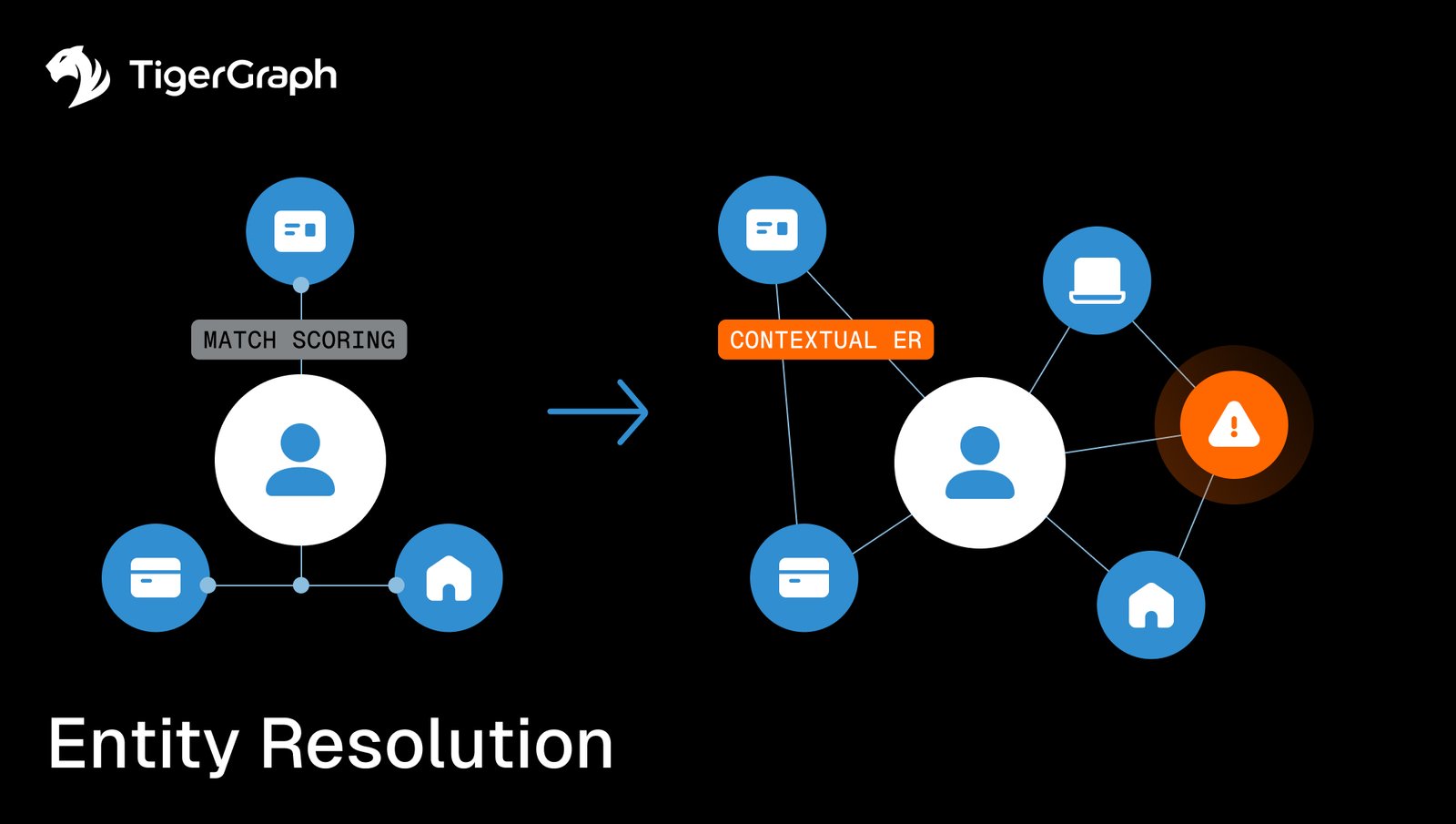
Most institutions rely on match scoring, with similarity checks, substitution rules like ‘Blvd for Boulevard,’ and weighted factors across attributes like names, DOB, and addresses. 

This approach is valuable for cleaning up typos and duplicates, and most banks already do it well. However, it still treats records in isolation, missing the deeper relational context that exposes fraud and enables true compliance. This is why forward-looking banks are turning to identity resolution with context—a shift that captures relationships, not just records.

Contextual Entity Resolution (ER) goes beyond matching records. It improves accuracy by consolidating duplicates, but its greater value comes from revealing the relationships and behaviors connected to each identity. By framing entity resolution as both precise matching and connected context, banks can address compliance requirements and uncover fraud networks that would otherwise remain hidden.

Fraudsters exploit gaps, making synthetic identities look clean on paper and mule accounts mimic legitimate customers. Without context, banks over-flag legitimate activity while missing sophisticated fraud.

As a result, leaders are moving from “matching” to “connecting,” and from static strings to dynamic graph-powered entity resolution that exposes relationships, lineage, and behavior across the enterprise. And because contextual ER considers both identities and their networks of connections, it naturally extends into fraud detection and AML compliance.

What Match Scoring Delivers (and Where It Stops)

Traditional match scoring provides useful hygiene:

  1. Similarity scoring: catches typos (“Jon” vs. “John”).
  2. Substitution scoring: recognizes equivalents (“Mumbai” vs. “Bombay”).
  3. Weighted scoring: aggregates across fields (name, DOB, phone).

Match scoring is necessary, but not sufficient. Regulators now expect a shift from field-level similarity to contextual identity resolution that shows why records belong together.

But its limitations are clear. The most damaging is that records are treated in isolation, which makes it easy for fraudsters to spread attributes across synthetic identities. These gaps blind banks to collusion and hidden risk. False positives and scalability challenges add cost and complexity, but the central issue is lack of context. Taken alone, match scoring’s limitations leave institutions exposed. 

This is where contextual entity resolution comes in.Traditional ER asks a narrow question: “Are these two records the same person?” Contextual ER asks the broader question: “Who and what is this person connected to?” That expanded view captures relationships and behaviors that record matching alone cannot. The result is more accurate resolution, greater scalability, and insights that compliance and fraud teams can act on with confidence.

Why Graph-Powered Entity Resolution Changes the Game

A graph database entity resolution approach shifts the model from comparing fields to mapping relationships. Instead of “Are these two strings close enough?” the question becomes: “How are these entities connected?”

Contextual ER delivers three advantages that legacy scoring cannot. The most critical is compliance lineage: when regulators ask why two records were merged, a graph shows the complete path, including devices, addresses, ownership—that supports the decision. In addition, it consolidates variations of the same customer into one accurate profile, and it exposes fraud networks that converge on shared infrastructure such as IP addresses or merchants.

Contextual Identity Resolution: Practical Benefits

Contextual ER delivers two levels of benefit. First, it makes identity resolution more accurate: duplicate profiles collapse into one true record, false positives decrease so investigators can focus on real risk, and audit-ready transparency provides path-level lineage regulators require.

Second, it strengthens fraud detection by mapping hidden relationships that traditional systems overlook. A graph framework shows when a party is connected to flagged entities or suspicious behaviors, while shared devices, merchants, and addresses expose coordinated fraud networks instead of isolated anomalies.

Match scoring vs. contextual entity resolution

DimensionMatch scoring systemsContextual entity resolution with graph
ContextField-by-field stringsMulti-hop relationships & lineage
AccuracyLimited by variationContextual ER improves match accuracy
Fraud detectionLimited without relationshipsContextual ER exposes fraud networks
AuditabilityScores onlyExplainable paths with evidence
ScalabilityBreaks at scaleSub-sec across millions of events/day


Real-World Impact in Banking of Entity Resolution

Contextual ER delivers impact by linking identities to their broader networks. It reveals the real parties behind synthetic identities and mule accounts, and shows how customers, devices, and merchants are connected. This broader context strengthens fraud detection, AML, and KYC alike.

In practice, contextual ER often appears in fraud or compliance use cases, where context analysis strengthens decision-making even if the core matching is handled elsewhere.

Identity resolution in banking delivers its full potential when powered by contextual graph intelligence.

Recommendations for Executives

An investment in contextual entity resolution delivers measurable compliance, fraud reduction, and ROI. But in most banks, ER, AML, and fraud detection sit under separate teams. To make these recommendations actionable, we preface them by function:

Contextual ER is not just “clean-up.” It is a foundation that strengthens fraud detection and compliance alike. By clarifying benefits for each function, leaders can pursue improvements in their own domains while also laying the groundwork for cross-silo collaboration.

Why TigerGraph Leads in Graph-Powered Identity Resolution

Most banks already run pilots that show graphs can unify customer records. The challenge is making those pilots production-ready at scale. TigerGraph was built for this reality, delivering speed, scale, explainability, and ML integration in ways that other platforms struggle to match:

Performance at enterprise scale: TigerGraph ingests and processes millions of daily events for Tier 1 banks while still responding in 10s of milliseconds on targeted queries. That means fraud detection, KYC onboarding checks, and AML screening can run in real time—even as payments and customer interactions stream in continuously. Unlike table joins or brute-force match scoring, graph queries filter efficiently across billions of relationships, surfacing the strongest matches in milliseconds.

High concurrency for live workloads: In banking, hundreds of analysts, data scientists, and automated systems need to query the same identity graph at once. TigerGraph supports thousands of simultaneous fraud and KYC queries without bottlenecks, ensuring no team is forced to wait for insights. This level of concurrency is what separates research projects from enterprise-ready deployments.

Graph-powered feature factory for ML: TigerGraph doesn’t just unify identities—it continuously generates advanced features like centrality measures of key entities, fan-in/fan-out patterns, and community memberships. These feed directly into AML and fraud models, improving precision and recall. For example, PageRank-derived influence scores can flag mule hubs before transactions settle, while proximity features reveal when a “new” account is only two hops from a known fraud ring.

Explainability and audit readiness: Regulators no longer accept black-box scoring. TigerGraph provides path-level lineage showing who was connected, when, and how. Investigators can export full evidence trails—shared devices, ownership chains, IP reuse—that explain exactly why a customer was flagged. This satisfies AML/KYC compliance requirements and builds trust with auditors and boards.

The result is that graph-powered fraud prevention and behavioral identity resolution are not just theoretical. TigerGraph makes them operational, turning what used to be fragile pilots into always-on infrastructure. 

For banks under pressure from both regulators and fraudsters, that’s the difference between “experimenting with graphs” and using graph as a core identity resolution strategy that reduces losses, speeds onboarding, and delivers measurable ROI.

Match scoring still plays a role in cleaning and standardizing records, but it must be augmented with relationships and behavioral linking. TigerGraph provides that added context, turning partial matches into complete, regulator-ready identity resolution.

Entity Resolution Conclusion

Match scoring is a start, but it’s not enough for fraud detection in banking, AML fraud detection, or customer identity resolution. Only graph-powered entity resolution provides the context that regulators demand, fraudsters can’t evade, and customers expect.

With TigerGraph, banks get the speed, scale, and transparency to unify identity, stop fraud, and satisfy compliance. The result: fewer false positives, faster investigations, and measurable ROI.

Cleaner data. Stronger compliance. Lower risk. Reach out today to learn more and explore TigerGraph Cloud to experience graph-powered identity resolution in action.

Why Matching Scoring Isn’t Enough for Identity in Banking

Identity is the heart of modern banking. Every compliance check, every AML investigation, every onboarding workflow ultimately depends on answering one deceptively simple question: who are we really dealing with? This is the challenge of identity resolution in banking.

And the stakes could not be higher. 

Fail to identify a bad actor, and you risk money laundering, fraud losses, and regulatory penalties. Fail to correctly recognize a legitimate customer, and you frustrate them with false positives, long onboarding times, or unnecessary investigations. Either way, the consequences are financial, reputational, and operational.

But identity data in banks is anything but clean. Names are misspelled. Addresses change. Phone numbers get recycled. Customers appear across multiple lines of business under slightly different profiles. A single “real person” may exist as half a dozen records, none of which tell the full story.

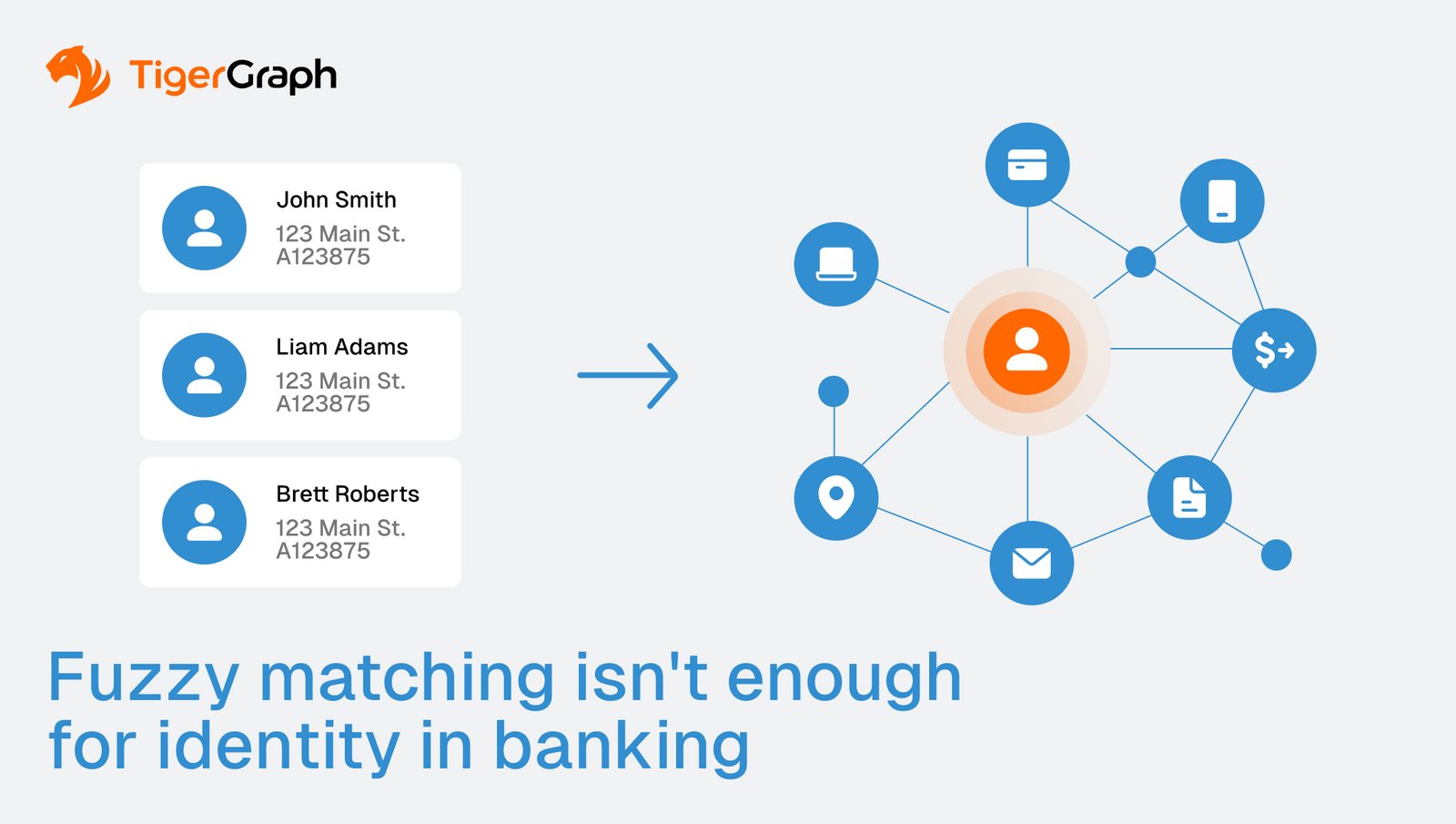
Traditionally, banks have leaned on match scoring to bridge the gaps. This includes similarity scoring (typos, misspellings), substitution scoring (Blvd ↔ Boulevard, Jack ↔ John, Mumbai ↔ Bombay), and weighted scoring of attributes (name, DOB, phone number, address). These methods improve basic data hygiene, but fuzzy matching limitations remain. Even with substitution and weighting, match scoring only looks at fields in isolation and misses the broader relational context that matters for identity resolution in banking.

Where Match Scoring Falls Short

Match scoring is widely used in banking, but its limitations are becoming painfully clear. Its focus on individual fields like names, addresses, and emails ignores the richer relational context of customer identity. And that narrow approach introduces four critical flaws:

  1. Records in isolation.
    Match scoring compares strings field by field, treating them as disconnected entries. But real-world identity spans products, devices, geographies, and counterparties. A customer listed as “Jon Smith” in one system and “John Smythe” in another might not register as a match, even though both connect to the same passport number or mobile device. By ignoring connections, match scoring delivers an incomplete picture.
  2. False positives.
    Similarity scores cut both ways. Two unrelated people with similar names or nearly identical addresses may be flagged as duplicates. Analysts then spend hours investigating matches that go nowhere. The more false positives flood in, the harder it becomes to focus on signals that matter. While match scoring is useful for catching typos and substitutions, its reliance on similarity scores increases false positives in large-scale banking environments.
  3. Missed sophisticated fraud.
    Criminals understand how match scoring works, and they know how to outsmart it by creating synthetic identities designed to look distinct on paper, but which share subtle relational ties. We see the same phone number used across multiple accounts, repeated IP addresses, or overlapping ownership structures.  Match scoring can’t connect those dots, so the fraud slips through. This is why regulators are emphasizing entity resolution for AML and KYC as a discipline that goes beyond match scoring.
  4. Poor scalability.
    As banks operate across more countries, identity data grows exponentially more complex. Different languages, alphabets, and address formats multiply the possibilities for variation. What looks like a simple transliteration error to a human appears as an entirely new customer to a string-matching system. The outcome is either missed matches or an avalanche of false positives that swamp compliance teams. Even advanced match scoring methods struggle to scale across diverse languages and jurisdictions.

Taken together, these flaws leave institutions exposed. Compliance teams waste resources chasing false alarms. Regulators demand precision and auditability that similarity scores alone cannot provide. And bad actors exploit the blind spots, moving money through gaps fuzzy logic was never designed to close.

Why Graph Transforms Entity Resolution

Graph technology changes the field of play by shifting from matching (exact or fuzzy) to connecting relationships. This is the essence of graph-powered identity resolution.

Instead of comparing one record to another in a vacuum, graph builds a connected network of customers, accounts, devices, and transactions. It’s in those relationships that true identity and true risk become visible. 

Consider duplicate customer records. A fuzzy match might hesitate to connect “Jon Smith” and “John Smythe.” But a graph model instantly highlights that both tie back to the same phone number, passport ID, or employer. The relational evidence confirms the match with higher confidence.

Graph also cuts through false positives. Two “Jane Lees” may appear similar in isolation, but if one is connected to Hong Kong retail accounts and the other to London pension assets, with no shared devices or addresses, the graph shows immediately that they are different people. Analysts avoid wasting time on dead-end investigations.

The same principle applies to fraud. Fraudsters often reuse pieces of infrastructure, like addresses, merchants, or devices, across otherwise distinct synthetic identities. 

Graph traversals can follow these shared anchors across multiple hops, exposing the collusion and fraud rings that fuzzy matching misses entirely. Instead of a collection of similarity scores, the investigator sees a network of relationships that tells the full story.

And unlike brittle rules-based systems, graph scales naturally with complexity. 

Whether it’s reconciling names across alphabets, normalizing addresses across jurisdictions, or mapping thousands of accounts to a single high-risk hub, graph models preserve context without breaking. 

TigerGraph, for example, has proven the ability to support billions of transactions per day with queries returning in milliseconds, making enterprise-grade entity resolution not just possible, but practical.

By moving beyond string similarity to relationship-driven resolution, graph delivers what banks need most: fewer false alarms, faster investigations, and greater confidence that they truly know their customers.

Real-World Outcomes of Graph-Powered Entity Resolution

When Tier-1 banks apply graph-powered entity resolution, the results show up across compliance, operations, and risk management.

For CDAOs and VP Data Science leaders, graph elevates entity resolution into a strategic advantage.

Why Now?

The pressure to get identity right has never been greater. Regulators like FinCEN, AMLD in Europe, and FATF globally are demanding more transparency and traceability. They no longer accept “black box” similarity scores; they expect clear evidence trails showing how entities are connected and why alerts are escalated or dismissed.

At the same time, fraudsters are innovating faster than quarterly compliance cycles. They exploit gaps in siloed systems, stitching together synthetic identities, laundering funds across borders, and hiding behind corporate structures that fuzzy matching cannot untangle. Every blind spot is an opportunity for loss.

Meanwhile, customer expectations are rising. Legitimate applicants don’t tolerate delays caused by false positives. If onboarding is slow or intrusive, they walk away, and competitors with smoother digital experiences win the relationship.

That’s why graph-powered entity resolution isn’t a “nice to have.” It’s essential for banks that want to stay ahead of regulators, outpace fraudsters, and meet customer expectations. The institutions that act now will gain cleaner data, stronger compliance, and faster investigations. Those who delay risk higher costs, greater exposure, and mounting regulatory scrutiny. 

Legacy fuzzy matching limitations are no longer acceptable; regulators expect graph-powered identity resolution to underpin explainability.

The question isn’t whether to move beyond fuzzy matching, it’s how quickly.

Cleaner data. Stronger compliance. Lower risk.

Reach out for more info on how to use graph-powered identity resolution to strengthen entity resolution for AML and KYC, reduce fuzzy matching limitations, and accelerate customer identity verification banking. And experience fraud detection with graph analytics in minutes by launching your free TigerGraph instance at tgcloud.io.