Time-Aware Graphs: Solving Temporal Risk in AML
The AML problem isn’t static, and your graph can’t be either.
Money laundering doesn’t follow neat rows in a spreadsheet. It mutates over time. A series of deposits just under reporting thresholds may appear benign until you notice they always occur right before the cutoff windows. Layering schemes weave across accounts and intermediaries, sometimes stretching over weeks. Dormant accounts suddenly reawaken to act as pass-throughs for suspicious flows.
Flat models treat each of these events as isolated. The result is a fragmented picture in which risky behavior looks ordinary, allowing illicit funds to slip through undetected.
Why Flat Models Miss Temporal Risk
Flat models miss the big picture, but more importantly, they miss the dimension of change itself. They score transactions as isolated rows, stripped of sequence and timing.
A $5,000 transfer may appear safe when viewed alone, but if it’s the third hop in a five-step cycle compressed into 36 hours, the story is very different. Without temporal awareness, the model fails to recognize how ordinary activity becomes suspicious when it accelerates, repeats, or aligns with known laundering tactics.
Batch processing makes this worse. Daily or weekly lookbacks create artificial windows that distort the picture.
Short windows overlook the slow-burn schemes that launder money over weeks or months, while long windows introduce too much noise and bury the signals in irrelevant activity. Either way, patterns emerge too late, if at all.
The consequences become clear when regulators demand a timeline. Investigators are expected to explain not only what happened but when and in what order.
Flat systems can’t deliver that directly, so analysts are left to manually stitch together spreadsheets, logs, and case notes to recreate a narrative that should have been visible from the start. It’s slow, error-prone, and undermines regulator confidence in the bank’s monitoring program.
Ultimately, without treating time as a first-class feature of the data model, risk detection is always reactive. Institutions are left responding after suspicious behavior has already occurred, rather than catching laundering rings or structuring bursts in the act.
Making Time First-Class with a Graph
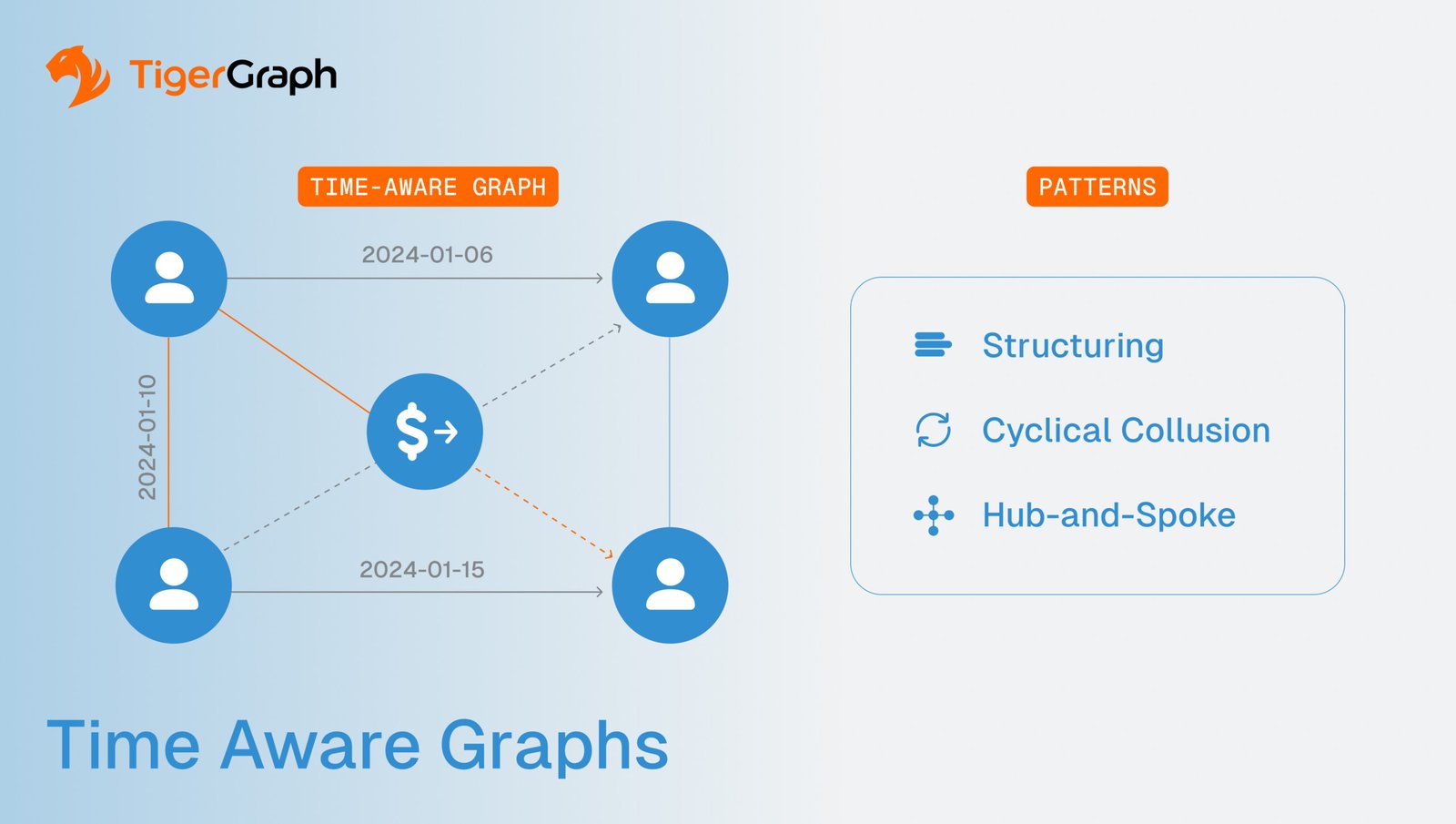
A time-aware graph connects entities through time. Every relationship carries timestamps, validity ranges, and recency markers that allow analysts to see how behavior unfolds. Instead of reassembling events from disconnected tables, teams query a living structure: “show me every transfer between these accounts in the last 48 hours,” or “give me a rolling 14-day view.”
This eliminates guesswork about when a relationship began, how long it persisted, or whether it intensified or decayed. By elevating time to a core property, compliance teams gain the ability to distinguish normal activity from suspicious evolution.
Patterns themselves become reusable features. Rhythmic bursts of small deposits, devices that reappear across seemingly unrelated accounts, or oscillating transaction sizes that repeat with uncanny regularity all stand out as time-based motifs. These patterns are baked directly into the graph model, making them available to both investigators and machine learning models in real time.
Patterns That Become Straightforward in a Time-Aware Graph
When time is embedded in the model, schemes that once took weeks of manual reconstruction become instantly visible.
Structuring, for example, appears as a tightly clustered pattern of sub-threshold deposits right before reporting deadlines. Cyclical collusion between merchants and cardholders shows up as synchronized spend-and-return cycles that repeat over nights or weekends.
Laundering rings that rely on rapid pass-throughs are revealed by hub-and-spoke patterns where short-lived accounts fan out through shared devices or IP addresses before vanishing. Even trust erosion can be quantified: an account that was “clean” last week can suddenly appear just one or two hops from a newly sanctioned entity today. These are exactly the kinds of dynamics regulators expect banks to detect and document, but which flat models consistently miss.
What Changes for the AML Operating Model
Embedding time into graphs sharpens detection and reshapes the daily workflow of AML teams.
Investigations shift from batch-driven lookbacks to continuous monitoring, where risks are surfaced as they form rather than after the fact. Rules are no longer hard-coded to static thresholds but evolve into recurring signals that fire automatically as the graph grows into those shapes.
Explainability also transforms. Instead of piecing together spreadsheets and logs, analysts can pull a complete, timestamped path from the graph in seconds.
Suspicious Activity Reports that once required days of evidence gathering can be drafted with defensible lineage already attached. For compliance leaders, this means faster reporting, fewer backlogs, and a stronger position in regulatory examinations.
How TigerGraph Operationalizes Temporal AML Analytics
TigerGraph makes this conceptual model operational at enterprise scale. Its native traversal engine supports sub-millisecond queries even across multi-hop, time-sensitive paths. This allows analysts to test hypotheses interactively rather than waiting for batch jobs to complete.
High-throughput ingestion keeps pace with the real world, streaming in roughly 50 million events per day, including transactions, sanctions updates, KYC refreshes, and alerts, so the graph always reflects the current state. Each edge is stamped with time properties, meaning investigators can export not just who and what, but also when and in what sequence.
For data scientists, TigerGraph acts as a feature factory. Time-weighted centrality scores, burstiness measures, and “distance to risk within N hours” can all be generated directly from the graph and piped into machine learning pipelines. The result is stronger models, faster investigations, and regulator-ready transparency in a single platform.
Time-aware graphs turn AML monitoring from a reactive process into a proactive safeguard.
With sub-millisecond traversal and ~50M daily events ingested, TigerGraph enables teams to detect not just that suspicious behavior exists, but when it begins to form. The result is fewer false positives, faster SAR preparation, and explainable narratives that withstand regulatory scrutiny. And it happens without requiring banks to rip out and rebuild existing compliance infrastructure.
AML isn’t slowing down, and neither can detection. Time-aware graphs are increasingly being adopted at Tier-1 scale to reduce false positives, accelerate SARs, and deliver regulator-ready transparency. The question isn’t if you’ll adopt temporal intelligence, but rather, how quickly you’ll embed it. TigerGraph is ready to help you start.
How Graph Databases Power AML/KYC in Banking
Compliance is at a breaking point. Anti-Money Laundering (AML) and Know Your Customer (KYC) requirements have never been more demanding. Banks are expected to stop financial crime while maintaining seamless customer experiences, and all under the scrutiny of regulators who demand accuracy, auditability, and explainability.
The challenge isn’t just volume. It’s complexity. Customers span multiple products, jurisdictions, and digital channels. Criminals exploit these layers with synthetic identities, nested ownership structures, and cross-border transactions that look ordinary on their own but form high-risk patterns in combination.
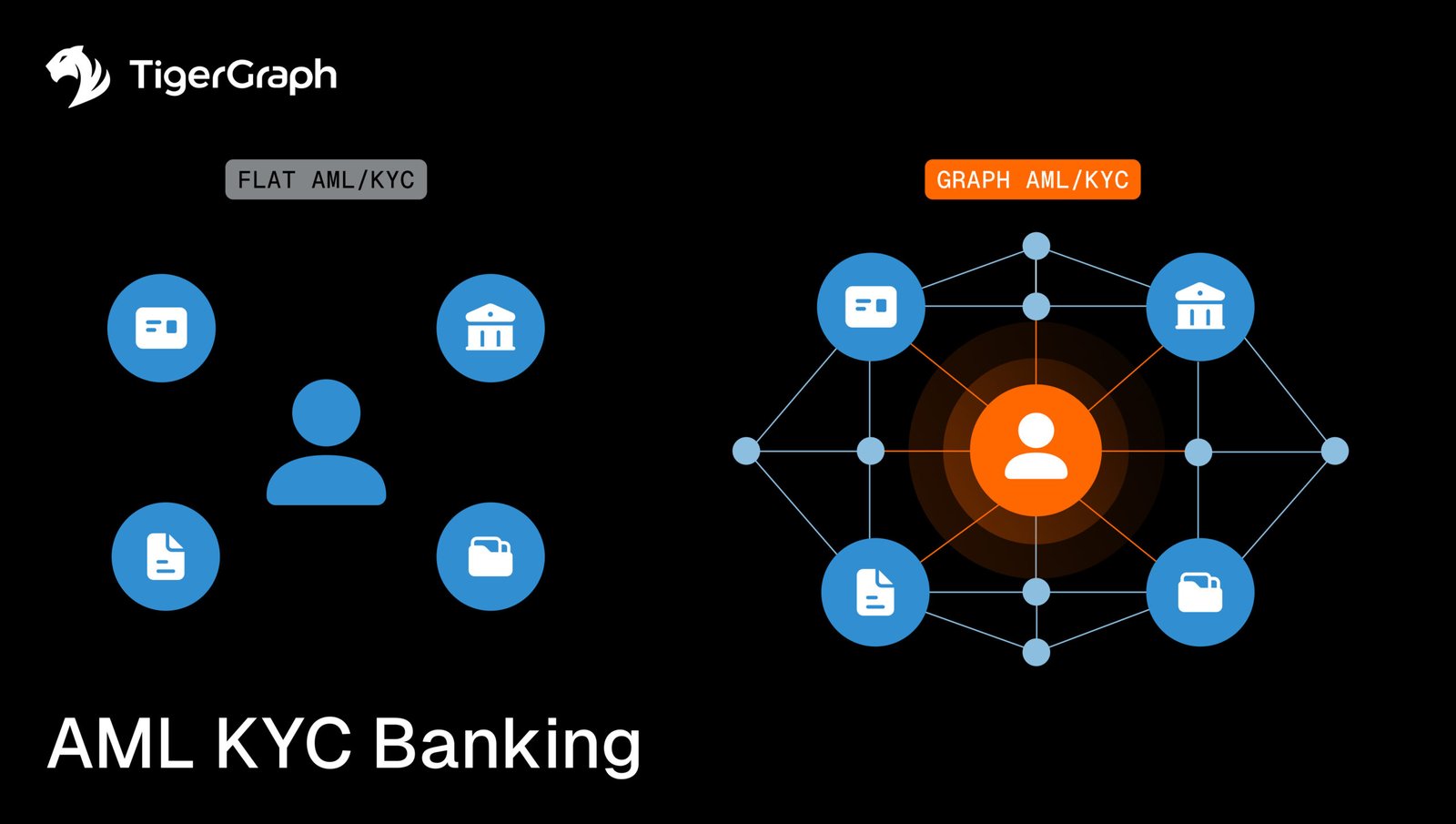
Traditional compliance systems weren’t built for this. Flat models and siloed databases can confirm a customer’s identity at onboarding or flag a large transaction after the fact, but they struggle to capture the relationships that define whether a client or transaction is truly high risk.
Why Flat Models Fall Short in AML/KYC
Traditional AML and KYC systems were designed for a simpler era of banking. Today, their limitations are showing.
Customer data is often siloed across business lines and geographies. A retail banking profile may live in one system, a commercial loan record in another, and wealth management details in a third. These systems rarely align, creating duplicates and blind spots that make it nearly impossible to maintain a true single view of the customer. Criminals exploit these cracks, spreading activity across silos to avoid detection.
Even when data is available, most compliance programs rely heavily on static rules and thresholds. Transfers over $10,000 get flagged, certain countries or industries trigger enhanced due diligence, and so on.
While these rules are necessary, they generate an overwhelming number of false positives that bury compliance teams in alerts. Analysts spend valuable time chasing anomalies that look suspicious in isolation but have no real risk when viewed in context, while more sophisticated, coordinated laundering activity slips under the radar.
Finally, many banks treat KYC as a snapshot exercise: a check at onboarding, followed by occasional refreshes. This static approach ignores how customer behavior and risk profiles change over time.
A client who once appeared low-risk may slowly build ties to higher-risk entities, or a small business may begin engaging in unusual cross-border flows. Without continuous monitoring of connections and context, these shifts go unnoticed until it’s too late.
The result is predictable. Compliance teams remain reactive, regulators remain unsatisfied with shallow audit trails, and bad actors continue to exploit the gaps that flat models can’t see.
How Graph Databases Change the Equation
Graph technology maps relationships. Every customer, transaction, account, and entity becomes part of a connected network that evolves as new data flows in. This shift from isolated rows to living networks gives compliance teams the ability to see beyond surface activity and uncover the patterns that matter most.
For example, fragmented customer identities can finally be unified. With entity resolution, duplicate or related records scattered across different business lines are linked, creating a single, consistent view of each customer and their connections. That unified view makes it much harder for criminals to hide behind duplicate or incomplete records.
Graph also excels at revealing hidden ownership structures. By traversing relationships and detecting patterns across accounts, businesses, and identities, it becomes clear when multiple entities ultimately tie back to the same beneficial owner, even if those links were deliberately buried in layers of intermediaries.
The same connected view applies to money movement. Instead of flagging a single suspicious transfer, graph exposes the entire transaction chain. It shows how funds move through multiple hops in a classic layering and integration strategy. Analysts gain the full picture, not just one piece of it.
Even customer due diligence evolves. Traditional KYC freezes at onboarding, but graph-powered models allow profiles to adapt as activity changes.
Risk ratings stay dynamic, ensuring that shifts in behavior, such as sudden international transfers or new high-risk associations, trigger timely reviews.
Graph also adds explainability to advanced technologies like generative AI. By anchoring AI insights in context-aware retrieval and clear relationship lineage, compliance teams can trust that recommendations are both actionable and auditable. This is, of course, a critical requirement in a regulated environment.
Real-World Results of Graph-Powered AML and KYC
At leading banks, the benefits of graph-powered AML and KYC are already clear. Compliance leaders gain auditability built in, with models that align directly with FinCEN, AML, and KYC regulations. This ensures every decision is transparent and defensible when regulators demand proof.
Analysts also face fewer false positives. Instead of being buried under a flood of threshold-based alerts, they can focus on the relationships that matter most, triaging alerts more quickly and accurately. The result is faster investigations and more time spent on true risk.
Just as important, these gains happen at enterprise scale. TigerGraph has been proven in production to handle more than a billion transactions per day, with queries returning in milliseconds. That level of performance makes real-time AML and KYC not only possible, but practical for the world’s largest banks. And this capacity is well-timed, as the pressure on compliance teams isn’t slowing down.
Regulators expect more transparency, customers demand smoother onboarding, and criminals continue to innovate. Flat systems can’t meet these rising demands. Graph can.
Reach out for more info on how to use graph to strengthen AML/KYC compliance by embedding context, relationships, and adaptability into every compliance decision. And experience graph analytics in minutes by launching your free TigerGraph instance at tgcloud.io.