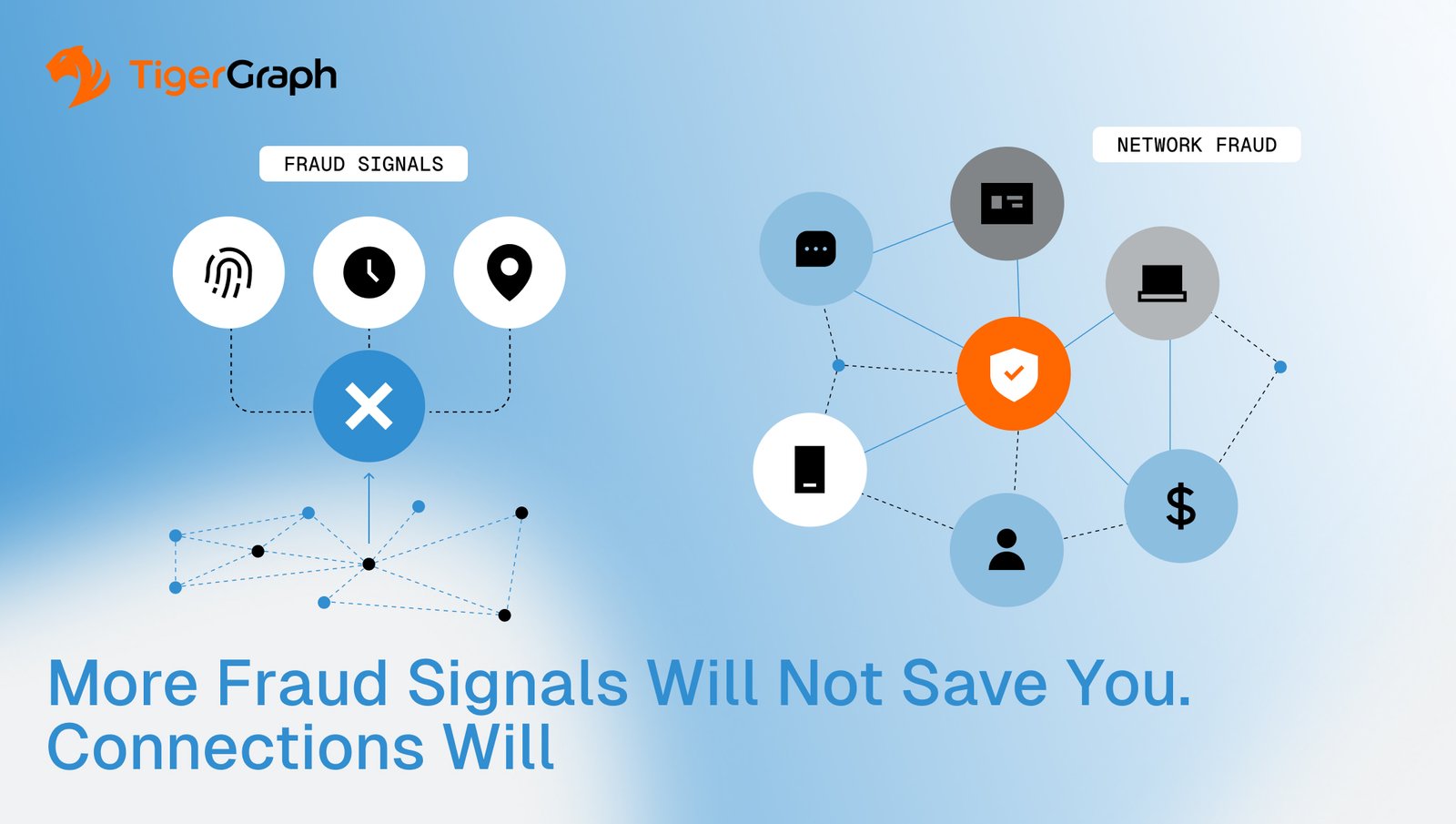
More Fraud Signals Will Not Save You. Connections Will.
Fraud teams today can collect hundreds of behavioral and technical signals during a single verification session.
- Device fingerprints.
- IP reputation.
- Session timing.
- App store attributes.
- Mobile device movement signals.
- Session switching patterns.
Ten years ago, the challenge was signal scarcity. Teams wished they had more visibility. That is no longer the problem. The problem today is signal saturation. Modern fraud systems are overwhelmed because they struggle to understand how that data connects. And that distinction changes everything.
Key Takeaways
- Capturing more signals does not automatically improve fraud detection.
- Stacking isolated signals can increase noise and false positives.
- Synthetic identity and GenAI-driven fraud operate across networks.
- Signals gain meaning when evaluated in relational context.
- Graph analytics enables multi-layer reasoning across entities.
The Fraud Signal Explosion
Verification workflows can now capture over one hundred attributes in a single interaction. These signals fall into several categories:
- Technical attributes such as VPN usage or device configuration
- Behavioral patterns such as mouse movement or session timing
- Derived measures such as account switching frequency
On paper, this looks like progress. More signals should mean more precision. But fraud does not stand still, and as defenses improve, fraudsters adapt.
- Synthetic identities reuse devices across accounts.
- GenAI tools automate realistic behavioral patterns.
- Fraud rings distribute activity across mule networks and shared infrastructure.
As adaptation increases, the value of any single signal decreases. This is where stacking enters the conversation.
When Fraud Signal Stacking Stops Working
Signal stacking combines multiple risk indicators to increase detection confidence. It works well when fraud is isolated and predictable, but it struggles when fraud becomes coordinated.
- A VPN flag alone may not indicate fraud.
- Unusual session timing may not indicate fraud.
- A device reset may not indicate fraud.
Individually, these signals are weak. Even together, within a single session, they may remain ambiguous. The shift happens when those same signals appear across connected accounts, shared IP ranges, and coordinated transaction paths.
Now the pattern changes. The signal is no longer just behavioral. It becomes structural.
Traditional rule engines and flat machine learning models evaluate signals within single sessions or single accounts. Coordinated fraud does not operate within those boundaries. It spreads across them. To understand why stacking fails in these cases, we have to look at how modern fraud actually behaves.
Fraud is a Relationship Problem
Fraud today is relational by design.
- Synthetic identities link to shared devices.
- GenAI-driven attacks reuse infrastructure across campaigns.
- Account takeovers cluster around reused credentials and recovery flows.
The central question shifts. It is no longer, “How many signals are present?” It becomes, “How are these signals connected across entities?”
A device used once tells one story, and a device shared across ten accounts tells another. An IP address appearing in a single session may be noise, but the same IP appearing inside multiple high-risk clusters signals coordinated activity. A newly opened account may look clean, yet the same account indirectly connected to sanctioned entities through ownership chains may carry hidden exposure.
These are network-level insights that require tracing relationship paths rather than counting attributes. That is the transition point from stacking signals to modeling structure.
From Fraud Signal Stacks to Fraud Signal Graphs
The next stage in fraud detection is understanding how they connect.
Graph modeling treats users, accounts, devices, transactions, and IP addresses as connected entities. Their relationships are stored explicitly rather than inferred on demand. This changes what fraud teams can see. They can:
- Identify shared infrastructure across accounts
- Detect tightly connected clusters of coordinated behavior
- Trace indirect exposure across ownership or transaction chains
- Evaluate whether a suspicious session sits inside a larger fraud network
Instead of evaluating signals in isolation, organizations evaluate them in context. So, although a single weak signal may be meaningless, ten weak signals connected across a network may indicate organized activity. That difference often determines whether fraud is detected early or after losses escalate.
This structural perspective becomes even more important as automation accelerates.
GenAI Raises the Stakes
Generative AI has made it easier than ever to imitate real users online. Automated bots can now:
- Replicate natural typing and browsing patterns
- Create synthetic profiles that appear realistic
- Randomize session behavior to avoid simple detection rules
In other words, surface-level signals are easier to manipulate.
Fraudsters can make an individual account look normal. They can make a single session appear legitimate. What they struggle to fake at scale is structure.
When fraud spreads across accounts, devices, and infrastructure, the connections between those entities leave patterns behind. Those patterns are harder to disguise than isolated behaviors. Connections remain even when individual attributes change.
This is why fraud detection must move beyond counting signals. The real advantage comes from understanding how signals relate to one another across a network. Not just what exists, but how it connects.
Structural Advantage in Fraud Defense
Fraud detection maturity is no longer measured by the number of signals captured.
It is measured by how well those signals are connected and analyzed.
Organizations that treat risk indicators as isolated data points face increasing false positives and missed coordinated fraud.
Organizations that model relationships explicitly gain visibility into fraud rings, infrastructure reuse, and indirect exposure before damage spreads.
As fraud becomes more distributed and more automated, relationship-aware detection becomes essential.
This is not about replacing signals. It is about placing them within structure.
Moving Beyond Signal Stacks
Collecting 100+ signals per session is technically impressive, but understanding how those signals connect across millions of users is strategically decisive.
TigerGraph enables fraud teams to model users, devices, sessions, transactions, and infrastructure as a connected graph. By storing relationships explicitly and enabling deep traversal across entities, organizations can detect coordinated fraud patterns that flat rule engines and isolated models miss.
Today’s fraud is a network problem.
Reach out today to learn how TigerGraph supports relationship-aware fraud detection at enterprise scale.
Frequently Asked Questions
1. What is The Difference Between Fraud Signals and Fraud Connections in Detection Systems?
Fraud signals are individual indicators like device or behavior data, while fraud connections reveal how those signals link across accounts, devices, and networks—exposing coordinated activity.
2. Why does Adding More Fraud Signals Often Increase False Positives Instead of Accuracy?
Adding more signals increases false positives because isolated indicators create noise without context, making it harder to distinguish legitimate behavior from coordinated fraud.
3. How do Fraudsters Exploit Isolated Signal-Based Detection Systems?
Fraudsters exploit these systems by spreading activity across multiple accounts and devices, ensuring each individual signal appears normal while the broader pattern remains hidden.
4. How does Relationship-Based Analysis Improve Detection of Coordinated Fraud?
Relationship-based analysis improves detection by connecting entities across multiple layers, revealing shared infrastructure, clusters, and multi-step fraud patterns.
5. What Makes Network-Level Fraud Detection More Effective Than Session-Level Analysis?
Network-level detection is more effective because it evaluates how signals propagate across connected entities, identifying patterns that cannot be seen within a single session.
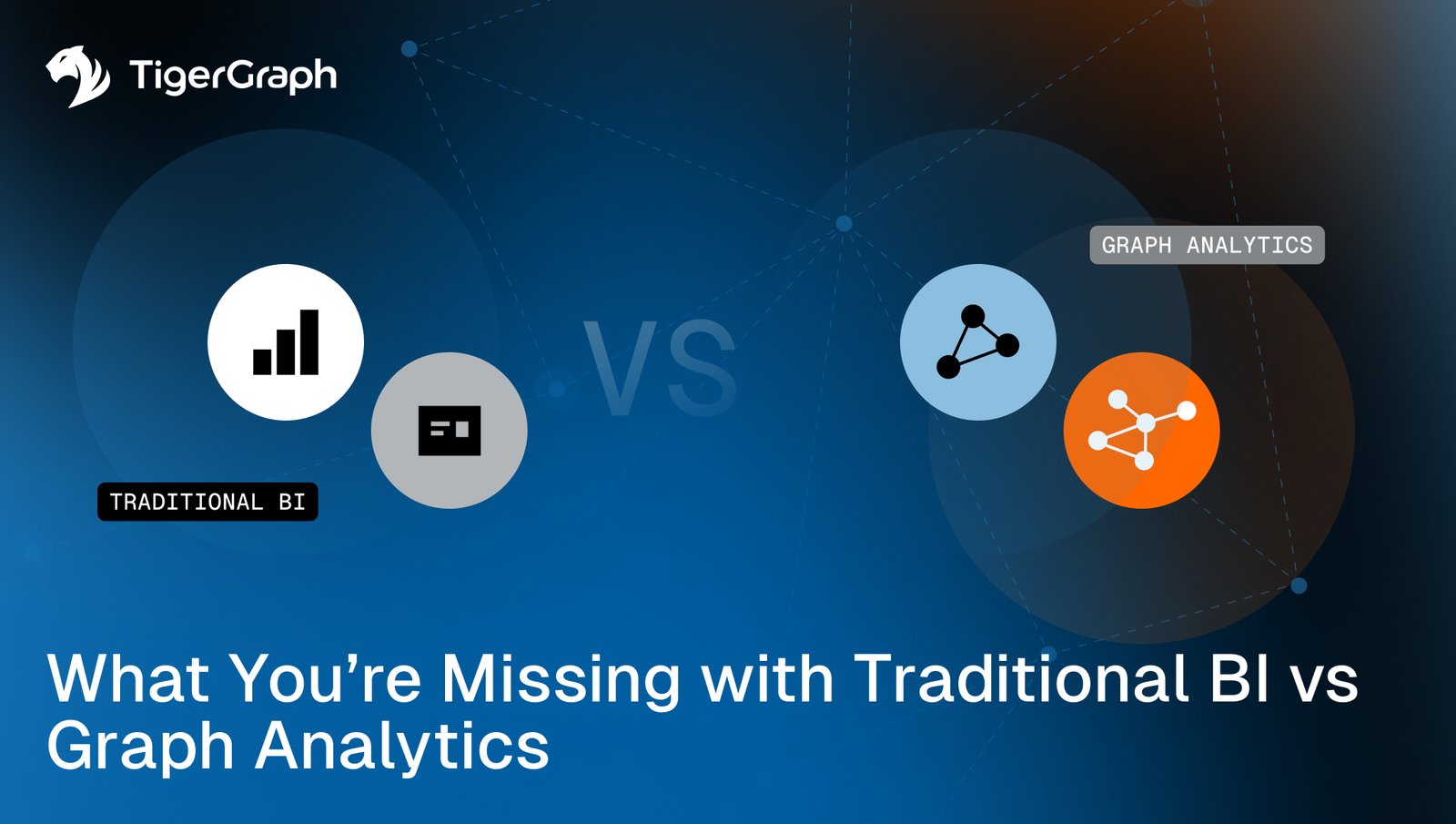
What You’re Missing with Traditional BI vs Graph Analytics
Most organizations feel confident in their data strategy because they have dashboards. The metrics are visible, the KPIs are tracked and trends are updated daily. On the surface, leadership appears to have a clear understanding of what is happening within the business. But dashboards are designed to summarize, not to explain.
Traditional business intelligence systems were built to aggregate, filter, and report. They excel at structured questions: What were sales last quarter? Which region underperformed? How many transactions triggered an alert? These are necessary views of the business. They are foundational.
The problem is that modern business risk and opportunity no longer live inside single domains or simple metrics. They move through relationships. And once relationships deepen, aggregation alone becomes insufficient.
Key Takeaways
- Dashboards summarize metrics. They do not preserve relational structure.
- Traditional BI excels at aggregation but strains under multi-hop, cross-domain questions.
- Join-based models become complex and brittle as relationship depth increases.
- Graph stores relationships directly and enables dynamic traversal across connected entities.
- Structural analysis reveals coordinated behavior, hidden dependencies, and propagation pathways that aggregation alone cannot expose.
- Graph complements BI by adding relational awareness to enterprise analytics.
The Structural Limitation of Traditional BI
Relational BI systems organize data into tables. Rows represent events and columns represent attributes. If you need to connect two entities, you “join” those tables together. That model works efficiently when relationships are shallow and predefined.
The strain begins when insight depends on chains of relationships.
Consider a fraud investigation. A customer is linked to a device. That device is linked to other customers. Maybe one of those customers previously triggered a fraud alert. There are transactions occurring within similar time windows. Each additional layer of context requires another “join.” As these joins stack, the queries grow more complex, harder to maintain, and more computationally expensive.
Technically, the relationships exist. But operationally, they become difficult to explore.
Graph analytics approaches the same problem differently. Instead of reconstructing relationships through repeated joins, it stores those relationships directly and makes them traversable.
What does that mean in practical terms?
It means you can start at one entity, such as a customer, and move step by step across its connections. From that customer to a device. From that device to other customers. From those customers to prior alerts. Each connection is followed dynamically, without rewriting the query logic for every additional layer.
You are not rebuilding the relationship each time you want to examine it. You are walking the network that already exists.
This is not simply a performance optimization. It is a modeling shift, one where relationships are treated as primary data elements rather than inferred connections.
And that shift changes the types of questions that can be asked, because the structure remains intact rather than flattened into summaries.
When Aggregation Flattens Structure
Business intelligence systems aggregate first and drill down second. They compress complex interaction patterns into summary tables so that metrics can be tracked consistently.
Summaries are useful for operational visibility. They are less useful for structural reasoning.
When relationships are flattened into intermediate tables, the original network structure disappears. That structure, sometimes referred to as the system’s topology, represents the full pattern of how entities are connected. Once compressed into summaries, that connection pattern is no longer visible. A fraud ring becomes a set of individual transactions. A referral bottleneck becomes a wait time metric. A supply chain dependency becomes a delayed shipment count.
Graph preserves structure. Instead of collapsing relationships into static views, it allows dynamic exploration. Analysts can begin with a single entity and expand outward across multiple layers, observing how connections propagate.
The difference determines whether patterns are discovered or overlooked. It exposes insight gaps.
Cross-Domain Problems Expose the Gaps
Traditional BI assumes that data is organized by domain. We see finance systems living separately from customer systems, and supply chain data stored elsewhere. Integration requires ETL pipelines and predefined logic about how these systems relate.
Modern business challenges rarely respect those boundaries.
- Fraud spans customers, devices, transactions, and geographic signals.
- Supply chain risk spans vendors, sub-vendors, logistics providers, and regulatory exposure.
- Customer churn spans product usage, support tickets, referral behavior, and marketing touchpoints.
These are interconnected systems. And when organizations attempt to answer network questions using domain-bound reporting tools, they end up stitching together partial views. Each dashboard reflects a perspective, and none captures the full view.
Graph modeling begins with the assumption that entities are connected. When a new data source appears, it becomes another node or relationship type in the network. The underlying structure remains intact and the model evolves without needing to rebuild the analytical foundation.
Let’s see this in action:
A Fraud Scenario: Totals vs. Topology
Imagine a fraud analyst reviewing a spike in transaction volume. A traditional dashboard highlights elevated activity in a particular region. Average transaction values remain within expected ranges, and nothing appears dramatically abnormal.
When the same data is examined through a graph model, though, a different pattern emerges. The transactions form a circular flow across multiple accounts. Several accounts share the same device fingerprint. That device links to multiple shipping addresses that previously appeared in chargeback cases. The timing of activity overlaps across accounts.
The issue is both volume and coordinated structure. BI identifies what changed numerically. Graph reveals how entities are connected operationally. The difference determines whether coordinated fraud is detected early or treated as isolated noise.
A Supply Chain Example: Hidden Dependency
Now consider a retail organization analyzing declining performance across a product category. BI reporting shows lower sales in specific regions and fluctuations in inventory levels.
Graph analysis uncovers that several high-margin products share a common upstream supplier. That supplier connects to a limited set of logistics hubs. A disruption at one hub cascades through multiple product lines, even though each appears independent in the reporting system.
The vulnerability is not obvious in the sales data, but it certainly exists in the dependency network. Without structural modeling, though, leadership responds to surface symptoms rather than underlying fragility.
Capturing this insight starts with a shift in data analysis.
Exploration as a First Principle
Traditional BI usually works the same way every time. You decide what you want to measure, aggregate the data into a report, and then drill into predefined segments if something looks unusual.
Graph flips that sequence. So, instead of starting with a summary, you can start anywhere in the system.
You might begin with a single customer, a supplier, a provider, or even one transaction. From there, you follow the connections outward. Who is this entity linked to? How many others connect through the same path? Does it sit at the center of a dense cluster, or does it bridge two otherwise separate groups?
You are not limited to slices that were defined in advance. You are exploring the structure as it exists.
In traditional systems, doing this kind of deep exploration requires building increasingly complex queries and temporary views just to trace a few layers of connection. In a graph model, following those relationships is a natural operation because the system was designed to move across connections.
As relationships grow deeper and more interconnected, that difference becomes increasingly important. What feels manageable in a shallow dataset becomes unwieldy in a dense, evolving network. Graph is built for that density.
Maintaining Relationship Integrity Over Time
One of the subtler limitations of traditional BI is that each report reflects a chosen perspective. When data is flattened into a summary view, certain relationship paths are highlighted while others disappear. What you see depends on how the report was designed.
Graph preserves the original connection structure. The relationships remain intact, even as the questions change. Instead of rebuilding views each time you want to explore a new angle, you can follow the existing connections in different directions.
As risks and opportunities evolve, the questions change. The structure does not need to be rebuilt each time.
What Organizations Overlook
Graph analytics is not a replacement for business intelligence. Organizations still need dashboards, KPIs, and operational reporting. Aggregation remains essential. What is often missing is structural awareness.
When companies rely solely on BI, they see metrics without understanding how influence or risk propagates across connected entities. They observe symptoms without understanding pathways.
As relationships deepen and cross-domain dependencies expand, traditional reporting frameworks fragment insight into separate views. Graph restores continuity by preserving relationship depth and enabling multi-hop reasoning across systems.
If your data is connected, and in nearly every enterprise it is, your analytics must reflect that connectivity. Connections are not supplemental; they define the system itself.
Contact TigerGraph
If your organization is working to detect coordinated fraud, understand supply chain dependencies, model referral networks, or analyze cross-domain risk, graph analytics can provide structural visibility that traditional reporting cannot.
Contact TigerGraph to explore how connected data modeling can strengthen your analytics strategy and provide deeper insight into how your systems truly operate.
Frequently Asked Questions
1. When Should Organizations Use Graph Analytics Instead of Traditional Business Intelligence Tools?
Organizations should consider graph analytics when insights depend on multi-entity relationships, cross-domain dependencies, or dynamic network behavior. Traditional BI works best for aggregated reporting and predefined metrics, while graph analytics is better suited for exploring how risks, influence, or opportunities propagate across interconnected systems.
2. How does Graph Analytics Improve Root-cause Analysis Compared to Dashboard-based Reporting?
Graph analytics enables teams to trace connections across entities step by step, revealing the pathways that drive business outcomes. Instead of analyzing summarized metrics, organizations can investigate how events, behaviors, or dependencies interact over time, improving diagnostic accuracy and strategic response.
3. Why do Complex Enterprise Risks Require Relationship-driven Analytics?
Modern risks such as fraud, supply chain disruption, and customer churn emerge from interactions across systems rather than isolated metrics. Relationship-driven analytics allows organizations to understand how these risks spread, cluster, or cascade through networks, providing deeper situational awareness than domain-specific reporting tools.
4. Can Graph Analytics be Integrated with Existing BI Platforms and Data Warehouses?
Yes. Graph analytics typically complements existing BI and data warehouse environments by adding relational context to aggregated insights. Organizations often use graph models alongside dashboards to enable network exploration, advanced investigation workflows, and multi-step reasoning that traditional reporting layers cannot support.
5. What Strategic Advantages does Relationship-aware Analytics Provide Executive Decision-makers?
Relationship-aware analytics enables executives to evaluate structural positioning, dependency exposure, and ecosystem dynamics more effectively. By understanding how entities connect across the enterprise, leadership can make more informed decisions about risk mitigation, investment prioritization, and operational strategy.
How Graph Neural Networks (GNN) Outperform Traditional Machine Learning
Traditional machine learning can tell you a lot but not everything, and especially not when the relationships between your data points are where the real intelligence lives. And this is a big problem.
Graph Neural Networks (GNNs) fundamentally change how we think about machine learning by embedding relationships and context directly into the learning process. A graph neural network learns from structure, not just statistics, allowing AI to reason over connected data. When fueled by TigerGraph’s high-performance graph technology, GNNs enable a new class of smarter, more trustworthy AI applications.
This is why context and GNNs matter—and why TigerGraph is the critical foundation for scaling GNN-powered intelligence.
The Tabular Trap: What Traditional Machine Learning Misses
In a conventional machine learning pipeline, data is flattened into rows and columns. Every entity (a person, a transaction, a device) is treated independently. Even when relationships matter, they are often awkwardly “engineered” via feature creation, which is a brittle and manual process.
Not only is it inefficient, it creates blind spots:
- Missed connections between related fraudsters who hide across accounts. These hidden relationships go undetected because traditional models only analyze isolated features—never the paths between them. TigerGraph’s real-time traversal surfaces these hidden paths, exposing coordinated fraud rings and linked account activity.
- Inability to detect collusion across complex supply chains. When multiple suppliers are connected through indirect partnerships, traditional models can’t see the full chain of influence, leading to blind spots. TigerGraph’s multi-hop analysis uncovers these paths in milliseconds.
- Lost opportunities to predict outcomes influenced by network effects, like cyberattacks or social behaviors. Graph analytics allow for multi-hop pathfinding that can surface these hidden influences in real time.
In essence, traditional ML sees dots, not the lines connecting them. It can see the trees, but not the forest. A network graph reveals what flat tables hide: the connections that carry meaning.
GNNs Learn from Relationships
Graph Neural Networks fix this fundamental flaw, as they don’t just analyze isolated features—they learn from the structure of the graph itself:
- Each node (entity) updates its understanding based on the features of its neighbors. This means that when one node in a fraud ring acts suspiciously, connected accounts can also be flagged for further inspection.
- Patterns emerge not just from what an entity is, but who and what it is connected to. By understanding connections, GNNs can surface hidden players in complex networks—something traditional ML misses entirely.
- Like convolutional neural networks (CNNs) for images, GNNs “convolve” across network graphs, making local context central to the learning process. [Convolution is the process where GNNs learn from their neighbors, aggregating information layer by layer to uncover hidden patterns across connected nodes].
GNN is essentially the ability to combine graph theory and deep learning to reason over connected data. This is critical for real-world applications where relationships are the signal:
- In fraud detection, knowing how accounts, devices, and transactions relate reveals hidden risks. For example, GNNs can reveal parties that are part of an orchestrated fraud ring that would be invisible to isolated attribute analysis.
- In cybersecurity, tracing how entities interact can highlight lateral movement and stealth attacks. Multi-hop traversal enables GNNs to detect threatsthat evade traditional monitoring.
- In personalized recommendations, understanding shared interests among friends or peers can dramatically improve targeting. GNNs understand not just individual behavior but community-driven interests.
Leveling Up with Hybrid Graph + Vector Search
TigerGraph’s Hybrid Graph + Vector Search, further extends learning from connections by combining two complementary methods:
- Graph Search surfaces hidden patterns and multi-hop relationships that reveal anomalies, including complex, network-wide irregularities that traditional machine learning models often miss.
- Vector Search identifies similarity across high-dimensional data such as text, images, or behavioral signals. It highlights closely matched patterns and can also flag items that deviate in meaningful ways.
The distinction between anomalies and outliers is critical:
- Outliers: Statistical deviations that may reflect ordinary variation.
- Anomalies: Structurally significant deviations that can expose risks such as coordinated fraud, operational weaknesses or network vulnerabilities.
Hybrid search unifies structural context and semantic similarity. Organizations can retrieve related entities, compare them through vector representations, and investigate issues with more complete context, without implying changes to GNN training workflows.
TigerGraph’s advantage lies in real-time, hybrid querying that brings structural insight and semantic similarity together, helping teams uncover hidden threats and unusual patterns faster than traditional models alone.
Traditional Databases Can’t Handle Multi-Hop Relationships
Traditional SQL databases are optimized for transactional data, which involves individual records linked by foreign keys. To analyze relationships, they rely on joins across multiple tables, which become increasingly slow and costly as the relationships become more complex. For example, tracing a money-laundering path across five banks and dozens of accounts could require nested joins that significantly slow down processing.
NoSQL solutions, while optimized for speed, prioritize document storage over relationships. They do not natively support multi-hop traversals and require complex application logic to reconstruct paths.
TigerGraph is purpose-built for multi-hop queries. Its native graph storage allows edges (relationships) to be traversed directly and instantly, even over billions of nodes.
TigerGraph’s native graph architecture enables GNNs and graph neural networks to traverse these relationships directly, by instantly mapping billions of entities and edges across the enterprise.
The Foundation for Real-World GNN Success
Running GNNs at scale isn’t just about algorithms. It’s about having the right data foundation. And that’s where TigerGraph uniquely excels:
- True Graph-Native Architecture: Stores and traverses connections natively—no costly joins or manual pre-computations required.
- Massive Parallelism: Deep parallel traversal engine enables real-time access to billions of connections, making it feasible to run GNN pipelines over enterprise-sized graphs.
- Rich Feature Engineering: Enables teams to efficiently extract graph features (such as centrality scores, community memberships, or shortest paths), to enrich the features used to train the model, both for GNNs as well as other models.
This is the difference between isolated models and true network graphs capable of continuous learning.
Frequently Asked Questions
1. What is a Graph Neural Network (GNN) and how does it differ from traditional machine learning?
A Graph Neural Network (GNN) is an AI model that learns directly from relationships and connections between data points—not just isolated attributes. Unlike traditional machine learning, which flattens data into rows and columns, GNNs analyze how entities influence one another through multi-hop connections, enabling far more accurate predictions on connected datasets such as fraud, cybersecurity, recommendations, and supply-chain intelligence.
2. Why do traditional machine learning models struggle with connected data?
Traditional ML treats each data point independently, causing it to miss critical patterns hidden in relationships, such as fraud rings, collusion networks, or multi-step cyberattacks. Features must be manually engineered to mimic relationships, which is brittle and incomplete. Traditional SQL/NoSQL databases also cannot handle multi-hop queries efficiently, leading to blind spots that limit real-world accuracy.
3. How do GNNs improve accuracy in fraud detection and cybersecurity?
GNNs analyze how accounts, devices, events, and transactions relate to one another across multiple hops. This allows them to detect structured anomalies such as coordinated fraud, lateral movement in cyberattacks, or hidden influencers in social networks—patterns that traditional ML models overlook because they only examine isolated features instead of full relationship paths.
4. What makes TigerGraph ideal for powering Graph Neural Networks?
TigerGraph is designed for native graph storage and real-time multi-hop traversal, enabling GNNs to reason over billions of nodes and connections at enterprise scale. With massive parallelism, high-speed traversal, and rich graph feature extraction (like centrality, community detection, or shortest paths), TigerGraph provides the foundational data infrastructure required for training high-performing GNN models.
5. What is Hybrid Graph + Vector Search, and why is it important for GNN-powered AI?
Hybrid Graph + Vector Search combines graph search (structural context) with vector search (semantic similarity). This dual approach helps organizations differentiate between simple outliers and meaningful anomalies, revealing hidden risks across fraud networks, supply chains, or user behaviors. TigerGraph’s real-time hybrid querying lets teams retrieve related entities, compare embeddings, and surface threats faster than traditional ML.
6. Can GNNs scale to enterprise-sized datasets with billions of relationships?
Yes—when built on a graph-native platform like TigerGraph. Traditional databases slow dramatically as relationship depth grows, but TigerGraph’s parallel traversal engine enables real-time multi-hop analysis across billions of edges. This makes it possible to run GNN pipelines at full enterprise scale for fraud detection, cyber intelligence, KYC/AML, and recommendation systems.
7. What are the main advantages of using GNNs over traditional machine learning?
GNNs deliver superior performance when relationships drive outcomes, offering:
Higher accuracy via contextual learning
Ability to detect multi-hop patterns traditional ML never sees
More explainable, trustworthy insights
Better detection of anomalies in connected data
Stronger predictions powered by real-world network effects
They essentially turn connected data into a competitive advantage.
8. What real-world problems are best solved with Graph Neural Networks?
GNNs excel anywhere context, influence, and relationships matter. Top use cases include:
Fraud detection and anti-money laundering
Cybersecurity threat detection
Supply chain risk analysis
Identity resolution and entity matching
Recommender systems and customer intelligence
Telecom churn prediction
Healthcare patient-pathway analytics
These scenarios require understanding how entities connect—not just their individual attributes.
9. Do GNNs replace traditional machine learning models?
Not necessarily. GNNs can enhance existing ML pipelines by enriching models with structural features derived from graph data. Many organizations pair GNNs with traditional ML to boost accuracy, reduce false positives, and improve explainability in complex decision systems.
10. How do I start implementing GNNs with TigerGraph?
Organizations typically begin by:
Loading connected data into TigerGraph’s native graph database
Extracting graph features (centrality, communities, embeddings)
Training GNN models using frameworks like PyTorch Geometric or DGL
Running hybrid graph + vector search for real-time inference
Operationalizing GNN intelligence across fraud, risk, or customer workflows
TigerGraph provides the scalable foundation and high-speed traversal required for GNN deployment in production environments.