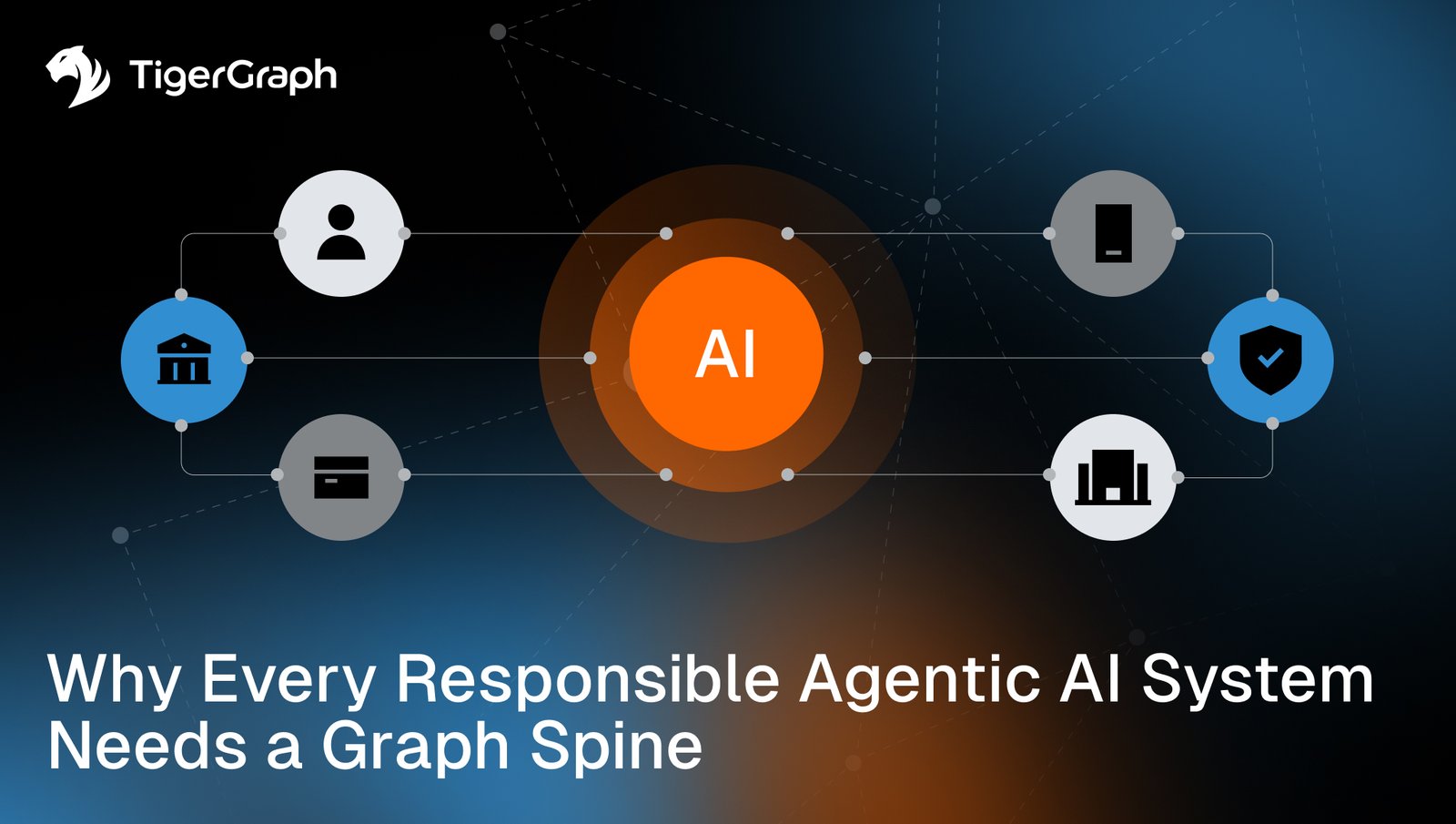
Why Every Responsible Agentic AI System Needs a Graph Spine
Autonomous systems are being asked to do more than generate answers. They are being asked to take action.
When an AI system approves a payment, flags a customer, routes a case, or blocks a transaction, that action must be grounded in context. It must be explainable, follow policy, and respect boundaries. Model accuracy alone is not enough.
A responsible agent needs to understand how people, accounts, devices, transactions, and policies connect to one another. Those connections are what give data meaning. A graph spine provides that connected structure. It organizes entities and their relationships in a way that an AI system can reason over, trace, and enforce.
Without that relational foundation, an agent operates on isolated signals. With it, the agent operates within a connected system.
That difference determines whether autonomy is accountable.
Key Takeaways
- Agentic AI systems require structural context, not just predictive capability.
- Relationships encode constraints, policies, and dependencies.
- Multi-hop reasoning is essential for traceability and explainability.
- Graph-enhanced learning captures network behavior that flat models miss.
- Responsible autonomy must be grounded in validated relational structure.
To understand why this structural foundation matters, it is important to examine where autonomous systems fail.
Autonomy Systems Without Structure is a Risk
Autonomous systems rarely fail because they lack intelligence. They fail because they lack context.
An AI model can be highly accurate in isolation. It can summarize text, generate recommendations, or trigger workflows with impressive speed. But once a system is asked to take action inside a real environment, intelligence alone is not enough. Action requires understanding how things connect.
Connections are what give data meaning.
A transaction is not just a number. It belongs to an account. That account belongs to a customer. That customer may share a device with others. That device may already be associated with prior risk. Policies, thresholds, and constraints sit on top of those relationships.
Enterprise environments are networks:
- Customers connect to accounts
- Accounts connect to transactions
- Transactions connect to devices and geolocations
- Policies connect to entities and risk rules
If an agent is asked to approve, deny, escalate, or automate actions within that environment, it must reason within that network of relationships. Without that structure, it evaluates isolated signals. It sees fragments instead of systems and that is where risk emerges.
A model that cannot reason over validated relationships cannot reliably enforce constraints. It cannot trace consequences across connected entities or explain why one action is safe while another is not.
A responsible system, therefore, requires more than a language model or a scoring function. It requires a structured representation of how entities relate to one another. That structured foundation is a graph.
Understanding why that structure matters requires looking more closely at what “context” actually means in an enterprise environment.
Context is Relational
If autonomy depends on structure, then context must be built from relationships. Context is not just the details of a single record. It is how that record connects to others.
In traditional machine learning, models often evaluate data as individual rows. Each transaction, account, or user is reduced to a list of attributes such as amount, time, location, or risk score. The model analyzes those attributes and produces a prediction.
That approach works for many problems. But it treats each record largely on its own.
A graph-based approach is different. Instead of analyzing records in isolation, it stores entities such as customers, accounts, devices, and transactions as connected nodes. The relationships between them are stored explicitly as links.
Because those connections are encoded directly, the system can evaluate not just a single transaction, but how that transaction sits inside a broader network. If an AI agent evaluates a payment, the first question might be, “Does this transaction look unusual based on its amount or timing?”
But that is only the starting point. A more complete set of questions includes:
- How is this account connected to other accounts?
- Has this device been used across multiple high-risk profiles?
- Is this customer part of a tightly connected group showing coordinated behavior?
These are relational questions. They depend on understanding paths across multiple connected entities, not just one record at a time.
Without a graph spine, an agent sees attributes. With a graph spine, it sees structure. That difference determines whether the system detects isolated anomalies or coordinated patterns across a network.
Traceability Requires Path Awareness
Autonomy without traceability creates risk. When an AI system takes action, an organization must be able to answer simple but critical questions:
- Why was this action taken?
- What information influenced the decision?
- How did the system reach that conclusion?
Those answers cannot rely on vague explanations or probability scores. They require visibility into the chain of relationships that led to the outcome.
A graph stores entities such as customers, accounts, devices, or vendors as nodes. The connections between them are stored as edges. Because those connections are explicit, the system can follow a path from one entity to another and record each step along the way.
In fraud detection, investigators often trace the chain of activity linking a suspicious transaction to related accounts or shared devices. The same capability supports explainability in autonomous systems. An agent operating on a graph can identify:
- The specific entities it examined
- The relationships it followed
- The connected patterns that triggered action
Explainability becomes structural. The system can point to the path it used rather than offering a narrative summary after the fact. Traceability is only one dimension of responsible autonomy. Equally important is the ability to enforce boundaries.
Boundaries and Constraints are Network Problems
Responsible AI must operate within defined boundaries. These boundaries may be regulatory, operational, or ethical. They determine what data can be accessed, which entities can interact, and what actions are permitted. A responsible agent must:
- Respect access controls
- Avoid prohibited relationships
- Detect conflicts of interest
- Enforce policy rules
These are not simple attribute checks. They depend on understanding how entities are connected. For example:
- A payment approval system must confirm that a user is not directly or indirectly connected to a sanctioned entity.
- A healthcare system must ensure that no harmful drug interaction exists across a patient’s full set of medications.
- A supply chain system must detect indirect exposure to restricted vendors through shared suppliers or facilities.
Each of these requires examining connections across multiple linked entities.
A graph makes those connections explicit. It allows the system to follow relationship paths and verify that no restricted link exists. Without that relational structure, the agent evaluates records in isolation and may miss indirect exposure or hidden dependencies.
Learning from Relational Structure
Relational structure is valuable for rules and constraints, and it also improves prediction.
Traditional machine learning models typically evaluate records independently. Each entity is converted into a set of features, and the model predicts based on those features.
Graph-based approaches go further. They incorporate connected context into the learning process. Instead of treating a customer or account as isolated, the model considers how it is linked to others.
In fraud scenarios, this matters because risky behavior often spreads across networks. Suspicious accounts may share devices, addresses, or transaction paths. When a model learns from those patterns, it can detect coordinated activity that isolated analysis would miss.
Agentic systems benefit from the same principle. If an agent is tasked with identifying emerging risks or recommending actions, it must recognize patterns that span connected entities, not just within individual records.
A graph-based foundation allows learning and reasoning to reflect how real systems operate: through relationships. Taken together, these capabilities define the role of the graph within an autonomous system.
The Graph Spine
At its core, a graph spine is the structural backbone of an AI system. It is not a dashboard or a visualization tool. It is the underlying model that defines:
- Which entities exist
- How they connect
- What relationships are valid
- How paths can be traversed
This foundation supports:
- Context-aware reasoning
- Clear traceability
- Enforceable policy boundaries
- Relationship-aware learning
Autonomous systems increase both efficiency and exposure. When they operate on disconnected fragments of data, they inherit fragmentation. When they operate on connected structure, they inherit context.
Responsible agentic AI is not achieved by adding controls after deployment. It begins with grounding autonomy in validated relationships from the start. Connections are not optional. They define how the system understands the world it acts within.
Autonomous AI systems depend on connected structure. TigerGraph provides the distributed graph foundation that enables explainable, policy-aware, relationship-driven decision making at scale.
Reach out today to discover how a graph spine can support responsible agentic AI across your enterprise.
Frequently Asked Questions
1. What is A Graph Spine and Why is it Critical for Responsible Autonomous Systems?
A graph spine is a structured data layer that stores entities and their relationships, enabling systems to reason over connected information and make context-aware, accountable decisions.
2. Why can’t Large Language Models Provide Sufficient Context for Enterprise Decision-Making On Their Own?
Large language models generate responses from text patterns but do not enforce validated relationships, making them insufficient for decisions that depend on connected, real-world data.
3. How does a Graph Improve Explainability and Traceability in Automated Decisions?
A graph improves explainability by storing relationships explicitly, allowing systems to trace the exact connection paths that influenced a decision and making outcomes transparent and auditable.
4. Is a Graph Spine Only Necessary for Fraud Detection and Risk Use Cases?
No, any domain where outcomes depend on how entities connect—such as supply chain, healthcare, cybersecurity, and compliance—benefits from a graph-based relational foundation.
5. How does Graph-Based Learning Differ From Traditional Machine Learning in Connected Systems?
Graph-based learning incorporates how entities connect across a network, enabling detection of patterns and dependencies that traditional models miss when evaluating records in isolation.
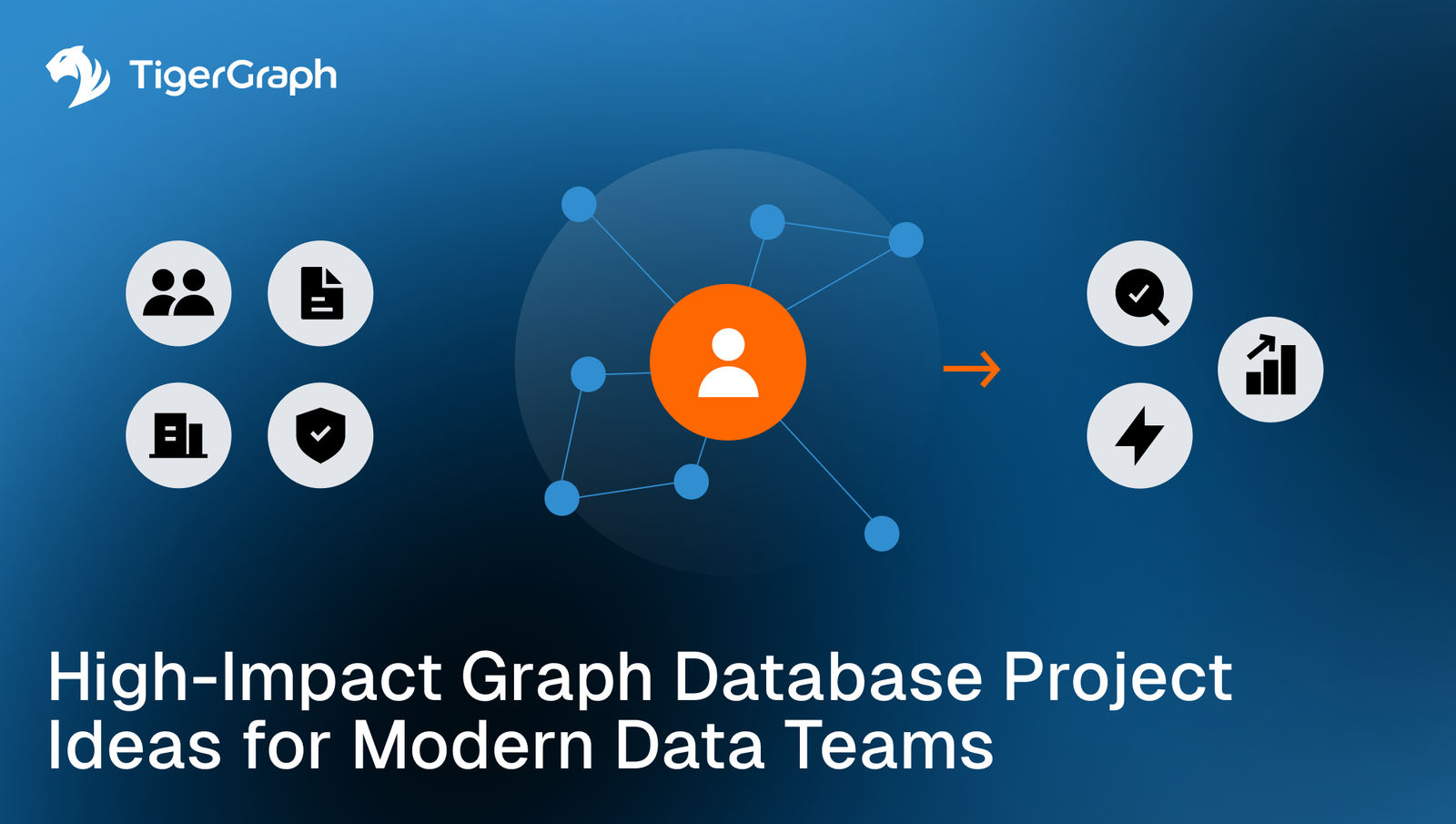
High-Impact Graph Database Project Ideas for Modern Data Teams
Modern data teams do not need more abstract diagrams or theoretical exercises. They need graph projects that help them understand what is really happening inside their systems.
When a graph is modeled cleanly, the relationships stop being guesswork and start acting like a diagnostic instrument. Suddenly, the behavior, risks, and dependencies are visible. And once you can see the structure, questions that relational systems were never designed to answer become straightforward.
What follows are graph project ideas that strike that balance. They’re approachable enough to build, substantial enough to matter, and aligned with multi-hop reasoning in real time.
Why Graph Ideas for Project Planning Matter?
The most successful graph initiatives begin with clarity, not with a massive dataset. The central question is always the same: what are we trying to understand?
When the model reflects that intent, graphs reveal the forces shaping a system. We can see customer behavior, process delays, identity overlap and supplier exposure. Relational tables can store facts, but graphs explain the connections that make those facts meaningful.
Teams that shift to connected insight can now see cause and effect instead of scattered facts. They surface root causes faster and make sharper predictions. Decision paths become explainable instead of mysterious and operational blind spots shrink with a structure that is visible.
TigerGraph works well here because it treats relationships as real data. They don’t have to be reassembled by the system on demand.
Instead of rebuilding connections through layers of joins, the platform stores edges directly and evaluates multi-hop paths as part of its native execution model. The graph can follow real structure in real time, which is exactly what these projects depend on.
The graph structure is consistent across queries, workloads and client applications. Developers and analysts rely on the same vertex and edge definitions. They’re no longer interpreting relationships ad hoc. That consistency reduces the modeling drift that usually creeps into long-running projects and keeps graph behavior aligned with the actual business logic.
With this foundation, graph projects move from “interesting prototype” to “we actually rely on this” much faster.
Beginner-Friendly Knowledge Graph Project Ideas
These early projects help new practitioners understand how nodes, edges, direction, cardinality, and traversal behave. The schemas are simple, with one or two node types and edge types. For example,
Person -[can]-> Skill
is a relationship between a Person node and a Skill node. They’re simple on purpose, but they lay the groundwork for the larger enterprise models that come later.
Building a Skills Knowledge Graph
Skills modeling is one of the easiest ways to understand why graphs matter. The relationships already exist in your mind: people learn skills, skills map to roles, roles require training, and courses teach skills. A graph simply makes that structure explicit.
Once the model is in place, you can trace development pathways, map experience patterns, and prototype matching or recommendation logic with very little effort. It’s usually the point where beginners realize they’re no longer looking at a list, but an ecosystem.
Modeling a Social or Community Network
Social graphs produce insight faster than almost any other beginner project. A handful of “follows” or “friend” edges, and patterns start revealing themselves. There are clusters you didn’t expect, influence paths you didn’t plan and weak ties that never show up in a table.
Because directionality, neighborhoods, and many-to-many relationships all matter, this is often the first time people understand why graphs outperform relational systems for connected data. The “aha” moment happens pretty quickly.
Workflow & State Transition Graphs
Every organization has a process that looks orderly on paper and behaves nothing like that in practice. Modeling workflows as graphs makes this visible.
Suddenly, the slow stages become obvious, and the places where work dies in a queue no longer require guessing. It is one of the cleanest ways to show executives why a graph is not just another visualization tool. Graph becomes a mirror of how the organization actually operates.
Enterprise Projects That Demonstrate Real Value
Once the fundamentals are in place, more complex models start to resemble actual enterprise problems. These require multi-hop reasoning, schema discipline, and the ability to evaluate structure at scale.
Fraud, Risk, and Transaction Networks
Fraud is rarely about a single transaction. It emerges in the relationships. One device tied to several different accounts, transfers that form a pattern only when seen together or merchants that reappear in irregular paths.
Graph modeling captures this structure directly, with customers, devices, accounts, and merchants connected in ways a relational model cannot express. TigerGraph evaluates these relationships in parallel, making it significantly easier to detect risk patterns early.
Supply Chain Dependency Mapping
Supply chains fail in the quiet places, like the second-tier supplier no one tracked, the shared facility that creates an unexpected bottleneck or the component dependency hidden three hops upstream. A graph brings those connections into view.
Once modeled, the hidden exposure and potential points of failure become uncomfortably clear. Production planning and scenario modeling both improve because the structure is no longer a mystery.
Identity and Access Relationship Graph
Identity data is scattered across most enterprises. It is contained in different systems, with different identifiers, conflicting attributes and partial profiles.
Graph modeling resolves this by showing how accounts, behaviors, attributes, and roles connect. Duplicate profiles, misuse patterns, and access anomalies become visible without relying on fragile rules.
It’s a natural extension of Customer 360 and one of the most useful applications of multi-hop reasoning.
Workflow Bottleneck Detection and Optimization
At scale, workflows stop behaving politely, and escalation paths loop.
Tasks bounce around. People route things in ways the process diagram never predicted. A ticket gets escalated, sent down again for more information, escalated again to someone different, and then kicked back to where it started. That circular motion is a loop, and it hides perfectly inside spreadsheets and dashboards.
Ticket queues are similar. They develop patterns, ping-ponging between teams, stalling at one handoff, dying completely in a certain state. And none of that shows up when all you can see is timestamps and status codes.
Approval chains are even worse. Something gets “sent for approval,” denied, edited, resubmitted, denied again, forwarded sideways, and eventually approved by someone who wasn’t even in the original chain. No table will ever show that structural mess.
A graph transforms a state into a node and a handoff into an edge. Each cycle becomes a visible pattern.
With a defined structure, you know exactly where things happen. It reveals where work slows and where it loops. And this, in turn, reveals where you’re losing time. It enables organizations to fix what they can now see, instead of guessing where the problem might be.
Multi-Domain Knowledge Graph
When information sprawls across teams, formats, or continents a knowledge graph becomes the connective tissue that makes the whole picture coherent.
Documents, topics, people, entities, and events form a model that supports enterprise search, contextual AI and cross-domain exploration. I’s a great example of how a graph becomes more valuable the more you add to it.
Table: Project Types and Their Goals
| Project Type | Skill Level | Primary Goal | Best For |
|---|---|---|---|
| Skills Graph | Beginner | Build recommendations | HR, Education |
| Social Graph | Beginner | Explore communities | Apps, Gaming |
| Workflow Graph | Beginner | Map processes | Operations |
| Fraud Graph | Enterprise | Detect multi-hop risk | Banking, FinTech |
| Supplier Graph | Enterprise | Map dependencies | Manufacturing |
| Identity Graph | Enterprise | Unify entities | Healthcare, Finance |
| Knowledge Graph | All Levels | Contextual search | Enterprise Search |
Why TigerGraph Strengthens Every Project?
TigerGraph is built for real reasoning, not simulated joins. Its engine evaluates multi-hop paths and scales without losing structural clarity.
Solution kits and tooling shorten the path from idea to prototype, and from prototype to something that actually runs. TigerGraph gives modern teams the speed, scale, and clarity required to build graph systems that work under real workloads.
Ready to move from exploration to execution?
Explore the platform or speak with our team to identify the right next steps for your graph project ideas and enterprise use cases.
Summary
Good graph ideas for project work turn relationship problems into insight. Beginner projects teach the fundamentals. Enterprise models uncover patterns that relational systems can’t see. TigerGraph supports both, with a graph engine built for connected data, real-time reasoning, and scale.
Frequently Asked Questions
1. What Problem Should a Graph Database Project Solve?
A graph database project should answer questions that depend on relationships, paths, or dependencies between entities rather than isolated records.
2. When does it Make Sense to use a Graph Instead of Tables?
A graph makes sense when understanding connections, multi-step interactions, or cascading effects is more important than reporting on individual rows.
3. Do Graph Projects Require Large or Complex Datasets?
No. Graph insight comes from structure and relationships, not data volume. Even small datasets can produce valuable results when modeled correctly.
4. What Determines Whether a Graph Project Succeeds?
Success depends on clear domain modeling, stable relationship definitions, and traversal logic that reflects real-world behavior.
5. Why do Graph Projects Scale Well to Real Systems?
Graph projects scale because relationships are stored and evaluated directly, allowing systems to reason over growing complexity without rebuilding connections at query time.