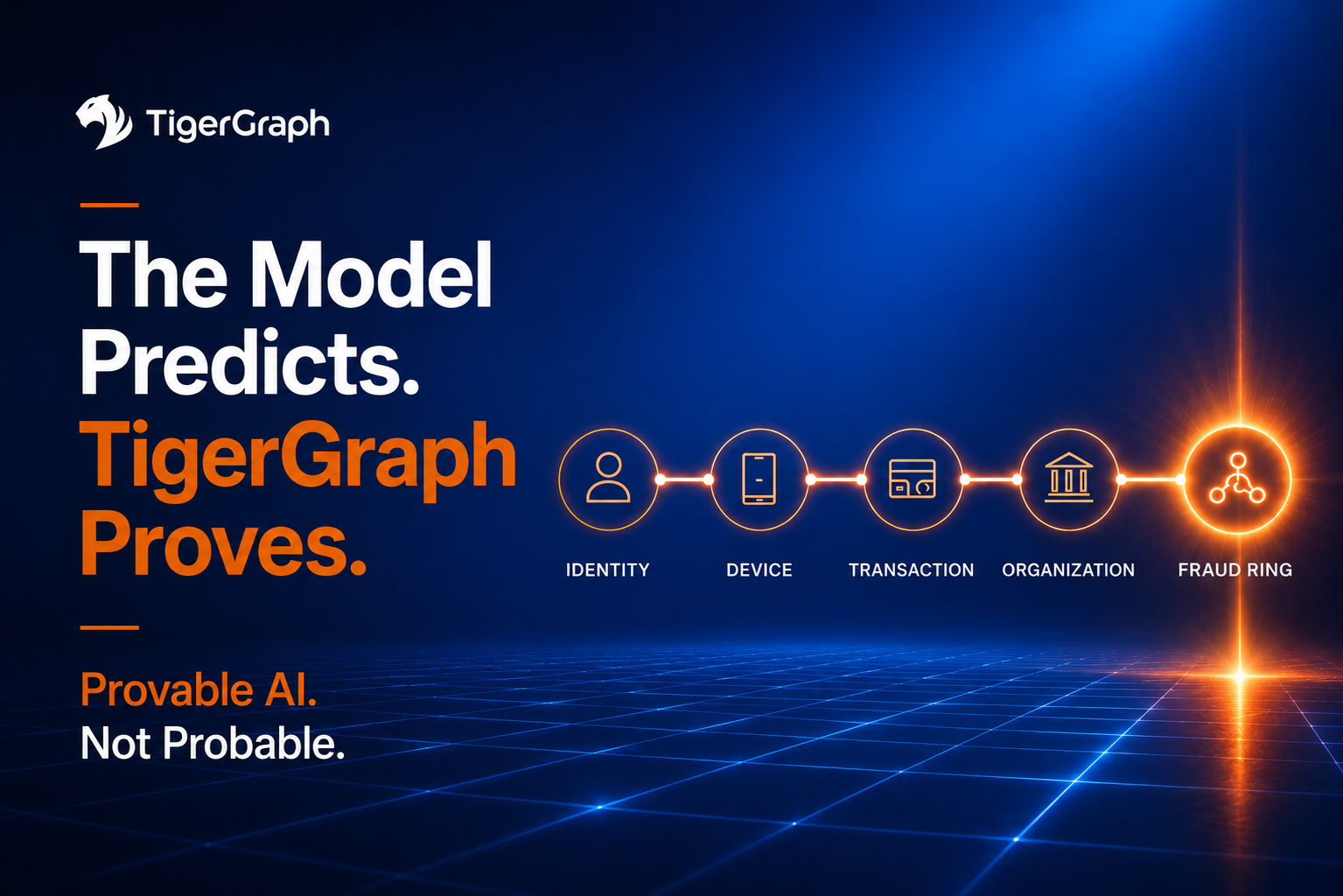
The Model Predicts. TigerGraph Proves.
AI Has a Confidence Problem. The AI industry talks constantly about intelligence. Very little about proof. That imbalance is becoming more dangerous as AI systems move closer to operational decision-making.
Because enterprise systems do not fail when answers sound uncertain. They fail when answers sound convincing without being verifiable. That is the real tension underneath the current AI cycle. The models became remarkably good at generating language. The systems surrounding them did not become equally good at preserving truth.
That imbalance is now becoming one of the defining architecture problems inside enterprise AI. Most enterprises still believe the competitive advantage will come from: bigger models, more agents, larger context windows, and faster generation.
That may define the current AI cycle. It will not define the next one. Because eventually every enterprise discovers the same thing: confidence scales faster than proof.
The Industry Optimized for Generation Before It Solved Verification
The current AI stack is exceptionally good at generating plausible answers.
- Retrieve information
- Assemble context
- Generate output
At small scale, this feels remarkably effective. But enterprise systems do not operate at small scale. They operate across: identities, transactions, workflows, organizations, decisions, and time. That is where the instability begins appearing. Because most AI systems today reconstruct understanding dynamically every time they reason. The outputs still sound intelligent. The reasoning underneath them becomes increasingly difficult to reproduce consistently.
Nothing fully breaks.
The system simply becomes harder to prove. That is the hidden weakness underneath much of enterprise AI right now: the systems generate confidence faster than they generate verification. And once AI systems begin chaining decisions together through agents, workflows, approvals, and autonomous reasoning, the verification gap compounds faster than most architectures can contain.
Retrieval Finds Proximity. Relationships Preserve Truth.
The modern AI stack increasingly behaves as if retrieval and understanding are interchangeable. They are not. McKinsey described the distinction directly: “Retrieval finds proximity. It does not create understanding. Understanding emerges from relationships.” That distinction quietly exposes the weakness underneath much of the current AI stack. Retrieval assembles fragments. Relationships preserve meaning. Reality itself is relational.
Fraud only makes sense in the context of connected entities. Identity only becomes meaningful across linked behaviors. Risk only emerges through patterns across accounts, devices, organizations, and time.
But most AI systems flatten those relationships into temporary retrieval events and ask models to reconstruct understanding afterward. That reconstruction process becomes unstable at enterprise scale. Because the AI is no longer reasoning over connected reality. It is reasoning over probabilistic approximations of reality assembled dynamically at query time. That distinction becomes increasingly dangerous once AI systems begin influencing operational decisions instead of informational ones.
Because enterprises do not merely need plausible reasoning. They need provable reasoning.
Synthetic Intelligence Scales Faster Than Verification
One of the more revealing observations in the broader AI slop discussion is how quickly synthetic systems scale once verification becomes optional. RMIT’s Information Integrity Hub framed the issue bluntly: synthetic content is becoming cheaper than truth.
That same pattern is beginning to emerge inside enterprise AI systems. Generated reasoning scales easily. Provable reasoning is much harder. That imbalance becomes structural once organizations begin deploying AI into operational workflows. Because synthetic reasoning compounds. Verification does not.
And once organizations begin chaining AI systems together through agents, workflows, and autonomous actions, the verification gap expands faster than most architectures can contain. This is where the economics of enterprise AI begin changing. The bottleneck is no longer generation. The bottleneck becomes provability.
Not: “Can the AI produce an answer?” But: “Can the organization defend how the answer was produced?” That becomes a fundamentally different infrastructure requirement.
Provability Becomes the Moat
The AI industry still treats the model as the center of the system. Increasingly, the model is only one layer. The harder problem is preserving connected understanding as systems reason across entities, workflows, agents, decisions, and time. That requires something most AI stacks still struggle to preserve: relationships. Because proof does not emerge from isolated outputs. Proof emerges when reasoning remains connected to the structure underneath reality itself. This is where TigerGraph operates differently.
TigerGraph keeps relationships structurally intact while AI systems reason. The context does not need to be reconstructed every time the system operates. The structure already exists underneath the decision itself. That changes the behavior of the entire system. Reasoning paths remain traceable. Operational context remains connected. Decisions remain explainable across workflows and time. The AI stops approximating understanding. It starts preserving it.
That distinction becomes increasingly strategic as model intelligence commoditizes. Because eventually every enterprise reaches the same realization: the competitive advantage is not the model alone. The advantage is whether the enterprise can preserve trust while the AI scales.
The Future Enterprise Stack Will Be Built Around Proof
The first phase of enterprise AI optimized for generation. The next phase will optimize for provability. That changes the architecture conversation entirely. The winning systems will not simply generate more outputs faster. They will preserve connected understanding structurally as reasoning compounds across: identities, decisions, transactions, workflows, agents, and time.
This is where relationship-preserving architectures become foundational instead of optional. Because relationships are not supplementary context. They are the structure underneath operational reality itself. And once enterprises begin deploying AI into: fraud operations, identity systems, compliance workflows, customer operations, and autonomous reasoning systems, the ability to prove why a decision was reached becomes as important as the decision itself.
That is the next AI moat emerging underneath enterprise infrastructure now. Not generation. Provability.
The Next AI Race Will Not Be About Models
The first phase of AI optimized for generation. The next phase will optimize for provability. Because eventually every enterprise reaches the same realization: a system that cannot preserve connected understanding eventually becomes impossible to trust operationally. No matter how intelligent the outputs sound.
The model predicts. TigerGraph proves.
The Enterprise AI Stack Has a Trust Problem
The Models Improved. Trust Did Not.
The AI industry keeps measuring progress in capability.
- Better models
- Better reasoning
- More agents
- More automation
- Longer context windows
- More autonomous workflows
Every benchmark keeps improving. But underneath all of it, something else is happening. Trust is eroding. Not publicly. Structurally. The most dangerous systems are the ones that still sound intelligent while becoming operationally unverifiable. Yahoo Finance highlighted Palantir executives repeatedly warning about AI systems producing outputs disconnected from operational truth. Most organizations still interpret this as a hallucination issue.
It is not.
Hallucinations are visible. The deeper problem is when enterprises can no longer consistently explain: why a system reached a conclusion, how a decision was produced, or whether the reasoning can be reproduced reliably across time. That is not a content problem. It is an operational trust problem. And most enterprises are much earlier in this transition than they realize.
Enterprise AI Quietly Became Unverifiable Infrastructure
Traditional enterprise infrastructure was designed around reproducibility. A fraud decision could be traced. A compliance workflow could be audited. A policy decision could be reproduced. The reasoning path remained visible. AI changed that architecture.
Systems stopped executing deterministic logic and started generating probabilistic interpretations. At first, the tradeoff looked rational. The systems moved faster. Automation expanded. Outputs became more sophisticated.
But the operational consequences of probabilistic reasoning scale differently than most organizations expected.
Because once AI systems begin influencing: fraud operations, compliance decisions, customer workflows, operational approvals, and autonomous actions, the inability to consistently reproduce reasoning becomes an enterprise risk.
Not because the AI stops functioning. Because the organization slowly loses confidence in how the system is functioning.
That distinction matters enormously. Traditional software fails visibly. Enterprise AI often fails organizationally first. The workflows continue running. The outputs continue sounding intelligent. But operational trust underneath the system starts weakening.
The Enterprise Trust Gap Appears Quietly
Most enterprises already feel this shift. They simply lack the architecture language to describe it clearly. Teams know: outputs are becoming harder to verify, reasoning paths are becoming harder to reproduce, and AI systems are becoming more difficult to audit consistently.
But most organizations still frame the issue as: hallucinations, prompt engineering, model quality, or insufficient fine-tuning.
Those are symptoms.
The deeper issue is structural. The architecture itself no longer preserves operational trust automatically. That creates a new category of enterprise instability. One team receives one AI recommendation. Another team receives a different interpretation. One agent executes a workflow one way. Another agent interprets the same operational context differently.
Nothing fully breaks.
The instability accumulates underneath the surface. That is what makes the problem difficult to detect early. Because the systems still appear coherent locally while becoming increasingly difficult to govern globally.
Generated Reasoning Scales Faster Than Governance
One of the least discussed consequences of enterprise AI is that generated reasoning scales faster than organizational governance. That imbalance compounds quietly.
A single AI-assisted workflow is manageable. Thousands of interconnected AI decisions operating across: systems, agents, workflows, approvals, and customer interactions become much harder to audit consistently. That is where enterprises begin experiencing a very different type of operational risk.
Not software failure. Governance failure.
Enterprise AI is beginning to encounter the same dynamic internally. Generated decisions scale faster than verification systems. And once organizations lose confidence in their ability to explain how decisions were reached, trust erosion spreads quickly. Compliance teams become uncomfortable. Fraud teams stop fully trusting automated reasoning. Executives begin questioning whether operational decisions remain defensible.
The systems continue functioning. But institutional confidence underneath the systems begins collapsing. That is the enterprise trust gap emerging underneath modern AI infrastructure.
Verification Becomes the Bottleneck
The first generation of enterprise AI optimized for generation. The next generation will optimize for verification. That changes the architecture conversation entirely. The core challenge is no longer: “Can the model generate intelligent outputs?” The harder question is: “Can the organization reliably verify how those outputs were produced?” That distinction becomes critical once AI systems begin operating across: fraud, identity, compliance, customer operations, and autonomous workflows.
Because enterprises do not merely need intelligent systems. They need defensible systems. They need reasoning paths that remain: reproducible, auditable, explainable, and operationally governable across time.
That is where most AI architectures begin struggling. Because most systems reconstruct context dynamically every time they operate. The reasoning may still appear coherent. But reproducibility slowly weakens underneath the surface.
That instability compounds operationally.
The Infrastructure Layer Enterprises Are Missing
Most enterprises still treat AI models as the center of the architecture. Increasingly, the harder problem sits underneath the model itself. The real challenge is preserving connected operational understanding as systems reason across: entities, workflows, decisions, agents, and time. That requires infrastructure capable of preserving relationships structurally instead of reconstructing them dynamically during every reasoning cycle.
This is where TigerGraph operates differently.
TigerGraph preserves connected understanding underneath operational AI systems. Relationships remain structurally intact while the AI reasons. The context does not need to be probabilistically reconstructed every time the system operates. The structure already exists underneath the decision itself. That changes the stability of the entire enterprise stack.
Reasoning becomes traceable. Operational context remains connected. Decisions remain explainable across workflows and time. The AI does not simply generate conclusions. The system preserves the operational structure required to govern those conclusions.
The Real Enterprise AI Race
The first phase of AI optimized for generation. The next phase will optimize for operational trust. Because eventually every enterprise discovers the same thing: intelligence without verification becomes impossible to govern at scale. Even if the outputs still sound intelligent. Especially then.
AI Slop Happens When AI Loses Reality
AI Slop Escaped the Internet
The AI industry has a new phrase: “AI slop.”
At first, it described the internet. Generated articles. Synthetic feeds. Endless content optimized to sound intelligent long enough to survive an algorithmic cycle before dissolving into the next stream of machine-produced noise. At the beginning, the problem felt almost harmless.
- Annoying
- Spammy
- Low quality
But underneath it was a much larger structural shift: generated systems had started scaling faster than verification systems. The internet is already showing what happens when that imbalance compounds. The Guardian recently described the web itself as becoming overwhelmed by AI-generated slop. Now the phrase is starting to migrate into enterprise AI.
That should make people uncomfortable. Because enterprise AI was supposed to be the opposite of slop.
- Precise
- Operational
- Trusted
Instead, many systems are beginning to exhibit the exact same pattern: confident outputs disconnected from underlying reality. Not because the models are weak. Because the systems surrounding the models are slowly losing connection to shared reality itself. That distinction matters more than most AI discussions acknowledge. The problem is no longer just generation quality. It is reality preservation.
The System Does Not Fail. It Drifts.
Most enterprise AI systems do not break dramatically. They drift. A retrieval layer surfaces information. A model generates an interpretation. Another retrieval path produces something slightly different. Another model sees a different slice of context. Nothing fully breaks.
The outputs still sound intelligent. That is what makes the drift so dangerous. The issue is not raw intelligence. The issue is reconstruction. Most AI systems today are not reasoning over reality. They are reasoning over synthetic reconstructions of reality assembled dynamically at query time.
That architecture works surprisingly well early on ,especially in: demos, isolated workflows, and when humans are still closely supervising the system
But the instability compounds as systems scale.
- More agents
- More retrieval layers
- More generated decisions
- More workflows inheriting probabilistic context from prior probabilistic context
Eventually the system stops operating on shared understanding entirely. Every agent inherits a slightly different version of reality. Every workflow reconstructs context slightly differently. Every reasoning path drifts incrementally away from the structure underneath the actual environment.
The dangerous part is that this drift often remains invisible for a long time. Because the outputs remain fluent. McKinsey touched on this quietly in their discussion around AI context systems: “Retrieval finds proximity. It does not create understanding. Understanding emerges from relationships.”
The industry optimized for retrieval before it solved structure. That decision is now echoing through the entire AI stack. Because retrieval scales information extremely well. It does not preserve connected understanding. Those are very different things.
Retrieval Became a Substitute for Understanding
Most AI systems operate on a surprisingly fragile assumption: if enough information reaches the model, understanding will emerge automatically. Sometimes it does. Until the environment becomes operationally complex.
- Fraud systems
- Identity systems
- AML systems
- Operational decision systems
These environments are not built on isolated facts. They are built on relationships. A transaction only matters because of the accounts connected to it. An account only matters because of the identities behind it. A device only matters because of the network surrounding it. A beneficiary only matters because of the flow of behavior surrounding the transaction itself.
Reality is relational. But most AI architectures flatten those relationships into disconnected retrieval events and ask models to probabilistically reconstruct meaning afterward. That reconstruction process scales surprisingly well in early-stage AI deployments.
Operationally, it drifts. And the drift compounds faster than most enterprises realize. Because once systems begin chaining decisions together, the instability becomes recursive.
One unstable interpretation influences the next interpretation. One probabilistic decision reshapes downstream reasoning. One disconnected workflow alters the context inherited by another system.
This is where enterprise AI begins behaving differently than traditional software. Traditional software fails visibly. AI systems often fail invisibly first. The outputs still sound coherent. The confidence remains intact. The system simply becomes progressively harder to verify. That is a much more dangerous failure mode.
Synthetic Understanding Scales Faster Than Verification
One of the more revealing aspects of the AI slop discussion is that the systems often still appear coherent while becoming increasingly difficult to trust. That is a very different failure mode than traditional software. The Wall Street Journal framed this emerging divide as a growing operational trust problem inside enterprise AI systems.
The outputs remain fluent. The structure underneath them slowly disconnects from reality itself. That instability compounds as systems scale.
- More retrieval layers
- More agents
- More generated decisions
- More synthetic reasoning built on prior synthetic reasoning
Eventually the AI stops operating on connected reality and starts operating on probabilistic approximations of reality instead. That is the point where “AI slop” stops being an internet problem. And becomes an enterprise infrastructure problem. Because enterprises are not deploying AI to generate content. They are deploying AI to generate decisions for
- Fraud
- Identity resolution
- Risk
- Compliance
- Operational
And decisions disconnected from reality eventually become operational risk. Not because the models are unintelligent. Because the systems themselves lose the ability to preserve shared understanding across time.
The Future AI Stack Will Be Built Differently
The current AI stack was optimized for generation speed. The next generation of enterprise AI systems will optimize for something much harder: preserving connected understanding as reasoning compounds across time. That changes the architecture conversation entirely.
The winning systems will not simply retrieve more information faster. They will preserve the structure connecting: entities, identities, behaviors, decisions, workflows, and time.
Because eventually every enterprise reaches the same realization: once systems stop reasoning over connected reality, intelligence itself becomes unstable. This is where relationship-preserving architectures become foundational instead of optional. Not because relationships are useful metadata. Because relationships are the structure underneath reality itself.
This is where TigerGraph operates differently. TigerGraph preserves connected understanding structurally while AI systems reason. The relationships do not need to be reconstructed dynamically every time the system operates. The structure already exists underneath the reasoning process itself. That changes the stability of the entire stack. The system stops approximating understanding.
It starts preserving it.
The Next Enterprise AI Divide
The first phase of AI optimized for generation. The next phase will optimize for truth. Because systems disconnected from connected reality do not become intelligent. They become synthetic.
Scaling Trust & Detecting Outliers with Graph Neural Networks
Our world is increasingly fueled by AI-driven decision-making, so trustworthy data is non-negotiable.
When algorithms determine who gets a loan, who passes a fraud screening, or which transactions are flagged for investigation, organizations must trust that these decisions are not only accurate but also explainable and fair. Traditional machine learning models often fall short of this standard, especially when the data is complex and highly interconnected. That’s where Graph Neural Networks (GNNs) come in—and where TigerGraph is leading the charge.
Neural networks have a reputation for being “black boxes” that don’t explain their predictions, but GNNs provide a path to explanatory models. Because they learn from relationships, not just attributes, their predictions can be traced back through the network of connections that influenced them. When combined with tools like attention layers or graph-based query inspection, this makes it possible to understand not just what a model predicted, but why—a critical step for building trust in AI systems.
Why Traditional Models Aren’t Enough
Most machine learning models analyze tabular data—discrete slices of information, such as income, age, or transaction history. And they make predictions based on these isolated features, but real-world behaviors don’t happen in isolation. They unfold in networks of relationships between accounts, devices, suppliers, and more.
Without properly modeling these relationships, organizations risk:
- False negatives: Fraudsters cleverly hide in complex transaction networks. GNNs catch these hidden connections by understanding multi-hop relationships that are invisible in flat data.
- False positives: Legitimate customers are denied based on incomplete views of their behavior. Traditional models can only see isolated points, while GNNs analyze relational context to reduce false positives.
- Bias reinforcement: Overfitting to skewed data patterns without understanding the broader context. GNNs mitigate this by uncovering patterns across entire networks, not just isolated attributes.
Graph-powered analytics solve these challenges by making connections first-class citizens in the data model. In TigerGraph, this is optimized at scale with distributed processing, ensuring that even multi-hop paths across billions of nodes are traversed in real time. The relationships are treated as primary, queryable objects within the database, not just implied links.
This means edges (connections) are directly accessible and traversable, enabling seamless multi-hop analysis that would otherwise require complex joins in traditional models. GNNs extend this power even further by learning from the structure of the graph itself—not just attributes, but the relationships between them.
What Graph Features and GNNs Bring to the Table
Graph-enhanced ML represents a significant leap forward in machine learning, as it learns not only from attributes but also from relationships. In first generation graph-enhanced learning, graph features such as PageRank and betweenness centrality are added to the training data, resulting in better accuracy and explainability, with proven results for use cases like financial fraud detection.. These graph features provide deeper visibility into network behavior:
- PageRank: Measures the influence or importance of a node within a network. In fraud detection, it surfaces central accounts in money-laundering rings or fraud rings, identifying the primary hubs where suspicious activity is coordinated. Unlike other graph databases, TigerGraph’s parallel processing speeds up PageRank calculations, even over billions of nodes, ensuring fraud detection is not just accurate, but real-time.
- Betweenness Centrality: Detects key intermediaries that serve as bridges in transaction pathways. In complex schemes, fraudulent accounts may not always initiate transactions but instead act as brokers or middlemen. Betweenness centrality helps locate these critical connectors, enabling earlier disruption of coordinated activities. TigerGraph’s unique in-memory parallelism allows it to compute these paths much faster than traditional graph databases, highlighting hidden pathways in milliseconds instead of minutes.
These features allow models to predict fraudulent behavior not just from isolated attributes, but from understanding influence and connectivity within the network. This is crucial for identifying hidden relationships and breaking fraud chains before they escalate.
TigerGraph-trained GNNs are the next generation of ML, going even deeper:
- They “convolve” over neighborhoods, learning hidden patterns across connected nodes. This is a process similar to how Convolutional Neural Networks (CNNs) process image data. In a CNN, the model scans through pixels in small grids, understanding spatial relationships. GNNs do the same with graph data—aggregating information from immediate neighbors, learning about the structure, and propagating this information through the network. This allows the model to detect multi-hop patterns like fraud rings or covert money transfers that traditional models would overlook.
- They generalize better across complex, changing networks where explicit rules fail. This is because GNNs do not rely on static features—they continuously learn from evolving connections. For example, in cybersecurity, the network topology of attacks is constantly evolving. GNNs adapt by updating their understanding of how nodes relate to one another, even as new threats emerge. This dynamic learning process allows GNNs to catch previously unseen fraud or network threats that rule-based models would miss entirely.
- They surface anomalies—not just simple outliers—that standalone attribute models miss entirely. This happens because GNNs leverage the graph’s structure to understand relationships and multi-hop paths that would be invisible in isolated attribute-based models. For example, a series of small transactions might seem benign individually, but when analyzed in the context of multi-hop relationships, they can reveal a money-laundering scheme or coordinated fraud ring. Traditional models treat these as disconnected points, while GNNs surface the hidden structure behind them.
- They offer both accuracy and explainability. Because their predictions are based on relationships and properties, a prediction can be deconstructed to see which relationships were the most influential in reaching that decision.
Understanding the Difference: Anomalies vs. Outliers
An outlier is a single data point that deviates from the norm (e.g., a single unusually large transaction). In contrast, an anomaly is a deviation within the structure or group behavior that is fundamentally different from the norm (e.g., a network of accounts interacting in non-standard ways). In other words, an outlier is an unusual outcome that may or may not have an unusual cause, whereas an anomaly is an event that is not explainable by ordinary behavior.
TigerGraph’s Hybrid Graph + Vector Search is purpose-built to identify both:
- Vector Search detects outliers—isolated points that are dissimilar to known patterns.
- Graph Search identifies anomalies—relational disruptions or hidden structures across multi-hop relationships.
This dual-layered approach enables a more granular and more explanation-based detection method that identifies both isolated irregularities and deeper structural fraud.
Why Traditional Databases Struggle with Relationships
Traditional databases like relational (SQL) and NoSQL systems are not designed to treat relationships as first-class citizens. In SQL, relationships are represented through foreign keys and require expensive joins to navigate connections. For example, understanding how a single account is linked to multiple fraudulent transactions across banks can require joining several tables, which dramatically slows down query speed.
NoSQL databases, like MongoDB or Cassandra, are optimized for document storage but treat relationships as secondary, often requiring manual stitching or external processing to understand multi-hop paths. This is why they struggle with real-time, multi-layered fraud detection or complex supply chain mapping.
TigerGraph is different: its graph-native storage makes edges (connections) primary objects. This allows for instant traversal across multiple hops, even at massive scale. In TigerGraph, relationships are direct, queryable, and optimized for real-time analysis—making anomaly detection faster and more efficient.
Making GNNs Work at Scale
Many platforms talk about GNNs—but TigerGraph makes them enterprise-ready. Unlike traditional graph databases, TigerGraph is purpose-built to scale with parallel traversal across billions of nodes. Here’s why:
- Speed and Scale: Native parallelism and distributed architecture allow massive graphs—hundreds of millions or even billions of connections—to be traversed and processed in real time. Traditional databases struggle or resort to costly workarounds.
- Direct Graph Integration: Rather than flattening a graph into a table, which destroys important structure, TigerGraph enables seamless feature extraction, graph querying, and GNN training. This preserves the rich relationships that power better models.
- Enterprise Readiness: TigerGraph is designed with the enterprise software features that businesses demand for maintenance and reliability, such as fine-grained access control and high availability with automatic failover.
- Data Science Friendly: Its pyTigerGraph Python library simplifies graph operations and presents them in the language of choice for data scientists – Python – so they focus on design and tuning models, without learning another graph query language.
And importantly, TigerGraph isn’t just “handling” graphs—it’s purpose-built to amplify graph-native intelligence. Its algorithmic computation (as opposed to just in-graph traversal) means that heavy analytics, like PageRank and community detection, execute in real time—no pre-computation required, delivering what our customers recognize as real-time, massively scalable, graph-powered machine learning.
Building More Trustworthy AI
Deploying GNNs on TigerGraph is about building AI systems people can trust, offering explainability, fairness, and adaptability.
- Explainability: Visualize how an account’s relationships contribute to a fraud score—no black box, just clear logic.
- Fairness: Detect anomalies based on behavior across networks, not biased assumptions.
- Adaptability: Models keep pace with evolving fraud tactics, customer behaviors, or cyber threats.
In a world where AI-driven decisions impact real lives, scaling trust is crucial. GNNs, powered by TigerGraph, make it possible.
Ready to scale trust in your AI models? Learn how our ML Workbench and graph-native infrastructure can help you uncover deeper insights and make smarter, fairer decisions faster.
Why the Enterprise Needs Graph for True Predictive Analytics
The phrase “predictive analytics” has been tossed around for years, but most systems haven’t lived up to the promise. Until now, predictive models have largely been retrospective, relying on flattened data and historical patterns to guess at future outcomes. What’s been missing is true context: an understanding of how behaviors unfold, how signals influence one another, and how decisions ripple across a network. Graph makes this possible.
As enterprises mature in their AI and data strategies, they’re realizing that traditional machine learning pipelines don’t offer the transparency or depth needed to act with confidence. Flat models treat data as isolated points. Graph models expose the relationships that give predictions meaning. The time for flat models is over.
The Problem with Flat Models
Most machine learning systems rely on rows, columns, and matrices to represent data. This tabular approach assumes each data point is independent, and that past behavior cleanly predicts future outcomes. That might be fine for transactional processes with stable patterns. But real-world behavior is rarely that tidy.
In practice, data is relational. People influence each other, systems interact in unexpected ways, and market shifts and operational anomalies don’t follow neat formulas. When we reduce this complexity into static features or aggregate summaries, we lose the connective tissue that drives real insight.
Flattening complex data into simple tables strips away critical signals: the who, how, and why behind the what. This results in models that may be technically accurate but operationally hollow, leaving teams with predictions they can’t explain or confidently act on.
Graph Brings Context to Prediction
Graph databases model people, processes, and systems as they actually behave: in relation to one another.
Unlike traditional approaches that assume data points are independent, graphs recognize that connection is often the most meaningful signal. Relationships—whether between customers and transactions, suppliers and shipments, or entities in a fraud ring—often carry more predictive power than any single attribute.
With TigerGraph, these relationships are both modeled and actionable. Native graph traversal and analytics let you explore paths, patterns, and anomalies in real time:
- Cascading effects: See how a single event or decision reverberates through a network.
- Influence patterns: Identify which nodes serve as bridges, amplifiers, or bottlenecks.
- Behavioral chains: Understand how sequences of interactions lead to key outcomes.
Graph-powered prediction is adaptive. As new data flows in, graph queries naturally traverse the new paths, sense the changed context, and compute updated metrics and patterns—without retraining the whole model.
What This Means for Predictive Use Cases
Prediction isn’t just about forecasting the next likely event; it’s about understanding the mechanisms that produce it. And that requires moving beyond pattern recognition to deeper system reasoning. Graph technology enables this shift by illuminating the cause-and-effect relationships behind the data.
Here’s what that looks like in practice:
- Fraud detection: Traditional systems might flag individual anomalies. A graph-based approach exposes the broader structure, linking transactions, devices, accounts, and behaviors into coordinated fraud rings.
- Supply chain risk: Instead of reacting to disruptions in isolation, graph allows you to visualize how dependencies and delays ripple through vendors, routes, or regions.
- Customer churn: Go beyond surface metrics like recency or spend and use graph to understand how peer influence, service issues, or interaction patterns contribute to churn in subtle but significant ways.
With graph, you don’t just react faster—you understand the system dynamics that let you intervene earlier and more effectively.
TigerGraph and Predictive AI
TigerGraph is purpose-built to support predictive analytics by enriching external machine learning models with deep, structural insight. Rather than training models internally, TigerGraph excels at extracting features, detecting patterns, and delivering graph-native inputs to ML workflows that run elsewhere.
This design allows teams to:
- Graph-driven feature extraction: Surface meaningful patterns, relationships, and structural features within the graph for integration into external machine learning workflows.
- Precomputed embeddings: Capture behavioral patterns and similarities to feed into downstream models or support hybrid search.
- Graph-native pattern recognition: Use built-in traversal and path analytics to detect critical signals that traditional pipelines overlook.
By integrating with external ML platforms, TigerGraph accelerates the path from insight to prediction, making models more contextual, accurate, and explainable without adding pipeline friction. It’s a foundation built for real-time AI in the real world.
From Probabilities to Priorities
Probabilities tell you what might happen. But in the enterprise, that’s not enough. Business leaders need to know where to focus, what to act on, and how to explain the rationale behind a decision. Without that context, predictive models become just another dashboard metric—interesting, but not actionable.
Graph shifts the focus from prediction to prioritization. It doesn’t just surface possible outcomes—it reveals the pathways, relationships, and triggers that make those outcomes likely. You move from guessing to guiding. From reacting to reasoning.
When you understand why something is happening—and how it connects to everything else—you’re no longer just forecasting. You’re making informed, strategic choices that move the business forward.
With TigerGraph, you can:
- Prioritize decisions based on context, not just correlation.
- Trace how and why predictions were made.
- Act sooner, with more confidence, and with clearer justification.
- Align machine learning with human intuition and operational goals.
Graph isn’t a layer on top. It’s the foundation underneath.
The future doesn’t wait for perfect predictions—it rewards decisive action.
TigerGraph helps you turn complex data into meaningful insights that drive results.
Ready to go beyond the guesswork?
The Agentic AI/Graph Database Combo Powering Emerging Applications
Static AI models that provide insights on demand are no longer enough. Today’s enterprise needs systems that can dynamically adapt, make autonomous decisions, and optimize workflows in real time. Enter Agentic AI, a fast-evolving approach in artificial intelligence that’s gaining serious traction for its potential to enable systems that act with autonomy and intent.
Agentic AI goes beyond pattern recognition to perception, reasoning, action, and learning in real-world environments. But to fully unlock its potential, Agentic AI needs the right data infrastructure—one that can handle complex relationships, adapt in real-time, and scale with ever-growing data demands. This is where graph databases come in, powering the next generation of agentic AI graph architectures, and where TigerGraph takes it even further.
Let’s start with the definitions.
Defining the Key Components
Agentic AI: AI That Acts, Not Just Reacts in Real Time
Agentic AI refers to AI systems that act independently to achieve a specific goal—for example, monitoring data in real-time and adapting its actions accordingly. To do this, an AI agent follows a structured process: it plans, executes, learns from outcomes, and adjusts based on changing conditions.
These capabilities make agentic AI a breakthrough for enterprise data management, continuously aligning insights with live operational data.
Relational Databases vs Graph Databases: Why Structure Matters
Most enterprise applications rely on relational databases, which work well for storing structured data in tables. However, they struggle with highly interconnected data. For instance, when analyzing multiple layers of connections (multi-hop relationships), such as tracing a product’s supply chain or detecting fraud across multiple accounts—relational databases rely on complex joins across multiple tables (combining data from two or more tables based on a shared key or common column). This approach becomes slow and inefficient as data complexity increases.
Additionally, relational databases aren’t built for real-time relationship analysis. They lack efficient graph traversal, meaning they can’t quickly follow connections between data points as they change. As businesses scale and data volumes grow into the billions, executing queries at high speed becomes increasingly difficult, leading to delays and performance bottlenecks.
Graph Databases: The Foundation for Agentic AI Applications
Graph databases are revolutionizing how businesses manage interconnected data. They are designed to overcome relational database limitations.
Instead of rigid tables, they store data as nodes (entities) and edges (relationships), making it easier to connect, analyze, and traverse complex relationships. Unlike relational databases, graphs allow AI to retrieve insights in real-time, making them ideal for fraud detection, recommendation systems, supply chain optimization, and knowledge graphs.
This means AI can process relationships instantly, uncovering previously hidden patterns or too slow to analyze with traditional databases. Graph databases enable AI to make more informed decisions in real-time, as they represent knowledge with identifiable entities and rich, meaningful relationships.
TigerGraph: The Next Evolution in Enterprise Graph Databases
While graph databases provide a strong foundation, TigerGraph takes it to the next level. As a native parallel graph database, TigerGraph is designed for high-performance, enterprise-scale analytics.
It was specifically designed as a graph where managing and tracing relationships is its primary function (native), without resorting to table joins or any extra modeling layers. It breaks down complex graph queries into smaller tasks and processes them simultaneously across different parts of the system (parallel). This makes it ideal for high-performance, enterprise-scale analytics, where large amounts of interconnected data need to be analyzed in real-time.
TigerGraph stores entities as nodes and relationships as edges, mirroring real-world interactions while enabling high-speed multi-hop queries that AI agents can traverse in milliseconds, even across massive datasets. It supports real-time analytics and dynamic pattern discovery, helping AI systems detect changes and make decisions instantly.
TigerGraph provides the dynamic relational awareness needed for intelligence agents to plan, reason and learn at scale. This makes TigerGraph uniquely positioned to make the most of Agentic AI.
Moving From Traditional AI to Agentic AI
Instead of static machine-learning models that rely on predefined rules and datasets, Agentic AI agents can plan, make decisions, act, and evolve in response to continuous input. This dynamic process defines an agentic workflow as a continuous loop of perception, reasoning, and adaptation that evolves with real-time data.
Thinking ahead and adapting makes Agentic AI more dynamic and capable than traditional AI models. Agentic AI can:
- Perceive: Analyze data streams and detect events and patterns.
- Reason: Make decisions based on relationships and historical trends.
- Act: Execute workflows and dynamically adjust business operations.
- Learn: Continuously refine its understanding through feedback loops.
For context, large language models by themselves are reactive. They respond to queries but cannot self-direct.
Agentic AI, on the other hand, has a goal in mind. It monitors its performance, makes decisions, and adjusts its workflow. This shift moves enterprises beyond automation. With knowledge graph agentic AI architectures, systems can anticipate change, reason across relationships, and optimize actions proactively.
By integrating Agentic AI with TigerGraph, enterprises unlock unprecedented capabilities in real-time decision-making, adaptive automation, and hyper-personalization. AI can understand and respond to complex relationships in real time, creating smarter, more autonomous enterprise applications. It empowers organizations to build context-aware AI models to navigate and infer insights from rich data networks.
Integrating TigerGraph with agentic AI is straightforward, connecting facts, decisions, and workflows in a live network:
- Data Ingestion: Structured and unstructured data is mapped into a graph schema.
- Graph Construction: AI agents traverse relationships between entities, decisions, and events.
- Agentic AI Deployment: AI models dynamically infer insights and execute actions.
The graph would provide both foundational knowledge and rules of engagement for Agentic AI. It can encode decision-making logic, allowing AI to follow predefined pathways while adapting dynamically. Agentic AI constantly monitors conditions and optimizes performance, offering maximum real-time adaptability.
The impact on the enterprise would be transformative—it already is.
Transformative Impact on the Enterprise
AI agents combined with graph databases can seamlessly navigate enterprise workflows, making autonomous, context-aware decisions without human input. By uncovering hidden patterns and deeper relationships within data, these advancements empower businesses to operate with greater intelligence, agility, and automation.
This foundation enables truly agentic AI data-driven decisions—insights that evolve continuously based on live context rather than static datasets.
For example, in logistics, an AI system monitoring shipping routes detects delays and automatically reroutes to minimize disruption. Supply chain optimization also benefits from AI-powered graph analytics, where real-time demand signals help dynamically adjust vendor orders and inventory management. In manufacturing, an energy management AI continuously assesses energy use, optimizes distribution, and adjusts dynamically to changing demands, ensuring operational efficiency.
In customer-facing applications, AI-driven personalization leverages graph-based insights to deliver hyper-personalized recommendations. By analyzing customer interactions across multiple touchpoints and understanding the relationships between purchases, interests, and user networks, AI can refine recommendations with greater accuracy. This capability enhances customer experience, leading to stronger engagement and increased sales.
In customer relationship management (CRM), AI can even predict customer needs by analyzing historical behavior and engagement patterns, allowing businesses to address concerns or offer tailored solutions proactively.
In cybersecurity and IT operations, agentic AI for data management and graph reasoning enable continuous transaction monitoring, user behavior, and access points, detecting anomalies that indicate fraudulent activity or potential system vulnerabilities. By dynamically adapting to evolving threats, AI strengthens enterprise security and reduces risks in real-time.
From logistics to personalization, supply chains to cybersecurity, integrating Agentic AI with graph databases revolutionizes business operations. It allows enterprises to anticipate challenges, optimize processes, and deliver smarter, data-driven decisions at scale.
It’s not without challenges, though.
Challenges and Considerations
While integrating Agentic AI with graph databases offers significant advantages, it also presents challenges that enterprises must navigate.
One major concern is data privacy and compliance. As AI systems make increasingly autonomous decisions, ensuring that their recommendations align with regulations such as GDPR and industry-specific data protection laws becomes critical. Enterprises must implement strict data governance frameworks to maintain transparency and accountability in AI-driven processes. TigerGraph enhances security with fine-grained access controls, encryption mechanisms, and compliance-ready solutions to help organizations manage sensitive data within a graph database environment.
Another challenge is system complexity. Managing large-scale graph search and reasoning processes requires sophisticated infrastructure to handle highly interconnected data. Managing agentic AI real-time data streams demands infrastructure that can process updates, context shifts, and model feedback with minimal latency.
As AI models grow in complexity, ensuring efficient query execution and maintaining system performance becomes increasingly difficult. As noted earlier, TigerGraph’s native parallel processing architecture delivers high-speed performance out of the box—so teams don’t need to jury-rig complex workarounds just to meet performance demands.
Scalability is also a key factor. Maintaining speed and accuracy without compromising system efficiency is a constant balancing act. TigerGraph’s distributed computing model ensures scalability by allowing enterprises to scale both vertically and horizontally.
Beyond these technical challenges, enterprises must also ensure good data quality, eliminate hallucinations in AI decision-making, and properly define AI’s operational boundaries.
AI-driven insights can become unreliable without robust validation mechanisms, leading to flawed decision-making. Addressing these concerns is crucial to ensuring that AI systems remain powerful, trustworthy, and effective in enterprise environments.
Future Outlook in Graph-powered Agentic AI
As AI and graph technology continue to evolve, real-time AI-driven graph insights are becoming essential for detecting patterns and anomalies—and making instant decisions. AI agents can continuously analyze graph patterns to identify fraud, security threats, or operational inefficiencies as they emerge, allowing organizations to respond proactively rather than reactively.
Next-generation agentic analytics software with automated data storytelling will visualize these insights—using adaptive dashboards, or even an agentic AI chart, to narrate complex graph results in human-readable form.
Graph provides an understandable way to encode rules and policies for AI—helping balance transparency and control in Agentic AI. The future of AI is not just automation—it’s intelligent decision-making that continuously adapts to real-world conditions. Graph and Agentic AI together make that possible.
Frequently Asked Questions (FAQ)
- What is Agentic AI?
Agentic AI is a form of artificial intelligence that perceives, reasons, acts, and learns continuously. It enables systems to make autonomous decisions and adapt to new information in real time. - How do graph databases support Agentic AI?
Graph databases provide the contextual framework Agentic AI needs to reason effectively. They store data as relationships, allowing AI to analyze connections and dependencies instantly. - What are the main business benefits of combining Agentic AI and graph databases?
Together, they enable faster, context-aware insights, dynamic decision-making, and self-optimizing workflows. These are essential for use cases like fraud detection, logistics, and customer personalization. - Why is TigerGraph ideal for Agentic AI applications?
TigerGraph’s native parallel architecture scales to billions of relationships, delivering the real-time analytics and reasoning power Agentic AI needs for enterprise-grade performance.
In Summary:
Enterprises that embrace graph-powered agentic AI will unlock new levels of efficiency, intelligence, and automation—driving the next generation of business applications and shaping the future of AI-driven innovation. Reach out to learn more!