How Graph Fixes the Remediation Loop Impacting Entity Resolution
Remediation is supposed to be temporary. Alerts are investigated, issues are corrected, and over time, similar problems should appear less frequently because prior work carries forward.
When that does not happen, though, remediation becomes a loop. The same entity types reappear, the same inconsistencies resurface and the same fixes are applied again and again with little lasting effect. Casework remains high even as teams actively address issues.
This pattern usually signals that entity resolution is not stable enough to support lasting fixes. Graph-based analysis helps teams see those hidden connection gaps so fixes carry forward instead of repeating.
Key takeaways
- Repeated remediation is often a symptom of unresolved entity resolution issues.
• When identity context is unstable, fixes do not persist across cases.
• ER quality problems convert one-time issues into recurring operational work.
• Graph-based workflows help expose why remediation does not stick.
To understand why remediation stops compounding and starts repeating, it helps to look at how remediation is expected to work when identity context is stable.
Why Remediation Loops Form?
In a healthy program, remediation improves future efficiency. A known issue is addressed. Context is corrected and the resolution layer updates. Future cases benefit from the work already done.
Remediation loops form when that continuity breaks.
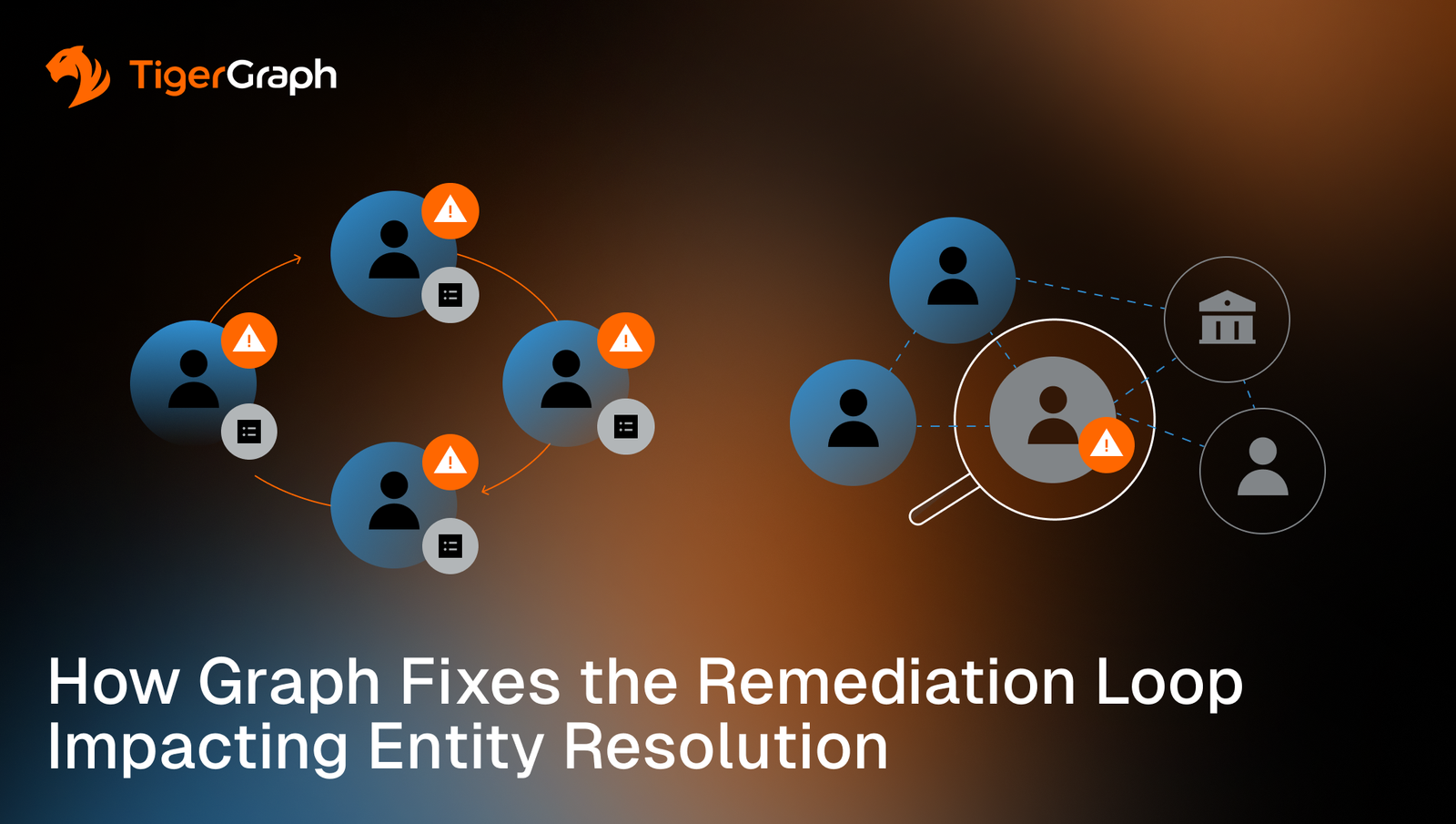
Investigators resolve the immediate case, but the underlying identity structure remains unchanged. The next alert arrives with slightly different records, links or attributes. The same issue is reviewed again because the prior resolution did not propagate.
From the outside, it looks like a normal workload. From inside the workflow, it feels like déjà vu. When continuity breaks, the cause is rarely the investigation itself. It is almost always upstream in how identity context is resolved and retained.
How ER Quality Issues Drive Repeated Remediation
Entity resolution sits upstream of most investigative and monitoring workflows. When it is unstable, downstream fixes cannot accumulate.
Common contributors include:
Resolution that does not persist across workflows
Identity links may exist in one system but not another. Remediation updates are applied locally and never stabilize the broader identity view.
Inconsistent linkage logic over time
Resolution rules change, thresholds adjust or models retrain. Previously remediated identities reappear because the logic that tied them together no longer applies consistently.
Fragmented identity context
Case outcomes are stored but not reliably attached to the resolved entity network. Future reviews cannot see what was already decided.
Over- or under-resolution that is never corrected
Entities remain over-merged or fragmented even after an investigation reveals the issue. The fix stops at the case, not the structure.
None of these failures requires poor investigation work. They reflect identity context that cannot retain corrective action.
Applying this insight operationally
Reducing operational drag caused by remediation loops does not require abandoning automation or rebuilding detection logic. It requires identifying where remediation is compensating for unstable entity resolution instead of correcting risk.
The following checklist can help teams determine whether remediation is genuinely improving outcomes or quietly increasing long-term workload.
Remediation loop diagnostic checklist
- The same identity surfaces reappear after remediation. Similar customers, businesses, or networks return to review even though prior decisions exist.
- Prior investigation outcomes are difficult to reuse with confidence. Reviewers hesitate to rely on earlier conclusions because identity context has shifted, fragmented, or been re-resolved.
- Fixes address alerts but not recurrence. Rules are tuned, models retrained, or procedures updated, yet case volumes remain flat or increase.
- Remediation is tracked at the case level instead of the entity level. Individual alerts are resolved, but outcomes are not attached to a durable identity view.
- Resolution changes invalidate earlier work. Matching logic evolves in ways that dissolve prior links or create new ones without reconciling historical decisions.
- Quality review focuses on consistency without structural visibility. Teams verify that procedures were followed, but cannot see whether identity context persisted across cases.
- Remediation effort concentrates in the same clusters over time. The same areas of the identity network generate repeated corrective work with little reduction in future volume.
When several of these conditions are present, remediation is likely absorbing the effects of entity resolution quality issues rather than eliminating them. Additional tuning may reduce noise temporarily, but it does not reduce the underlying operational load.
At that point, the constraint is structural, not procedural.
The reason these signals are easy to miss is not a lack of effort, but a lack of visibility into how cases relate over time.
Why this is Hard to Diagnose with Flat Wiews
From a case-level perspective, remediation looks successful. Each case closes, each alert is addressed and each fix appears reasonable in isolation.
What flat views cannot easily show is repetition across time and across related entities.
Without connected context, teams cannot see that the same identity structure is re-entering the workflow under slightly different forms. The loop only becomes visible when investigations are connected back to a shared identity surface.
This is why remediation loops persist even in well-staffed, well-controlled programs.
Making remediation behavior visible requires connecting cases back to the identity structures that generated them.
What Connected Analysis Adds
Connected analysis makes remediation behavior observable. Instead of treating each fix as an endpoint, teams can examine how remediation relates to identity structure over time.
This enables several critical insights.
Visibility into repeated remediation targets
Teams can see when the same resolved entity or network drives multiple remediation events.
Linkage between past fixes and current cases
Investigators can understand whether prior remediation addressed the identity surface or only the immediate record.
Identification of structural root causes
Patterns reveal whether repeated remediation stems from fragmentation, over-merging or unstable link logic.
Evidence for governance decisions
When remediation fails to reduce recurrence, teams can demonstrate why resolution changes are required.
The goal is to create fixes that last. When remediation patterns are visible, their long-term impact on program efficiency becomes easier to evaluate.
Entity Resolution Quality Affects Long-term Efficiency
Entity resolution quality determines whether effort compounds or evaporates. When identity context is durable, remediation improves future outcomes. When it is not, remediation becomes maintenance. Over time, this creates a hidden cost.
Operational capacity is consumed by recurring issues. Program maturity stalls and improvements feel incremental because the underlying identity truth never stabilizes. This is how ER quality issues translate into permanent operational drag.
Addressing this drag requires identity context that can persist, accumulate and be revisited across cases.
How TigerGraph Fits the Workflow
The challenge is ensuring that remediation changes identity context in a durable way. TigerGraph supports this by enabling:
- Persistent identity networks that retain corrective updates
• Traversal that links new cases to prior remediation outcomes
• Evidence paths showing how identity structure has or has not changed
• Analysis of recurrence patterns across entities and time
The system does not decide what remediation to apply. It allows us to see whether remediation actually altered the identity surface or merely addressed a single instance. Breaking remediation loops starts with changing what teams track and where corrective action is applied.
By making identity structure visible across time and across cases, teams can identify where ER failures turn fixes into loops and break the cycle of permanent operational drag.
If remediation continues without reducing workload, the issue is likely structural. Contact TigerGraph to see how persistent identity context helps corrective work compound instead of repeat.
Frequently Asked Questions
1. Why do Fraud and AML Remediation Efforts Keep Repeating the Same Issues?
Fraud and AML remediation efforts often repeat when entity resolution fails to maintain a stable identity view across systems and investigations. Investigators may correct a specific case, but if the underlying identity relationships are not updated or persisted, similar alerts reappear under slightly different records. Graph-based identity analysis helps prevent this by connecting investigations to a durable network of entities, attributes, and relationships so corrective actions carry forward.
2. How can Entity Resolution Problems Create Recurring Investigation Workloads?
When entity resolution is inconsistent, the same real-world entity can appear under multiple records or fragmented profiles across systems. Each variation can trigger new alerts, investigations, or remediation steps. Because previous decisions are not reliably connected to the underlying identity network, investigators must repeatedly review similar cases. Graph-based identity modeling reduces this repetition by linking related records into a persistent entity network.
3. What are Common Signs that Remediation Loops are Caused by Entity Resolution Failures?
Several operational signals indicate that entity resolution issues are driving remediation loops:
The same entities or networks appear repeatedly in investigations
Prior investigation outcomes cannot be reused with confidence
Case volumes remain steady despite repeated remediation efforts
Identity relationships change between systems or across time
Graph analytics helps reveal these patterns by connecting cases, entities, and investigation outcomes across the identity network.
4. How does Graph Analytics Help Fraud and AML Teams Prevent Recurring Remediation?
Graph analytics enables investigators to analyze how cases, entities, and relationships connect over time. By traversing identity networks across accounts, devices, businesses, and transactions, teams can determine whether a remediation action corrected the underlying identity structure or only addressed an individual alert. This connected analysis helps organizations identify structural causes of recurring issues and apply fixes that persist across future investigations.
5. Why is Persistent Identity Context Important for KYC, Fraud, and AML Programs?
Persistent identity context ensures that decisions made during investigations remain connected to the underlying entity network. In KYC, fraud, and AML programs, investigators must be able to see how current alerts relate to previous cases, relationships, and remediation actions. Graph-based identity systems maintain these connections, allowing institutions to reuse investigation outcomes, reduce redundant casework, and improve the long-term efficiency of financial crime programs.
Why Temporal Conflicts in Entity Resolution Cause Chaos
Entity resolution often assumes that identity becomes more stable over time. As more data arrives, records are expected to converge, links are expected to strengthen, and confidence is expected to increase. But in reality, time can be disruptive.
Many entity resolution failures do not stem from missing data or weak matching logic alone. They emerge when changes over time are ignored, misinterpreted or collapsed into a single static view. The result is an identity representation that looks coherent on paper but no longer reflects reality.
This is where temporal conflicts appear.
Key takeaways
- Identity resolution breaks down when time is treated as background metadata instead of core evidence.
- Temporal conflicts arise when outdated attributes and relationships remain active in a resolved entity.
- Static “single customer views” can hide drift, lifecycle mismatches and stale links that affect downstream decisions.
- Time-aware, relationship-based analysis improves reviewability, remediation targeting, and audit defensibility.
Why Time Creates Risk in Entity Resolution
Entity resolution answers a practical operational question: “Which records represent the same real-world entity right now?”
That question changes continuously. People move, businesses restructure, accounts open and close, and behavior shifts across channels and over time.
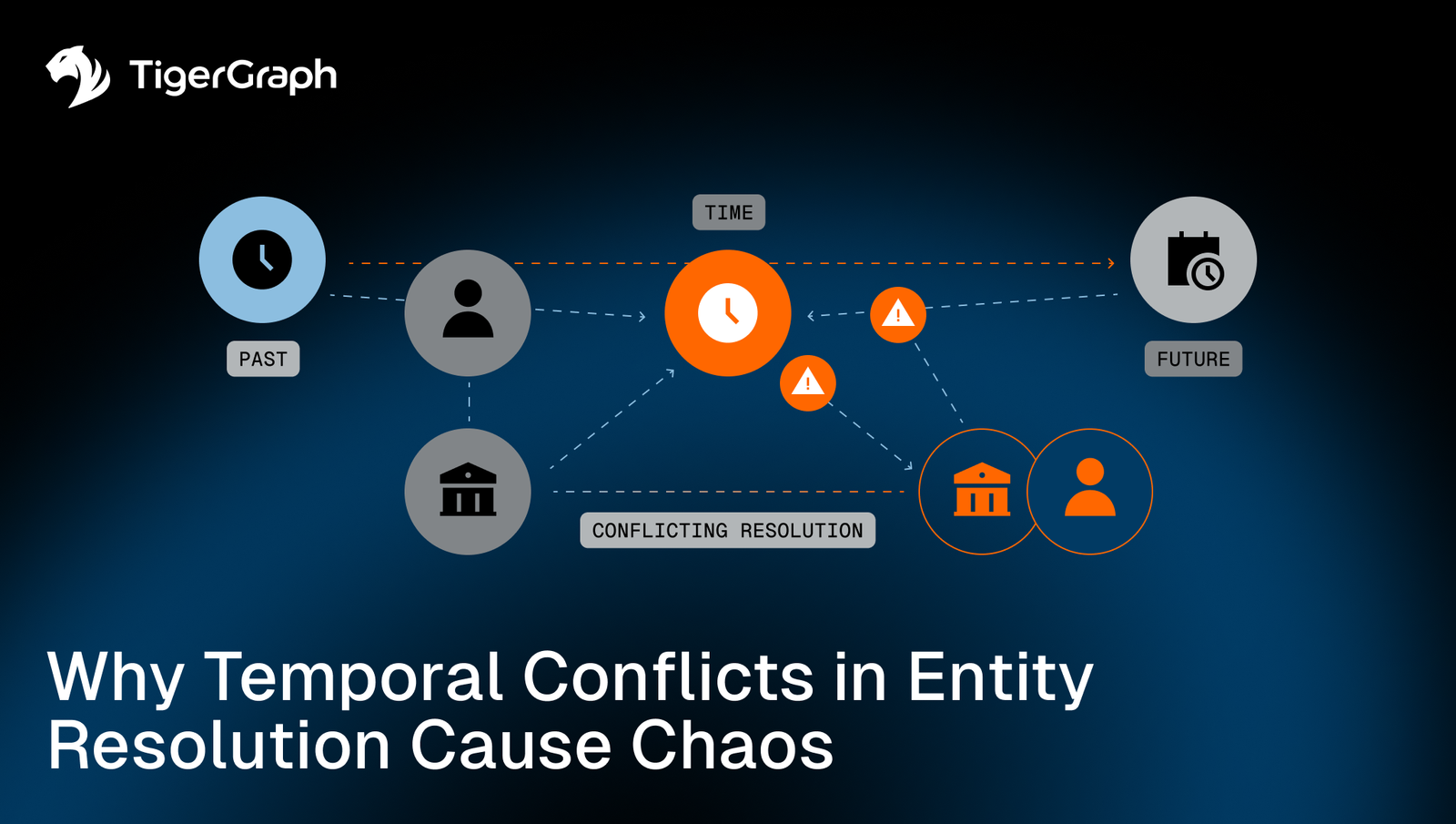
Most resolution pipelines are designed to link records based on similarity at a point in time. They are far less effective at evaluating whether those links remain valid as conditions change. When time is treated as secondary metadata rather than as part of link validity, outdated relationships persist longer than they should.
This creates tension between historical truth and current truth. Both may be accurate in isolation. The risk emerges when they are treated as equivalent.
The tension becomes operationally visible in a small number of repeatable failure patterns.
Where Temporal Conflicts Show Up in Practice
These conflicts do not appear randomly. They tend to surface in a small number of recurring patterns.
Incompatible attributes within a resolved entity
Attributes that should not coexist appear together because they were correct at different moments. Address histories overlap incorrectly, device usage patterns conflict and behavioral timelines no longer align.
Identity change without resolution update
Records update, but resolution does not. New identifiers are added while old ones continue to dominate linkage logic. The resolved entity stops evolving even as the underlying evidence changes.
Lifecycle stage mismatches
Records from incompatible stages are merged because they share attributes, even though their timing makes the merge questionable. Onboarding data collapses into previously closed profiles and dormant relationships persist as active ones.
In each case, the issue is that time is not being evaluated when determining whether links still make sense. When these conflicts persist, their impact extends beyond resolution accuracy into downstream decision-making.
Why Static Resolution Breaks Downstream Workflows
A static “single customer view” creates operational confidence. Teams assume that once records are resolved, identity context is settled.
When that assumption is wrong, downstream systems inherit the error.
Detection models train on outdated identity groupings, and risk scores blend evidence that should no longer be combined. Investigations struggle to reconcile current behavior with historical attributes that still influence decisions.
Explanations become harder as well. When reviewers ask why records are linked or why a risk score changed, the answer often depends on evidence that is no longer relevant but remains structurally present.
This is how time-related resolution failures turn into operational friction rather than obvious data defects. Addressing this requires a way to evaluate identity structure as it changes, not just how it appears at rest.
What Connected Context Adds to Time-aware Resolution
Connected data makes temporal conflicts visible because it allows teams to evaluate identity structure over time, not just attributes at rest.
Instead of asking whether two records match, teams can ask whether the relationships that justified the match still hold given when the evidence occurred.
Graph traversal supports this by allowing reviewers to follow relationships step by step across time-stamped connections. Traversal simply means walking through related entities and relationships to understand how they connect and how those connections change over time.
Some links strengthen as evidence accumulates. Others weaken, expire or diverge as behavior changes. Evaluating relationship paths rather than static pairwise similarity makes it easier to detect drift before it cascades downstream.
This approach does not infer intent or predict behavior. It preserves time as evidence and evaluates whether identity structure remains coherent as the network evolves.
Making temporal structure visible changes how teams review, validate and correct resolution outcomes.
How this Supports Review, QA, and Remediation
Time-aware resolution improves reviewability. Investigators can see when links were formed, what evidence supported them at the time and what has changed since.
Quality assurance teams can identify recurring failure modes where resolution freezes too early or updates too slowly. Remediation becomes more targeted because teams can focus on links that no longer align with current evidence instead of reworking entire identity clusters.
Most importantly, decisions become easier to explain. Resolution outcomes can be justified based on how identity evolved, not just how it was matched at a single point in time.
Supporting this consistently depends on whether the underlying platform can treat time as part of relationship logic.
How TigerGraph Fits the Workflow
The operational challenge is not detecting change. It is determining whether existing identity links still hold given when the supporting evidence occurred.
TigerGraph supports this workflow by enabling teams to treat time as part of relationship context rather than background metadata. Relationships can be evaluated alongside timestamps so reviewers can understand when links were formed, how they evolved, and whether they remain relevant.
In practice, this supports:
- Traversal across time-aware relationships to follow identity evolution
• Consistent re-evaluation of links as new evidence arrives or old evidence ages out
• Preservation of relationship paths and timing as reviewable evidence for QA and audit
Resolution logic, thresholds and remediation decisions remain program-defined. TigerGraph provides the connected, time-aware context that allows those decisions to be applied consistently and explained clearly.
Conclusion
Temporal conflicts reveal where resolution logic has stopped keeping pace with reality. Addressing them doesn’t mean abandoning existing approaches, but it does require evaluating whether identity links still make sense given when the evidence occurred.
Use these patterns to assess whether your resolution process can detect identity changes, lifecycle mismatches, and stale linkages before they surface as inconsistent decisions, degraded models or investigation dead ends.
A stable customer view is not defined once; it has to be maintained over time, and TigerGraph helps teams facilitate that capability. Reach out today to learn more about this and other entity resolution features that graph models offer.
Frequently Asked Questions
1. What are Temporal Conflicts in Entity Resolution?
Temporal conflicts in entity resolution occur when records that were accurate at different times are merged into a single identity without considering when the information was valid. For example, outdated addresses, devices, or relationships may remain linked to a profile even after they are no longer relevant. These conflicts create identity views that appear consistent but no longer reflect the current real-world entity.
2. Why can a Static “Single Customer View” Create Risk in Data Systems?
A static single customer view assumes that once records are linked, the identity remains stable. In reality, identities evolve as customers move, businesses restructure, or accounts change status. When time is ignored, outdated relationships and attributes may remain active in the resolved entity, leading to incorrect risk assessments, inconsistent analytics, and investigation confusion.
3. How do Temporal Conflicts Affect Fraud, AML, and Compliance Workflows?
Temporal conflicts can cause fraud detection models, AML monitoring systems, and compliance reviews to rely on outdated identity information. When historical and current data are blended together without context, risk scores may reflect conditions that no longer exist. Investigators may also struggle to explain why certain records are linked or why risk levels changed.
4. How does Graph Analysis Help Manage Identity Changes Over Time?
Graph analysis models identities, attributes, and relationships as a connected network that can include time-based context. By following relationships step by step across time-stamped connections, investigators can evaluate when links were valid and whether they should still influence the current identity structure. This approach helps detect identity drift, stale relationships, and lifecycle mismatches.
5. Why is Time-aware Identity Analysis Important for Entity Resolution Quality?
Time-aware identity analysis ensures that entity resolution reflects how identities evolve rather than how they appeared at a single moment. By evaluating when relationships were created, updated, or expired, teams can maintain more accurate identity views, improve data quality, and provide clearer explanations during audits, investigations, or regulatory reviews.