Contact Us

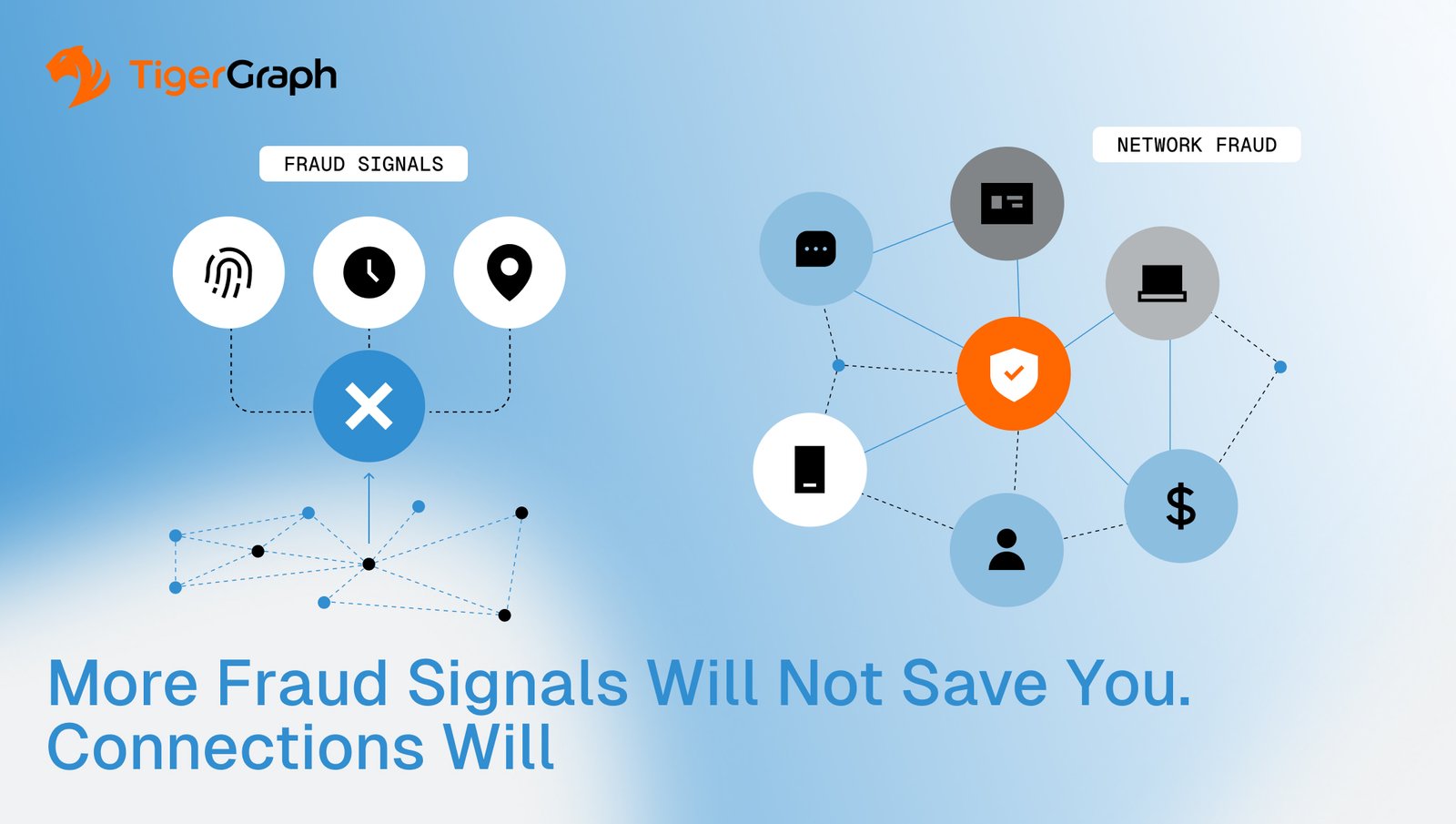
More Fraud Signals Will Not Save You. Connections Will.

Fraud teams today can collect hundreds of behavioral and technical signals during a single verification session.

Ten years ago, the challenge was signal scarcity. Teams wished they had more visibility. That is no longer the problem. The problem today is signal saturation. Modern fraud systems are overwhelmed because they struggle to understand how that data connects. And that distinction changes everything.

Key Takeaways

The Fraud Signal Explosion

Verification workflows can now capture over one hundred attributes in a single interaction. These signals fall into several categories:

On paper, this looks like progress. More signals should mean more precision. But fraud does not stand still, and as defenses improve, fraudsters adapt.

As adaptation increases, the value of any single signal decreases. This is where stacking enters the conversation.

When Fraud Signal Stacking Stops Working

Signal stacking combines multiple risk indicators to increase detection confidence. It works well when fraud is isolated and predictable, but it struggles when fraud becomes coordinated.

Individually, these signals are weak. Even together, within a single session, they may remain ambiguous. The shift happens when those same signals appear across connected accounts, shared IP ranges, and coordinated transaction paths.

Now the pattern changes. The signal is no longer just behavioral. It becomes structural. 

Traditional rule engines and flat machine learning models evaluate signals within single sessions or single accounts. Coordinated fraud does not operate within those boundaries. It spreads across them. To understand why stacking fails in these cases, we have to look at how modern fraud actually behaves.

Fraud is a Relationship Problem

Fraud today is relational by design.

The central question shifts. It is no longer, “How many signals are present?” It becomes, “How are these signals connected across entities?” 

A device used once tells one story, and a device shared across ten accounts tells another. An IP address appearing in a single session may be noise, but the same IP appearing inside multiple high-risk clusters signals coordinated activity. A newly opened account may look clean, yet the same account indirectly connected to sanctioned entities through ownership chains may carry hidden exposure.

These are network-level insights that require tracing relationship paths rather than counting attributes. That is the transition point from stacking signals to modeling structure.

From Fraud Signal Stacks to Fraud Signal Graphs

The next stage in fraud detection is understanding how they connect.

Graph modeling treats users, accounts, devices, transactions, and IP addresses as connected entities. Their relationships are stored explicitly rather than inferred on demand. This changes what fraud teams can see. They can:

Instead of evaluating signals in isolation, organizations evaluate them in context. So, although a single weak signal may be meaningless, ten weak signals connected across a network may indicate organized activity. That difference often determines whether fraud is detected early or after losses escalate.

This structural perspective becomes even more important as automation accelerates.

GenAI Raises the Stakes

Generative AI has made it easier than ever to imitate real users online. Automated bots can now:

In other words, surface-level signals are easier to manipulate.

Fraudsters can make an individual account look normal. They can make a single session appear legitimate. What they struggle to fake at scale is structure.

When fraud spreads across accounts, devices, and infrastructure, the connections between those entities leave patterns behind. Those patterns are harder to disguise than isolated behaviors. Connections remain even when individual attributes change.

This is why fraud detection must move beyond counting signals. The real advantage comes from understanding how signals relate to one another across a network. Not just what exists, but how it connects.

Structural Advantage in Fraud Defense

Fraud detection maturity is no longer measured by the number of signals captured.

It is measured by how well those signals are connected and analyzed.

Organizations that treat risk indicators as isolated data points face increasing false positives and missed coordinated fraud.

Organizations that model relationships explicitly gain visibility into fraud rings, infrastructure reuse, and indirect exposure before damage spreads.

As fraud becomes more distributed and more automated, relationship-aware detection becomes essential.

This is not about replacing signals. It is about placing them within structure.

Moving Beyond Signal Stacks

Collecting 100+ signals per session is technically impressive, but understanding how those signals connect across millions of users is strategically decisive.

TigerGraph enables fraud teams to model users, devices, sessions, transactions, and infrastructure as a connected graph. By storing relationships explicitly and enabling deep traversal across entities, organizations can detect coordinated fraud patterns that flat rule engines and isolated models miss.

Today’s fraud is a network problem.

Reach out today to learn how TigerGraph supports relationship-aware fraud detection at enterprise scale.

Frequently Asked Questions

1. What is The Difference Between Fraud Signals and Fraud Connections in Detection Systems?

Fraud signals are individual indicators like device or behavior data, while fraud connections reveal how those signals link across accounts, devices, and networks—exposing coordinated activity.

2. Why does Adding More Fraud Signals Often Increase False Positives Instead of Accuracy?

Adding more signals increases false positives because isolated indicators create noise without context, making it harder to distinguish legitimate behavior from coordinated fraud.

3. How do Fraudsters Exploit Isolated Signal-Based Detection Systems?

Fraudsters exploit these systems by spreading activity across multiple accounts and devices, ensuring each individual signal appears normal while the broader pattern remains hidden.

4. How does Relationship-Based Analysis Improve Detection of Coordinated Fraud?

Relationship-based analysis improves detection by connecting entities across multiple layers, revealing shared infrastructure, clusters, and multi-step fraud patterns.

5. What Makes Network-Level Fraud Detection More Effective Than Session-Level Analysis?

Network-level detection is more effective because it evaluates how signals propagate across connected entities, identifying patterns that cannot be seen within a single session.

How to Supercharge Fraud Detection with Graph Models

Fraud is a network problem. It rarely appears as one obviously suspicious transaction. More often, it unfolds over time as a sequence of actions across multiple accounts, devices, and payment instruments.

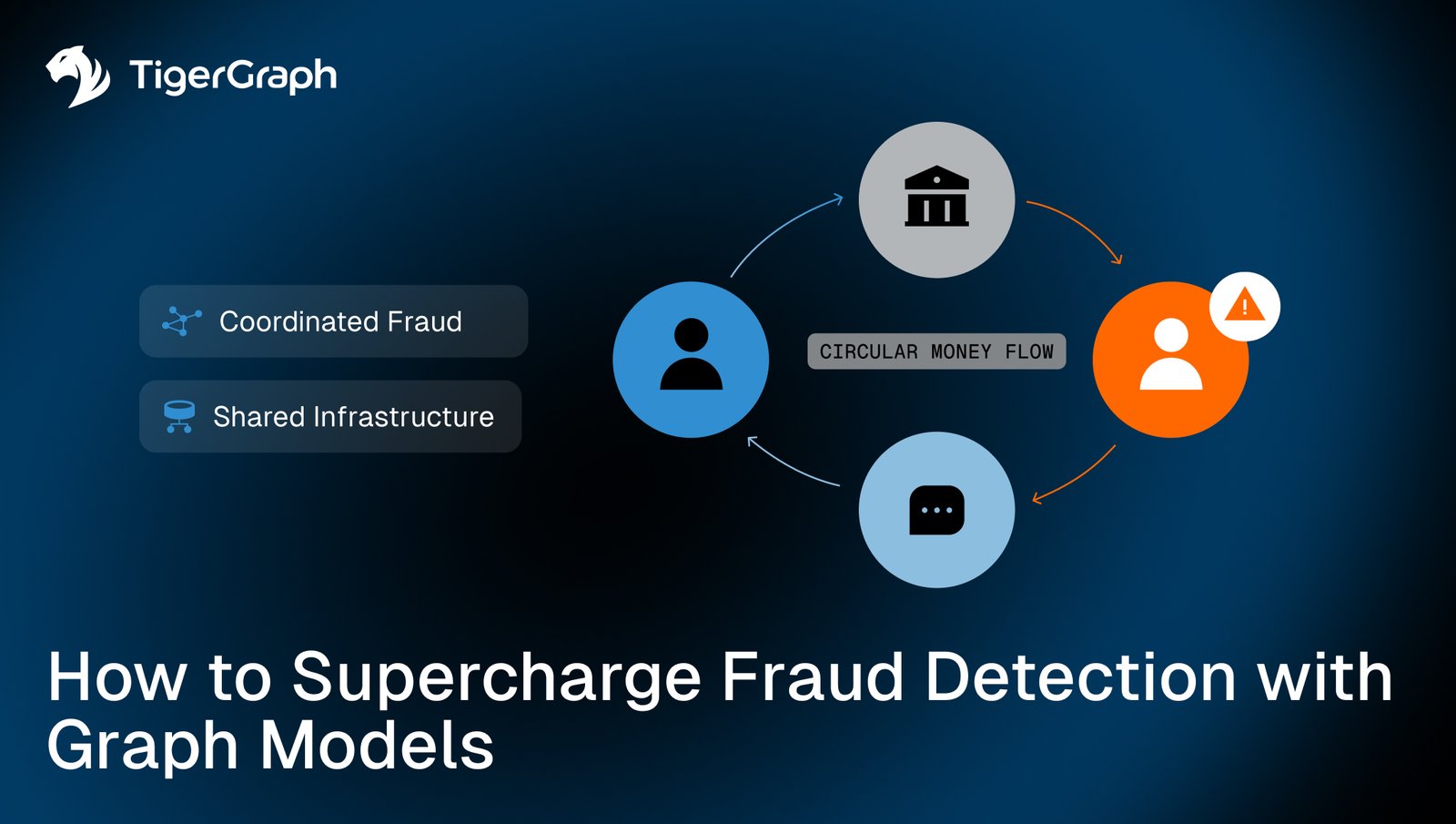
Funds move in loops, within accounts that share infrastructure. Money is layered through intermediaries and the overall activity is fragmented to avoid triggering simple rules. The challenge is not identifying a single outlier. It is recognizing a coordinated pattern embedded inside legitimate activity.

That is a structural problem. And structure is what graph models are designed to capture.

Key Takeaways

Fraud is a Pattern, Not a Row

Financial institutions typically monitor fraud in two major areas: identity verification and transaction activity.

Transaction monitoring systems flag unusual payments, changes in velocity, or threshold breaches. Analysts then begin with a suspicious entity and expand outward to review related activity.

In a traditional tabular database, data is stored in separate tables. Customer information lives in one table. Transactions live in another. Device data may live somewhere else. To analyze how those entities relate, the system must perform a “join.” A join is the operation that links rows from different tables based on a shared field, such as a customer ID or device token.

That works for simple relationships.

But as investigations deepen, each additional connection requires another join. If an analyst wants to move from a customer to their device, then from that device to other customers, and then to those customers’ transactions, each step adds more joins. Queries grow longer, harder to maintain, and more computationally expensive.

Fraudsters exploit that friction.

They distribute transactions across multiple users. They reuse devices across accounts. They route funds through intermediaries and recycle money back to the origin. The deeper the pattern, the more complex the query needed to uncover it.

In a relational database, these behaviors appear as separate rows scattered across multiple tables.

But in a graph model, they appear as connected structures that can be followed step by step, or “traversed.”

Modeling Financial Crime as a Network

When transactions are modeled as a graph, entities such as users, transactions, devices, and payment instruments become nodes. Their interactions become relationships.

Instead of asking, “Is this transaction unusual?” we can ask:

Consider a circular money flow where a user sends funds to another account and that account forwards the funds onward. After several steps, the money returns to the original sender. The amounts are similar and the timing is tight.

In a dashboard, this appears as several ordinary transfers. In a graph, it appears as a loop. That difference matters.

Graph “traversal” allows investigators to follow multi-step paths across accounts and time, reconstructing the sequence of activity exactly as it occurred. Fraud becomes a network investigation rather than a transaction review.

Moving Beyond Fraud System Rules

Many fraud systems begin with rules.

Rules work well for patterns we already understand. But fraud tactics evolve. Once criminals learn the thresholds, they adjust their behavior to avoid triggering them.

Machine learning adds adaptability and helps spot behaviors that traditional rules miss. Instead of relying only on fixed thresholds, models learn from historical fraud cases. They detect combinations of signals that humans may not have explicitly defined. A transaction might look ordinary on its own, but unusual when evaluated alongside dozens of other attributes.

Graph strengthens this approach in two important ways.

1. It generates structural features. These are signals derived from how an account behaves within a network, not just what it does individually. For example, how many other accounts connect to it? How close is it to previously identified fraud? Does it sit at the center of a dense cluster?

2. Graph allows models to incorporate relational structure directly. Rather than treating each account as an isolated record, the model can learn from its neighborhood and connections.

This combination moves fraud detection beyond static rules toward adaptive, structure-aware detection.

Graph Feature Engineering

One of the most practical advantages of graph modeling is the ability to create better inputs for machine learning. Instead of feeding a model only raw transaction details, such as amount, time, and location, graph modeling allows us to generate features based on how an account behaves within the network.

For example, we can calculate:

These are not attributes stored in a single transaction record. They describe position and behavior within the broader system.

That added context changes how a model evaluates risk. Instead of judging an account only by what it did, the model can evaluate where it sits and how it interacts with others. That often leads to stronger signals and fewer blind spots.

Feature engineering strengthens traditional models, and graph neural networks go a step further.

Graph Neural Networks

Traditional models treat each account as an independent data point. They look at rows of attributes and try to classify them. Graph neural networks treat each account as part of a neighborhood.

If a cluster of connected accounts exhibits suspicious behavior, that pattern influences predictions for nearby accounts. The model learns not only from individual attributes, but from how behavior spreads across connections.

In coordinated fraud scenarios, this matters. Fraud typically propagates through shared devices, mule accounts, intermediaries and recycled funds. Models that incorporate neighborhood structure are better positioned to detect those coordinated patterns.

The underlying logic is simple:

Graph strengthens fraud detection in three clear and practical ways.

 1. It Exposes Coordinated Patterns

Graph models allow investigators to follow connections step by step. Instead of seeing separate transactions, they see the full flow of activity.

These coordinated patterns are difficult to uncover when transactions are treated as independent rows. Graph makes them visible because it models how entities are connected.

2. It Adds Network Context to Machine Learning

Machine learning models are only as strong as the signals they receive. Graph modeling generates additional signals based on how an account behaves within the network. For example:

These signals describe position and influence, not just transaction details. When added to traditional models, they provide context that simple attributes cannot capture.

The model no longer evaluates activity in isolation. It evaluates behavior within a connected system.

3. It Allows Models to Learn from Relationships

Graph neural networks go a step further by incorporating connections directly into prediction.

Instead of analyzing each account independently, the model learns from neighborhoods. If a group of connected accounts shows suspicious behavior, that structural signal influences predictions across the cluster.

This is especially powerful in coordinated fraud scenarios, where the risk is not confined to one account but spreads across many. Fraudsters operate in networks, so effective detection systems must do the same.

Contact TigerGraph

If your organization is working to detect coordinated fraud, reduce false positives, or strengthen transaction monitoring with structural insight, graph analytics provides the foundation.

Contact TigerGraph to explore how connected data modeling and graph-enhanced machine learning can strengthen your fraud detection strategy.

Frequently Asked Questions

1. Why is Fraud Detection More Effective When Modeled as a Network Instead of Individual Transactions?

Fraud detection is more effective as a network because coordinated schemes span multiple accounts, devices, and transactions, which cannot be fully detected when analyzed in isolation.

2. How do Graph Models Uncover Hidden Fraud Patterns That Traditional Systems Miss?

Graph models uncover hidden patterns by connecting entities and revealing multi-step relationships such as circular flows, shared infrastructure, and coordinated activity.

3. What Makes Multi-Step Fraud Schemes Difficult to Detect With Traditional Databases?

Multi-step schemes are difficult to detect because they require complex joins across multiple tables, making it hard to trace connections and reconstruct full activity patterns.

4. How does Network Context Improve Fraud Detection Accuracy and Reduce False Positives?

Network context improves accuracy by evaluating how entities interact within a system, helping distinguish legitimate activity from coordinated fraud patterns.

5. What Types of Fraud Signals Become Visible When Relationships are Modeled Explicitly?

When relationships are modeled, signals such as circular money flows, shared devices, mule networks, and clustered behavior become visible and measurable.

How Graph-Powered AML Systems Catch What Traditional Rules Miss?

Financial crime evolves faster than compliance systems. Static AML monitoring tools built on decades-old frameworks struggle to interpret modern, cross-border transaction behavior. They rely on rules that look for surface-level anomalies like amount, frequency, or geography. 

But they don’t understand intent. They can’t see relationships. And that’s where money moves unnoticed.

False positives pile up and risk hides in connections that relational databases can’t model. Compliance teams lose time reviewing noise instead of real threats.

That’s why modern AML transaction monitoring use cases now depend on connected intelligence. 

Graph technology turns fragmented data into dynamic context that links people, accounts, devices, and geographies into one living picture of financial activity. It doesn’t just detect anomalies. It explains them.

Context is how financial institutions stay compliant and ahead.

How to Understand AML Transaction Monitoring Rules?

In anti-money laundering, transaction monitoring rules define the logic used to flag suspicious behavior. They’re the backbone of compliance programs—the thresholds, velocity checks, and patterns that indicate potential laundering. Common triggers include:

Each rule provides signal, but isolated signals are incomplete.

For instance, a single transaction may appear routine. Yet when connected to dozens of others sharing similar metadata, like common phone numbers, IPs, or addresses—a hidden network emerges. 

A graph-based AML platform captures those relationships in real time. It creates a contextual map that reveals who’s connected, how funds move, and where anomalies cluster.

The result is faster detection, fewer false positives, and explainable reasoning auditors can trust.

What are Common AML Transaction Monitoring Scenarios?

Compliance teams apply structured AML monitoring scenarios to simulate real-world laundering typologies. Traditional systems test these in silos. Graph analytics tests them together, because criminals don’t act in isolation.

Traditional tools look for any one of these. Graph systems find when several overlap, revealing intent through patterns that span time, accounts, and borders.

Graph analytics transforms detection from static event analysis into dynamic behavioral understanding.

AML Rules in Action: Real-World Examples

ScenarioRule TypeGraph Insight
Rapid movement of fundsFrequency thresholdDetects coordinated transfers across multiple entities
StructuringTransaction value limitIdentifies distributed deposits under shared ownership
Geographic riskCountry ruleUncovers indirect routing through intermediary banks
CollusionShared identifiersMaps hidden ties among merchants, brokers, or mules
Dormant-to-active accountsVelocity anomalyLinks reactivated accounts to ongoing laundering rings

Traditional SQL-based models evaluate each rule separately. Graph databases evaluate them together, following paths across people, systems, and transactions in milliseconds.

This connected reasoning converts suspicion into understanding. It shows not only what is happening, but why.

Why Graph Databases Strengthen AML Monitoring?

The future of AML lies in context. Graph databases are built for it. They model relationships directly, storing both entities and edges as first-class data citizens. That difference changes everything.

Legacy AML systems require complex joins across flat tables just to simulate connectivity. Each join slows performance and increases noise. Graph-native AML systems operate differently: they traverse relationships instantly, finding hidden pathways no rule-based engine could anticipate.

The advantages are measurable:

With graph analytics, investigators don’t just respond to alerts—they interpret networks. They see cause, effect, and risk in one motion.

What Are the Most Common AML Use Cases Across Financial Institutions?

The same connected intelligence applies across every corner of finance. From retail banking to wealth management, graph-powered AML monitoring turns fragmented detection into a unified understanding of risk.

Retail Banking:
Retail banks process millions of transactions daily, many across shared accounts, devices, or phone numbers. Graph analytics helps compliance teams detect layering and structuring that spans multiple customer profiles. By linking identifiers across accounts, institutions can expose coordinated behavior that single-rule systems would miss, reducing false positives and improving investigator accuracy.

Corporate Banking:

Corporate networks conceal shell entities that transact heavily with overlapping vendors or offshore intermediaries. But graph-based AML models reveal these ownership and funding relationships. It maps directors, suppliers, and payment routes, so banks can pinpoint circular money flows and isolate potential trade-based money laundering (TBML) operations before they escalate.

Fintech and Payments:

Launderers exploit speed and anonymity of digital platforms through micro-laundering and rapid fund movement. Graph analytics correlates peer-to-peer transactions, wallet IDs, and device signatures in real time, creating context that helps fintech firms identify suspicious clusters. And it works even when individual transfers appear benign. This strengthens both compliance and customer trust.

Insurance:
Fraud and laundering can cross-pollinate in insurance claims, particularly when policyholders, brokers, and repair shops collaborate to hide illicit payments. Graph models expose collusion networks that traditional systems overlook by connecting entities through shared addresses, phone numbers, or payout destinations. This gives investigators a full relational view of how fraudulent claims are born across policies and providers.

Wealth Management:
High-net-worth clients often hold assets through layered trusts, intermediaries, and investment vehicles. A graph-based approach links beneficial ownership structures to transactional activity, creating visibility across jurisdictions. This clarity supports both AML compliance and transparency requirements under global regulations.

Correspondent Banking:
Cross-border transactions come with unique challenges when monitoring nested accounts and proxy institutions. Graph analytics helps trace flows across correspondent relationships, revealing intermediary banks and hidden beneficiaries. This connected view enables compliance teams to detect high-risk corridors and document every path of funds for regulatory audits.

Each domain benefits from the same advantage—clarity. When relationships are visible, patterns of abuse no longer hide in the gaps between systems. Graph analytics transforms AML from reactive compliance to proactive intelligence, empowering institutions to understand risk, not just report it.

Integrating Graphs into AML Operations

Graphs don’t replace existing AML systems—they elevate them. Rule engines still trigger alerts. Graph analytics gives those alerts meaning. It connects entities across institutions, channels, and jurisdictions.

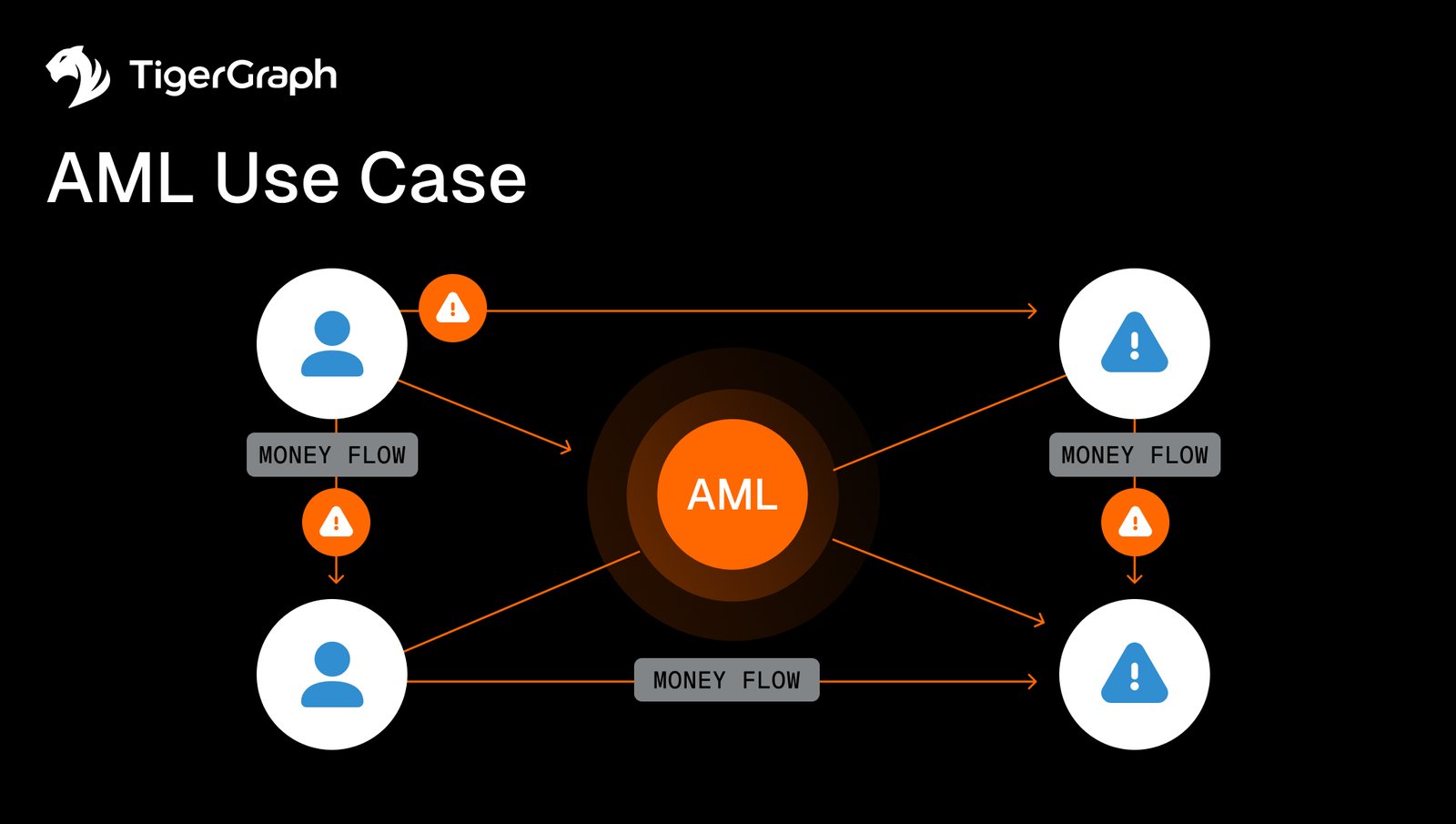
When a rule flags “rapid movement of funds,” graph traversal shows the full pattern, revealing who initiated it, how accounts relate, and where similar behavior repeats. Investigators no longer start from scratch. They see the network immediately.

This context-first approach shortens investigation time dramatically. It also eliminates repetitive false positives—helping teams focus on real risk.

How Graph Technology Improves AML Efficiency?

ChallengeTraditional AML SystemGraph-Powered AML System
Alert volumeHigh false positivesContextual clustering cuts noise 
Data silosFragmented sourcesUnified entity resolution
Investigation timeHours per caseMinutes via real-time graph traversal
ExplainabilityManual tracebacksVisual, regulator-ready audit trails

Graph analytics transforms AML investigation from a rule-based task into a reasoning-driven process. Analysts see entire risk ecosystems instead of isolated records.

Regulatory and Business Impact

Compliance is about more than catching bad actors. It’s about proving diligence. Graph databases support both. They make risk decisions explainable, auditable, and fast.

Institutions deploying graph-powered AML systems have reported significant operational gains, including measurable reductions in false positives, faster case resolution, and improved collaboration across compliance, fraud, and cybersecurity teams.

Explainability is critical under regulatory frameworks. Graph-based transparency meets that requirement, ensuring every conclusion can be justified step by step.

How Does TigerGraph Enable AML?

TigerGraph provides the foundation for enterprise-scale AML. Its native parallel graph engine handles billions of transactions with sub-second speed, linking every account, entity, and event into one connected network.

Financial institutions use TigerGraph to unify AML, sanctions, and fraud detection pipelines. It delivers adaptive transaction monitoring rules that evolve alongside criminal typologies, not behind them.

Our advantage lies in context, turning static compliance systems into intelligent risk networks, and helping institutions detect, explain, and act faster than ever.

Summary

Money laundering thrives in the gaps between systems. Graph analytics closes those gaps. It connects data across silos, creating context that reveals intent.

From rapid movement of funds to collusive transaction patterns, graph-powered AML monitoring uncovers hidden links and strengthens compliance outcomes. It reduces false positives, accelerates investigations, and satisfies regulatory scrutiny with explainable precision.

TigerGraph enables that transformation. It gives financial institutions a connected, scalable foundation to detect financial crime with clarity, confidence, and speed. Reach out today to learn more and see graph technology in action.


How Graph Databases Power AML/KYC in Banking

Compliance is at a breaking point. Anti-Money Laundering (AML) and Know Your Customer (KYC) requirements have never been more demanding. Banks are expected to stop financial crime while maintaining seamless customer experiences, and all under the scrutiny of regulators who demand accuracy, auditability, and explainability.

The challenge isn’t just volume. It’s complexity. Customers span multiple products, jurisdictions, and digital channels. Criminals exploit these layers with synthetic identities, nested ownership structures, and cross-border transactions that look ordinary on their own but form high-risk patterns in combination.

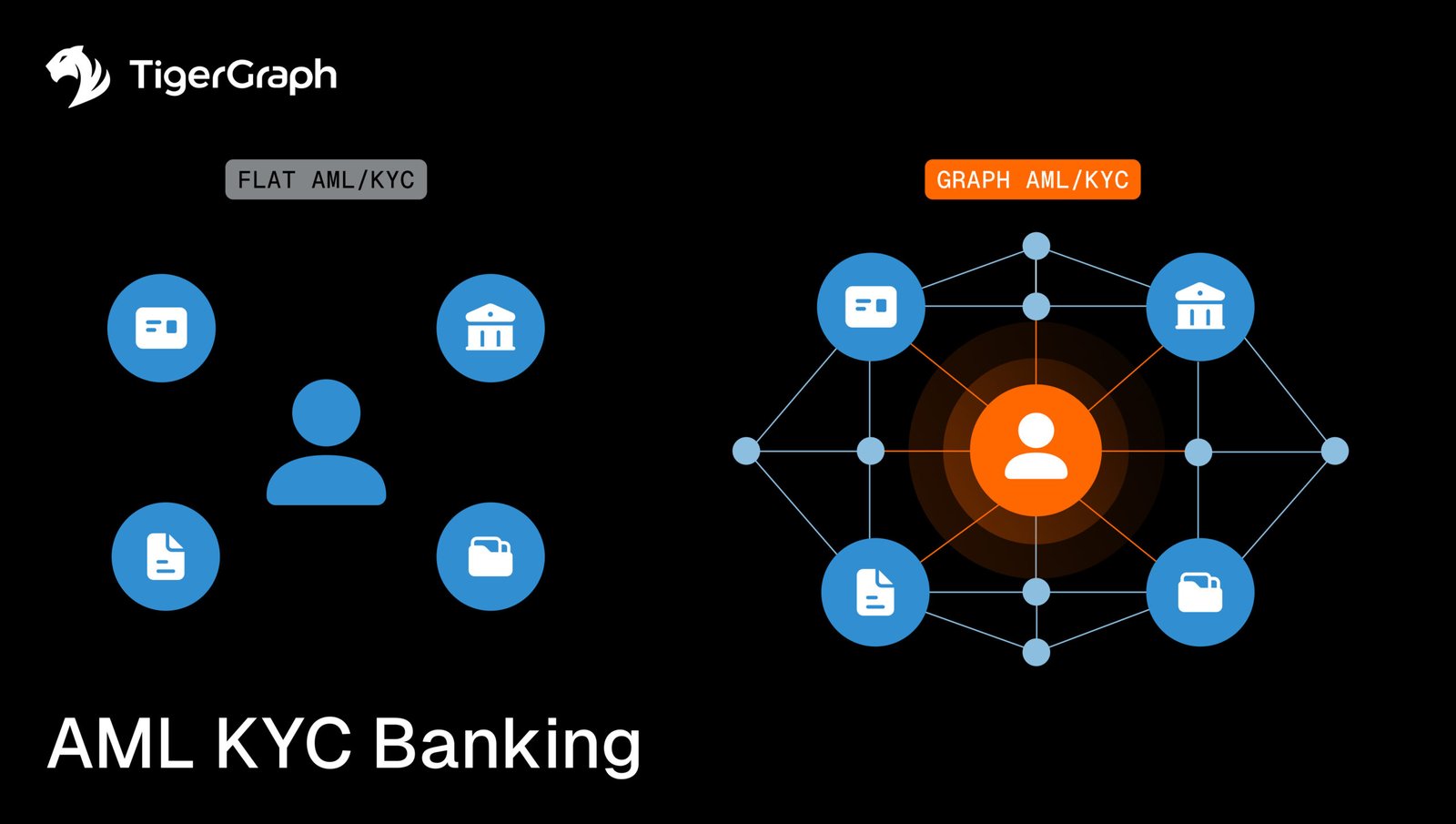
Traditional compliance systems weren’t built for this. Flat models and siloed databases can confirm a customer’s identity at onboarding or flag a large transaction after the fact, but they struggle to capture the relationships that define whether a client or transaction is truly high risk.

Why Flat Models Fall Short in AML/KYC

Traditional AML and KYC systems were designed for a simpler era of banking. Today, their limitations are showing.

Customer data is often siloed across business lines and geographies. A retail banking profile may live in one system, a commercial loan record in another, and wealth management details in a third. These systems rarely align, creating duplicates and blind spots that make it nearly impossible to maintain a true single view of the customer. Criminals exploit these cracks, spreading activity across silos to avoid detection.

Even when data is available, most compliance programs rely heavily on static rules and thresholds. Transfers over $10,000 get flagged, certain countries or industries trigger enhanced due diligence, and so on. 

While these rules are necessary, they generate an overwhelming number of false positives that bury compliance teams in alerts. Analysts spend valuable time chasing anomalies that look suspicious in isolation but have no real risk when viewed in context, while more sophisticated, coordinated laundering activity slips under the radar.

Finally, many banks treat KYC as a snapshot exercise: a check at onboarding, followed by occasional refreshes. This static approach ignores how customer behavior and risk profiles change over time. 

A client who once appeared low-risk may slowly build ties to higher-risk entities, or a small business may begin engaging in unusual cross-border flows. Without continuous monitoring of connections and context, these shifts go unnoticed until it’s too late.

The result is predictable. Compliance teams remain reactive, regulators remain unsatisfied with shallow audit trails, and bad actors continue to exploit the gaps that flat models can’t see.

How Graph Databases Change the Equation

Graph technology maps relationships. Every customer, transaction, account, and entity becomes part of a connected network that evolves as new data flows in. This shift from isolated rows to living networks gives compliance teams the ability to see beyond surface activity and uncover the patterns that matter most.

For example, fragmented customer identities can finally be unified. With entity resolution, duplicate or related records scattered across different business lines are linked, creating a single, consistent view of each customer and their connections. That unified view makes it much harder for criminals to hide behind duplicate or incomplete records.

Graph also excels at revealing hidden ownership structures. By traversing relationships and detecting patterns across accounts, businesses, and identities, it becomes clear when multiple entities ultimately tie back to the same beneficial owner, even if those links were deliberately buried in layers of intermediaries.

The same connected view applies to money movement. Instead of flagging a single suspicious transfer, graph exposes the entire transaction chain. It shows how funds move through multiple hops in a classic layering and integration strategy. Analysts gain the full picture, not just one piece of it.

Even customer due diligence evolves. Traditional KYC freezes at onboarding, but graph-powered models allow profiles to adapt as activity changes. 

Risk ratings stay dynamic, ensuring that shifts in behavior, such as sudden international transfers or new high-risk associations, trigger timely reviews.

Graph also adds explainability to advanced technologies like generative AI. By anchoring AI insights in context-aware retrieval and clear relationship lineage, compliance teams can trust that recommendations are both actionable and auditable. This is, of course, a critical requirement in a regulated environment.

Real-World Results of Graph-Powered AML and KYC

At leading banks, the benefits of graph-powered AML and KYC are already clear. Compliance leaders gain auditability built in, with models that align directly with FinCEN, AML, and KYC regulations. This ensures every decision is transparent and defensible when regulators demand proof.

Analysts also face fewer false positives. Instead of being buried under a flood of threshold-based alerts, they can focus on the relationships that matter most, triaging alerts more quickly and accurately. The result is faster investigations and more time spent on true risk.

Just as important, these gains happen at enterprise scale. TigerGraph has been proven in production to handle more than a billion transactions per day, with queries returning in milliseconds. That level of performance makes real-time AML and KYC not only possible, but practical for the world’s largest banks. And this capacity is well-timed, as the pressure on compliance teams isn’t slowing down. 

Regulators expect more transparency, customers demand smoother onboarding, and criminals continue to innovate. Flat systems can’t meet these rising demands. Graph can.

Reach out for more info on how to use graph to strengthen AML/KYC compliance by embedding context, relationships, and adaptability into every compliance decision. And experience graph analytics in minutes by launching your free TigerGraph instance at tgcloud.io.