Why Entity Resolution Risk Scoring Needs Graph
Entity resolution decisions shape risk, compliance and customer experience long before a case is ever reviewed. Yet many programs treat resolution outcomes as binary. Records are linked or they are not. Entities are resolved or unresolved. That assumption creates blind exposure.
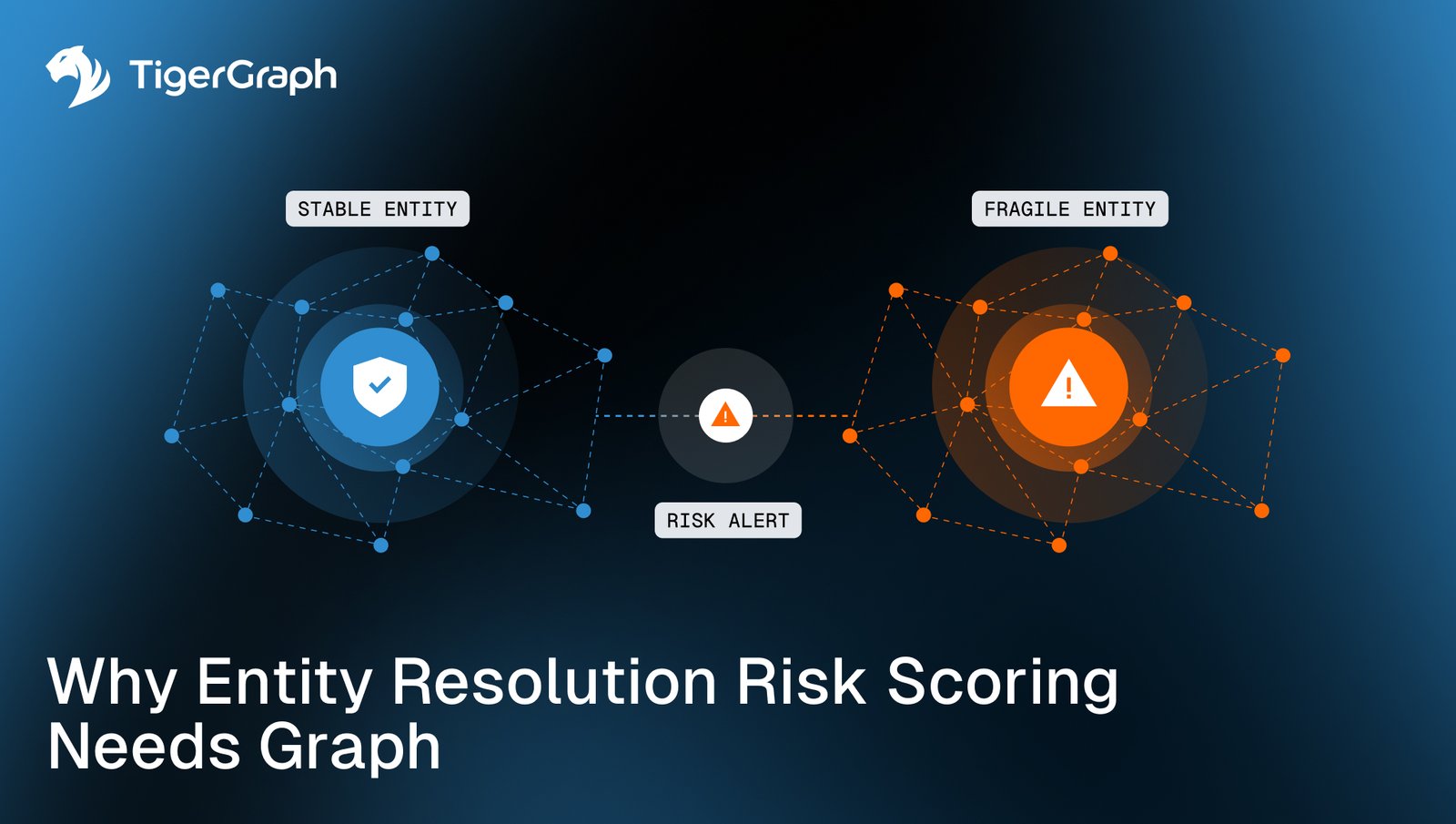
Some resolved entities are structurally stable and well supported. Others rest on aging, indirect or conflicting evidence. When those differences are invisible, every entity is treated the same. Teams either over-review everything or allow weak identity context to flow downstream into detection, investigation and audit workflows.
With graph analysis, resolution confidence is based on how records actually connect, not just on similarity scores. It gives teams a clear signal for which identities they can trust, which require review, and which may be introducing risk. The following sections outline how this works operationally.
Key takeaways
- Not all resolved entities carry the same level of confidence.
- Entity resolution quality scoring helps prioritize review and remediation without reopening every entity.
- Graph-based context grounds confidence in structure, not just match signals.
Resolution quality is rarely the measurement problem. The real challenge is turning those measurements into defensible operational priorities.
Why Entity Resolution Quality Needs to be Operationalized
Entity resolution outputs are often treated as static outcomes. Records are linked, a profile is created and the system moves on.
But resolution is dynamic. Evidence strengthens or decays, relationships change, and data sources evolve. Some entities remain coherent over time while others gradually destabilize.
Without a confidence gradient, resolution becomes a fixed artifact instead of a managed asset. Stable entities and fragile ones look identical in downstream workflows. That forces teams into two inefficient options: review broadly or trust blindly.
Entity resolution quality scoring introduces a controlled middle ground. It makes confidence visible and actionable.
What Entity Resolution Quality Scoring Actually Measures
Entity resolution quality scoring does not measure customer risk. It measures resolution risk. It evaluates how confident the organization should be that a resolved entity accurately represents a single real-world subject and remains structurally coherent given its connected relationships. Common indicators include:
- Strength and consistency of supporting relationships
- Degree of internal conflict within the entity
- Reliance on weak or indirect linkage signals
- Evidence decay over time
- Structural coherence of the resolved network
The objective is to surface uncertainty before it propagates into downstream workflows. Because when resolution uncertainty is tolerated instead of addressed, it eventually shows up as operational friction.
How Low-confidence Entity Resolution Creates Operational Risk
When weak resolution is treated as durable, the consequences surface indirectly.
Suppressed or distorted alerts
Over-merged or weakly linked entities dilute behavior and exposure. Risk signals average out and alerts fail to fire appropriately.
Repeated investigations
When identity context is unstable, prior decisions do not carry forward. Teams end up re-investigating the same customers and accounts because earlier conclusions cannot be trusted.
Inconsistent decisions
Different workflows interpret the same entity differently. Review outcomes diverge because resolution confidence is assumed rather than assessed.
Escalation friction
When entities must be defended to QA or auditors, weak resolution becomes a liability. Teams struggle to reconstruct why records were linked in the first place.
These are not detection failures. They are failures to prioritize resolution confidence before it compounds.
Why Simple Scoring Approaches Fall Short
Many programs attempt entity resolution quality scoring using match confidence or rule strength alone. As mentioned, this approach introduces new blind spots.
A high similarity score does not guarantee structural coherence, as a strong match at one point in time may no longer be valid. Conversely, a lower score supported by durable relationships may represent greater real-world stability.
Scoring without structure produces numbers. Scoring with structure produces governance. Without structural context, scores reflect likelihood rather than durability.
What Connected Context Adds to Entity Resolution Quality Scoring
Connected analysis anchors confidence in structure. Instead of evaluating records in isolation, teams can assess whether the resolved entity holds together as a network.
Structural support
Graph analysis reveals whether links form coherent neighborhoods or depend on thin, indirect connections.
Conflict visibility
Contradictions in attributes, behaviors or relationships become visible when examined structurally.
Evidence durability
Time-aware relationships show whether supporting evidence is strengthening or decaying.
Targeted prioritization
Structure-grounded scores focus review effort on genuinely unstable entities rather than statistically ambiguous ones.
When confidence is tied to network integrity, ER quality scoring becomes a resource allocation tool rather than a reporting artifact.
Turning Entity Resolution Quality Scores into Action
Scoring only creates value when it drives decisions.
Programs typically use entity resolution quality scores to:
- Prioritize entities for manual review
- Trigger structural validation checks
- Gate reuse of prior investigation outcomes
- Inform remediation queues
- Monitor resolution health over time
Scores guide attention; they do not replace judgment. They indicate where structural confidence may require reinforcement.
To support this consistently, scoring must be grounded in connected, reviewable evidence.
How TigerGraph Fits the Workflow
The real operational challenge is simple: can you trust the score, and can you explain it when asked?
TigerGraph supports entity resolution quality scoring by grounding confidence in connected data, not just isolated match rules. Rather than matching records one by one, teams can evaluate the full network around an identity to determine whether it truly holds together.
With a connected graph foundation, teams can:
- Assess whether an identity is structurally consistent across accounts, devices and interactions
- Detect entities that may be over-merged or weakly supported
- Preserve the connection paths that explain why confidence is high or low
- Apply consistent scoring logic across detection and investigation workflows
TigerGraph does not define what “good” resolution means. That standard remains program-defined. What it provides is the connected context needed to measure and manage confidence in a structured, defensible way.
If your organization is modernizing detection and investigation workflows but still treating resolution confidence as an assumption, it may be time to make it measurable.
Contact TigerGraph to explore how graph-based entity resolution scoring can help your team manage identity confidence as a controllable risk factor rather than an invisible source of friction.
Frequently Asked Questions
1. What is Entity Resolution Risk Scoring and Why is it Critical for Detection and Compliance?
Entity resolution risk scoring measures the confidence that a resolved entity accurately represents a real-world identity, helping teams prioritize review and prevent weak identity data from impacting downstream decisions.
2. Why do Binary Entity Resolution Outcomes Create Hidden Operational Risk?
Binary outcomes create risk because they treat all resolved entities equally, masking differences between stable identities and those supported by weak or conflicting evidence.
3. How does Weak Entity Resolution Confidence Impact Fraud Detection and Investigations?
Weak confidence distorts risk signals, leads to missed alerts, causes repeated investigations, and creates inconsistent decisions across workflows.
4. How can Organizations Prioritize Which Resolved Entities Require Review or Remediation?
Organizations can prioritize by using confidence scores grounded in structural relationships, focusing attention on entities with weak, conflicting, or decaying evidence.
5. What Makes Graph-Based Entity Resolution Scoring More Reliable Than Traditional Approaches?
Graph-based scoring is more reliable because it evaluates how records connect within a network, ensuring confidence is based on structural coherence rather than isolated similarity scores.
Explainability in Entity Resolution Decisions Shows Why Records Were Linked or Merged
Entity resolution decisions shape everything that follows. Alerts, investigations, risk scores, suppressions, and escalations all depend on whether records were linked, merged or kept separate. Yet in many programs, the reasoning behind those decisions is difficult to retrieve after the fact.
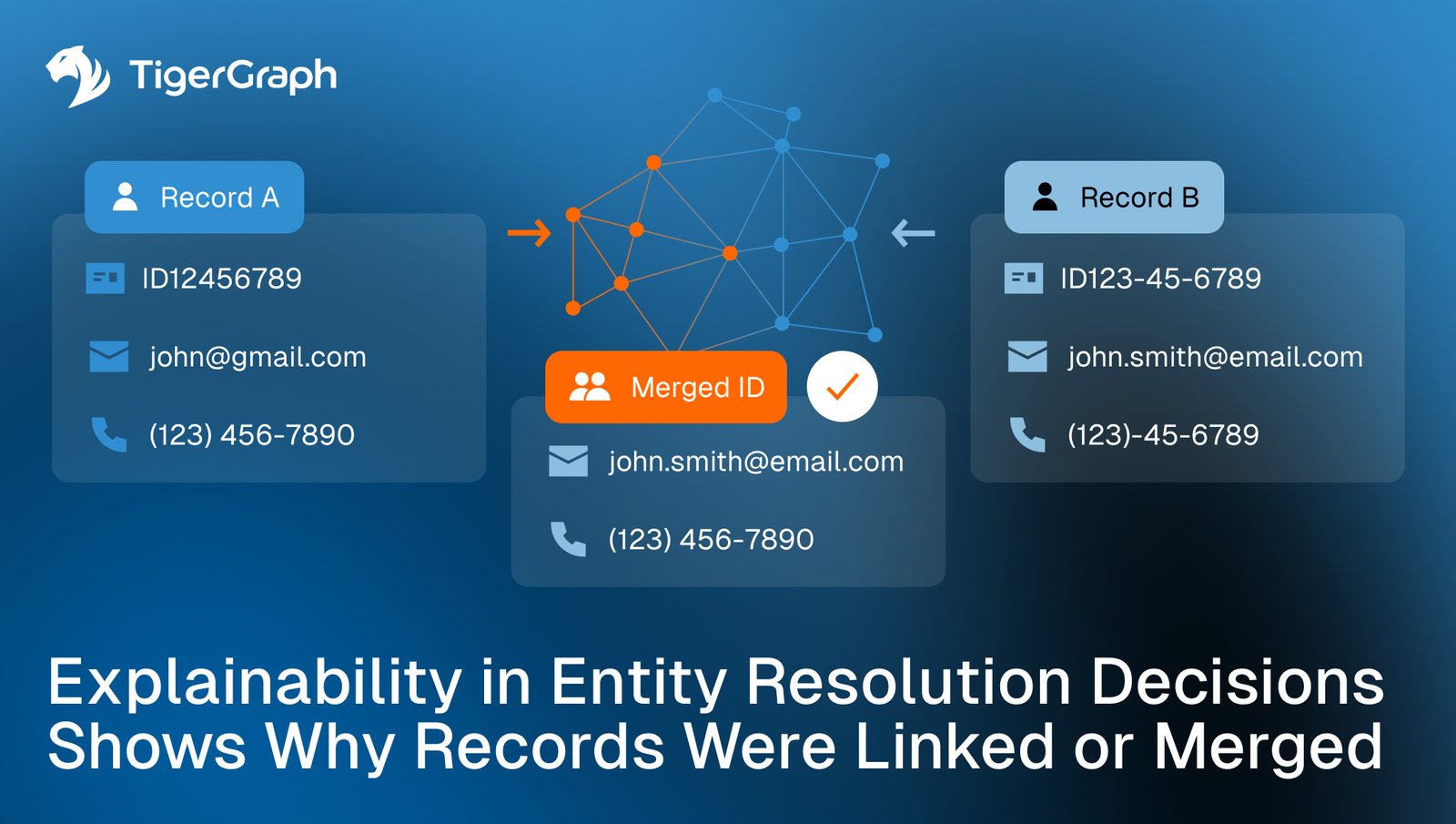
When reviewers, QA teams, or auditors ask why two records were linked, the answer is often incomplete. The response is often limited to a score, a rule trigger or the fact that a merge occurred. The supporting evidence is scattered or no longer visible. This is where explainability breaks down, and where entity resolution becomes harder to defend at scale. This is also where graph comes in.
Key takeaways
- Entity resolution decisions must be explainable long after they occur, not only at the moment of matching.
- Scores and rules alone are insufficient without evidence of preserved relationships.
- Graph-based workflows support explainability by returning connection paths that show how and why records were linked or merged.
To see why explainability becomes such a persistent problem, it helps to look at how resolution decisions are actually used downstream.
Why Explainability Matters in Entity Resolution
Entity resolution answers a deceptively simple question. Do these records represent the same real-world entity?
The operational impact of that answer is significant. Once records are linked or merged, downstream systems assume the decision is correct and durable. Reviews build on it, suppression logic depends on it, and prior outcomes are reused because the identity context appears settled.
Explainability matters because these decisions are reviewed later, often under pressure, and often by people who were not involved in the original match. Without clear evidence, teams are left to reconstruct history rather than evaluate risk.
The challenge is preserving explainability once decisions move into production.
Where Explainability Typically Breaks Down
Most explainability gaps aren’t due to missing data. They come from how resolution decisions are stored and reviewed.
Decisions reduced to scores or outcomes
Similarity scores and match thresholds are useful for prioritization, but they do not explain why records were linked. A numeric value does not show which attributes mattered, which relationships contributed or what evidence was decisive.
Links without preserved context
Records may be linked based on shared devices, addresses or identifiers, but the connection itself is not retained as reviewable evidence. Over time, the rationale disappears even though the link remains.
Merges that cannot be unpacked
When multiple records are collapsed into a single profile, reviewers often cannot see the internal structure that justified the merge. Conflicting attributes coexist without explanation, and the original linkage logic is no longer visible.
Inconsistent explanations across workflows
A record may be linked in one system and unresolved in another. Without a shared, explainable foundation, teams struggle to reconcile differences or explain why outcomes diverged. These gaps do not imply bad matching logic. They indicate that resolution decisions are not being treated as first-class, reviewable artifacts.
These breakdowns point to a gap between how resolution decisions are made and how they are stored for review.
What Explainability Requires in Practice
Explainable entity resolution is about preserving evidence in a way that supports review. At a minimum, teams need to answer three questions consistently:
- Which records were linked or merged?
- What evidence justified that decision at the time?
- How do those records relate structurally, not just statistically?
Meeting these requirements becomes harder as resolution complexity increases and as decisions are reused across time and systems. Teams require a way to consistently retain and revisit the structure behind each decision. They need connected analysis.
What Connected Analysis Adds
Connected analysis improves explainability by shifting the focus from outcomes to structure.
Instead of relying only on similarity scores or rule results, teams can examine the relationships that connect records. These relationships become the explanation.
Connection paths as evidence
A connection path shows the sequence of relationships that link one record to another. This might include shared devices, shared contact information, ownership links or transactional relationships. Preserving that path allows reviewers to see how records were connected, not just that they were.
Structure instead of abstraction
Graph queries return concrete relationships rather than abstract confidence levels. Reviewers can inspect which elements contributed to linkage and whether those elements remain valid.
Reproducible decisions
When the same query logic returns the same paths, decisions become repeatable. QA teams can reproduce results, auditors can follow the evidence and disagreements become resolvable. This approach aligns with the need for explainability without turning resolution into a manual process.
When decision structure is visible, explainability stops being theoretical and starts showing up in daily workflows.
How TigerGraph Fits the Workflow
The operational challenge is preserving explanations as part of the resolution process. TigerGraph supports this by storing entities and relationships directly and returning connection paths as part of query results. This allows teams to:
- Retrieve the relationships that justified a link or merge
- Show how records are connected through shared context
- Apply consistent logic across investigations, QA and audit review
The system does not decide whether records should be linked or merged. Those decisions remain governed by program policy. TigerGraph provides the connected evidence needed to explain and defend them.
When explainability is treated as a quality requirement, resolution outcomes become easier to trust and reuse.
Entity resolution decisions fail when they cannot be explained. Explainability turns entity resolution from a black box into a defensible process. It allows teams to trust past decisions without freezing them in place.
When resolution decisions are explainable, they remain usable. When they are not, they quietly become liabilities.
If explainability is becoming a governance requirement in your program, contact TigerGraph to see how connected, path-level evidence can make entity resolution decisions reviewable, defensible and repeatable at scale.
Frequently Asked Questions
1. What does Explainability Mean in Entity Resolution and Why is it Important?
Explainability in entity resolution means providing clear, reviewable evidence showing why records were linked or merged, ensuring decisions can be validated and trusted over time.
2. Why are Scores and Match Rules Insufficient for Explaining Identity Decisions?
Scores and rules are insufficient because they summarize outcomes without showing the underlying relationships or evidence that justified the decision.
3. How can Organizations Provide Auditable Evidence for Entity Resolution Decisions?
Organizations can provide auditable evidence by preserving relationship paths and connection data that show how records are structurally linked.
4. What Challenges do Teams Face When Trying to Reconstruct Past Resolution Decisions?
Teams struggle because context is often lost, making it difficult to trace which attributes or relationships originally justified a link or merge.
5. How does Relationship-Based Analysis Improve Trust in Entity Resolution Outcomes?
Relationship-based analysis improves trust by making decisions transparent, reproducible, and grounded in visible connections rather than abstract scores.