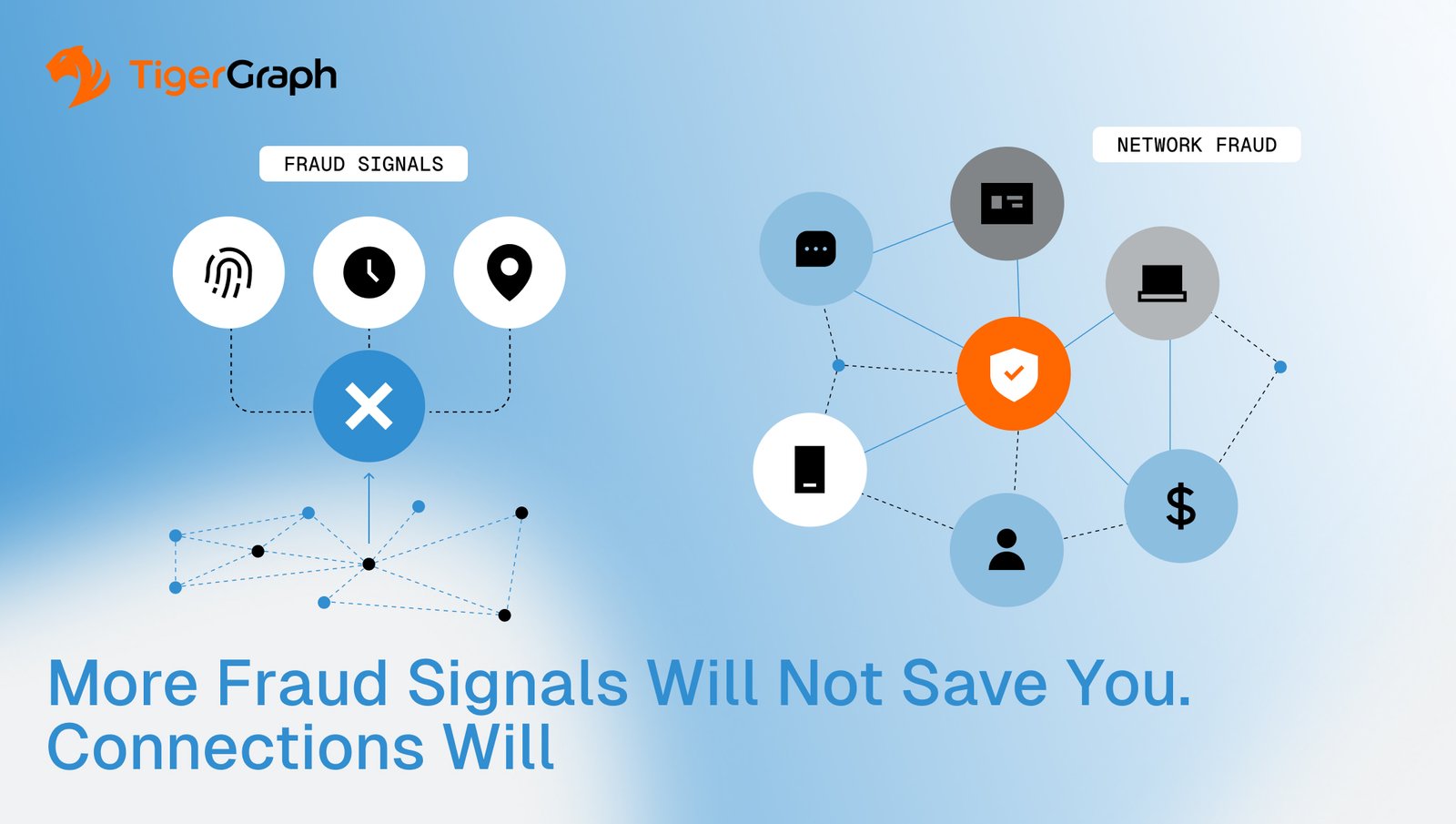
More Fraud Signals Will Not Save You. Connections Will.
Fraud teams today can collect hundreds of behavioral and technical signals during a single verification session.
- Device fingerprints.
- IP reputation.
- Session timing.
- App store attributes.
- Mobile device movement signals.
- Session switching patterns.
Ten years ago, the challenge was signal scarcity. Teams wished they had more visibility. That is no longer the problem. The problem today is signal saturation. Modern fraud systems are overwhelmed because they struggle to understand how that data connects. And that distinction changes everything.
Key Takeaways
- Capturing more signals does not automatically improve fraud detection.
- Stacking isolated signals can increase noise and false positives.
- Synthetic identity and GenAI-driven fraud operate across networks.
- Signals gain meaning when evaluated in relational context.
- Graph analytics enables multi-layer reasoning across entities.
The Fraud Signal Explosion
Verification workflows can now capture over one hundred attributes in a single interaction. These signals fall into several categories:
- Technical attributes such as VPN usage or device configuration
- Behavioral patterns such as mouse movement or session timing
- Derived measures such as account switching frequency
On paper, this looks like progress. More signals should mean more precision. But fraud does not stand still, and as defenses improve, fraudsters adapt.
- Synthetic identities reuse devices across accounts.
- GenAI tools automate realistic behavioral patterns.
- Fraud rings distribute activity across mule networks and shared infrastructure.
As adaptation increases, the value of any single signal decreases. This is where stacking enters the conversation.
When Fraud Signal Stacking Stops Working
Signal stacking combines multiple risk indicators to increase detection confidence. It works well when fraud is isolated and predictable, but it struggles when fraud becomes coordinated.
- A VPN flag alone may not indicate fraud.
- Unusual session timing may not indicate fraud.
- A device reset may not indicate fraud.
Individually, these signals are weak. Even together, within a single session, they may remain ambiguous. The shift happens when those same signals appear across connected accounts, shared IP ranges, and coordinated transaction paths.
Now the pattern changes. The signal is no longer just behavioral. It becomes structural.
Traditional rule engines and flat machine learning models evaluate signals within single sessions or single accounts. Coordinated fraud does not operate within those boundaries. It spreads across them. To understand why stacking fails in these cases, we have to look at how modern fraud actually behaves.
Fraud is a Relationship Problem
Fraud today is relational by design.
- Synthetic identities link to shared devices.
- GenAI-driven attacks reuse infrastructure across campaigns.
- Account takeovers cluster around reused credentials and recovery flows.
The central question shifts. It is no longer, “How many signals are present?” It becomes, “How are these signals connected across entities?”
A device used once tells one story, and a device shared across ten accounts tells another. An IP address appearing in a single session may be noise, but the same IP appearing inside multiple high-risk clusters signals coordinated activity. A newly opened account may look clean, yet the same account indirectly connected to sanctioned entities through ownership chains may carry hidden exposure.
These are network-level insights that require tracing relationship paths rather than counting attributes. That is the transition point from stacking signals to modeling structure.
From Fraud Signal Stacks to Fraud Signal Graphs
The next stage in fraud detection is understanding how they connect.
Graph modeling treats users, accounts, devices, transactions, and IP addresses as connected entities. Their relationships are stored explicitly rather than inferred on demand. This changes what fraud teams can see. They can:
- Identify shared infrastructure across accounts
- Detect tightly connected clusters of coordinated behavior
- Trace indirect exposure across ownership or transaction chains
- Evaluate whether a suspicious session sits inside a larger fraud network
Instead of evaluating signals in isolation, organizations evaluate them in context. So, although a single weak signal may be meaningless, ten weak signals connected across a network may indicate organized activity. That difference often determines whether fraud is detected early or after losses escalate.
This structural perspective becomes even more important as automation accelerates.
GenAI Raises the Stakes
Generative AI has made it easier than ever to imitate real users online. Automated bots can now:
- Replicate natural typing and browsing patterns
- Create synthetic profiles that appear realistic
- Randomize session behavior to avoid simple detection rules
In other words, surface-level signals are easier to manipulate.
Fraudsters can make an individual account look normal. They can make a single session appear legitimate. What they struggle to fake at scale is structure.
When fraud spreads across accounts, devices, and infrastructure, the connections between those entities leave patterns behind. Those patterns are harder to disguise than isolated behaviors. Connections remain even when individual attributes change.
This is why fraud detection must move beyond counting signals. The real advantage comes from understanding how signals relate to one another across a network. Not just what exists, but how it connects.
Structural Advantage in Fraud Defense
Fraud detection maturity is no longer measured by the number of signals captured.
It is measured by how well those signals are connected and analyzed.
Organizations that treat risk indicators as isolated data points face increasing false positives and missed coordinated fraud.
Organizations that model relationships explicitly gain visibility into fraud rings, infrastructure reuse, and indirect exposure before damage spreads.
As fraud becomes more distributed and more automated, relationship-aware detection becomes essential.
This is not about replacing signals. It is about placing them within structure.
Moving Beyond Signal Stacks
Collecting 100+ signals per session is technically impressive, but understanding how those signals connect across millions of users is strategically decisive.
TigerGraph enables fraud teams to model users, devices, sessions, transactions, and infrastructure as a connected graph. By storing relationships explicitly and enabling deep traversal across entities, organizations can detect coordinated fraud patterns that flat rule engines and isolated models miss.
Today’s fraud is a network problem.
Reach out today to learn how TigerGraph supports relationship-aware fraud detection at enterprise scale.
Frequently Asked Questions
1. What is The Difference Between Fraud Signals and Fraud Connections in Detection Systems?
Fraud signals are individual indicators like device or behavior data, while fraud connections reveal how those signals link across accounts, devices, and networks—exposing coordinated activity.
2. Why does Adding More Fraud Signals Often Increase False Positives Instead of Accuracy?
Adding more signals increases false positives because isolated indicators create noise without context, making it harder to distinguish legitimate behavior from coordinated fraud.
3. How do Fraudsters Exploit Isolated Signal-Based Detection Systems?
Fraudsters exploit these systems by spreading activity across multiple accounts and devices, ensuring each individual signal appears normal while the broader pattern remains hidden.
4. How does Relationship-Based Analysis Improve Detection of Coordinated Fraud?
Relationship-based analysis improves detection by connecting entities across multiple layers, revealing shared infrastructure, clusters, and multi-step fraud patterns.
5. What Makes Network-Level Fraud Detection More Effective Than Session-Level Analysis?
Network-level detection is more effective because it evaluates how signals propagate across connected entities, identifying patterns that cannot be seen within a single session.
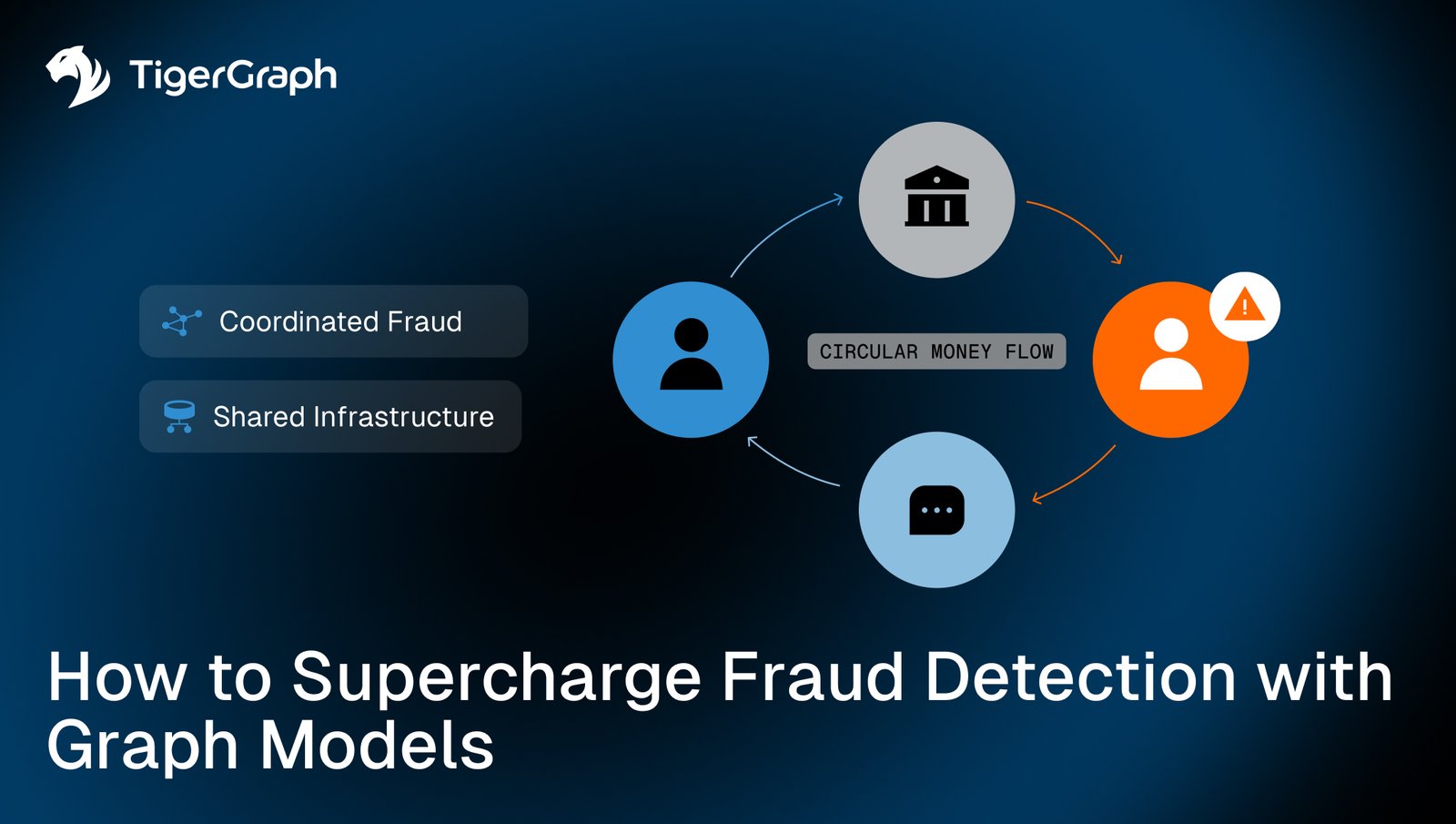
How to Supercharge Fraud Detection with Graph Models
Fraud is a network problem. It rarely appears as one obviously suspicious transaction. More often, it unfolds over time as a sequence of actions across multiple accounts, devices, and payment instruments.
Funds move in loops, within accounts that share infrastructure. Money is layered through intermediaries and the overall activity is fragmented to avoid triggering simple rules. The challenge is not identifying a single outlier. It is recognizing a coordinated pattern embedded inside legitimate activity.
That is a structural problem. And structure is what graph models are designed to capture.
Key Takeaways
- Fraud is typically a coordinated pattern across accounts, devices, and transactions, not a single anomalous event.
- Traditional transaction monitoring struggles to detect multi-step, multi-entity schemes.
- Graph models expose circular flows, mule networks, shared infrastructure, and layered transfers.
- Graph feature engineering enriches machine learning models with structural signals.
- Graph neural networks incorporate neighborhood structure directly into prediction.
- Structural detection reduces blind spots that rule-based or row-based systems miss.
Fraud is a Pattern, Not a Row
Financial institutions typically monitor fraud in two major areas: identity verification and transaction activity.
Transaction monitoring systems flag unusual payments, changes in velocity, or threshold breaches. Analysts then begin with a suspicious entity and expand outward to review related activity.
In a traditional tabular database, data is stored in separate tables. Customer information lives in one table. Transactions live in another. Device data may live somewhere else. To analyze how those entities relate, the system must perform a “join.” A join is the operation that links rows from different tables based on a shared field, such as a customer ID or device token.
That works for simple relationships.
But as investigations deepen, each additional connection requires another join. If an analyst wants to move from a customer to their device, then from that device to other customers, and then to those customers’ transactions, each step adds more joins. Queries grow longer, harder to maintain, and more computationally expensive.
Fraudsters exploit that friction.
They distribute transactions across multiple users. They reuse devices across accounts. They route funds through intermediaries and recycle money back to the origin. The deeper the pattern, the more complex the query needed to uncover it.
In a relational database, these behaviors appear as separate rows scattered across multiple tables.
But in a graph model, they appear as connected structures that can be followed step by step, or “traversed.”
Modeling Financial Crime as a Network
When transactions are modeled as a graph, entities such as users, transactions, devices, and payment instruments become nodes. Their interactions become relationships.
Instead of asking, “Is this transaction unusual?” we can ask:
- Is this user part of a circular flow of funds?
- Are multiple accounts operating from the same device?
- Is money returning to its origin within a short time window?
- Do several accounts share infrastructure previously linked to chargebacks?
Consider a circular money flow where a user sends funds to another account and that account forwards the funds onward. After several steps, the money returns to the original sender. The amounts are similar and the timing is tight.
In a dashboard, this appears as several ordinary transfers. In a graph, it appears as a loop. That difference matters.
Graph “traversal” allows investigators to follow multi-step paths across accounts and time, reconstructing the sequence of activity exactly as it occurred. Fraud becomes a network investigation rather than a transaction review.
Moving Beyond Fraud System Rules
Many fraud systems begin with rules.
- If a transaction exceeds a certain amount, flag it.
- If too many payments occur in a short window, trigger an alert.
- If an account interacts with a known high-risk entity, escalate it.
Rules work well for patterns we already understand. But fraud tactics evolve. Once criminals learn the thresholds, they adjust their behavior to avoid triggering them.
Machine learning adds adaptability and helps spot behaviors that traditional rules miss. Instead of relying only on fixed thresholds, models learn from historical fraud cases. They detect combinations of signals that humans may not have explicitly defined. A transaction might look ordinary on its own, but unusual when evaluated alongside dozens of other attributes.
Graph strengthens this approach in two important ways.
1. It generates structural features. These are signals derived from how an account behaves within a network, not just what it does individually. For example, how many other accounts connect to it? How close is it to previously identified fraud? Does it sit at the center of a dense cluster?
2. Graph allows models to incorporate relational structure directly. Rather than treating each account as an isolated record, the model can learn from its neighborhood and connections.
This combination moves fraud detection beyond static rules toward adaptive, structure-aware detection.
Graph Feature Engineering
One of the most practical advantages of graph modeling is the ability to create better inputs for machine learning. Instead of feeding a model only raw transaction details, such as amount, time, and location, graph modeling allows us to generate features based on how an account behaves within the network.
For example, we can calculate:
- How many other accounts connect to this one
- How many transactions flow in and out
- Whether funds move repeatedly through the same group of accounts
- How close this account is to previously confirmed fraud cases
- Whether the account sits at the center of a dense cluster
These are not attributes stored in a single transaction record. They describe position and behavior within the broader system.
That added context changes how a model evaluates risk. Instead of judging an account only by what it did, the model can evaluate where it sits and how it interacts with others. That often leads to stronger signals and fewer blind spots.
Feature engineering strengthens traditional models, and graph neural networks go a step further.
Graph Neural Networks
Traditional models treat each account as an independent data point. They look at rows of attributes and try to classify them. Graph neural networks treat each account as part of a neighborhood.
If a cluster of connected accounts exhibits suspicious behavior, that pattern influences predictions for nearby accounts. The model learns not only from individual attributes, but from how behavior spreads across connections.
In coordinated fraud scenarios, this matters. Fraud typically propagates through shared devices, mule accounts, intermediaries and recycled funds. Models that incorporate neighborhood structure are better positioned to detect those coordinated patterns.
The underlying logic is simple:
- Fraud spreads through connections.
- Models that understand connections detect it more effectively.
Graph strengthens fraud detection in three clear and practical ways.
1. It Exposes Coordinated Patterns
Graph models allow investigators to follow connections step by step. Instead of seeing separate transactions, they see the full flow of activity.
- Circular money movement.
- Clusters of mule accounts.
- Multiple users operating from the same infrastructure.
These coordinated patterns are difficult to uncover when transactions are treated as independent rows. Graph makes them visible because it models how entities are connected.
2. It Adds Network Context to Machine Learning
Machine learning models are only as strong as the signals they receive. Graph modeling generates additional signals based on how an account behaves within the network. For example:
- How many other accounts connect to it
- Whether it sits at the center of a dense cluster
- How close it is to previously confirmed fraud
These signals describe position and influence, not just transaction details. When added to traditional models, they provide context that simple attributes cannot capture.
The model no longer evaluates activity in isolation. It evaluates behavior within a connected system.
3. It Allows Models to Learn from Relationships
Graph neural networks go a step further by incorporating connections directly into prediction.
Instead of analyzing each account independently, the model learns from neighborhoods. If a group of connected accounts shows suspicious behavior, that structural signal influences predictions across the cluster.
This is especially powerful in coordinated fraud scenarios, where the risk is not confined to one account but spreads across many. Fraudsters operate in networks, so effective detection systems must do the same.
Contact TigerGraph
If your organization is working to detect coordinated fraud, reduce false positives, or strengthen transaction monitoring with structural insight, graph analytics provides the foundation.
Contact TigerGraph to explore how connected data modeling and graph-enhanced machine learning can strengthen your fraud detection strategy.
Frequently Asked Questions
1. Why is Fraud Detection More Effective When Modeled as a Network Instead of Individual Transactions?
Fraud detection is more effective as a network because coordinated schemes span multiple accounts, devices, and transactions, which cannot be fully detected when analyzed in isolation.
2. How do Graph Models Uncover Hidden Fraud Patterns That Traditional Systems Miss?
Graph models uncover hidden patterns by connecting entities and revealing multi-step relationships such as circular flows, shared infrastructure, and coordinated activity.
3. What Makes Multi-Step Fraud Schemes Difficult to Detect With Traditional Databases?
Multi-step schemes are difficult to detect because they require complex joins across multiple tables, making it hard to trace connections and reconstruct full activity patterns.
4. How does Network Context Improve Fraud Detection Accuracy and Reduce False Positives?
Network context improves accuracy by evaluating how entities interact within a system, helping distinguish legitimate activity from coordinated fraud patterns.
5. What Types of Fraud Signals Become Visible When Relationships are Modeled Explicitly?
When relationships are modeled, signals such as circular money flows, shared devices, mule networks, and clustered behavior become visible and measurable.
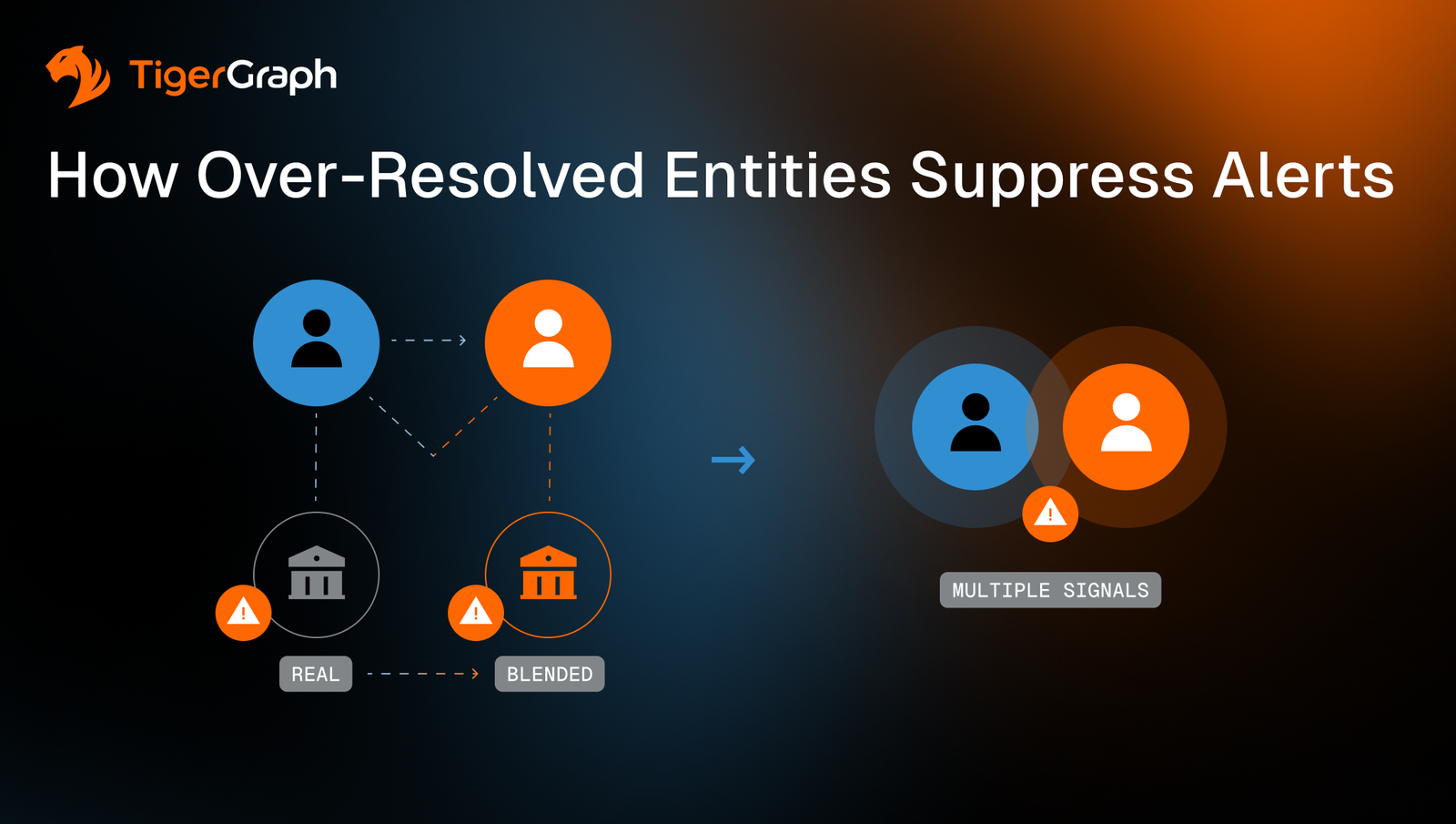
How Over-Resolved Entities Suppress Alerts
Most monitoring failures are discussed as detection problems, meaning missed rules, weak thresholds or gaps in coverage. Less attention is paid to a quieter failure that sits upstream of detection and quietly reshapes what the system can see: Over-resolved entities.
When entity resolution collapses multiple real-world identities into a single profile, alerts do not disappear because risk is absent. They disappear because risk is blended, averaged or suppressed inside an entity view that no longer represents a coherent subject.
This is how false negatives form even when detection logic behaves exactly as designed.
Key takeaways
- Over-merging can suppress alerts even when risky behavior is present.
- Blended entity views dilute signals and alter how thresholds, baselines, and suppression logic behave.
- False negatives often originate in entity structure, not in detection logic.
- Graph-based analysis helps surface where merged entities hide conflicting behavior and exposure.
To understand why these false negatives form, it helps to look at how detection systems depend on entity resolution in the first place.
Why False Negatives Often Start With Entity Resolution
Detection systems assume that the entity being evaluated represents a single, coherent subject. Transaction monitoring, behavioral baselines, alert thresholds and suppression rules all rely on that assumption.
When an entity is over-merged, the assumption breaks.
Distinct behaviors, usage patterns and risk profiles are treated as belonging to one identity. This does not always produce obvious contradictions. In many cases, it produces something more subtle.
It produces normal-looking averages.
High-risk activity can be absorbed into a larger pool of unrelated low-risk behavior. This means thresholds are no longer crossed and alerts no longer fire. Suppression logic activates because the merged entity appears established, previously reviewed or historically low risk.
Nothing looks broken, but risk is no longer visible.
When this assumption breaks, its effects surface in a small set of repeatable operational patterns.
How Over-resolved Entities Suppress Alerts in Practice
This failure mode tends to appear in a small number of recurring patterns.
Risk dilution through aggregation
When multiple identities are merged, high-risk behavior can be blended with unrelated low-risk activity. Scoring models and rules evaluate the combined view rather than the underlying fragments. The result is a lower apparent risk profile, even though the risky behavior persists.
Alerts suppressed by inherited history
Merged entities inherit history that may not belong to all underlying identities. Prior clearances, account age, or historical trust signals can suppress alerts that would have fired if the activity were evaluated independently.
Conflicting behaviors hidden inside one profile
Incompatible patterns coexist without triggering review. Because the system treats them as a single entity, contradictions are normalized instead of flagged.
Repeated remediation without resolution
Teams adjust thresholds, retrain models or tune rules, but the same issues recur. The root cause is not detection logic. It is an entity view that no longer represents a single subject.
None of these failures requires bad rules; they occur because of a distorted identity surface.
What makes these patterns persistent is how difficult they are to see using traditional, record-centric views.
Why Flat Views Struggle to Catch Over-merge Failures
Over-merge failures are often obscured. From a record-centric or flat view, the entity looks complete. It has attributes, history and activity across channels and time.
What is missing is structural clarity.
Flat views make it difficult to see whether behaviors, relationships and activity clusters actually belong together or only appear coherent because they were forced into a single profile. Without examining how evidence connects internally, teams cannot easily identify where aggregation has gone too far.
This is why false negatives caused by over-merging often persist across model versions, rule changes and review cycles.
Addressing this gap requires examining how evidence holds together structurally, not just how it appears in isolation.
What Connected Analysis Adds
Connected analysis shifts the focus from attributes to structure. So, instead of asking whether an entity looks risky overall, it asks whether the evidence that makes up the entity belongs together.
This approach supports alert quality in several ways.
It exposes internal separation
Graph analysis can show whether behaviors, devices, accounts or relationships form distinct sub-clusters inside a merged profile. Weak or fragmented connectivity is often the first sign that aggregation has exceeded structural coherence.
It makes dilution visible
By examining how risk signals are distributed across connected components, teams can see where high-risk evidence is being absorbed into unrelated activities.
It preserves paths as evidence
When alerts are suppressed, connected analysis allows teams to show which relationships and behaviors contributed to that outcome. This supports QA, escalation review and model governance.
It separates structure from judgment
The graph returns connected context. Decisions about splitting, escalation or suppression remain governed by policy and human review.
Making structure visible creates a clear path from diagnosis to practical remediation.
Applying this Insight Operationally
Reducing false negatives caused by over-merging does not require abandoning automation. It requires adding structural checks upstream.
Programs typically benefit from:
- Monitoring for internal fragmentation within resolved entities
- Reviewing alert suppression decisions when merged profiles contain conflicting behavior
- Prioritizing remediation where aggregation affects detection outcomes
- Treating repeated suppression as a signal of possible resolution failure, not reviewer error
When alert suppression changes materially after a merge, that merge should be reviewable. Entity structure should be part of the explanation, not an assumption.
How TigerGraph Fits the Workflow
The operational challenge is understanding how entity structure determines whether alerts appear at all.
Graph workflows support this by storing relationships directly and returning connected context as part of the output. Teams use this to:
- Examine whether merged entities contain structurally distinct neighborhoods
- Identify where aggregation changes risk visibility
- Review suppression decisions with connection-level evidence
The system does not decide whether an alert should fire. It provides the structural clarity needed to understand why an alert did or did not appear.
When entity resolution collapses distinct identities into a single profile, risk does not disappear. It becomes harder to see.
By making internal structure visible and reviewable, teams can identify where merges suppress alerts, dilute signals and undermine confidence in outcomes. This allows remediation to focus on the failures that matter most to detection, escalation, and auditability.
Over-resolved entities quietly change what the system can detect, and graph technology helps head this off. Contact TigerGraph to see how connected, reviewable identity context helps teams surface suppressed alerts and correct over-resolved entities before they distort outcomes.
Conclusion
Over-resolved entities don’t break detection, they quietly change what gets seen. When distinct identities are collapsed into one profile, risk doesn’t disappear. It gets diluted, averaged, and often suppressed. The system still runs. The alerts just stop showing up where they should.
This isn’t a detection problem. It’s an identity problem. You don’t fix it by tuning rules. You fix it by making entity structure visible and verifying that what’s been merged actually belongs together. Because detection is only as good as the entity it evaluates.
Frequently Asked Questions
1. What are Over-Resolved Entities and How do They Suppress Risk Alerts?
Over-resolved entities occur when multiple identities are merged into one profile, causing risk signals to blend and reducing the likelihood that alerts are triggered.
2. Why do False Negatives in Fraud Detection Often Originate From Entity Resolution?
False negatives often originate from entity resolution because merged identities distort behavior, causing detection systems to evaluate averaged or diluted risk signals.
3. How does Merging Multiple Identities Into One Profile Distort Risk Signals?
Merging identities distorts risk by combining unrelated behaviors, lowering apparent risk levels and masking high-risk activity within broader low-risk patterns.
4. How can Organizations Detect When Entity Resolution is Hiding Risk Instead of Revealing it?
Organizations can detect hidden risk by analyzing structural inconsistencies, such as fragmented clusters or conflicting behaviors within a single entity profile.
5. What Role Does Structural Analysis Play in Improving Alert Accuracy and Detection Quality?
Structural analysis improves accuracy by evaluating how data connects, ensuring that risk signals are assessed within the correct context rather than diluted through aggregation.