Contact Us

Before You Flag It as Fraud, Know Who You’re Dealing With

Banks operate on trust, but that trust is under siege. Every new account or transaction could belong to a loyal customer, or to a fraudster exploiting blind spots. Knowing the difference has become the defining challenge for fraud prevention and compliance.

The reputational damage from getting this wrong is increasingly hard to recover from. This is especially true in an environment where customers expect frictionless digital experiences and regulators demand audit-ready precision.

The challenge is that fraud detection in banking and Know Your Customer (KYC) compliance depend on more than transactions or static attributes. They depend on context. Without accurate customer identity resolution in banking, institutions risk two extremes: frustrating legitimate customers with false positives or missing sophisticated fraud entirely.

That’s why entity resolution for fraud prevention is so important.

Most banks already use match scoring, with similarity checks, substitution rules like “Blvd for Boulevard,” and weighted factors across attributes such as names, DOB, and addresses. These methods help clean up typos and duplicates, and most banks are fairly good at this hygiene.

But match scoring still treats fields in isolation, which leaves blind spots. To truly know your customer in banking, institutions must move from scoring to connecting, using graph-powered identity resolution that maps relationships, lineage, and behavior across the enterprise.

Why Traditional Fraud Detection Falls Short

Legacy systems were designed to monitor anomalies in isolation:

These techniques help, but they miss the bigger picture. Even with advances in match scoring, critical context remains invisible:

  1. False positives. Legitimate customers with unusual patterns, like frequent travelers or families sharing devices, get flagged. Analysts waste hours on false alarms that damage customer relationships.
  2. Missed collusion. Fraud networks thrive on shared infrastructure: devices, IP addresses, merchants, shell companies. Field-level checks never surface these overlaps.
  3. Compliance gaps. Regulators want explainable evidence paths, not black-box scores. Without lineage, banks cannot prove why an alert was generated.

This results in investigators drowning in alerts, legitimate customers locked out, and fraudsters slipping through gaps that match scoring systems cannot close.

How Entity Resolution Strengthens Fraud Detection

Entity resolution in banking unifies fragmented records into a connected graph, consolidating duplicate profiles and linking customers to accounts, devices, merchants, and transactions.

Instead of debating whether “John Smith” and “Jon Smythe” look similar enough to be the same, a graph database entity resolution approach ties both records back to the same passport, device, or employer. Context, not string similarity, proves the match.

This shift powers fraud detection with identity graph capabilities that expose:

It’s important to note that graph-powered fraud prevention augments match scoring; it does not replace it. 

Banks still need similarity and substitution scoring for hygiene. But when combined with graph relationships and behavioral linking, the institution gains visibility into fraud schemes that static scoring alone cannot reveal.

And because a graph-powered entity resolution model is inherently explainable, investigators can export clear evidence trails showing which nodes and edges triggered the alert. This satisfies auditors, strengthens board confidence, and builds trust with regulators.

Real-World Example: Fraud Network Analysis

A leading multinational bank struggled with false positives that overwhelmed analysts. Rules flagged anomalies, but investigators couldn’t see the networks behind them. By applying fraud network analysis with TigerGraph, the bank shifted from isolated rules to relationships.

Analysts could:

The results were transformative:

Instead of drowning in alerts, investigators zeroed in on the nodes that mattered most, exposing fraud rings in hours instead of weeks.

Why Contextual Identity Resolution Matters

Fraud isn’t random; it’s relational. To stop it, banks need contextual identity resolution that blends attributes, transactions, and behaviors into one connected view.

Traditional ToolsGraph + Identity Resolution
DetectionTransaction anomalies only. Systems catch large transfers or odd geographies but miss subtle coordination.Entity resolution for fraud prevention connects customers, devices, and merchants to surface hidden collusion.
IdentityField-level match scoring. Relies on names, DOB, and addresses that can be falsified or duplicated.Customer identity resolution in banking ties records to shared infrastructure like IPs, devices, or employers.
False PositivesHigh. Analysts chase harmless anomalies, frustrating legitimate customers.Reduced with context—behavioral linking separates real risk from unusual but valid activity.
CollusionInvisible. Fraud rings sharing devices or merchants look unrelated.Visible with fraud network analysis, where shared nodes expose mule hubs and shell companies.
AuditabilityBlack-box. Regulators see only a score with no explanation.Explainable lineage regulators can follow, showing which paths triggered the alert.

With this approach, fraud teams can show not just that an account was flagged, but why—whether it was device reuse, overlapping ownership, or proximity to a known mule hub. That transparency is exactly what regulators and boards now demand.

TigerGraph’s Advantage

TigerGraph operationalizes this at enterprise scale, turning pilots into production-ready systems:

This makes fraud detection with identity graph practical for Tier 1 banks operating at global scale, not just for controlled pilots.

Recommendations for Fraud Leaders

  1. Integrate fraud and identity. Don’t treat fraud detection and customer identity resolution in banking as separate workflows. 
  2. Prioritize explainability. Regulators expect evidence trails, not opaque similarity scores. 
  3. Adopt behavioral linking to surface collusion patterns invisible in flat data. Dynamic identity resolution does this by connecting behavior over time. 
  4. Invest in scalability, with tools that handle millions of daily events with consistent performance.

Fraud detection in banking is about knowing who you’re dealing with. Graph-powered entity resolution for AML and fraud detection enables banks to unify identities, reveal hidden networks, and satisfy regulators with explainable lineage.

With TigerGraph, financial institutions achieve fewer false positives, faster investigations, and measurable ROI.

Fraud is the transactions, people, devices, merchants, and money in motion. To stop it, you need context. And context comes from graph-powered fraud prevention.

Ready to see how this works in practice? Explore TigerGraph Cloud or reach out to our team  to discuss how leading banks are achieving millions in fraud savings with enterprise-scale graph analytics. 

What’s Missing from Your Identity Graph? Behavior.

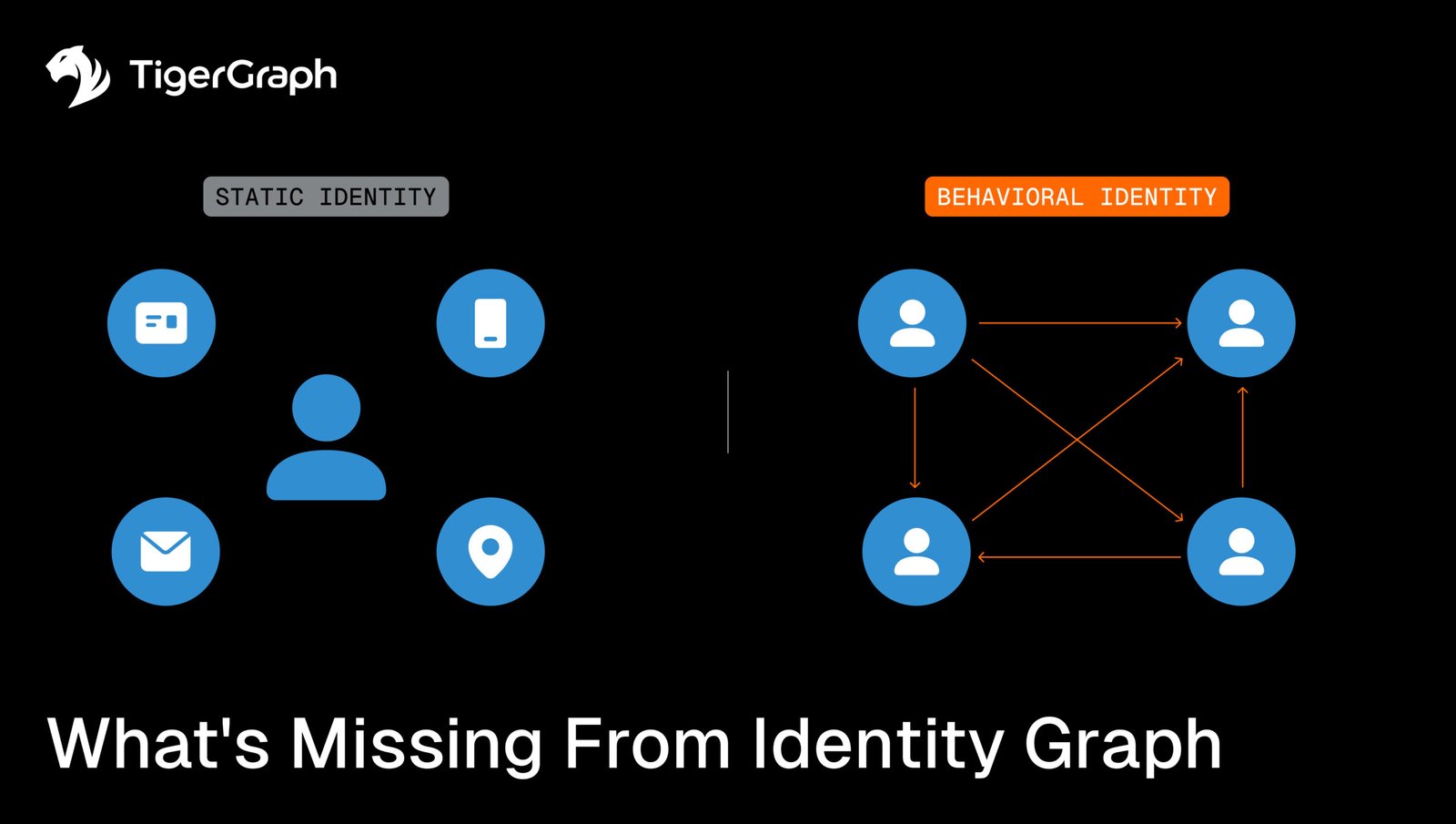
Behavior is the missing layer in most identity graphs, especially when it comes to financial crime and AML/KYC programs. Although banks have unified names, addresses, and device IDs into consolidated profiles, what they often lack is the dynamic activity that exposes risk in real time.

Forward-thinking businesses are using graphs to perform identity resolution in banking, the customer record matching that is essential for customer 360, personalization, compliance, and fraud detection with identity graph analytics. Dynamic identity resolution has become the cornerstone of modern fraud detection, KYC, and AML programs. For banks, an identity graph in banking that includes behavior is critical for staying ahead of fraudsters. 

Banks have invested millions into building “identity graphs” that unify customer attributes, including names, addresses, emails, phone numbers, and device IDs, into a single profile. This consolidation was an essential step forward. It allowed institutions to collapse duplicate records, flag synthetic identities built from mismatched data, and reduce onboarding friction for legitimate customers.

But unfortunately, most identity graphs stop there. They unify static attributes, but they don’t capture the dynamic behaviors that reveal fraud as it unfolds. A mule account looks legitimate on paper. A synthetic ID passes the attribute check. A merchant onboarding request matches a plausible business address. The static data isn’t what makes them suspicious; it’s the patterns of activity and connections over time.

Without behavioral linking, an identity graph is essentially a frozen snapshot. It’s useful for cleaning up records, but blind to how fraud actually unfolds. The gaps fraudsters exploit are almost always revealed in movement and relationships:
• Accounts that transact with each other more often than chance would allow.
• Devices that log into multiple, seemingly unrelated profiles.
• Merchants that consistently appear at the center of chargeback clusters.
• IP addresses that bounce between identities in multiple jurisdictions.

These are exactly the blind spots regulators warn about. Without behavioral identity resolution banks remain vulnerable in AML and KYC compliance.

An attribute-only identity graph will miss these because it lacks a memory of when, how often, and with whom entities interact. That means fraud teams end up reacting after the losses, instead of seeing the network form before it strikes.

In short, what’s missing is behavior. And without it, identity resolution stops short of its true purpose—turning static data into living intelligence that can keep pace with fraud in motion.

Why Behavior Matters in Identity Resolution

Behavior isn’t an optional layer on top of identity resolution in banking, but the context that makes an identity graph useful for fraud detection with identity graph methods. Three forces make this especially urgent for top banks today:

  1. Fraud is networked action, not individual states.
    Modern fraud schemes are designed to pass basic attribute checks. A synthetic identity may have a real SSN paired with a fake address; a mule account may look indistinguishable from a legitimate customer profile. What exposes them is the web of interactions:

These patterns are invisible when records are flattened into rows. But they light up in a behavioral identity graph that records the interactions as well as the objects.

  1. Regulators demand explainable context.
    Compliance frameworks like AML, KYC, and FinCEN’s new priorities increasingly require why an account was flagged, not just that it was. Behavioral linking provides this lineage, a critical aspect of behavioral data for AML and KYC audits. Banks can demonstrate, for example:

This creates audit-ready transparency, which regulators expect and which static identity resolution cannot deliver.

  1. Customers demand speed and fairness.
    False positives erode trust and send good customers to competitors. Behavioral linking makes it possible to separate legitimate anomalies from truly suspicious activity.

By adding behavior, banks can approve legitimate activity faster while focusing investigator attention on actual risk. That’s why banks are adopting graph-powered fraud prevention, reducing false positives while improving customer experience.

How TigerGraph Elevates Identity Graphs

While traditional tools flatten data into rows, TigerGraph makes relationships and behavior first-class citizens.

Real-World Example: At one leading digital bank, identity resolution alone wasn’t catching scam networks. By layering in behavioral context, such as device reuse, temporal patterns, and shortest-path proximity to known mule accounts, the bank significantly increased fraud recall, while also cutting false positives. This resulted in millions of monthly losses prevented, faster investigations, and stronger protection for customers—showing the power of behavioral identity resolution at scale. And it was all possible without adding headcount. 

An identity graph without behavior is like a map without roads. You can see the landmarks, but not how they connect or where the traffic is flowing. TigerGraph combines entity resolution with behavioral linking and context, giving banks and other businesses the ability to expose fraud rings, meet compliance demands, and protect customers in real time. 

This is just one example of how graph-powered fraud prevention and dynamic identity resolution strengthen financial crime defenses while improving customer trust.

Ready to see the full picture? TigerGraph can help you build identity intelligence that scales with your business and outpaces fraudsters. Reach out to learn more today.


Why Matching Scoring Isn’t Enough for Identity in Banking

Identity is the heart of modern banking. Every compliance check, every AML investigation, every onboarding workflow ultimately depends on answering one deceptively simple question: who are we really dealing with? This is the challenge of identity resolution in banking.

And the stakes could not be higher. 

Fail to identify a bad actor, and you risk money laundering, fraud losses, and regulatory penalties. Fail to correctly recognize a legitimate customer, and you frustrate them with false positives, long onboarding times, or unnecessary investigations. Either way, the consequences are financial, reputational, and operational.

But identity data in banks is anything but clean. Names are misspelled. Addresses change. Phone numbers get recycled. Customers appear across multiple lines of business under slightly different profiles. A single “real person” may exist as half a dozen records, none of which tell the full story.

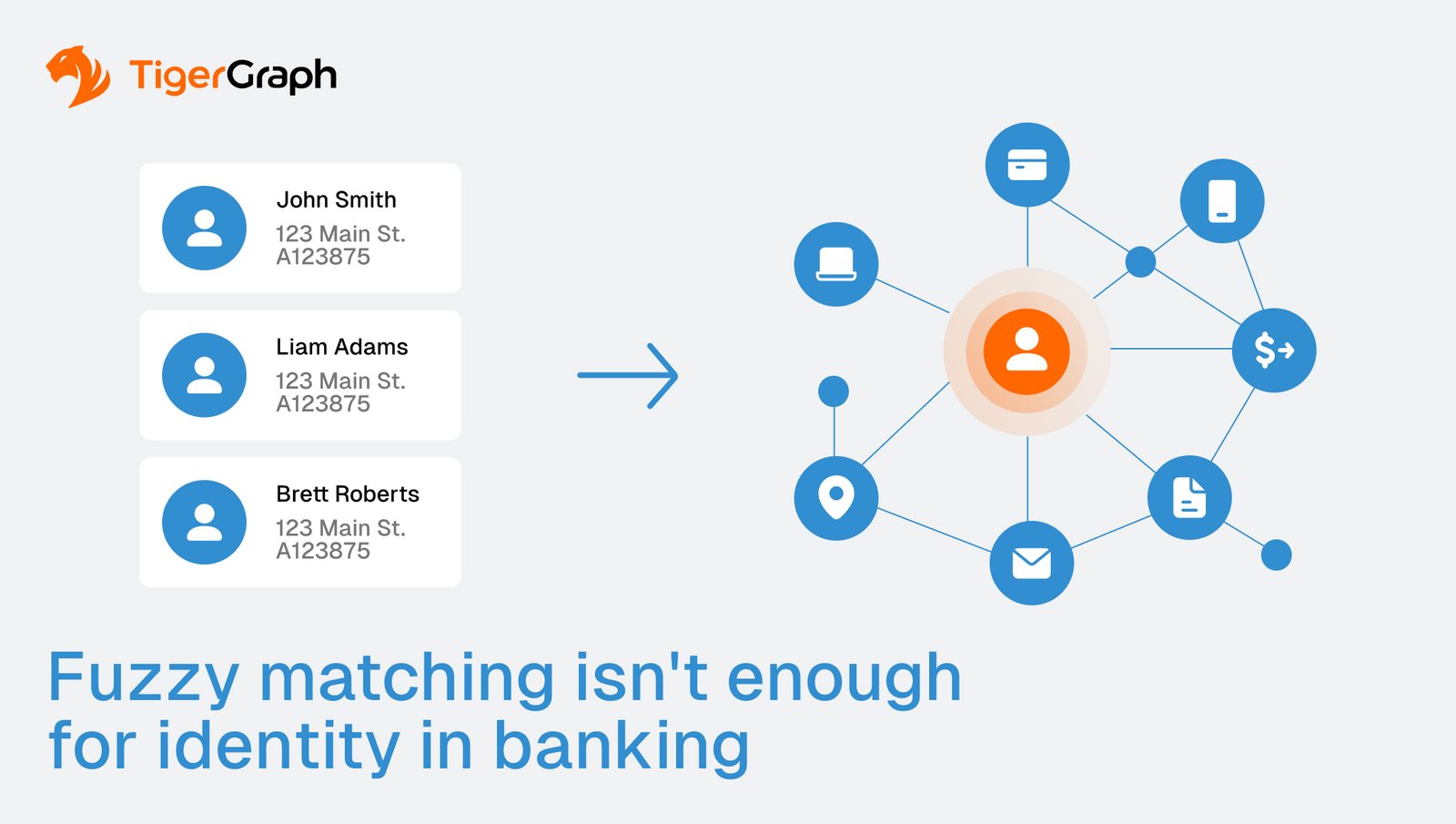
Traditionally, banks have leaned on match scoring to bridge the gaps. This includes similarity scoring (typos, misspellings), substitution scoring (Blvd ↔ Boulevard, Jack ↔ John, Mumbai ↔ Bombay), and weighted scoring of attributes (name, DOB, phone number, address). These methods improve basic data hygiene, but fuzzy matching limitations remain. Even with substitution and weighting, match scoring only looks at fields in isolation and misses the broader relational context that matters for identity resolution in banking.

Where Match Scoring Falls Short

Match scoring is widely used in banking, but its limitations are becoming painfully clear. Its focus on individual fields like names, addresses, and emails ignores the richer relational context of customer identity. And that narrow approach introduces four critical flaws:

  1. Records in isolation.
    Match scoring compares strings field by field, treating them as disconnected entries. But real-world identity spans products, devices, geographies, and counterparties. A customer listed as “Jon Smith” in one system and “John Smythe” in another might not register as a match, even though both connect to the same passport number or mobile device. By ignoring connections, match scoring delivers an incomplete picture.
  2. False positives.
    Similarity scores cut both ways. Two unrelated people with similar names or nearly identical addresses may be flagged as duplicates. Analysts then spend hours investigating matches that go nowhere. The more false positives flood in, the harder it becomes to focus on signals that matter. While match scoring is useful for catching typos and substitutions, its reliance on similarity scores increases false positives in large-scale banking environments.
  3. Missed sophisticated fraud.
    Criminals understand how match scoring works, and they know how to outsmart it by creating synthetic identities designed to look distinct on paper, but which share subtle relational ties. We see the same phone number used across multiple accounts, repeated IP addresses, or overlapping ownership structures.  Match scoring can’t connect those dots, so the fraud slips through. This is why regulators are emphasizing entity resolution for AML and KYC as a discipline that goes beyond match scoring.
  4. Poor scalability.
    As banks operate across more countries, identity data grows exponentially more complex. Different languages, alphabets, and address formats multiply the possibilities for variation. What looks like a simple transliteration error to a human appears as an entirely new customer to a string-matching system. The outcome is either missed matches or an avalanche of false positives that swamp compliance teams. Even advanced match scoring methods struggle to scale across diverse languages and jurisdictions.

Taken together, these flaws leave institutions exposed. Compliance teams waste resources chasing false alarms. Regulators demand precision and auditability that similarity scores alone cannot provide. And bad actors exploit the blind spots, moving money through gaps fuzzy logic was never designed to close.

Why Graph Transforms Entity Resolution

Graph technology changes the field of play by shifting from matching (exact or fuzzy) to connecting relationships. This is the essence of graph-powered identity resolution.

Instead of comparing one record to another in a vacuum, graph builds a connected network of customers, accounts, devices, and transactions. It’s in those relationships that true identity and true risk become visible. 

Consider duplicate customer records. A fuzzy match might hesitate to connect “Jon Smith” and “John Smythe.” But a graph model instantly highlights that both tie back to the same phone number, passport ID, or employer. The relational evidence confirms the match with higher confidence.

Graph also cuts through false positives. Two “Jane Lees” may appear similar in isolation, but if one is connected to Hong Kong retail accounts and the other to London pension assets, with no shared devices or addresses, the graph shows immediately that they are different people. Analysts avoid wasting time on dead-end investigations.

The same principle applies to fraud. Fraudsters often reuse pieces of infrastructure, like addresses, merchants, or devices, across otherwise distinct synthetic identities. 

Graph traversals can follow these shared anchors across multiple hops, exposing the collusion and fraud rings that fuzzy matching misses entirely. Instead of a collection of similarity scores, the investigator sees a network of relationships that tells the full story.

And unlike brittle rules-based systems, graph scales naturally with complexity. 

Whether it’s reconciling names across alphabets, normalizing addresses across jurisdictions, or mapping thousands of accounts to a single high-risk hub, graph models preserve context without breaking. 

TigerGraph, for example, has proven the ability to support billions of transactions per day with queries returning in milliseconds, making enterprise-grade entity resolution not just possible, but practical.

By moving beyond string similarity to relationship-driven resolution, graph delivers what banks need most: fewer false alarms, faster investigations, and greater confidence that they truly know their customers.

Real-World Outcomes of Graph-Powered Entity Resolution

When Tier-1 banks apply graph-powered entity resolution, the results show up across compliance, operations, and risk management.

For CDAOs and VP Data Science leaders, graph elevates entity resolution into a strategic advantage.

Why Now?

The pressure to get identity right has never been greater. Regulators like FinCEN, AMLD in Europe, and FATF globally are demanding more transparency and traceability. They no longer accept “black box” similarity scores; they expect clear evidence trails showing how entities are connected and why alerts are escalated or dismissed.

At the same time, fraudsters are innovating faster than quarterly compliance cycles. They exploit gaps in siloed systems, stitching together synthetic identities, laundering funds across borders, and hiding behind corporate structures that fuzzy matching cannot untangle. Every blind spot is an opportunity for loss.

Meanwhile, customer expectations are rising. Legitimate applicants don’t tolerate delays caused by false positives. If onboarding is slow or intrusive, they walk away, and competitors with smoother digital experiences win the relationship.

That’s why graph-powered entity resolution isn’t a “nice to have.” It’s essential for banks that want to stay ahead of regulators, outpace fraudsters, and meet customer expectations. The institutions that act now will gain cleaner data, stronger compliance, and faster investigations. Those who delay risk higher costs, greater exposure, and mounting regulatory scrutiny. 

Legacy fuzzy matching limitations are no longer acceptable; regulators expect graph-powered identity resolution to underpin explainability.

The question isn’t whether to move beyond fuzzy matching, it’s how quickly.

Cleaner data. Stronger compliance. Lower risk.

Reach out for more info on how to use graph-powered identity resolution to strengthen entity resolution for AML and KYC, reduce fuzzy matching limitations, and accelerate customer identity verification banking. And experience fraud detection with graph analytics in minutes by launching your free TigerGraph instance at tgcloud.io.