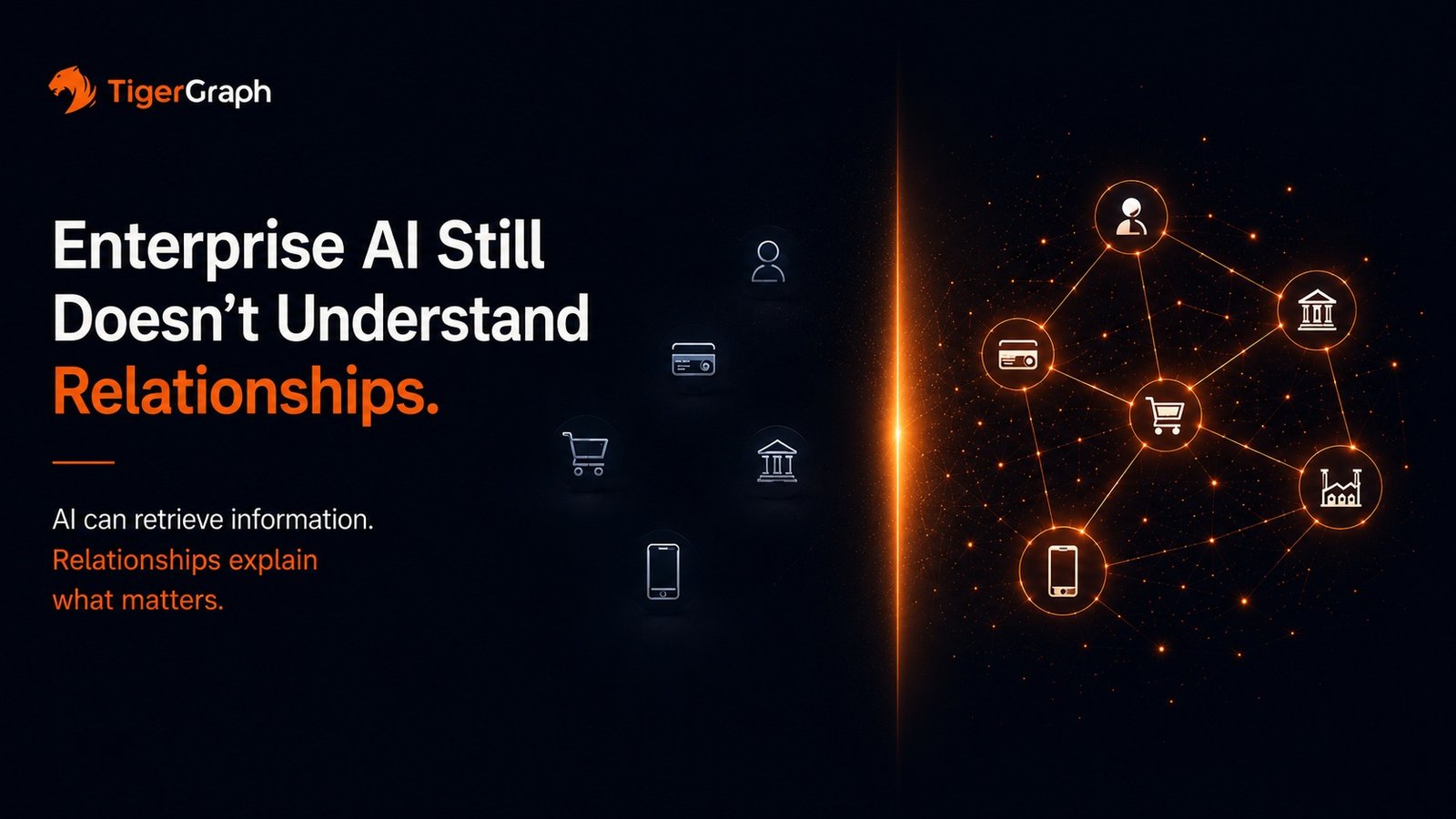
Enterprise AI Still Doesn’t Understand Relationships
AI systems have become very good at retrieving information. They can summarize documents, generate answers, classify content, write code, search across large knowledge bases, and reason through complex instructions with remarkable speed. That progress is real.
But as enterprises move AI closer to production decision-making, a harder problem is becoming visible. AI can retrieve information. It still struggles to understand how the enterprise actually works. That distinction matters because enterprises are not collections of isolated records. They are networks of customers, accounts, devices, identities, transactions, organizations, behaviors, dependencies, and trust relationships.
Most important business decisions do not come from one record or one document. They come from understanding how things connect over time. That is where many current AI architectures remain incomplete. They can retrieve relevant information. They can assemble context. They can generate fluent answers. But retrieval is not the same as understanding. And in operational environments, that gap becomes increasingly difficult to ignore.
Enterprises Do Not Operate as Isolated Records
A large part of the AI stack still treats enterprise context as something that can be assembled at query time. Retrieve the closest documents. Pull the most relevant records. Pass the context into the model. Generate an answer. For many informational tasks, that works well.
But production systems are different. A fraud investigation is not just a set of transactions. A risk decision is not just an account record. An identity decision is not just a customer profile. A cybersecurity event is not just an alert. The meaning comes from how those signals relate to one another.
Who is connected to whom. Which device appears across multiple accounts. Which behavior changed over time. Which transaction is connected to which merchant, organization, identity, location, or prior decision. That is the structure underneath operational reality. And it is relational.
This is why enterprise AI often performs well in controlled tasks but becomes harder to trust in production environments. The system may retrieve useful information, but it may not preserve the relationships that make that information meaningful. That is not a small limitation.
It is an infrastructure problem.
Retrieval Finds Information. Relationships Explain Meaning.
The modern AI stack has made retrieval central to how systems reason. That is understandable. Enterprises have enormous amounts of information, and AI systems need a way to find what matters.
But retrieval has limits. Retrieval can find proximity. It can surface similar documents. It can identify relevant fragments. It can reduce the amount of information passed into a model.
What it does not automatically do is preserve the connected structure of the enterprise. That structure matters.
A transaction by itself rarely explains fraud. A network often does. An account by itself rarely explains risk. Relationships often do. A document by itself rarely explains identity. Connected behavior over time often does. This is the difference between retrieving information and understanding the relationships underneath it. For enterprise AI, that difference becomes critical.
Because once AI systems begin participating in operational decisions, organizations need more than plausible answers. They need reasoning that is grounded in how the business actually operates. They need context that persists across workflows. They need decisions that can be explained. They need systems that can understand not only what information is relevant, but why it matters in relation to everything else.
That is where relationship intelligence becomes foundational.
The Most Important Enterprise Problems Are Relationship Problems
Many of the highest-value AI use cases in the enterprise are not isolated data problems. They are relationship problems.
Fraud detection is a relationship problem. Fraud rarely appears as a single obvious transaction. It emerges through connected behaviors across identities, devices, accounts, merchants, channels, and time.
Anti-money laundering is a relationship problem. Suspicious activity often becomes visible only when transactions, counterparties, accounts, entities, and patterns are connected.
Identity resolution is a relationship problem. A customer, device, household, business, account, and behavioral history may each exist in separate systems, but the decision depends on understanding how they connect.
Cybersecurity is a relationship problem. Threats rarely exist as isolated alerts. They move through systems, privileges, users, devices, and access patterns. Operational risk is a relationship problem. Risk propagates across dependencies, workflows, organizations, vendors, and decisions.
These are precisely the environments where AI is becoming more important. They are also the environments where isolated retrieval is least sufficient. Because the important question is rarely, “What information is similar to this?” The better question is, “How is this connected to everything else we know?” That is the question most enterprises need AI to answer in production.
Agentic AI Makes the Relationship Problem More Important
This problem becomes even more important as organizations move toward agentic AI.
A single AI assistant answering a question is one thing. A network of AI systems retrieving information, making recommendations, escalating issues, updating workflows, and triggering actions across an enterprise is something very different. In that environment, relational grounding becomes essential.
If autonomous systems operate without a durable understanding of entity relationships, they begin making decisions from partial views of reality. One system may evaluate a transaction. Another may assess an identity. Another may review a customer profile. Another may trigger an action. Each step may look reasonable on its own.
But if those systems do not share an understanding of how the underlying entities connect, the enterprise loses coherence. The problem is not that the AI is incapable of reasoning. The problem is that the reasoning is not grounded in the connected structure of the business. That is where risk enters.
An AI system can sound confident while missing the relationship that changes the meaning of the decision. It can retrieve the right document while missing the network around the entity.
It can summarize the record while failing to see the pattern. That is why relationship intelligence is not a technical enhancement at the edge of the architecture. It is becoming part of the foundation.
Vectors Are Powerful. They Are Not Enough.
Vector search has become an important part of modern AI infrastructure. It is powerful for similarity. It helps systems find relevant content. It makes large knowledge bases more accessible. It plays an important role in retrieval-augmented generation and enterprise search.
But similarity is not the same as relationship understanding. Two documents can be semantically similar without explaining how entities connect. Two transactions can look similar without belonging to the same fraud ring. Two customer records can appear separate while representing the same person, household, or business relationship. Two alerts can look unrelated until the underlying device, account, credential, or behavior pattern connects them.
This is where relationship intelligence changes the system. It gives AI a way to reason over connected reality rather than isolated fragments. Not because graphs replace vectors. Not because relationships replace models. Because enterprise AI needs both. Vectors help retrieve relevant information.
Relationships help explain how that information fits into the operational structure of the enterprise. That combination becomes increasingly important as AI systems move from answering questions to supporting decisions.
TigerGraph Preserves the Structure AI Needs
This is where TigerGraph operates differently. TigerGraph is built to preserve relationships structurally, at enterprise scale, in real time. That matters because the context does not need to be reconstructed from scratch every time an AI system reasons. The relationships are already part of the operational foundation.
Entities remain connected. Decision paths become easier to trace. Multi-hop context becomes accessible. Patterns across accounts, devices, transactions, identities, and behaviors can be evaluated as part of the system itself.
That changes how AI behaves. The system is no longer reasoning only over temporary fragments assembled at query time. It can reason over the connected structure of the enterprise. For fraud, that means seeing the network behind the transaction. For identity, it means understanding the relationships behind the profile. For risk, it means evaluating how signals propagate across entities and time. For operational AI, it means preserving context as decisions move across workflows.
This is the infrastructure layer many enterprises will need as AI becomes more autonomous, more persistent, and more deeply embedded in production environments. The value is not simply that the data is connected. The value is that the system can preserve connected understanding while AI operates. That is the difference between information retrieval and operational intelligence.
The Future Enterprise Stack Will Include a Relationship Layer
The first phase of enterprise AI focused heavily on models. The next phase is becoming more architectural. Enterprises will still need powerful models. They will still need retrieval. They will still need orchestration, governance, and security.
But those layers will not be enough on their own. As AI moves into operational environments, enterprises will increasingly need a relationship layer: infrastructure that preserves how entities, behaviors, decisions, and risks connect in real time. That layer will be especially important in high-stakes environments where decisions must remain explainable, auditable, and defensible.
Because in those environments, the question is not simply whether AI can produce an answer. The question is whether the system can understand the context behind the answer. That context is rarely flat. It is connected.
The future of enterprise AI will not be defined only by systems that retrieve more information. It will be defined by systems that understand how information relates. That is the next infrastructure shift. The first generation of enterprise AI connected models to data. The next generation will connect AI to relationships. Because in production environments, isolated information is rarely enough.
What matters is whether the system understands how everything connects.
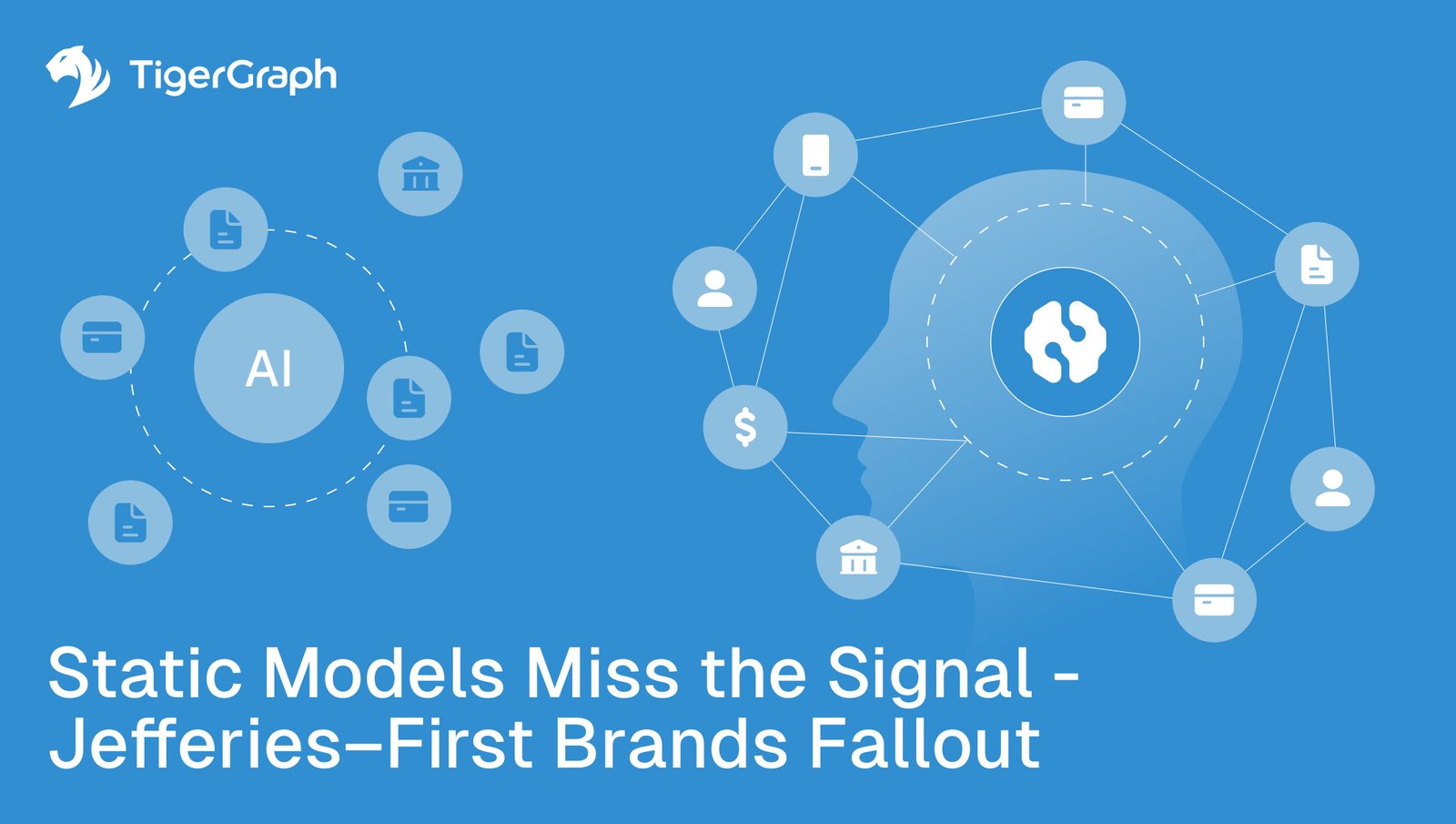
How Jefferies’ First Brands Scandal Exposed the Limits of Static AI and Why Graph Intelligence Is the Future of Financial Risk Detection
When Jefferies Financial Group revealed that it had been defrauded by bankrupt auto parts maker First Brands, it highlighted the fragility of traditional financial intelligence. The firm’s exposure wasn’t buried in a bad deal. It was buried in disconnected data.
Separate funds, subsidiaries, and creditors were all tracking their own numbers without seeing how those portfolios overlapped. When the defaults hit, the relationships between funds and borrowers became visible only in hindsight. It was a classic case of “flat data” in a networked world. It serves as a warning that static AI and siloed systems miss the most important signals.
What the Fallout Revealed
Jefferies’ leadership described the event as outright fraud. Yet the real story is one of fragmentation.
The firm’s asset management fund held receivables connected to First Brands, while its investment banking division operated under a separate structure. Both had partial context but no complete picture.
When markets rely on spreadsheets, reports, and static models, they see numbers, not networks. Those tools can capture financial transactions, but can’t show how one fund, borrower, or guarantor connects to another. This results in disconnected datasets and blind spots large enough to obscure systemic exposure until losses surface.
And this is not unique to Jefferies.
Across finance, compliance teams and risk officers face the same challenge. They’re using systems designed to measure performance, not relationships. When those relationships turn toxic, even the best statistical model can’t explain why.
Why Static AI Fails to Catch Relationship Risk
AI built on isolated data is inherently myopic. Machine learning models trained on historical features, like credit scores, repayment rates, or asset values, can detect anomalies but can’t reason about causality. They flag when something looks wrong, but not when connections make it risky.
The Jefferies–First Brands collapse shows what that gap looks like in practice. The problem wasn’t hidden transactions, but hidden proximity. The relationships among borrowers, creditors, and funds that no one system was built to track.
Without a framework for relational reasoning, AI sees financial entities as independent points rather than nodes in an interconnected web. It can model events but not exposure chains. That’s why fraud or default often looks like a surprise when the warning signs were there.
They were all linked, just invisible.
How Graph-Based Reasoning Fills the Gap
Graph technology changes the focus from isolated transactions to interconnected entities. Every borrower, fund, guarantor, and asset becomes a node, and each relationship, such as ownership, co-signing, shared collateral, becomes an edge.
By analyzing those edges, institutions can:
- Visualize exposure chains. Map how a single borrower connects to multiple funds or creditors.
- Detect shared guarantors. Identify individuals or entities repeating across portfolios.
- Model ripple effects. Simulate how one default could spread through related assets or partners.
In the Jefferies case, a graph model could have shown how receivables tied to First Brands intersected with other distressed entities or guarantors already showing strain. The network view transforms what looks like an isolated loan into a connected risk story.
From Detection to Reasoning
Traditional analytics tell institutions that a default happened. Graph analytics explains how it spread. By combining structure with behavioral context, a connected model enables reasoning instead of reaction.
- Entity resolution links records appearing under different corporate names or fund structures, connecting addresses, guarantors, and filings to the same real-world counterparties.
- Community detection identifies clusters of borrowers, intermediaries, or investors that interact abnormally. This reveals hidden ecosystems of shared exposure.
- Path analysis shows how one financial failure might propagate through common suppliers or cross-owned assets.
This turns risk analytics into reasoning in motion. It takes advantage of a system that not only tracks transactions but also understands relationships and consequences. For complex financial ecosystems that shift from snapshots to storylines is everything.
AI + Graph: Understanding “Why,” Not Just “What”
Most AI retrieval systems today use Retrieval-Augmented Generation (RAG) to help large language models (LLMs) access external information.
When you ask a question, RAG looks for textually similar content within a predefined dataset and summarizes it. It’s a powerful technique for pulling facts or context, but it has one big limitation: it finds what looks alike, not why it’s related.
In financial risk, that distinction matters. Two filings may both mention the same borrower or guarantor, but if those names are written differently or appear in separate datasets, a traditional RAG system won’t connect them. The model sees surface similarity in wording, not the structural relationship underneath.
That’s where GraphRAG, or Graph-based Retrieval-Augmented Generation, comes in. It expands retrieval beyond semantic similarity to include relational context.
Instead of relying solely on vector embeddings (which measure the semantic similarity between two pieces of text), GraphRAG also explores how entities connect within the data itself.
For example, when assessing loan risk, GraphRAG could reveal that two seemingly unrelated borrowers share the same guarantor, property, or legal representative. It uncovers how those documents are linked by real-world relationships.
Now, when you pair GraphRAG with agentic AI, the system can decide the best way to answer each question:
- Traverse the graph to map concrete relationships between entities.
- Use vector similarity to retrieve contextually related text, such as filings or court documents, with matching patterns.
- Hybridize both approaches, connecting structured and unstructured data into a single, contextual answer.
That decision-making layer makes retrieval situational, not mechanical. The AI can reason through connections, transitioning between relational logic and semantic meaning as needed by the task.
This hybrid graph + vector approach transforms AI from a pattern detector into a reasoning engine. When applied to financial fraud or exposure analysis, it can show which entities appear connected and also why they’re connected. It traces every relationship that led to a flagged result.
For regulators and compliance teams, that level of traceability is critical. It means every AI-driven alert can be explained and audited, not just observed.
Pairing AI with graph context gives financial institutions what they’ve been missing: a system that thinks in context.
From Reaction to Prevention
In the wake of the Jefferies fallout, analysts noted how quickly market anxiety spread. That speed is the real risk, as exposure propagates faster than oversight. Connected data analytics changes that by providing continuous, contextual visibility.
With graph-powered AI, financial institutions can:
- Detect fund overlap and counterparty exposure in real time.
- Model network effects across loans, suppliers, and receivables.
- Correlate unstructured filings, contracts, and public disclosures to identify emerging risks.
- Generate early alerts when new entities link to known problem areas.
The goal is to surface risk before it compounds.
Why TigerGraph Enables Explainable Risk Intelligence
TigerGraph delivers the hybrid graph + vector database foundation needed to uncover hidden relationships at scale. Its parallel computation engine analyzes billions of relationships daily, correlating structured financial data with unstructured content like filings, news reports, or internal notes.
For institutions balancing regulatory scrutiny and market speed, TigerGraph’s unified architecture provides:
- Real-time performance for monitoring evolving exposure networks.
- Explainable outputs that trace every AI insight back to its data relationships.
- Solution kits for fraud detection, AML, and risk intelligence that accelerate deployment.
By connecting structure with meaning, TigerGraph transforms “flat” analytics into connected reasoning. Financial teams can act on insight, not assumptions, and see where exposure exists and how it spreads.
Summary
The Jefferies–First Brands fallout revealed how static models and siloed AI leave organizations blind to relationship-driven risk. In complex financial ecosystems, context is the real signal and graphs are the only structure that can show it in time.
With TigerGraph’s hybrid graph + vector architecture, institutions can see beyond transactions to the relationships that define them. The result is explainable AI for finance that’s transparent, accountable, and capable of reasoning through risk before it becomes loss.
Ready to Unlock Your Data’s Hidden Value? Reach out today to join thousands of developers and data scientists using TigerGraph’s leading graph analytics platform to solve complex problems with connected data. And start experimenting and prototyping at no cost, with a free TigerGraph Savanna.
Frequently Asked Questions
What caused Jefferies Financial Group to miss the First Brands fraud warning signs?
Jefferies relied on siloed systems and static data models that couldn’t connect related entities—funds, borrowers, and guarantors—across divisions. Without a unified relationship graph, overlapping exposures stayed invisible until defaults triggered losses.
How does disconnected financial data create systemic risk?
When departments manage isolated spreadsheets and reports, they can’t visualize how portfolios, creditors, and counterparties overlap. This fragmented view hides shared guarantors and exposure chains that amplify losses when one entity fails.
Why can’t traditional AI models catch relationship-driven fraud?
Conventional AI learns from static features such as credit scores or payment patterns. It lacks relational reasoning—the ability to see why two entities are risky together. Graph analytics adds that missing context by modeling real-world connections.
What advantages does GraphRAG bring to financial intelligence?
Graph-based Retrieval-Augmented Generation (GraphRAG) fuses semantic search with relational data. It not only retrieves similar text but also traces how entities connect—revealing hidden guarantors, co-borrowers, or legal links that plain RAG systems overlook.
How can financial institutions apply graph reasoning today?
Banks and asset managers can deploy graph databases to unify lending, compliance, and risk data. With tools like GraphRAG and agentic AI, they can simulate contagion paths, identify shared exposures, and explain every flagged risk with full transparency for auditors.