Before You Flag It as Fraud, Know Who You’re Dealing With
Banks operate on trust, but that trust is under siege. Every new account or transaction could belong to a loyal customer, or to a fraudster exploiting blind spots. Knowing the difference has become the defining challenge for fraud prevention and compliance.
The reputational damage from getting this wrong is increasingly hard to recover from. This is especially true in an environment where customers expect frictionless digital experiences and regulators demand audit-ready precision.
The challenge is that fraud detection in banking and Know Your Customer (KYC) compliance depend on more than transactions or static attributes. They depend on context. Without accurate customer identity resolution in banking, institutions risk two extremes: frustrating legitimate customers with false positives or missing sophisticated fraud entirely.
That’s why entity resolution for fraud prevention is so important.
Most banks already use match scoring, with similarity checks, substitution rules like “Blvd for Boulevard,” and weighted factors across attributes such as names, DOB, and addresses. These methods help clean up typos and duplicates, and most banks are fairly good at this hygiene.
But match scoring still treats fields in isolation, which leaves blind spots. To truly know your customer in banking, institutions must move from scoring to connecting, using graph-powered identity resolution that maps relationships, lineage, and behavior across the enterprise.
Why Traditional Fraud Detection Falls Short
Legacy systems were designed to monitor anomalies in isolation:
- Rules flag transactions that exceed thresholds. Maybe it’s a large transfer, or from a foreign country.
- Identity verification in banking leans on attributes like SSN, phone number, or address.
- AML fraud detection applies similarity scores to catch typos, substitutions, or duplicate records.
These techniques help, but they miss the bigger picture. Even with advances in match scoring, critical context remains invisible:
- False positives. Legitimate customers with unusual patterns, like frequent travelers or families sharing devices, get flagged. Analysts waste hours on false alarms that damage customer relationships.
- Missed collusion. Fraud networks thrive on shared infrastructure: devices, IP addresses, merchants, shell companies. Field-level checks never surface these overlaps.
- Compliance gaps. Regulators want explainable evidence paths, not black-box scores. Without lineage, banks cannot prove why an alert was generated.
This results in investigators drowning in alerts, legitimate customers locked out, and fraudsters slipping through gaps that match scoring systems cannot close.
How Entity Resolution Strengthens Fraud Detection
Entity resolution in banking unifies fragmented records into a connected graph, consolidating duplicate profiles and linking customers to accounts, devices, merchants, and transactions.
Instead of debating whether “John Smith” and “Jon Smythe” look similar enough to be the same, a graph database entity resolution approach ties both records back to the same passport, device, or employer. Context, not string similarity, proves the match.
This shift powers fraud detection with identity graph capabilities that expose:
- Hidden mule networks, with dozens of accounts funneling payments through a single merchant or device.
- Synthetic identities creating different names or addresses, and sharing the same phone number or IP address.
- Shell structures that have overlapping ownership across jurisdictions, and signal money-laundering risks.
It’s important to note that graph-powered fraud prevention augments match scoring; it does not replace it.
Banks still need similarity and substitution scoring for hygiene. But when combined with graph relationships and behavioral linking, the institution gains visibility into fraud schemes that static scoring alone cannot reveal.
And because a graph-powered entity resolution model is inherently explainable, investigators can export clear evidence trails showing which nodes and edges triggered the alert. This satisfies auditors, strengthens board confidence, and builds trust with regulators.
Real-World Example: Fraud Network Analysis
A leading multinational bank struggled with false positives that overwhelmed analysts. Rules flagged anomalies, but investigators couldn’t see the networks behind them. By applying fraud network analysis with TigerGraph, the bank shifted from isolated rules to relationships.
Analysts could:
- Use entity resolution for AML and KYC to unify fragmented records into complete customer profiles.
- Apply graph centrality in fraud detection to pinpoint mule accounts sitting at the core of payment networks.
- Run PageRank fraud detection to prioritize high-influence nodes most likely to spread illicit activity.
The results were transformative:
- Cut false positives in half, while catching more true fraud.
- 300% faster investigations.
- More than $20M in annual fraud savings.
Instead of drowning in alerts, investigators zeroed in on the nodes that mattered most, exposing fraud rings in hours instead of weeks.
Why Contextual Identity Resolution Matters
Fraud isn’t random; it’s relational. To stop it, banks need contextual identity resolution that blends attributes, transactions, and behaviors into one connected view.
| Traditional Tools | Graph + Identity Resolution | |
|---|---|---|
| Detection | Transaction anomalies only. Systems catch large transfers or odd geographies but miss subtle coordination. | Entity resolution for fraud prevention connects customers, devices, and merchants to surface hidden collusion. |
| Identity | Field-level match scoring. Relies on names, DOB, and addresses that can be falsified or duplicated. | Customer identity resolution in banking ties records to shared infrastructure like IPs, devices, or employers. |
| False Positives | High. Analysts chase harmless anomalies, frustrating legitimate customers. | Reduced with context—behavioral linking separates real risk from unusual but valid activity. |
| Collusion | Invisible. Fraud rings sharing devices or merchants look unrelated. | Visible with fraud network analysis, where shared nodes expose mule hubs and shell companies. |
| Auditability | Black-box. Regulators see only a score with no explanation. | Explainable lineage regulators can follow, showing which paths triggered the alert. |
With this approach, fraud teams can show not just that an account was flagged, but why—whether it was device reuse, overlapping ownership, or proximity to a known mule hub. That transparency is exactly what regulators and boards now demand.
TigerGraph’s Advantage
TigerGraph operationalizes this at enterprise scale, turning pilots into production-ready systems:
- Performance: Handles millions of daily events with sub-millisecond multi-hop queries, enabling real-time fraud interdiction.
- Concurrency: Supports hundreds of analysts, investigators, and ML models querying simultaneously without bottlenecks.
- Feature factory: Continuously generates graph-native features—fan-in/fan-out patterns, community membership, and entity centrality banking scores—streamed directly into fraud models for higher recall and precision.
- Audit-ready lineage: Produces regulator-ready trails showing exactly why alerts were triggered, down to the device, IP, or beneficial owner.
This makes fraud detection with identity graph practical for Tier 1 banks operating at global scale, not just for controlled pilots.
Recommendations for Fraud Leaders
- Integrate fraud and identity. Don’t treat fraud detection and customer identity resolution in banking as separate workflows.
- Prioritize explainability. Regulators expect evidence trails, not opaque similarity scores.
- Adopt behavioral linking to surface collusion patterns invisible in flat data. Dynamic identity resolution does this by connecting behavior over time.
- Invest in scalability, with tools that handle millions of daily events with consistent performance.
Fraud detection in banking is about knowing who you’re dealing with. Graph-powered entity resolution for AML and fraud detection enables banks to unify identities, reveal hidden networks, and satisfy regulators with explainable lineage.
With TigerGraph, financial institutions achieve fewer false positives, faster investigations, and measurable ROI.
Fraud is the transactions, people, devices, merchants, and money in motion. To stop it, you need context. And context comes from graph-powered fraud prevention.
Ready to see how this works in practice? Explore TigerGraph Cloud or reach out to our team to discuss how leading banks are achieving millions in fraud savings with enterprise-scale graph analytics.
Contextual Entity Resolution in Banking – Beyond Just Matching
Every major bank faces one deceptively simple question: Who are we really dealing with? It’s a question that runs through every process in modern banking, from onboarding to fraud detection to AML/KYC compliance—all of which hinge on identity resolution in banking.
Most institutions rely on match scoring, with similarity checks, substitution rules like ‘Blvd for Boulevard,’ and weighted factors across attributes like names, DOB, and addresses.
This approach is valuable for cleaning up typos and duplicates, and most banks already do it well. However, it still treats records in isolation, missing the deeper relational context that exposes fraud and enables true compliance. This is why forward-looking banks are turning to identity resolution with context—a shift that captures relationships, not just records.
Contextual Entity Resolution (ER) goes beyond matching records. It improves accuracy by consolidating duplicates, but its greater value comes from revealing the relationships and behaviors connected to each identity. By framing entity resolution as both precise matching and connected context, banks can address compliance requirements and uncover fraud networks that would otherwise remain hidden.
Fraudsters exploit gaps, making synthetic identities look clean on paper and mule accounts mimic legitimate customers. Without context, banks over-flag legitimate activity while missing sophisticated fraud.
As a result, leaders are moving from “matching” to “connecting,” and from static strings to dynamic graph-powered entity resolution that exposes relationships, lineage, and behavior across the enterprise. And because contextual ER considers both identities and their networks of connections, it naturally extends into fraud detection and AML compliance.
What Match Scoring Delivers (and Where It Stops)
Traditional match scoring provides useful hygiene:
- Similarity scoring: catches typos (“Jon” vs. “John”).
- Substitution scoring: recognizes equivalents (“Mumbai” vs. “Bombay”).
- Weighted scoring: aggregates across fields (name, DOB, phone).
Match scoring is necessary, but not sufficient. Regulators now expect a shift from field-level similarity to contextual identity resolution that shows why records belong together.
But its limitations are clear. The most damaging is that records are treated in isolation, which makes it easy for fraudsters to spread attributes across synthetic identities. These gaps blind banks to collusion and hidden risk. False positives and scalability challenges add cost and complexity, but the central issue is lack of context. Taken alone, match scoring’s limitations leave institutions exposed.
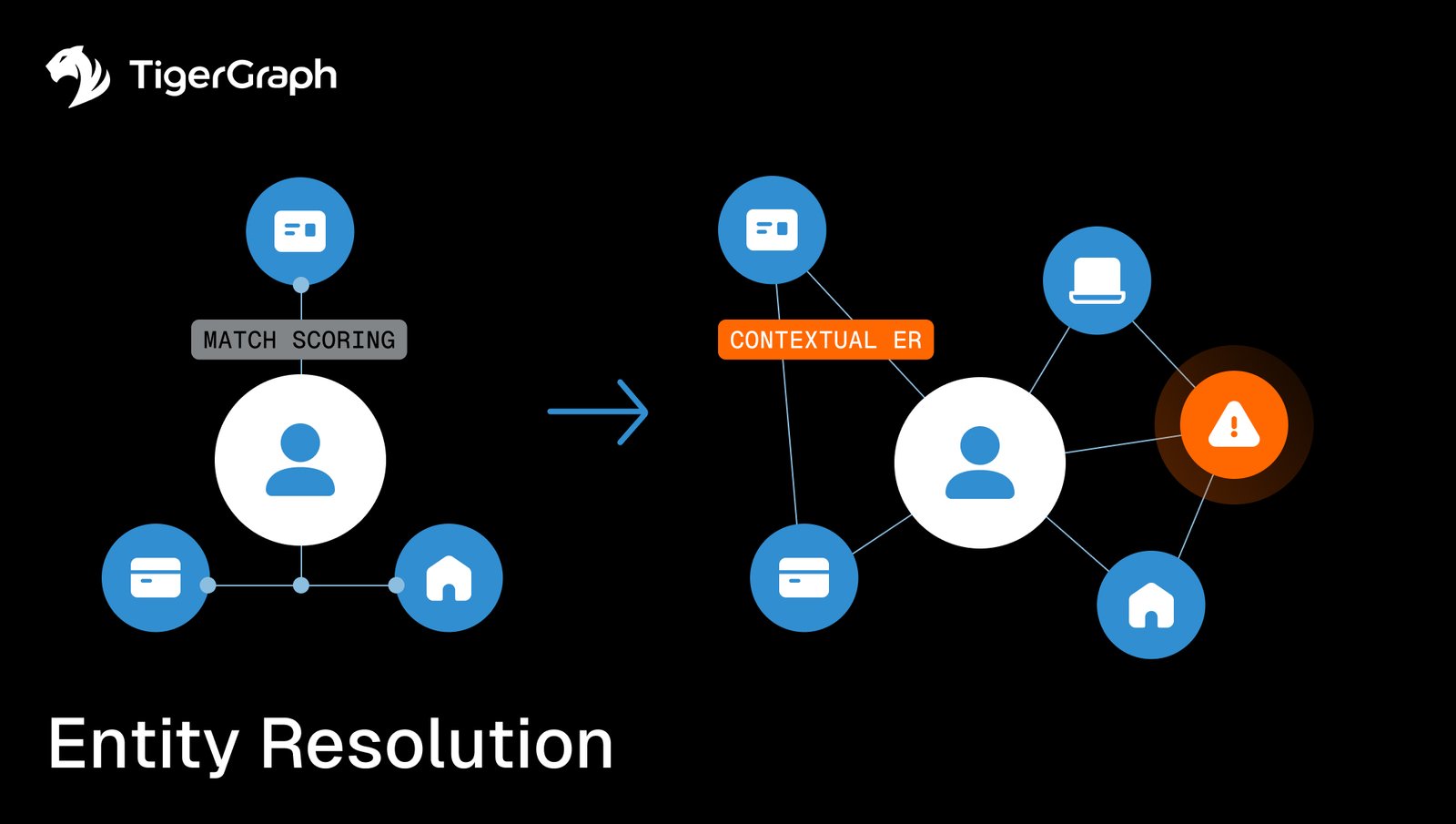
This is where contextual entity resolution comes in.Traditional ER asks a narrow question: “Are these two records the same person?” Contextual ER asks the broader question: “Who and what is this person connected to?” That expanded view captures relationships and behaviors that record matching alone cannot. The result is more accurate resolution, greater scalability, and insights that compliance and fraud teams can act on with confidence.
Why Graph-Powered Entity Resolution Changes the Game
A graph database entity resolution approach shifts the model from comparing fields to mapping relationships. Instead of “Are these two strings close enough?” the question becomes: “How are these entities connected?”
Contextual ER delivers three advantages that legacy scoring cannot. The most critical is compliance lineage: when regulators ask why two records were merged, a graph shows the complete path, including devices, addresses, ownership—that supports the decision. In addition, it consolidates variations of the same customer into one accurate profile, and it exposes fraud networks that converge on shared infrastructure such as IP addresses or merchants.
Contextual Identity Resolution: Practical Benefits
Contextual ER delivers two levels of benefit. First, it makes identity resolution more accurate: duplicate profiles collapse into one true record, false positives decrease so investigators can focus on real risk, and audit-ready transparency provides path-level lineage regulators require.
Second, it strengthens fraud detection by mapping hidden relationships that traditional systems overlook. A graph framework shows when a party is connected to flagged entities or suspicious behaviors, while shared devices, merchants, and addresses expose coordinated fraud networks instead of isolated anomalies.
Match scoring vs. contextual entity resolution
| Dimension | Match scoring systems | Contextual entity resolution with graph |
| Context | Field-by-field strings | Multi-hop relationships & lineage |
| Accuracy | Limited by variation | Contextual ER improves match accuracy |
| Fraud detection | Limited without relationships | Contextual ER exposes fraud networks |
| Auditability | Scores only | Explainable paths with evidence |
| Scalability | Breaks at scale | Sub-sec across millions of events/day |
Real-World Impact in Banking of Entity Resolution
Contextual ER delivers impact by linking identities to their broader networks. It reveals the real parties behind synthetic identities and mule accounts, and shows how customers, devices, and merchants are connected. This broader context strengthens fraud detection, AML, and KYC alike.
In practice, contextual ER often appears in fraud or compliance use cases, where context analysis strengthens decision-making even if the core matching is handled elsewhere.
- Nubank: Faced 9,000+ fraud reports each month and $1.8M in monthly scam losses. Its models had recall rates as low as 28%, allowing synthetic identities and mule accounts to pass through. By integrating graph features such as PageRank fraud detection, community detection, and device proximity, Nubank significantly boosted recall, cut false positives, and prevented millions in monthly scam losses. This improved customer protection without requiring additional headcount.
- JPMC: Processes 50M+ transactions per day across a 30TB dataset. Previously, siloed systems flagged activity but missed cross-domain connections. With graph-powered context analysis, JPMC now generates 30+ graph-based fraud features (e.g., shortest paths to high-risk entities, device reuse, ownership overlaps). The result: fewer false positives, higher fraud detection accuracy, and $50M in annual savings—all while protecting 60M households.
Identity resolution in banking delivers its full potential when powered by contextual graph intelligence.
Recommendations for Executives
An investment in contextual entity resolution delivers measurable compliance, fraud reduction, and ROI. But in most banks, ER, AML, and fraud detection sit under separate teams. To make these recommendations actionable, we preface them by function:
- ER: Are we relying only on scoring tables?
Traditional match scoring systems, which rely on similarity, substitution, and weighted attributes, help improve data quality but overlook the deeper relational context that reveals collusion and fraud. Ask whether your vendors are providing dynamic identity resolution with behavioral linking, or just extending legacy scoring methods. - Fraud detection: Can our current tools scale with fraud and regulation?
Fraudsters exploit gaps across billions of fast-moving transactions, while regulators now expect lineage that spans silos. Without a graph database entity resolution platform that can handle millions of daily events, compliance teams will drown in false positives and miss critical connections. - AML/Compliance: Where is the ROI?
Entity resolution in banking should deliver measurable business outcomes. Leading banks using graph-powered entity resolution report double-digit improvements in detection accuracy, faster investigations, and hundreds of millions in fraud savings annually. If your current platform isn’t producing similar results, it’s time to reassess.
Contextual ER is not just “clean-up.” It is a foundation that strengthens fraud detection and compliance alike. By clarifying benefits for each function, leaders can pursue improvements in their own domains while also laying the groundwork for cross-silo collaboration.
Why TigerGraph Leads in Graph-Powered Identity Resolution
Most banks already run pilots that show graphs can unify customer records. The challenge is making those pilots production-ready at scale. TigerGraph was built for this reality, delivering speed, scale, explainability, and ML integration in ways that other platforms struggle to match:
Performance at enterprise scale: TigerGraph ingests and processes millions of daily events for Tier 1 banks while still responding in 10s of milliseconds on targeted queries. That means fraud detection, KYC onboarding checks, and AML screening can run in real time—even as payments and customer interactions stream in continuously. Unlike table joins or brute-force match scoring, graph queries filter efficiently across billions of relationships, surfacing the strongest matches in milliseconds.
High concurrency for live workloads: In banking, hundreds of analysts, data scientists, and automated systems need to query the same identity graph at once. TigerGraph supports thousands of simultaneous fraud and KYC queries without bottlenecks, ensuring no team is forced to wait for insights. This level of concurrency is what separates research projects from enterprise-ready deployments.
Graph-powered feature factory for ML: TigerGraph doesn’t just unify identities—it continuously generates advanced features like centrality measures of key entities, fan-in/fan-out patterns, and community memberships. These feed directly into AML and fraud models, improving precision and recall. For example, PageRank-derived influence scores can flag mule hubs before transactions settle, while proximity features reveal when a “new” account is only two hops from a known fraud ring.
Explainability and audit readiness: Regulators no longer accept black-box scoring. TigerGraph provides path-level lineage showing who was connected, when, and how. Investigators can export full evidence trails—shared devices, ownership chains, IP reuse—that explain exactly why a customer was flagged. This satisfies AML/KYC compliance requirements and builds trust with auditors and boards.
The result is that graph-powered fraud prevention and behavioral identity resolution are not just theoretical. TigerGraph makes them operational, turning what used to be fragile pilots into always-on infrastructure.
For banks under pressure from both regulators and fraudsters, that’s the difference between “experimenting with graphs” and using graph as a core identity resolution strategy that reduces losses, speeds onboarding, and delivers measurable ROI.
Match scoring still plays a role in cleaning and standardizing records, but it must be augmented with relationships and behavioral linking. TigerGraph provides that added context, turning partial matches into complete, regulator-ready identity resolution.
Entity Resolution Conclusion
Match scoring is a start, but it’s not enough for fraud detection in banking, AML fraud detection, or customer identity resolution. Only graph-powered entity resolution provides the context that regulators demand, fraudsters can’t evade, and customers expect.
With TigerGraph, banks get the speed, scale, and transparency to unify identity, stop fraud, and satisfy compliance. The result: fewer false positives, faster investigations, and measurable ROI.
Cleaner data. Stronger compliance. Lower risk. Reach out today to learn more and explore TigerGraph Cloud to experience graph-powered identity resolution in action.