Knowledge Graphs as the Missing Context Layer for AI
A growing number of enterprises are discovering the same problem at the same time. Their AI systems respond quickly, generate fluent output, and sound confident, but they’re confidently wrong.
These systems struggle the moment a workflow depends on understanding rather than prediction. The model can retrieve information, summarize it, or generate an answer, but it cannot determine whether the answer reflects how the business actually works.
This gap becomes visible in every environment where context determines correctness.
- Fraud patterns hinge on shared devices, merchants and accounts.
- Supply chains depend on upstream and downstream dependencies.
- Customer intelligence requires unifying fragmented records.
AI cannot see the structure behind these signals to follow relationships or interpret what connects one event to the next.
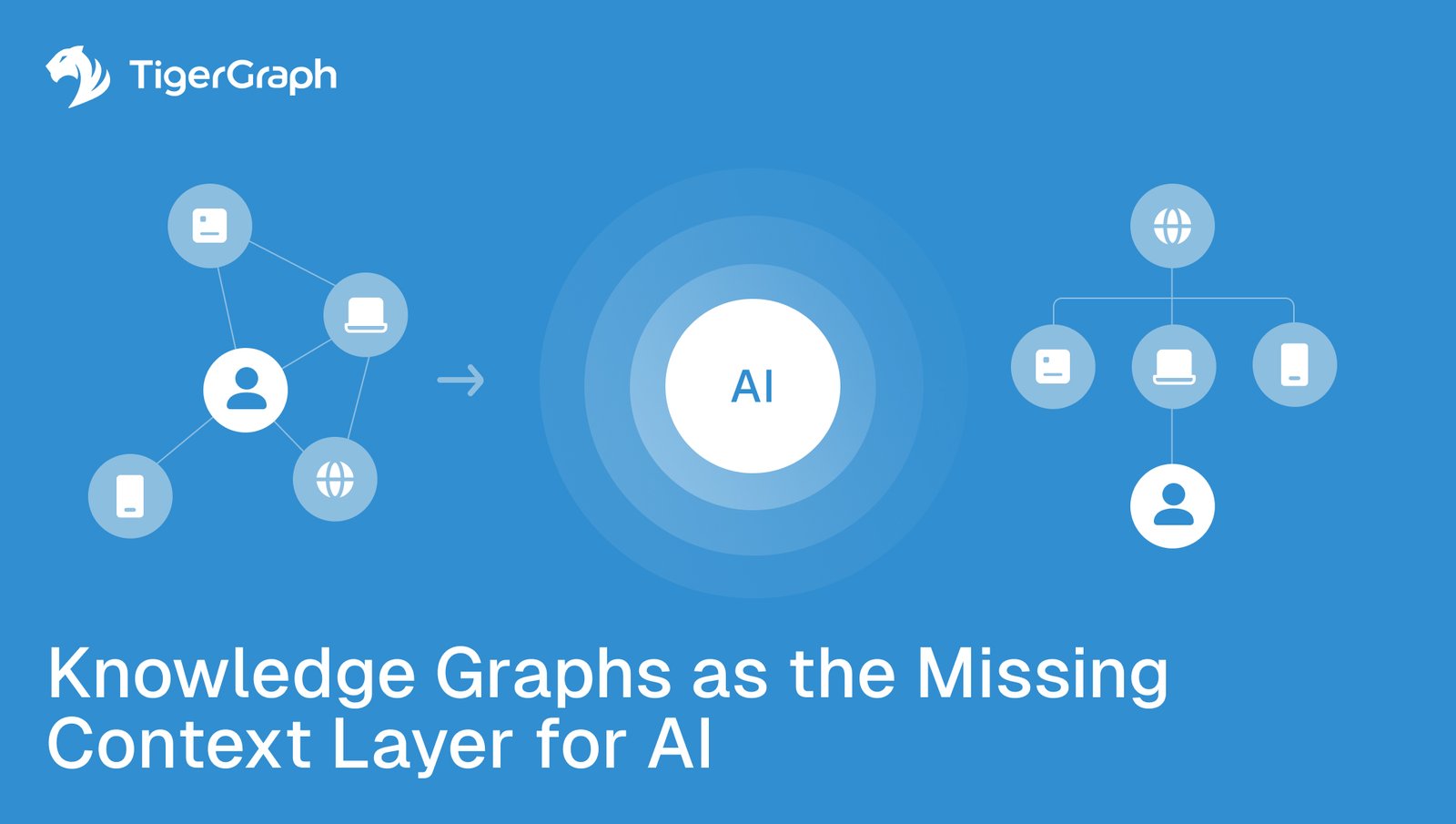
A knowledge graph fills that gap, providing the structural context and logic that ties the signals together.
This article explains how a knowledge graph informs graph-powered AI, and how the graph improves retrieval, reasoning and trust.
Understanding the Role of a Knowledge Graph in AI
A knowledge graph models real-world structure. It creates an information foundation to use when generating answers, evaluating risk or supporting operational decisions.
Organizations adopt knowledge graphs because modern data is inherently interconnected.
- Customers move across channels.
- Devices share upstream dependencies.
- Transactions form chains.
- Risks propagate through multi-step patterns.
These relationships cannot be expressed reliably in isolated tables. A graph data model captures these connections directly, preserving the meaning that AI systems require.
A knowledge graph is not an overlay. It is the structural source of truth that grounds AI behavior in the actual shape of the business.
A model predicts and approximates, and the knowledge graph explains and validates.
This is why organizations are adding a graph layer beneath their AI stack. It replaces guesswork with connected, verifiable data.
Why AI Requires a Context Layer?
Large language models perform well in natural language tasks, but they are probabilistic engines.
They generate plausible answers by identifying statistical similarity, but they do not validate these answers against authoritative data. This creates several operational gaps that appear immediately in enterprise systems:
- Limited understanding of multi-hop relationships
• No transparent explanation of how an answer was formed
• Susceptibility to hallucinated or unsupported claims
• No mechanism for verifying retrieved information
• Difficulty interpreting the meaning of connected events
AI without context behaves as an isolated predictor, operating without a mechanism to confirm whether its output aligns with enterprise reality. It can produce output, but it cannot confirm whether that output aligns with enterprise reality. And this is where a knowledge graph becomes essential.
The graph provides structure, logic and relationships. It gives the AI system a grounding mechanism for deductive reasoning, rather than relying solely on inductive prediction.
A context-aware AI system can justify its answers, trace the logic behind them, and operate with greater reliability. The knowledge graph provides the connective layer required to make this possible.
How Knowledge Graphs Enhance AI Retrieval?
Modern AI systems increasingly rely on hybrid retrieval, because no single retrieval method captures both meaning and structure.
Vector embeddings capture semantic similarity. A graph database provides structural precision. TigerGraph supports both approaches within one workflow so organizations do not have to choose between linguistic relevance and factual accuracy.
What Are Vector Embeddings?
Vector embeddings represent text, images, or other complex information as high-dimensional numerical arrays. Instead of matching exact keywords, a vector model measures meaning. It retrieves content that is conceptually related.
For tasks involving language, summarization, or intent understanding, vectors provide an efficient first layer of recall.
However, semantic similarity alone is insufficient in enterprise environments. A vector may retrieve text that “sounds” relevant but is contextually unrelated, outdated, or inconsistent with the organization’s actual data. Vectors are useful but naive.
AI systems need a mechanism to confirm whether retrieved information matches real entities, relationships, and business logic. This is the role of the graph.
Deconstructing a Graph Database Workflow
A graph database helps determine whether the semantically similar results retrieved by an AI system make sense in the real world. It can show:
- how the entities involved are connected
• whether the dependencies match the patterns the business knows to be true
• and whether the implied relationships reflect how the system actually behaves
This step acts as a filter. It removes results that look relevant in language but fall apart once structure is considered. It keeps retrieval grounded in verified, authoritative data instead of statistical probability alone.
This workflow forms the basis of GraphRAG, where structured graph context is assembled before the model generates an answer.
Demystifying GraphRAG
GraphRAG is an extension of retrieval-augmented generation that incorporates graph structure into the retrieval process. Traditional RAG retrieves documents based on vector similarity. GraphRAG adds a layer of structural reasoning so the system retrieves not only linguistically relevant information, but information that is contextually and relationally accurate.
In a GraphRAG workflow, the knowledge graph becomes the source of truth for context assembly.
The system begins by identifying the entities, attributes and relationships associated with a query. It then traverses multi-hop paths to understand how those elements connect, whether they share dependencies, and which subgraphs are relevant to the task.
This produces a structured context package. Instead of receiving unfiltered content, the LLM receives a graph-derived snapshot of the domain, including the entities involved, the relationships that bind them, the constraints that govern them, and the pathways that shape their behavior. This grounding enables the model to work with accurate context rather than probability alone.
GraphRAG is not a separate model or a different form of generation. It is a retrieval architecture that ensures the LLM is guided by authoritative structure.
By integrating semantic reach from vectors with the structural precision of a graph database, GraphRAG offers retrieval that is more consistent, more explainable, and better aligned with how real systems operate.
Graph-powered AI System Operation
A graph-powered AI system goes beyond vector similarity alone. It works with the actual structured knowledge of the business and uses that structure to guide retrieval, validation, and reasoning. This enables it to perform tasks that conventional retrieval pipelines cannot.
- Follow explicit multi-step relationships.
The system traces chains of connected entities. It could connect customers to accounts to devices to merchants, or suppliers to components to facilities. This mirrors how events occur in practice rather than how they appear in unstructured text. - Evaluate dependencies spanning several hops.
It can determine whether separate events share a cause, whether they influence one another, or whether a change in one area will have downstream effects. This provides context that statistical models cannot infer on their own. - Identify relevant subgraphs for reasoning.
Instead of pulling broad, generic content, the system extracts the precise slice of the enterprise graph needed for the task at hand. This keeps retrieval focused, efficient, and aligned with the organization’s domain. - Validate retrieved facts against an authoritative structure.
The graph acts as a guardrail. It checks that retrieved information matches known relationships before the model uses it. This helps the model reject contradictory, incomplete or irrelevant data.
Together, vectors provide semantic reach, while the knowledge graph supplies structural grounding. The combination creates a more accurate retrieval workflow, one that is less prone to hallucinations, and aligned with how the enterprise actually operates.
Knowledge Graphs Strengthen Explainability
A knowledge graph naturally strengthens explainability. It makes reasoning paths transparent and auditable.
When an AI system produces an output, the graph can show which entities were involved and how they were connected. It also shows which relationships influenced the answer and how multi-hop logic contributed to the outcome.
This is essential for banking, healthcare, insurance, supply chain, and customer-facing environments.
A graph database ensures AI-driven decisions remain traceable, governed, and reviewable. It provides a direct, inspectable logic path that traditional AI systems cannot produce on their own.
Building Graph-Powered AI with TigerGraph
TigerGraph supports real-time context across large, complex enterprise environments by delivering the performance, scale, and clarity required for enterprise-grade graph-powered AI. Its architecture evaluates multi-hop relationships in real time, enforces schema consistency, and supports high-load analytics across large, connected datasets.
To summarize, TigerGraph strengthens the AI stack with:
- Real-time graph analytics for immediate insight
• Schema-driven modeling for reliable interpretation
• High-performance traversal for large subgraphs
• Graph and vector search for hybrid retrieval
• Consistent structure for various applications and business domains
TigerGraph enables contextual AI systems to reason over relationships instead of relying on probability-based predictions.
Best Practices for Implementing a Knowledge Graph
Here are several design principles for organizations build a knowledge graph:
- Model entities and relationships that directly reflect business logic.
- Maintain a schema that enforces clarity, consistency and long-term stability.
- Validate relationship direction, type, and cardinality early in development.
- Track lineage for attribute changes to support governance and versioning.
- Integrate vector search only after structural accuracy has been established.
Why is this order crucial?
Because, as mentioned, vector search uses semantic similarity, which is powerful but also imprecise. If you add vector retrieval before you have a stable structural model, the system will retrieve items that feel relevant in language but do not fit your business logic. Without the guardrail of a well-defined graph, those errors spread quickly.
Once the graph structure is correct, vector search becomes the “semantic expansion layer.”
But the graph remains the source of truth. It’s the filter that prevents hallucinations and incorrect associations.
A well-designed knowledge graph is an enterprise asset that improves every analytical process.
Summary
AI excels at language but struggles with structure. A knowledge graph provides the relationships, context, and multi-hop reasoning that modern AI systems require. TigerGraph supports this architecture with a high-performance graph database built for real-time insight, explainability, and connected decision-making.
By combining generative models with structural intelligence, organizations can deploy AI systems that reflect the actual shape of their business and deliver answers grounded in accuracy, clarity, and context.
If your organization is evaluating how to build contextual AI that performs reliably at enterprise scale, TigerGraph provides the structural foundation required for consistent reasoning and explainability. Reach out today to learn more.
Frequently Asked Questions
1. Why do AI systems fail when business decisions depend on understanding relationships?
Most AI models operate on probability rather than structure. They generate answers based on patterns in language, not on how entities, events, and dependencies are actually connected. Without a relationship-aware context layer, AI cannot reliably interpret cause, impact, or sequence across complex workflows.
2. How does a knowledge graph help AI distinguish between relevant and misleading information?
A knowledge graph validates retrieved information against real entities and known relationships. This prevents AI systems from using data that appears relevant linguistically but conflicts with how the business actually operates, reducing hallucinations and false assumptions.
3. What types of enterprise decisions benefit most from graph-powered AI?
Decisions involving risk propagation, dependency analysis, entity resolution, or multi-step causality benefit the most. Examples include fraud detection, supply chain disruption analysis, customer intelligence, compliance investigations, and operational planning.
4. How does combining graphs with vector search improve AI accuracy?
Vector search expands semantic reach by identifying conceptually related information, while the graph confirms whether that information is structurally valid. Together, they ensure AI retrieves content that is both meaningful and factually grounded in enterprise reality.
5. What makes a knowledge graph a long-term asset rather than a one-time AI enhancement?
Once established, a knowledge graph becomes a reusable source of truth that supports search, analytics, AI reasoning, and governance across many use cases. As the graph evolves with new data, it continuously improves the accuracy, explainability, and trustworthiness of AI systems built on top of it.
Graph for LLM Observability is The Missing Layer in Agentic AI Systems
Today’s large language models (LLMs) aren’t just responding to prompts; they’re taking action. As these models evolve into autonomous agents capable of making decisions, adapting to new information, and chaining complex tasks together, the stakes get higher.
This new generation of agentic AI systems generates text, but it also interacts with users, retrieves data, calls APIs, and even reasons across workflows. And with that power comes a pressing question for every enterprise deploying them: How do we keep these systems accountable?
Traditional metrics aren’t enough. You can’t rely on surface-level outputs when an AI agent is making critical decisions on your behalf. What you need is insight into the why and how behind each action, not just the what.
- What context did the agent have at that moment?
- Which prior prompts or data sources shaped its decision?
- Is its behavior aligned with policy, ethics, or intent?
In other words: How do I understand what my agents are doing? How do I make their behavior traceable, explainable, and safe?
That’s where graph comes in.
Graph technology gives enterprises the structure they need to track, model, and make sense of LLM-driven behavior. It provides the memory, context, and relational insight that agentic AI requires to be both powerful and accountable.
The Rise of Agentic AI
Traditional LLM use cases, including summarization, translation, and classification, are giving way to agentic workflows where AI agents dynamically retrieve information, make decisions, and interact with external systems. These agents increasingly power:
- Fintech bots navigating multi-step risk assessments
- Healthcare assistants triaging symptoms and surfacing treatment options
- Genetic AI models reasoning across patient data and research findings
But autonomy introduces complexity.
The same LLM that fetches a document today might revise a strategy tomorrow. And when the agent takes a wrong turn and outputs biased results, leaks sensitive data, or contradicts a prior decision, businesses need to understand what happened, and why?
The LLM Observability Gap
Traditional observability tools fall short. Logs may show that a prompt was issued and a response returned, but they don’t explain:
- The context state at time of execution
- Which prior steps or memory the agent drew from
- What entity relationships, intent layers, or role assumptions shaped the outcome
This is the “black box” problem in a new form: not just why the model said what it did, but how it reasoned across time, interaction, and role.
Without a deeper structure, enterprises are left with surface-level snapshots that are disconnected, decontextualized, and difficult to audit.
Graph as the Solution
When it comes to making sense of LLM-driven behavior, few technologies are better suited than graph. By storing relationships between data points, graphs can both hold the knowledge and ground rules to provide better standard LLM responses, but also record the step-by-step progress to provide observable steering for agentic AI.
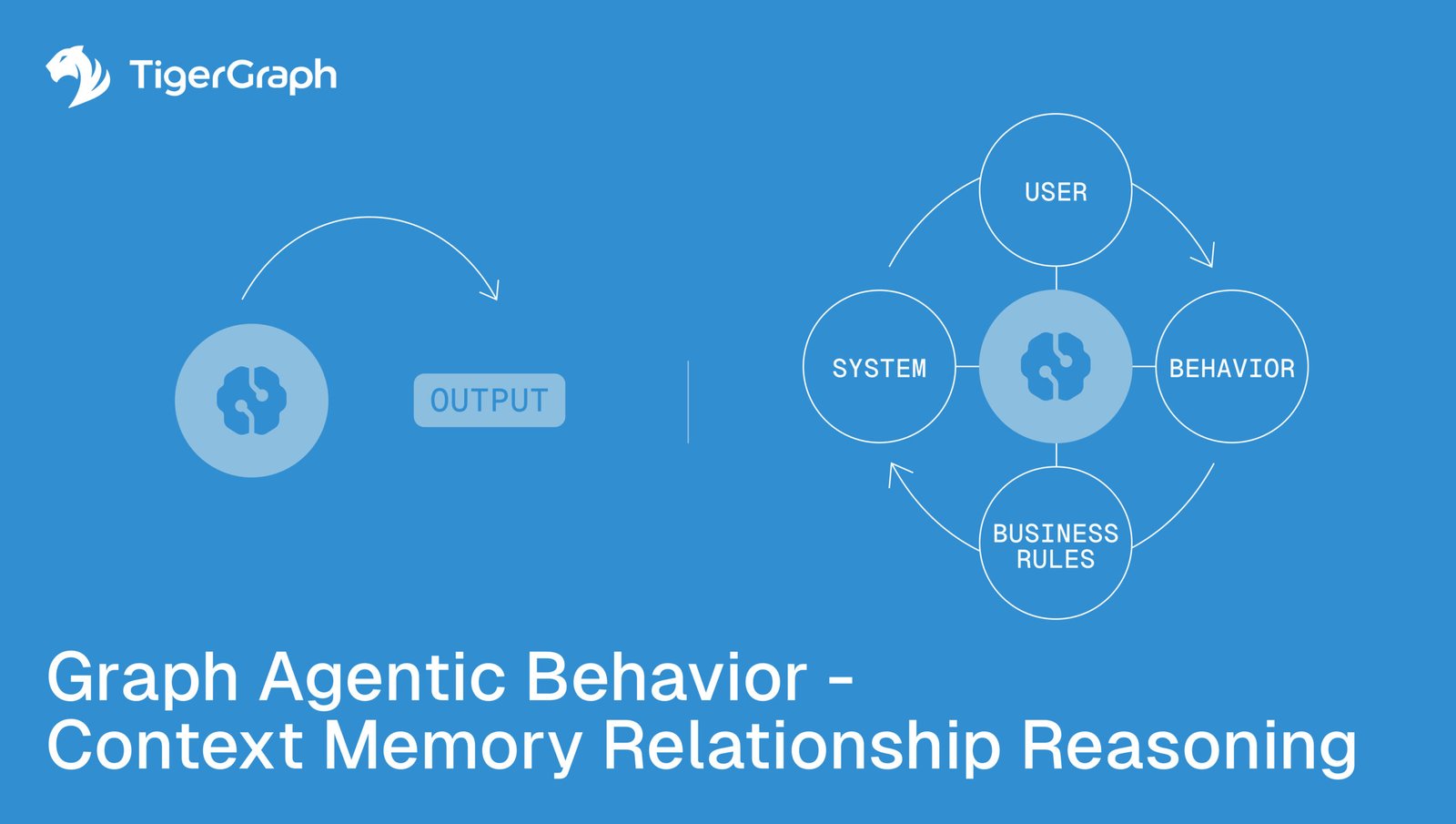
Graphs let you represent and query the relationships between people, data, actions, intentions, and outcomes. Instead of asking, “What did the AI say?” you can ask, “What did it know, why did it say it, and how did it get there?”
But not all graph systems are created equal.
This is where TigerGraph comes in. Built for performance at scale, TigerGraph delivers a combination of context persistence, behavioral traceability, and dynamic relationship modeling that goes beyond what most graph solutions offer.
- Context persistence means you don’t lose the thread between sessions, agents, or workflows. The memory sticks.
- Behavioral traceability means you can track how inputs cascade through the system, triggering decisions or shifts in intent.
- Dynamic relationship modeling means the graph adapts as new people, roles, or signals enter the picture, keeping your AI grounded in reality, not just static rules.
You don’t just want to know what the LLM said. You want to understand the full stack of context, timing, intent, and interaction. That’s what graph reveals.
How TigerGraph Powers Observability in Practice
TigerGraph was purpose-built to handle the real-time, high-complexity needs of modern enterprises. Its native parallel traversal engine and schema-first approach allow it to operate at the speed and scale that agentic AI demands.
Here’s how that plays out in practice:
- Prompt execution graphs connect every prompt to its prior context, data sources, and reasoning steps, so you can reconstruct the full decision path.
- Context chaining and memory graphs preserve what each agent knew, when they knew it, and how that influenced downstream choices.
- Risk-aware decision graphs highlight behavior patterns, like repeated overconfidence or hallucination risk, before they become problems.
This level of observability transforms AI from a black box to a transparent, auditable system. You’re not just reacting to what the model spits out, you’re understanding why it behaved that way in the first place.
Graph as Guardrail: Building Safer Agentic AI
Observability is only part of the story. Graphs also enable agentic AI to behave more responsibly from the start.
By encoding policies, norms, and relational awareness into the graph itself, you’re giving AI systems a set of embedded guardrails rather than just after-the-fact fixes.
Here’s what that looks like in action:
- A financial assistant avoids offering high-risk products to customers with low trust scores, because the graph reveals that context.
- A healthcare agent cross-references treatment suggestions with validated sources, because the graph filters out unsupported or outdated info.
- A customer service bot escalates cases with care because the graph knows the user’s history, tone, and past preferences.
This is proactive intelligence—the kind that helps AI systems act with awareness, alignment, and nuance.
Don’t Just Prompt — Observe
The move toward autonomous AI is already happening. But autonomy without oversight is a risk few enterprises can afford.
Agentic AI needs observability. That means knowing not just what your models are saying, but how they got there, and where they might go next. It means building systems that can adapt, explain, and operate within guardrails you can trust.
Because prompting without observability is like flying blind, and graph gives agents memory, context, and accountability. So, if you’re building agentic systems, don’t rely on guesswork or static logs. Start with the graph and give your AI the structure it needs to stay intelligent and aligned.
Ready to future-proof your organization with agents that do more than guess? Start observing.
Let’s talk about how graph can help you stay ahead of inevitable shifts.
Every enterprise needs to track, model, and make sense of system behavior. Graph fills that gap, bringing memory, context, and relational insight into every decision. It’s time to experience agentic AI systems acting with awareness rather than focusing solely on output.
Try TigerGraph Savanna for free at tgcloud.io.
Using Graph to Ground Agent Reasoning in Real Time
Autonomous AI agents don’t just need instructions—they need context to reason. As AI systems grow more agentic, taking initiative, coordinating tasks, and acting independently, the question becomes not just what they’re doing, but how they decide what to do.
This context-grounded reasoning isn’t a bonus feature. It’s a necessity.
Customer preferences shift, network behavior changes, and business rules evolve, and this means that rigid agents quickly become brittle. They follow yesterday’s logic into tomorrow’s mistakes.
What separates brittle agents from resilient ones is the richer, governed feedback loop. They need the ability to sense changes, understand ripple effects, and modify future behavior accordingly. And the architecture that powers this kind of feedback isn’t just more prompts or clever APIs. It’s graph.
TigerGraph makes adaptive intelligence operational by modeling relationships, behavioral signals, and evolving context in real time. This is where static agents become context-aware decision makers,and where graph becomes the control layer.
Why Agentic AI Needs Context, Not Just Feedback
Language models can generate responses and even self-critique with enough scaffolding. But ask them to recall the impact of a decision made five steps earlier or adjust based on shifting dynamics across a network and the limitations become clear. Without structured memory and situational awareness, their adaptation remains superficial.
To adapt wisely, agents need a feedback system grounded in context and continuity. That means understanding:
- Current State: What’s happening right now? What’s changed in the environment—among users, systems, or inputs?
- Historical Memory: What happened last time a similar scenario played out? What worked? What failed?
- Relational Feedback: How does a single action affect the web of connections around it—from user sentiment to inter-agent dependencies?
This trifecta of awareness, memory, and feedback isn’t something stateless LLMs can handle on their own. But it’s exactly what graph databases are designed to do.
And TigerGraph doesn’t just make it possible—it makes it performant, enabling agents to tap into these signals at enterprise scale and in real time.
How Graph Enables Contextual Reasoning for Agents
Imagine an agent responsible for customer outreach. One of its tasks is to send follow-up messages after product updates. It seems simple. But what if, after one outreach cycle, support tickets spike? What if users start disengaging, or sentiment drops on connected social accounts?
A traditional AI pipeline might never notice. It operates in silos with an endless “prompt in, action out” functionality. But with TigerGraph, modeling the relational context, those signals don’t disappear—they surface.
Using TigerGraph’s real-time graph traversal, the agent can:
- Reassess its communication strategy based on user reactions or support volume.
- Modify timing and tone for specific segments based on prior outcomes.
- Detect emergent friction in parts of the network and escalate or pause action accordingly.
These aren’t pre-programmed responses. They’re live decisions based on the changing structure of relationships and signals in the graph. This is what turns rigid prompt chains into adaptive systems.
Building Smarter, Safer Agents with Graph Feedback Loops
Let’s break down how a feedback loop actually works in a graph-powered environment:
- The agent takes an action, say, recommending a financial product to a user.
- The network responds, other users ask questions, support tickets rise, or conversion drops.
- The graph updates and new relationships are formed, weights shift, and alerts are triggered.
- The agent sees the new picture and adjusts their strategy, revising their messaging, escalating to a human, or pausing outreach entirely.
Now imagine that loop happening not every week or day, but every minute, across millions of nodes and edges, all updating in near real time.
That’s not just automation. That’s autonomous systems learning how to behave better. And it’s only possible when agents operate in a live, structured, relational context. In other words: a graph.
Why TigerGraph Is Built for This
While any graph database can model relationships, TigerGraph is purpose-built to turn those models into operational systems that support AI at scale.
What makes TigerGraph stand out?
- Real-time streaming graph updates: The graph state reflects what’s happening now, not a stale snapshot from last night’s ETL run.
- Parallel, multi-hop traversal at scale: Ask questions like “Which agents are influencing others negatively?” or “Where is engagement collapsing?”—and get answers in milliseconds.
- Schema-first modeling for governance: Adaptation is powerful, but without structure, it’s chaos. TigerGraph lets you encode business logic and compliance constraints directly into the graph.
- ML and GNN-ready graph features: Feed graph-based signals into downstream learning models or run them natively using TigerGraph’s integrated AI capabilities.
Together, these features allow organizations to move beyond hardcoded logic and into systems that evolve safely, responsibly, and in alignment with business goals.
From Rules to Responsiveness: Building AI That Listens, Learns, and Evolves
Autonomous systems are being asked to make decisions, influence outcomes, and interact with real people; and static rules are no longer enough. Responsiveness grounded in context, history, and relational understanding is what defines whether agentic AI will succeed or spiral out of control.
To move from brittle automation to intelligent adaptation, we need more than smarter prompts or faster models. We need infrastructure that understands change as it happens, that retains memory across interactions, and that reasons through the ripple effects of every choice an agent makes.
Graph offers that infrastructure. It doesn’t just connect data—it reveals how actions flow through networks, how behavior unfolds over time, and how intent, influence, and outcome intersect in dynamic systems.
TigerGraph operationalizes this for real-time environments. But the broader shift is what matters most: a move away from reactive logic and toward systems that truly learn from their impact.
If you’re building agentic AI for the enterprise—systems that must evolve responsibly, reason transparently, and adapt to the world around them—this is the moment to embed the right foundation.
Not more rules, but smarter responsiveness. Not more control, but deeper awareness. And not just intelligence—relational intelligence.
The future of autonomy isn’t scripted. It’s situational. And that means it starts with graph.
Your Agents Can’t Adapt Without Feedback
Scripted responses won’t cut it in dynamic environments. TigerGraph gives your AI agents the real-time context, behavioral feedback loops, and adaptive reasoning they need to evolve safely and intelligently.
Try TigerGraph Cloud for free and start building agents that learn as they go. https://tgcloud.io