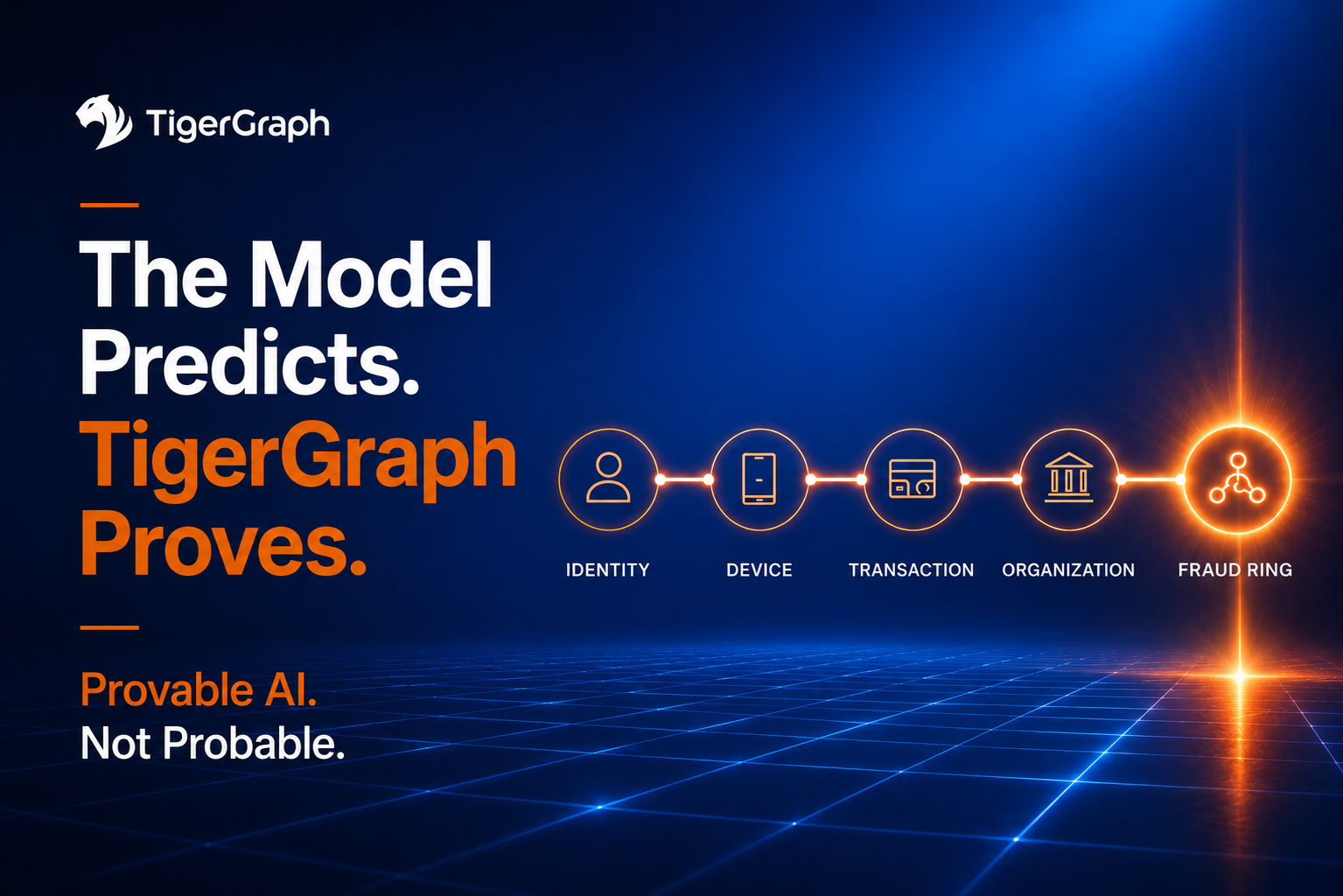
The Model Predicts. TigerGraph Proves.
AI Has a Confidence Problem. The AI industry talks constantly about intelligence. Very little about proof. That imbalance is becoming more dangerous as AI systems move closer to operational decision-making.
Because enterprise systems do not fail when answers sound uncertain. They fail when answers sound convincing without being verifiable. That is the real tension underneath the current AI cycle. The models became remarkably good at generating language. The systems surrounding them did not become equally good at preserving truth.
That imbalance is now becoming one of the defining architecture problems inside enterprise AI. Most enterprises still believe the competitive advantage will come from: bigger models, more agents, larger context windows, and faster generation.
That may define the current AI cycle. It will not define the next one. Because eventually every enterprise discovers the same thing: confidence scales faster than proof.
The Industry Optimized for Generation Before It Solved Verification
The current AI stack is exceptionally good at generating plausible answers.
- Retrieve information
- Assemble context
- Generate output
At small scale, this feels remarkably effective. But enterprise systems do not operate at small scale. They operate across: identities, transactions, workflows, organizations, decisions, and time. That is where the instability begins appearing. Because most AI systems today reconstruct understanding dynamically every time they reason. The outputs still sound intelligent. The reasoning underneath them becomes increasingly difficult to reproduce consistently.
Nothing fully breaks.
The system simply becomes harder to prove. That is the hidden weakness underneath much of enterprise AI right now: the systems generate confidence faster than they generate verification. And once AI systems begin chaining decisions together through agents, workflows, approvals, and autonomous reasoning, the verification gap compounds faster than most architectures can contain.
Retrieval Finds Proximity. Relationships Preserve Truth.
The modern AI stack increasingly behaves as if retrieval and understanding are interchangeable. They are not. McKinsey described the distinction directly: “Retrieval finds proximity. It does not create understanding. Understanding emerges from relationships.” That distinction quietly exposes the weakness underneath much of the current AI stack. Retrieval assembles fragments. Relationships preserve meaning. Reality itself is relational.
Fraud only makes sense in the context of connected entities. Identity only becomes meaningful across linked behaviors. Risk only emerges through patterns across accounts, devices, organizations, and time.
But most AI systems flatten those relationships into temporary retrieval events and ask models to reconstruct understanding afterward. That reconstruction process becomes unstable at enterprise scale. Because the AI is no longer reasoning over connected reality. It is reasoning over probabilistic approximations of reality assembled dynamically at query time. That distinction becomes increasingly dangerous once AI systems begin influencing operational decisions instead of informational ones.
Because enterprises do not merely need plausible reasoning. They need provable reasoning.
Synthetic Intelligence Scales Faster Than Verification
One of the more revealing observations in the broader AI slop discussion is how quickly synthetic systems scale once verification becomes optional. RMIT’s Information Integrity Hub framed the issue bluntly: synthetic content is becoming cheaper than truth.
That same pattern is beginning to emerge inside enterprise AI systems. Generated reasoning scales easily. Provable reasoning is much harder. That imbalance becomes structural once organizations begin deploying AI into operational workflows. Because synthetic reasoning compounds. Verification does not.
And once organizations begin chaining AI systems together through agents, workflows, and autonomous actions, the verification gap expands faster than most architectures can contain. This is where the economics of enterprise AI begin changing. The bottleneck is no longer generation. The bottleneck becomes provability.
Not: “Can the AI produce an answer?” But: “Can the organization defend how the answer was produced?” That becomes a fundamentally different infrastructure requirement.
Provability Becomes the Moat
The AI industry still treats the model as the center of the system. Increasingly, the model is only one layer. The harder problem is preserving connected understanding as systems reason across entities, workflows, agents, decisions, and time. That requires something most AI stacks still struggle to preserve: relationships. Because proof does not emerge from isolated outputs. Proof emerges when reasoning remains connected to the structure underneath reality itself. This is where TigerGraph operates differently.
TigerGraph keeps relationships structurally intact while AI systems reason. The context does not need to be reconstructed every time the system operates. The structure already exists underneath the decision itself. That changes the behavior of the entire system. Reasoning paths remain traceable. Operational context remains connected. Decisions remain explainable across workflows and time. The AI stops approximating understanding. It starts preserving it.
That distinction becomes increasingly strategic as model intelligence commoditizes. Because eventually every enterprise reaches the same realization: the competitive advantage is not the model alone. The advantage is whether the enterprise can preserve trust while the AI scales.
The Future Enterprise Stack Will Be Built Around Proof
The first phase of enterprise AI optimized for generation. The next phase will optimize for provability. That changes the architecture conversation entirely. The winning systems will not simply generate more outputs faster. They will preserve connected understanding structurally as reasoning compounds across: identities, decisions, transactions, workflows, agents, and time.
This is where relationship-preserving architectures become foundational instead of optional. Because relationships are not supplementary context. They are the structure underneath operational reality itself. And once enterprises begin deploying AI into: fraud operations, identity systems, compliance workflows, customer operations, and autonomous reasoning systems, the ability to prove why a decision was reached becomes as important as the decision itself.
That is the next AI moat emerging underneath enterprise infrastructure now. Not generation. Provability.
The Next AI Race Will Not Be About Models
The first phase of AI optimized for generation. The next phase will optimize for provability. Because eventually every enterprise reaches the same realization: a system that cannot preserve connected understanding eventually becomes impossible to trust operationally. No matter how intelligent the outputs sound.
The model predicts. TigerGraph proves.
The Enterprise AI Stack Has a Trust Problem
The Models Improved. Trust Did Not.
The AI industry keeps measuring progress in capability.
- Better models
- Better reasoning
- More agents
- More automation
- Longer context windows
- More autonomous workflows
Every benchmark keeps improving. But underneath all of it, something else is happening. Trust is eroding. Not publicly. Structurally. The most dangerous systems are the ones that still sound intelligent while becoming operationally unverifiable. Yahoo Finance highlighted Palantir executives repeatedly warning about AI systems producing outputs disconnected from operational truth. Most organizations still interpret this as a hallucination issue.
It is not.
Hallucinations are visible. The deeper problem is when enterprises can no longer consistently explain: why a system reached a conclusion, how a decision was produced, or whether the reasoning can be reproduced reliably across time. That is not a content problem. It is an operational trust problem. And most enterprises are much earlier in this transition than they realize.
Enterprise AI Quietly Became Unverifiable Infrastructure
Traditional enterprise infrastructure was designed around reproducibility. A fraud decision could be traced. A compliance workflow could be audited. A policy decision could be reproduced. The reasoning path remained visible. AI changed that architecture.
Systems stopped executing deterministic logic and started generating probabilistic interpretations. At first, the tradeoff looked rational. The systems moved faster. Automation expanded. Outputs became more sophisticated.
But the operational consequences of probabilistic reasoning scale differently than most organizations expected.
Because once AI systems begin influencing: fraud operations, compliance decisions, customer workflows, operational approvals, and autonomous actions, the inability to consistently reproduce reasoning becomes an enterprise risk.
Not because the AI stops functioning. Because the organization slowly loses confidence in how the system is functioning.
That distinction matters enormously. Traditional software fails visibly. Enterprise AI often fails organizationally first. The workflows continue running. The outputs continue sounding intelligent. But operational trust underneath the system starts weakening.
The Enterprise Trust Gap Appears Quietly
Most enterprises already feel this shift. They simply lack the architecture language to describe it clearly. Teams know: outputs are becoming harder to verify, reasoning paths are becoming harder to reproduce, and AI systems are becoming more difficult to audit consistently.
But most organizations still frame the issue as: hallucinations, prompt engineering, model quality, or insufficient fine-tuning.
Those are symptoms.
The deeper issue is structural. The architecture itself no longer preserves operational trust automatically. That creates a new category of enterprise instability. One team receives one AI recommendation. Another team receives a different interpretation. One agent executes a workflow one way. Another agent interprets the same operational context differently.
Nothing fully breaks.
The instability accumulates underneath the surface. That is what makes the problem difficult to detect early. Because the systems still appear coherent locally while becoming increasingly difficult to govern globally.
Generated Reasoning Scales Faster Than Governance
One of the least discussed consequences of enterprise AI is that generated reasoning scales faster than organizational governance. That imbalance compounds quietly.
A single AI-assisted workflow is manageable. Thousands of interconnected AI decisions operating across: systems, agents, workflows, approvals, and customer interactions become much harder to audit consistently. That is where enterprises begin experiencing a very different type of operational risk.
Not software failure. Governance failure.
Enterprise AI is beginning to encounter the same dynamic internally. Generated decisions scale faster than verification systems. And once organizations lose confidence in their ability to explain how decisions were reached, trust erosion spreads quickly. Compliance teams become uncomfortable. Fraud teams stop fully trusting automated reasoning. Executives begin questioning whether operational decisions remain defensible.
The systems continue functioning. But institutional confidence underneath the systems begins collapsing. That is the enterprise trust gap emerging underneath modern AI infrastructure.
Verification Becomes the Bottleneck
The first generation of enterprise AI optimized for generation. The next generation will optimize for verification. That changes the architecture conversation entirely. The core challenge is no longer: “Can the model generate intelligent outputs?” The harder question is: “Can the organization reliably verify how those outputs were produced?” That distinction becomes critical once AI systems begin operating across: fraud, identity, compliance, customer operations, and autonomous workflows.
Because enterprises do not merely need intelligent systems. They need defensible systems. They need reasoning paths that remain: reproducible, auditable, explainable, and operationally governable across time.
That is where most AI architectures begin struggling. Because most systems reconstruct context dynamically every time they operate. The reasoning may still appear coherent. But reproducibility slowly weakens underneath the surface.
That instability compounds operationally.
The Infrastructure Layer Enterprises Are Missing
Most enterprises still treat AI models as the center of the architecture. Increasingly, the harder problem sits underneath the model itself. The real challenge is preserving connected operational understanding as systems reason across: entities, workflows, decisions, agents, and time. That requires infrastructure capable of preserving relationships structurally instead of reconstructing them dynamically during every reasoning cycle.
This is where TigerGraph operates differently.
TigerGraph preserves connected understanding underneath operational AI systems. Relationships remain structurally intact while the AI reasons. The context does not need to be probabilistically reconstructed every time the system operates. The structure already exists underneath the decision itself. That changes the stability of the entire enterprise stack.
Reasoning becomes traceable. Operational context remains connected. Decisions remain explainable across workflows and time. The AI does not simply generate conclusions. The system preserves the operational structure required to govern those conclusions.
The Real Enterprise AI Race
The first phase of AI optimized for generation. The next phase will optimize for operational trust. Because eventually every enterprise discovers the same thing: intelligence without verification becomes impossible to govern at scale. Even if the outputs still sound intelligent. Especially then.
AI Slop Happens When AI Loses Reality
AI Slop Escaped the Internet
The AI industry has a new phrase: “AI slop.”
At first, it described the internet. Generated articles. Synthetic feeds. Endless content optimized to sound intelligent long enough to survive an algorithmic cycle before dissolving into the next stream of machine-produced noise. At the beginning, the problem felt almost harmless.
- Annoying
- Spammy
- Low quality
But underneath it was a much larger structural shift: generated systems had started scaling faster than verification systems. The internet is already showing what happens when that imbalance compounds. The Guardian recently described the web itself as becoming overwhelmed by AI-generated slop. Now the phrase is starting to migrate into enterprise AI.
That should make people uncomfortable. Because enterprise AI was supposed to be the opposite of slop.
- Precise
- Operational
- Trusted
Instead, many systems are beginning to exhibit the exact same pattern: confident outputs disconnected from underlying reality. Not because the models are weak. Because the systems surrounding the models are slowly losing connection to shared reality itself. That distinction matters more than most AI discussions acknowledge. The problem is no longer just generation quality. It is reality preservation.
The System Does Not Fail. It Drifts.
Most enterprise AI systems do not break dramatically. They drift. A retrieval layer surfaces information. A model generates an interpretation. Another retrieval path produces something slightly different. Another model sees a different slice of context. Nothing fully breaks.
The outputs still sound intelligent. That is what makes the drift so dangerous. The issue is not raw intelligence. The issue is reconstruction. Most AI systems today are not reasoning over reality. They are reasoning over synthetic reconstructions of reality assembled dynamically at query time.
That architecture works surprisingly well early on ,especially in: demos, isolated workflows, and when humans are still closely supervising the system
But the instability compounds as systems scale.
- More agents
- More retrieval layers
- More generated decisions
- More workflows inheriting probabilistic context from prior probabilistic context
Eventually the system stops operating on shared understanding entirely. Every agent inherits a slightly different version of reality. Every workflow reconstructs context slightly differently. Every reasoning path drifts incrementally away from the structure underneath the actual environment.
The dangerous part is that this drift often remains invisible for a long time. Because the outputs remain fluent. McKinsey touched on this quietly in their discussion around AI context systems: “Retrieval finds proximity. It does not create understanding. Understanding emerges from relationships.”
The industry optimized for retrieval before it solved structure. That decision is now echoing through the entire AI stack. Because retrieval scales information extremely well. It does not preserve connected understanding. Those are very different things.
Retrieval Became a Substitute for Understanding
Most AI systems operate on a surprisingly fragile assumption: if enough information reaches the model, understanding will emerge automatically. Sometimes it does. Until the environment becomes operationally complex.
- Fraud systems
- Identity systems
- AML systems
- Operational decision systems
These environments are not built on isolated facts. They are built on relationships. A transaction only matters because of the accounts connected to it. An account only matters because of the identities behind it. A device only matters because of the network surrounding it. A beneficiary only matters because of the flow of behavior surrounding the transaction itself.
Reality is relational. But most AI architectures flatten those relationships into disconnected retrieval events and ask models to probabilistically reconstruct meaning afterward. That reconstruction process scales surprisingly well in early-stage AI deployments.
Operationally, it drifts. And the drift compounds faster than most enterprises realize. Because once systems begin chaining decisions together, the instability becomes recursive.
One unstable interpretation influences the next interpretation. One probabilistic decision reshapes downstream reasoning. One disconnected workflow alters the context inherited by another system.
This is where enterprise AI begins behaving differently than traditional software. Traditional software fails visibly. AI systems often fail invisibly first. The outputs still sound coherent. The confidence remains intact. The system simply becomes progressively harder to verify. That is a much more dangerous failure mode.
Synthetic Understanding Scales Faster Than Verification
One of the more revealing aspects of the AI slop discussion is that the systems often still appear coherent while becoming increasingly difficult to trust. That is a very different failure mode than traditional software. The Wall Street Journal framed this emerging divide as a growing operational trust problem inside enterprise AI systems.
The outputs remain fluent. The structure underneath them slowly disconnects from reality itself. That instability compounds as systems scale.
- More retrieval layers
- More agents
- More generated decisions
- More synthetic reasoning built on prior synthetic reasoning
Eventually the AI stops operating on connected reality and starts operating on probabilistic approximations of reality instead. That is the point where “AI slop” stops being an internet problem. And becomes an enterprise infrastructure problem. Because enterprises are not deploying AI to generate content. They are deploying AI to generate decisions for
- Fraud
- Identity resolution
- Risk
- Compliance
- Operational
And decisions disconnected from reality eventually become operational risk. Not because the models are unintelligent. Because the systems themselves lose the ability to preserve shared understanding across time.
The Future AI Stack Will Be Built Differently
The current AI stack was optimized for generation speed. The next generation of enterprise AI systems will optimize for something much harder: preserving connected understanding as reasoning compounds across time. That changes the architecture conversation entirely.
The winning systems will not simply retrieve more information faster. They will preserve the structure connecting: entities, identities, behaviors, decisions, workflows, and time.
Because eventually every enterprise reaches the same realization: once systems stop reasoning over connected reality, intelligence itself becomes unstable. This is where relationship-preserving architectures become foundational instead of optional. Not because relationships are useful metadata. Because relationships are the structure underneath reality itself.
This is where TigerGraph operates differently. TigerGraph preserves connected understanding structurally while AI systems reason. The relationships do not need to be reconstructed dynamically every time the system operates. The structure already exists underneath the reasoning process itself. That changes the stability of the entire stack. The system stops approximating understanding.
It starts preserving it.
The Next Enterprise AI Divide
The first phase of AI optimized for generation. The next phase will optimize for truth. Because systems disconnected from connected reality do not become intelligent. They become synthetic.
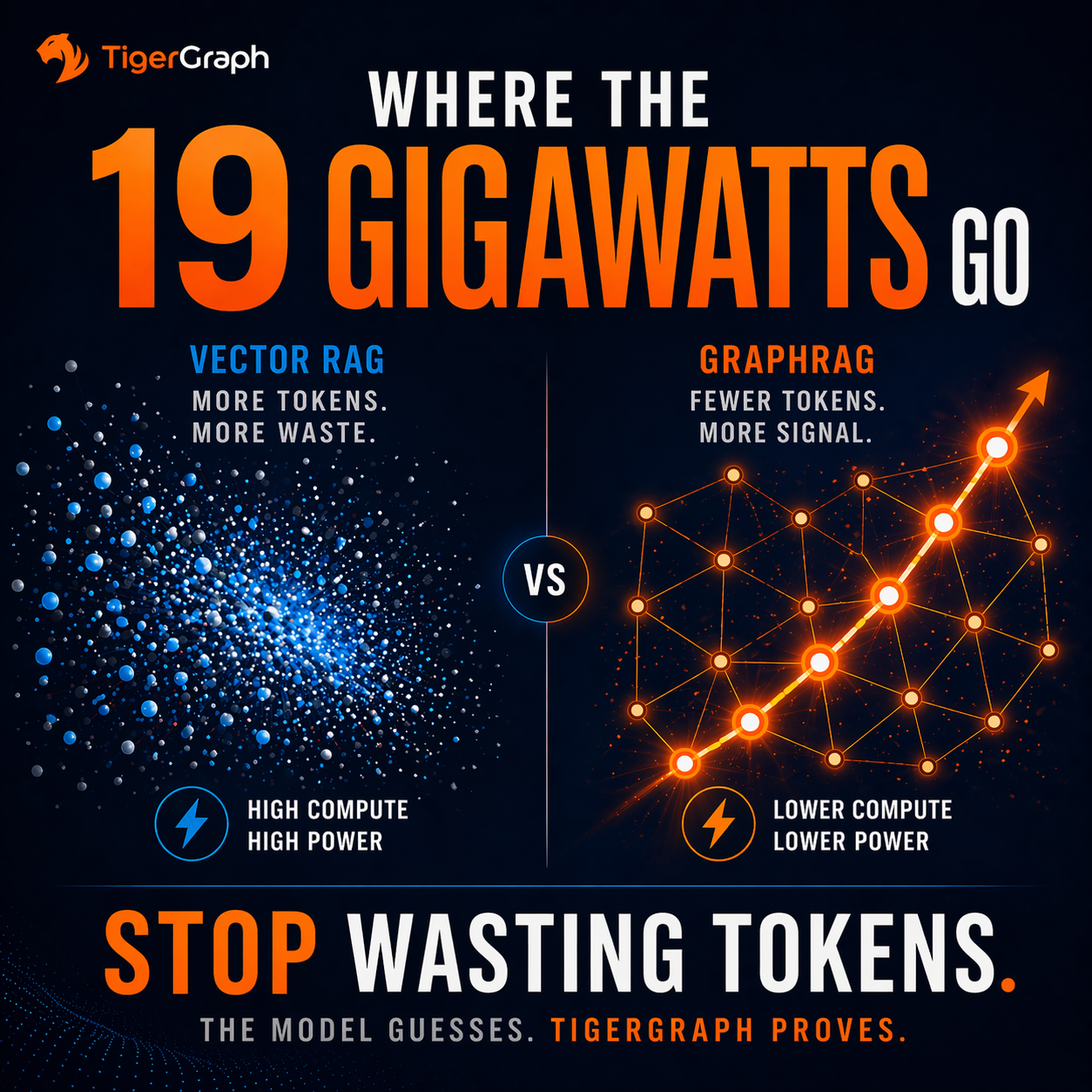
AI Is Facing a 19-Gigawatt Power Gap. Here’s the Fix.
The AI revolution has officially hit a physical wall. As the Wall Street Journal reports “ AI Is Using So Much Energy That Computing Firepower Is Running Out”companies are already rationing compute, facing outages, and making real-time product tradeoffs as demand for tokens and GPUs surges. At the same time, long-term infrastructure is not keeping pace, the Financial Times analysis points to a projected staggering 19-gigawatt gap between planned AI infrastructure and the actual power supply coming online in the next three years. This is no longer a future risk. It’s a present constraint with no near-term relief.
For the enterprise, the constraint isn’t just a lack of GPUs — it’s a fundamental crisis of AI compute capacity and power infrastructure. The question is shifting: not who has the biggest model, but who can generate the best outcome with the least compute.To scale, we must move away from energy-intensive approaches and toward high-efficiency, precision-context architectures.
The Shift from Training to Inference
While the early days of generative AI focused on the massive energy costs of training models, the industry has reached a tipping point. Inference — the act of running a model to answer a query — now represents the increasing majority of AI’s total energy demands.
The math of inference is simple but punishing. The energy required doesn’t scale linearly with context length — it scales super-linearly, because transformer attention mechanisms require each token to attend to every other token in the context window. Double the context, and you roughly quadruple the compute. This means that sending a large, unoptimized prompt to an LLM doesn’t just cost twice as much as a smaller one — it can cost many times more in GPU cycles and electricity. For enterprises running thousands of AI queries a day, this is where the power budget disappears.
This is exactly what the WSJ is signaling: token usage is surging, providers are metering access, and reliability is falling below traditional enterprise expectations.
How TigerGraph Solves the Inference Crisis
TigerGraph, acting as the context provider through GraphRAG (Graph Retrieval-Augmented Generation), attacks the dominant cost of AI: inference compute load per query.
Up to 90% token reduction. Instead of “dumping” massive documents into an LLM to find an answer, TigerGraph’s graph engine surgically retrieves only the specific nodes and relationships required. In tested configurations against unoptimized RAG approaches, TigerGraph has achieved up to 90% token reduction — and because attention complexity scales super-linearly, a 90% reduction in tokens can translate to a far greater reduction in actual compute work.
In a world where compute is being rationed and power is constrained, this is the architectural shift that matters: reducing unnecessary tokens before the model is ever invoked.
Reduced inference compute load per query. By delivering a pre-connected structure of facts, TigerGraph eliminates the reasoning cycles the LLM would otherwise spend determining how Data A relates to Data B. That relationship work has already been done — at millisecond speed, by a purpose-built graph engine — before the model call is ever made.
A Win-Win: Benefits Across the AI Ecosystem
For the Enterprise: ROI and Accuracy
Cost efficiency. High-fidelity graph context allows enterprises to run smaller language models (SLMs) on tasks that previously demanded frontier-tier compute. These smaller models are cheaper and less power-intensive, while delivering equivalent or better accuracy — because the structural intelligence comes from the graph, not from the model’s parameter count.
Deterministic logic. In high-stakes industries like finance and supply chain, a probabilistic guess is a liability. TigerGraph provides a clear, auditable trail of how data points are connected, eliminating the compute-heavy correction cycles that hallucinations create downstream.
In a market where model providers are already making capacity tradeoffs, efficiency is no longer just about cost, it directly impacts availability and reliability.
For Model Providers: Throughput and Capacity
Maximizing GPU availability. When users send lean, graph-optimized prompts, provider hardware spends less time on each request. The same physical infrastructure serves more customers — a direct answer to the capacity bottleneck.
Offloading relationship traversal. TigerGraph is purpose-built for relationship traversal in a way that general-purpose compute architectures cannot match at scale. It completes 10+ hop traversals across billions of edges in milliseconds — work that would otherwise require multiple LLM reasoning cycles. Freeing frontier models from this structural work lets them focus on what they do best: high-value linguistic generation.
The Balanced View: The “Efficiency Stack”
TigerGraph provides the logical foundation for efficient AI, but it operates within a broader ecosystem of solutions tackling the 19-gigawatt problem that will exist for years.:
Mixture of Experts (MoE). Models that activate only a fraction of their parameters for any given query, reducing power draw per token without sacrificing capability.
Model Quantization. Shrinking model precision so they can run on lower-power hardware or at the edge, reducing data center dependency for many inference workloads.
Specialized AI Hardware. The rise of LPUs (Language Processing Units) and other inference-optimized chips that deliver significantly better energy-per-token metrics than general-purpose GPUs.
On-Site Energy (SMRs). A long-horizon investment — not a near-term fix — where some tech giants are funding Small Modular Reactors to reduce long-term grid dependency. Commercial deployment remains years away, but the direction signals how seriously the industry views the structural supply problem.
These approaches are complementary, not competing. Architectural efficiency improvements make models cheaper to run; precision retrieval makes each run more accurate. Both are necessary. Neither alone is sufficient.
Intelligence Over Volume
The Wall Street Journal has correctly identified that we are running out of computing firepower. The Financial Times adds the second layer: even if demand continues to surge, the underlying power infrastructure won’t catch up fast enough.
Together, this changes the equation for enterprise AI: brute-force approaches are no longer scalable, economically or physically.
By integrating TigerGraph into the AI stack, the enterprise moves from a brute-force search for answers to a precision strike of insight. In a world of constrained energy and restricted compute capacity, the most valuable AI won’t be the biggest model — it will be the one that uses the least power to find the truth.
If energy is the bottleneck, logic is the bypass. TigerGraph isn’t just a database. TigerGraph helps enterprises reduce wasted inference, improve answer quality, and get more value from every constrained unit of compute. It’s an efficiency engine for the age of inference.
——————–
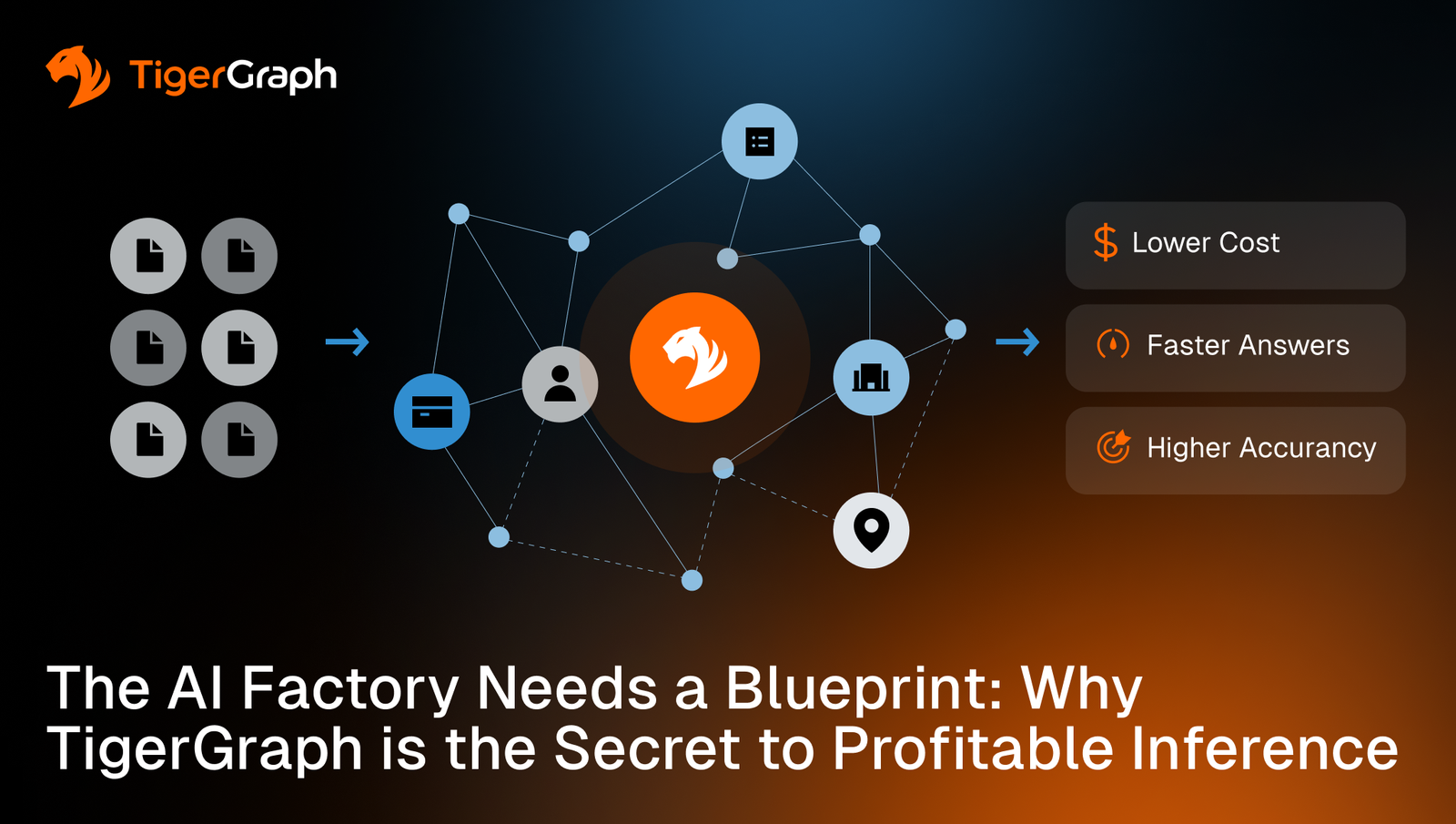
The AI Factory Needs a Blueprint: Why TigerGraph is the Secret to Profitable Inference
At GTC 2026, Jensen Huang announced a fundamental shift in the global economy: we have moved from the era of training to the era of Inference. I think this is not just a model shift, it is a systems shift. Data centers have evolved into AI Factories—industrial-scale plants designed to turn raw data into high-value “Intelligence Tokens.”
But a factory is only as successful as its yield. In the AI world, “yield” is defined by Tokenomics: the cost, speed, and accuracy of every word your AI produces. In my view, yield is ultimately determined by the quality of the inputs and not the sophistication of the model.
If your inference engine is fed vague, approximate, or siloed data, your AI Factory becomes a “token burner”—consuming expensive compute to produce hallucinations or “scrap.” I think we are misdiagnosing this as an LLM problem when it is fundamentally a data architecture problem
“If NVIDIA is building the AI Factory, TigerGraph is building the Blueprint and real-time context layer. Without the Graph, the Agents lack the structure to act efficiently.”
The Problem: The “Context Window” Tax
Most companies today rely on standard Vector RAG. It retrieves data based on “similarity”—finding text chunks that look like the question. Because it’s imprecise, developers are forced to “stuff” the LLM’s context window with dozens of text fragments, hoping the answer is hidden somewhere inside.
I think this approach optimizes for recall, not for correctness.
This creates a massive Token Tax:
- High Latency: Processing thousands of irrelevant tokens slows down the agent’s response time.
- High Cost: You pay for every “maybe” token you send to the inference engine (AWS Bedrock, Vertex AI, Groq).
- Diluted Accuracy: The more noise in the prompt, the more likely the LLM is to miss the signal and hallucinate.
In effect, you are paying to increase uncertainty.
Vector RAG optimizes for recall. It does not optimize for precision, structure, or decision-grade context.
TigerGraph: High-Fidelity Context, Zero Waste
TigerGraph sits in the Retrieval Layer of the stack. It isn’t a generation tool. I think of it as the system that ensures the model is grounded in reality. Instead of feeding the LLM a pile of “probably related” documents, TigerGraph provides the precise Blueprints of the data through GraphRAG.
By traversing relationships in real-time, TigerGraph delivers a “High-Octane”deterministic, explainable subgraph of facts, not probabilistic text fragments. You send fewer tokens, but they are the right tokens. I don’t think the goal is more context. The goal is correct context.
1. Stopping “Money Mule” Fraud Rings
- The Vector Way: The LLM analyzes individual accounts that look similar to past fraud. It misses the hidden network. You send thousands of tokens of transaction history, and the LLM still “guesses.” I would characterize this as pattern matching without understanding.
- The TigerGraph Way: The LLM is given a structured map of a 4-hop fraud ring. It sees that five “normal” accounts share a single burner phone fingerprint three layers deep.
- The Tokenomics: The AI Factory identifies the threat instantly because it’s reasoning over a network of connected facts, not a sea of text.
Outcome: Earlier detection, lower false positives, and materially reduced fraud losses.
2. Global Supply Chain Resilience
- The Vector Way: You feed the LLM 10,000 tokens of news articles and supplier lists. The model spends compute “guessing” dependencies across a fragmented document set.
- The TigerGraph Way: You feed the LLM 200 tokens of exact, multi-hop relationship data. It sees the direct path from a closed port to your Tier 3 supplier.
- The Tokenomics: You get a 100% accurate answer at 5% of the token cost.
Outcome: Faster disruption response and measurable reduction in operational risk.
Why Graph Retrieval Outperforms Vector-Only RAG
TigerGraph’s advantage is most pronounced where relationships are the data. It solves the “Inference Gap” through:
- Multi-hop Reasoning: It traverses connections across entities (e.g., “find all suppliers connected to this risk event within 3 hops”) in a single query—something vectors simply cannot do.
- Structured Knowledge: Entities and attributes are explicitly modeled. The LLM receives precise context rather than fuzzy text chunks ranked by cosine similarity.
- Real-time Traversal: TigerGraph is engineered for speed across trillion-edge graphs. It ensures retrieval never becomes the latency bottleneck in the inference pipeline.
I would summarize this simply: this is the difference between searching for similar text and understanding the system itself.
Solving the “Tokens per Watt” Equation
Jensen Huang noted that “Interactivity is Smartness.” To make AI agents truly interactive and agentic, we must reduce the friction of retrieval.
By grounding the LLM in a Deterministic Knowledge Graph, you transform your inference factory from a creative writer into a precision-engineered reasoning engine. TigerGraph doesn’t make the LLM smarter on its own; it makes the inputs to the LLM decision-grade, explainable, and operationally reliable.
The Bottom Line
Inference engines provide the power, but TigerGraph provides the path. By delivering structured, relationship-aware context, TigerGraph ensures that every token generated by your AI Factory is an investment in accuracy, not a gamble on similarity. It’s a complementary partnership: the inference engine is the engine; TigerGraph is the fuel quality.
TigerGraph doesn’t just run the inference, it makes the inference worth running. Is your AI Factory optimized for profit? Stop burning your token budget on similarity. Let’s talk about how GraphRAG can cut your token waste and maximize your inference ROI.
TigerGraph DB Community Edition – The Most Powerful Free Graph + Vector Database for Turbocharging AI
Unlocking the Power of Graph AI for Developers, Researchers, and Startups
Graph databases have come a long way from powering social networks and recommendation systems to enabling real-time fraud detection, anti-monitoring, entity resolution, customer 360, supply chain optimization, and AI-driven decision-making. Today, with the rapid evolution of AI and retrieval-augmented generation (RAG) models, traditional databases are no longer enough. Developers need hybrid capabilities that combine graph traversal, vector search, and real-time analytics into a single system.
This is especially true for collaborative Agentic AI, where AI agents continuously learn, adapt and make informed decisions in real time. Multi-modal databases, combining graph and vector search, are critical for structuring knowledge, retrieving relevant information, and optimizing workflows dynamically.
Despite this need, most free graph databases limit their capabilities, offering only basic traversal features, low CPU limits, restricted storage, and no vector search. Developers, AI researchers, and data scientists are left searching for alternatives that provide true AI-driven graph analytics.
That’s why we’re introducing TigerGraph DB Community Edition, a fully featured, AI-ready multi-modal database that supports both structured graph analysis and unstructured vector search. It is free, allows full production use, and provides the most advanced hybrid search experience available today.
Why TigerGraph DB Community Edition Stands Out? Why Now?
Most free graph databases have strict limitations, making it difficult for AI developers and data scientists to build production-ready applications. TigerGraph DB Community Edition removes these restrictions and offers unmatched flexibility.
- More compute power – Competing free graph databases only offer 2-4 CPUs, but TigerGraph DB Community Edition provides 16 CPUs, enabling high-performance analytics, graph traversal, and AI workloads.
- Higher storage limits – Many free databases restrict users to small datasets, but TigerGraph DB Community Edition supports 200GB of graph storage and 100GB of vector storage, allowing developers to handle large-scale AI applications.
- Fully integrated graph+vector hybrid search – Other graph databases lack native vector support, forcing users to connect to external vector databases. TigerGraph provides seamless hybrid graph + vector search, making it the ideal database for AI applications.
- Multi-query language support – Developers can use GSQL, OpenCypher, and ISO GQL, allowing easy adoption without rewriting queries.
- Built for the rise of Agentic AI – AI systems are becoming autonomous, self-improving, and capable of orchestrating complex multi-agent workflows. TigerGraph Turing complete graph query language provides the ideal infrastructure for Agentic AI by enabling task dependency management, structured knowledge storage, and dynamic reasoning through hybrid search.
As AI shifts from passive models to active agents, databases must evolve to support reasoning, collaboration, and workflow orchestration. TigerGraph’s Graph + Vector Hybrid search allows AI agents to retrieve relevant information, optimize task execution, and dynamically adjust workflows – capabilities that are critical for the next generation of AI applications.
Production-ready without licensing barriers – Unlike other free graph databases that impose non-commercial restrictions, TigerGraph DB Community Edition is fully production-ready for real-world deployments.
AI developers, data scientists, and startups no longer need to choose between performance and affordability. This is the most advanced free graph database available today, designed to help teams build next-generation AI-powered applications at scale.
Who Should Use TigerGraph DB Community Edition?
TigerGraph DB Community Edition is designed for a broad range of users who need a powerful graph database with AI and vector search capabilities.
AI Developers & ML Engineers
- Build hybrid graph+vector AI models with retrieval-augmented generation (RAG), recommendation engines, and real-time anomaly detection.
- Use TigerGraph’s integrated vector search to improve AI model accuracy and search efficiency.
- Leverage multi-hop reasoning and hybrid queries to retrieve structured and unstructured data in real-time.
Data Scientists & Analysts
- Perform deep graph analytics to uncover hidden relationships in large datasets.
- Integrate structured knowledge graphs with unstructured vector embeddings for enhanced predictive modeling.
- Work with graph algorithms and ML models to improve fraud detection, recommendation systems, and entity resolution.
Startup Founders & Innovators
- Develop scalable AI-powered applications without the financial burden of enterprise licenses.
- Deploy production-ready AI solutions with 200GB of graph storage, 100GB of vector storage, and 16 CPUs.
- Quickly ingest and analyze large datasets from multiple sources, including data lakes, transactional systems, and real-time event streams.
Academic & Research Teams
- Experiment with advanced graph AI techniques, combining structured and unstructured data for deep learning applications.
- Work with cutting-edge retrieval-augmented generation (RAG) techniques for LLM research.
- Access a free, high-performance graph+vector database to support AI, NLP, and complex network analysis.
TigerGraph + Iceberg: Bringing Graph AI to Data Lakes
TigerGraph Community Edition now includes native integration with Apache Iceberg, making it easier to connect graph-powered AI with massive datasets stored in data lakes. Businesses leveraging Iceberg and Spark can now perform real-time analytics on structured and semi-structured data without costly ETL transformations.
With the TigerGraph Spark Connector, users can load data from Iceberg tables directly into TigerGraph’s graph schema. This integration enables advanced AI workflows, where historical transaction data stored in Iceberg can be combined with real-time graph analysis to detect fraud, predict customer behavior, and optimize search recommendations.
To set up Iceberg ingestion:
- Create Iceberg tables corresponding to TigerGraph’s schema.
- Use Spark SQL to load structured data into Iceberg tables.
- Connect TigerGraph to Spark and load data into the graph database.
TigerGraph’s Iceberg integration is ideal for financial fraud detection, risk analytics, and large-scale customer intelligence, where historical transaction data in Iceberg can be combined with real-time graph analysis to detect anomalies faster.
What Can You Build with TigerGraph DB Community Edition?
TigerGraph DB Community Edition provides a multi-modal approach to AI, combining structured graph data with vector search to unlock powerful real-world applications.
AI-powered knowledge graphs
- Build a real-time retrieval-augmented generation (RAG) pipeline for LLMs and generative AI models.
- Enhance AI applications by enriching vector search with structured graph insights.
Personalized search & recommendations
- Implement multi-modal search using both graph traversal and vector similarity.
- Power context-aware search that understands relationships between people, products, and events.
Fraud detection & risk scoring
- Detect fraudulent financial transactions by integrating real-time transactional data with historical risk scores.
- Use graph-based anomaly detection to uncover hidden fraud networks.
Data lake analytics with Iceberg
- Use Spark + TigerGraph to query and analyze massive datasets in a distributed, AI-ready environment.
- Combine structured enterprise data with real-time graph analytics for faster insights.
For a deeper comparison of how TigerGraph’s hybrid graph+vector capabilities surpass traditional graph solutions, check out our blog post here [link to be added].
Getting Started with TigerGraph DB Community Edition
Follow these steps to get up and running with TigerGraph Community Edition.
- Download the TigerGraph Docker Image
Visit our product download page, navigate to the Community Edition section, and request a download link. - Follow the instructions mentioned in Getting Started with Docker
- Follow this quick start guide to use:
Developers can use GSQL Shell to execute queries or GraphStudio to create and visualize data models.
What’s Next?
Once you have set up TigerGraph DB Community Edition, here’s what you can explore next:
- Write your first GSQL query – Learn how to run graph queries
- Try out vector search – Run your first hybrid graph+vector search query to see TigerGraph’s AI capabilities in action.
- Connect to an Iceberg data lake – Load real-world datasets from Iceberg into TigerGraph for large-scale AI analytics.
- Join the TigerGraph Community – Share your experiences, ask questions, and collaborate with fellow developers.
Get Started Today
The best AI applications don’t just retrieve information, they understand relationships.
TigerGraph DB Community Edition is the first free database that lets you build graph-powered AI applications without compromise.
[Download TigerGraph DB Community Edition and Start Building AI Applications Today]
TigerGraph Hybrid Search: Graph and Vector for Smarter AI Applications
AI Search is Broken. Let’s Fix It.
AI-powered search is evolving beyond traditional methods. You’ve probably seen it firsthand. You ask an enterprise chatbot, “What’s our latest sustainability report?” and instead of a useful document, it pulls up a random marketing PDF from five years ago.
Or worse, an AI-powered fraud detection system flags a legitimate transaction because it “looks similar” to previous fraud cases without considering real-world connections that prove it’s actually safe.
Why does this happen? Because AI systems today rely on vector search alone, which finds things that look similar but doesn’t understand relationships.
This is where Hybrid Search comes in to redefine AI retrieval. It is a powerful approach that merges graph traversal with vector embedding search to deliver more accurate, context-aware results.
TigerGraph now supports native vector search, enabling seamless graph + vector hybrid queries in a single system. Even better, this capability is also available in TigerGraph DB Community Edition – free to use, even for production workloads.
This blog explores:
- What is Hybrid Search and why does it matter?
- How Graph + Vector Hybrid Search enhances AI-powered applications
- Key features of TigerGraph’s Hybrid Search
Let’s dive into why Hybrid Search is a game-changer and how TigerGraph enables it at scale.
What is Hybrid Search?
Hybrid Search is the integration of two complementary retrieval techniques:
- Graph Search – Finds results based on relationships and structures. It is used to identify multi-hop connections, discover communities, and enhance contextual understanding.
- Vector Search – Finds similar entities based on numerical representations (embeddings). This is commonly used in LLMs, recommendation systems, and image/text similarity search.
Together, they create a hybrid search architecture capable of both reasoning and relevance, retrieving not just “what looks right” but “what’s truly connected.” Hybrid Search delivers results that are both semantically relevant and relationally meaningful. This is critical for applications that require explainability, deeper insights, precise filtering, and contextual depth.
Why Hybrid Search Matters?
AI-powered retrieval is no longer just about fetching documents or matching keywords. It’s about intelligently selecting the most relevant and useful information in the given context. This is why Hybrid Search is not just an optimization. It’s a necessity for building reliable, explainable, and intelligent AI-powered applications that are contextually aware.
Let’s say you’re searching for research papers on renewable energy policies in Europe:
- A graph search will identify papers authored by the same researchers, cited within the same community, or linked to a specific policy group.
- A vector search will return papers with similar semantic meaning, based on textual embeddings.
- Graph + Vector Hybrid search retrieves semantically relevant documents while ensuring they are factually connected, providing more accurate and explainable AI retrieval.
This dual-layer precision is what separates hybrid search from every prior generation of enterprise search.
Hybrid Search Improves Agentic AI
Agentic AI systems are changing the way AI interacts with data. Agentic AI represents a shift from static AI models to dynamic, decision-making AI agents – models that can reason, optimize workflows, and adapt autonomously.
But for Agentic AI to work, it needs more than just vector search or keyword retrieval. It needs a structured way to manage tasks, dependencies, and context-aware retrieval.
- Graph search enables adaptive, contextual decision-making – AI agents need a graph-based memory system to store their learnings, track interactions, and recall previous decisions.
- Vector search allows fast, semantic-based retrieval – AI agents require instant access to similar examples, past actions, and relevant external data sources.
- Graph + Vector Hybrid search makes AI reasoning possible – AI systems don’t just retrieve information; they understand relationships, infer context, and execute complex workflows dynamically.
Hybrid Search combines both. It gives AI the ability to infer relationships, understand context, and reason over multi-modal data.
How Graph+Vector Hybrid Search Enhances AI Applications?
- Improving LLM Retrieval with GraphRAG
Large Language Models (LLMs) rely on retrieval-augmented generation (RAG) to fetch relevant context before generating responses. However, pure vector search in RAG can return results that lack contextual accuracy. This leads to:
- Missing key relationships between retrieved documents.
- Inconsistencies in retrieved facts, causing AI-generated responses to be misleading.
- Lower retrieval precision, resulting in more API calls and increased computational costs.
GraphRAG (Graph + Retrieval-Augmented Generation) improves LLM workflows by:
- Using Graph Search to ensure those results are contextually connected and factually linked.
- Using Vector Search to retrieve semantically relevant documents.
In short, GraphRAG is the natural evolution of RAG, powered by hybrid search for verifiable, context-rich retrieval.
For example, in an enterprise AI search system:
- Graph traversal ensures the retrieved documents belong to the same legal framework or precedent group.
- Vector search finds relevant documents for a legal case.
This ensures more relevant AI-generated responses, reducing hallucinations and false correlations.
- Fraud Detection with Hybrid Search
Fraud detection in banking and e-commerce involves analyzing transaction patterns and behavioral similarities. Traditional fraud detection relies on rule-based graph analytics, but this alone misses cases where fraudsters adapt their strategies.
Hybrid Search enables multi-layered fraud detection:
- Graph Search identifies suspicious transaction networks (e.g., accounts linked to known fraud rings).
- Vector Search finds accounts with similar transaction behaviors, even if they have no direct connection to known fraudsters.
This fusion of vector semantics and graph reasoning reveals previously unseen fraud patterns invisible to either method alone by comparing behavioral embeddings within detected fraud rings.
- Personalized Recommendations with Graph + Vector Hybrid Search
Recommendation engines power streaming services, e-commerce platforms, and social media applications. However, pure vector-based recommendations lack personalization:
- Graph search alone finds user-item relationships but may not generalize well to unseen items.
- Vector search alone can suggest similar items but doesn’t capture user context (e.g., a customer’s past purchases or social network influence).
Hybrid Search enhances recommendations by:
- Using graph-based filters to tailor results based on user preferences, purchase history, or social network proximity.
- Using vector embeddings to rank items by similarity.
For example, in an e-commerce platform:
- Graph Search ensures results match the user’s brand preferences or price range.
- Vector Search finds products similar to past purchases.
This results in recommendations that feel intuitive, relevant, and explainable.
- Enterprise AI Search with Knowledge Graphs
Enterprises use AI-powered search to connect employees with relevant internal knowledge. However, traditional search struggles with:
- Understanding relationships between internal documents, reports, and expert contacts.
- Ensuring the credibility of retrieved information in large organizations.
Hybrid Search solves this by:
- Using Graph Search to ensure results come from verified sources, trusted expert authors, or approved corporate documents.
- Using Vector Search to retrieve similar knowledge base articles.
This enables more reliable and explainable enterprise search applications.
- Supply Chain Optimization with Graph + Vector Hybrid Search
Supply chains are complex networks with suppliers, manufacturers, logistics hubs, and distribution points. Traditional supply chain analytics rely on graph modeling for network optimization, but vector search enhances predictive insights:
Supplier Risk Analysis:
- Graph Search identifies supplier dependencies and potential bottlenecks.
- Vector Search finds suppliers with similar risk profiles (e.g., based on historical performance, geopolitical risks, or financial health).
Logistics Route Optimization:
- Graph Search models transportation networks, warehouse locations, and shipment paths.
- Vector Search retrieves historically similar shipping delays and disruptions, helping optimize routes dynamically.
Demand Forecasting and Inventory Management:
- Graph Search identifies relationships between products, suppliers, and seasonal trends.
- Vector Search matches historical demand patterns to current market conditions for better inventory planning.
By combining graph relationships with vector-based similarity analysis, Hybrid Search allows supply chain leaders to make smarter, data-driven decisions while adapting to real-time disruptions.
Key Features of TigerGraph’s Hybrid Search
Multi-Modal Graph + Vector Analytics
- Store vector embeddings alongside graph vertices.
- Build GraphRAG, fraud detection, and supply chain optimization applications with a single query engine.
- Retrieve semantically relevant results while filtering by graph relationships.
High-Performance Vector Search
- 5.2X faster vector searches with 23% higher recall than competitors to rapidly uncover the most similar items while using 22.4X fewer resources and reducing operational costs.
Native Hybrid Querying
- Filter vector search results using graph-based constraints.
- Combine graph algorithms with vector similarity ranking.
- Run multi-hop traversals with vector search for knowledge graphs and fraud detection.
Real-Time Vector Indexing
- 6X Faster Indexing – Vectors are indexed on ingestion, eliminating manual reindexing.
- Incremental Index Updates – Supports real-time updates to keep retrieval accurate.
Free, Production-Ready in Community Edition
- 200GB of graph data and 100GB of vector data at zero cost.
- Full hybrid search capabilities for real-world AI workloads.
TigerGraph’s Hybrid Search enables faster, more accurate, and explainable AI applications. It bridges the gap between graph reasoning and vector similarity, making it a must-have for LLMs, fraud detection, supply chain optimization, and personalized recommendations.
Frequently Asked Questions (FAQ)
1. What is Hybrid Search and why is it better than vector search alone?
Hybrid Search combines graph search (relationships, context, explainability) with vector search (semantic similarity).
Unlike vector-only systems—which often return irrelevant or hallucinated results—Hybrid Search retrieves items that are semantically relevant AND relationally connected, making AI outputs more accurate, trustworthy, and grounded in real-world context.
2. How does Hybrid Search improve LLM and RAG performance?
Most RAG pipelines rely only on vector embeddings, which can surface “similar” content but miss crucial relationships—leading to hallucinations.
Hybrid Search strengthens LLM performance by:
Using vector search to locate semantically related documents
Using graph traversal to validate factual relationships and ensure contextual accuracy
This produces higher-precision retrieval, fewer hallucinations, and more explainable AI responses.
3. Why do AI search systems fail without Hybrid Search?
Pure vector search can’t understand structure, relationships, dependencies, or provenance.
This causes:
Irrelevant or outdated document retrieval
False positives in fraud detection
Conflicting or duplicated knowledge in enterprise search
Hybrid Search fixes these gaps by merging semantic relevance + connected context, allowing AI to reason, not just match.
4. What are the top real-world use cases for Graph + Vector Hybrid Search?
Hybrid Search powers high-value, context-critical applications, including:
LLM retrieval / GraphRAG for accurate enterprise search
Fraud detection using behavioral similarity + graph-based risk networks
Personalized recommendations with both user context and content similarity
Supply chain optimization using dependency graphs + predictive similarity
Knowledge graph–powered enterprise search with verified, explainable results
These are all use cases where relationships and semantic similarity must coexist.
5. How does Hybrid Search support Agentic AI?
Agentic AI requires both memory and reasoning. Hybrid Search provides:
Graph-based memory for tracking tasks, decisions, and dependencies
Vector-based retrieval for pulling similar examples or historical context instantly
Together, they enable adaptive, explainable, multi-step reasoning—which pure vector or keyword search cannot achieve.
6. What makes TigerGraph’s Hybrid Search different from other solutions?
TigerGraph provides native graph + vector capabilities in one engine, offering:
Real-time vector indexing (6× faster)
5.2× faster vector search with 23% higher recall
Multi-modal analytics across structured + semantic signals
One unified query model for GraphRAG, fraud detection, supply chain, and recommendations
A free, production-ready Community Edition supporting 200GB graph + 100GB vector data
This makes TigerGraph the most scalable, enterprise-ready hybrid search system.
7. When should enterprises adopt Hybrid Search over traditional AI search?
Hybrid Search is essential when:
Accuracy matters more than speed
Explainability is required (finance, healthcare, government)
Data is highly connected (customers, transactions, suppliers)
LLMs need to avoid hallucinations
Fraud, risk, or compliance rely on understanding relationships
If context determines correctness, Hybrid Search is the right choice.
8. Is TigerGraph Hybrid Search suitable for production AI workloads?
Yes. TigerGraph offers production-grade Hybrid Search with:
High-performance vector indexing
Distributed graph analytics
Real-time updates
Enterprise security and scalability
A free Community Edition that includes full hybrid capabilities
Download TigerGraph DB Community Edition
Try it today and unlock a new level of AI-powered retrieval.