How Knowledge Graphs Reveal Meaning Hidden in Enterprise Data
Traditional analytics systems focus on isolated data points, but context gives information meaning. From customer insight to fraud detection, every decision depends on understanding relationships across systems. That’s why knowledge graph use cases are transforming enterprise data strategy. They connect people, processes, and events to reveal insights hidden in plain sight.
Knowledge graphs unify scattered data into structured intelligence. They allow teams to find answers and also the reasoning behind the answers. In fast-moving industries, that difference determines whether a company reacts or anticipates.
What Is a Knowledge Graph?
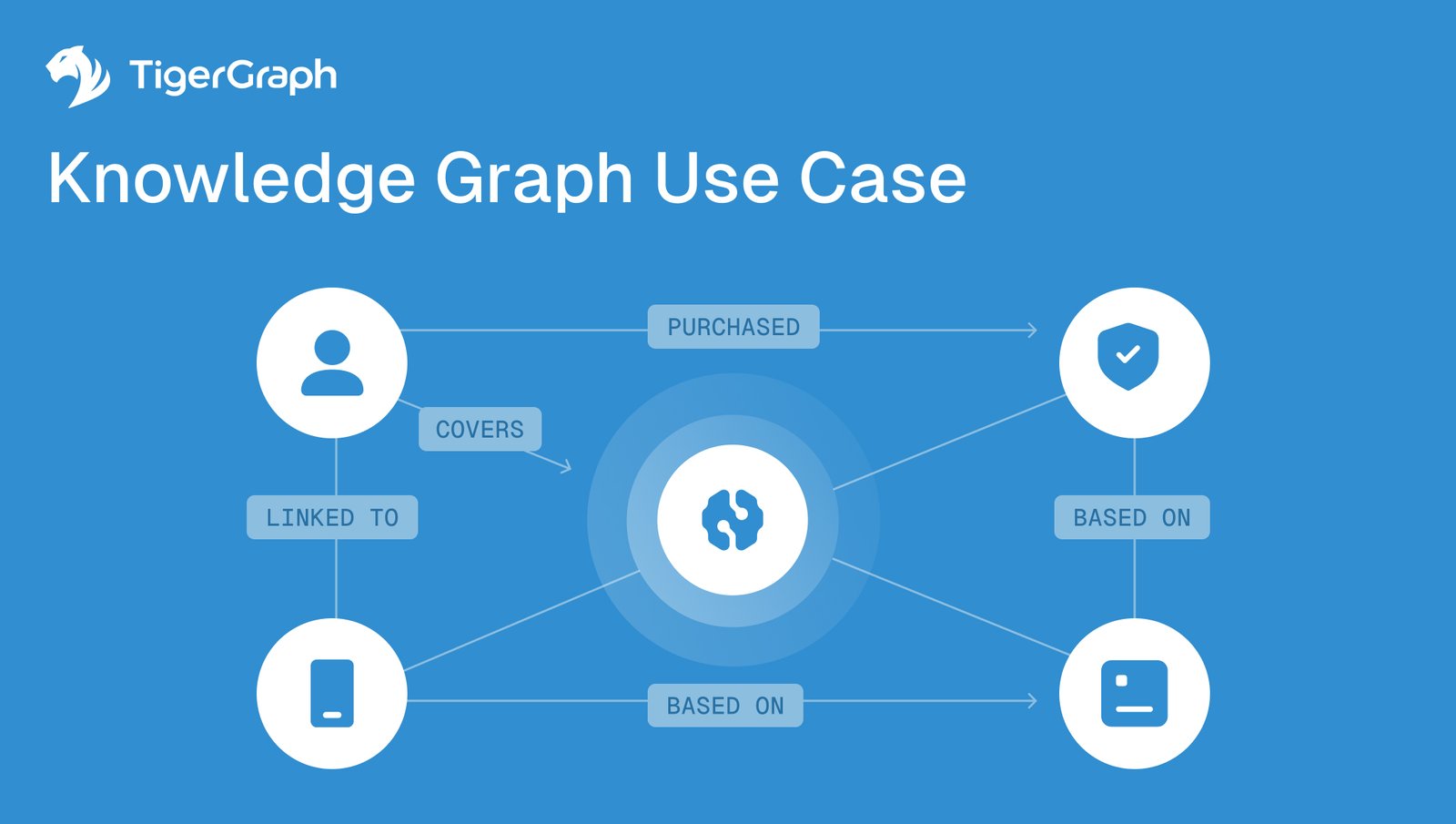
A knowledge graph represents data as entities and relationships, creating a network of connected meaning. Each node corresponds to a concept, such as a product, customer, or event—while edges describe how those entities relate.
This connected structure mirrors how humans think about information. It links data from across sources, forming a shared framework that both people and machines can query intuitively.
A knowledge graph example might map how customers engage with products, marketing, and support systems to create a unified view of interactions that were once siloed. In practice, this makes it possible to ask business-ready questions like, “Which customers are most likely to respond to an upsell campaign?” or “Which suppliers connect to our highest-risk regions?”—and get immediate, explainable answers.
Knowledge graphs organize data the way the world actually works—through connections.
Why Knowledge Graphs Matter for Modern Enterprises
Organizations rely on knowledge to operate efficiently, yet traditional databases treat facts as separate pieces. A knowledge graph bridges those gaps, connecting data into a coherent whole.
This integration produces measurable benefits—faster analytics, higher data quality, and shared understanding across business units. It shortens time-to-insight for data scientists and builds confidence for decision-makers. Each can see that recommendations are rooted in verified context.
That’s why knowledge graph applications are gaining traction in financial services, healthcare, telecom, retail, and government. Wherever complexity and change intersect, graphs reveal what matters most.
When relationships drive value, graphs deliver insight that scales.
Knowledge Graph Use Cases Across Industries
The versatility of knowledge graphs allows them to serve almost any data-rich domain. Below are the most impactful enterprise knowledge graph use cases, spanning both business and AI contexts.
Finance and Financial Crime Detection
In financial services, connected data saves time, cuts losses, and ensures compliance. A knowledge graph connects accounts, transactions, and identities to expose hidden relationships that flat databases miss. Fraud detection models use these links to identify suspicious clusters and uncover multi-hop money flows.
Banks use knowledge graphs to trace beneficial ownership, strengthen AML and KYC processes, and visualize how entities interact over time. The result: fewer false positives, faster investigations, and improved auditability for regulators.
Customer Experience and Personalization
Customer data lives across marketing systems, CRMs, and e-commerce platforms. A customer knowledge graph unifies these silos—connecting preferences, interactions, and purchase history into one dynamic profile.
This enables hyper-personalized recommendations, more relevant product suggestions, and real-time segmentation. Retailers and service providers can track evolving customer behavior while preserving explainability and compliance.
Healthcare and Life Sciences
Knowledge graphs link clinical records, genomics, and outcomes in healthcare. Hospitals use them to correlate treatments and conditions, improving care quality and supporting precision medicine.
Pharma and research organizations rely on knowledge graph examples for drug discovery—mapping compounds, side effects, and protein interactions. This approach accelerates research, reduces redundancy, and enables explainable AI for clinical validation.
Supply Chain and Manufacturing
Modern supply chains demand visibility across global ecosystems. A supply chain knowledge graph connects suppliers, logistics routes, materials, and risk indicators in real time.
Manufacturers identify bottlenecks, predict disruptions, and assess supplier reliability by modeling dependencies. Equipment and maintenance graphs power predictive maintenance, reduce downtime and optimize production.
Retail and Commerce
Retailers use knowledge graph applications to merge product catalogs, customer data, reviews, and supply-chain metrics. With connected data, they can dynamically adjust pricing, predict inventory needs, and enhance cross-sell performance.
When an e-commerce platform integrates graph analytics, every product and customer interaction adds intelligence—driving conversions while reducing returns and waste.
Telecom and Network Operations
Telecommunications networks contain billions of interconnected devices. A telecom knowledge graph maps relationships between users, routers, and infrastructure. It makes real-time monitoring and predictive insights possible.
With these connections visible, operators can detect failures before customers notice, optimize routing, and proactively balance network loads. This directly translates into higher uptime and improved customer satisfaction.
Cybersecurity and Threat Intelligence
In cybersecurity, knowledge graphs model access patterns, credentials, and data flows across an enterprise. Security teams can see relationships between compromised accounts, shared devices, or privileged users, identifying lateral movement before breaches occur.
Context-rich detection replaces siloed alerts with a holistic view of threat networks. This is essential for zero-trust environments.
Public Sector and Government
Government agencies and NGOs use enterprise knowledge graphs to connect policy data, public records, and citizen services. By breaking down departmental silos, knowledge graphs reveal how policies interact, improve response coordination, and ensure transparent decision-making.
Knowledge graphs turn bureaucracy into connected intelligence.
Knowledge Graphs for AI and RAG Workflows
Knowledge graphs are also essential for retrieval-augmented generation (RAG) and GraphRAG systems that feed large language models (LLMs). They act as a source of truth, providing verified, structured data to ground AI reasoning.
In enterprise AI, this means fewer hallucinations, faster responses, and explainable outcomes. For agentic AI systems, knowledge graphs act as dynamic memory. They allow models to reason, adapt, and learn continuously.
And when relationships become visible, decisions become smarter.
How Knowledge Graphs Improve Business Performance
The business value of a knowledge graph stems from its ability to clarify relationships at scale. Compared with conventional systems, the difference is dramatic.
| Challenge | Traditional Data Systems | Knowledge Graph Approach |
|---|---|---|
| Data Integration | Manual joins and rigid ETL pipelines | Seamless connections among entities |
| Adaptability | Frequent schema redesigns | Flexible models that evolve with new data |
| Query Speed | Degrades as relationships multiply | Maintains near-linear performance |
| Transparency | Hidden logic in code or joins | Directly traceable relationships |
This transparency enables analysts to explain results, auditors to verify logic, and executives to act with confidence. By translating complexity into clarity, a knowledge graph becomes both a technical and strategic asset.
Knowledge Graphs and Artificial Intelligence
In advanced analytics and machine learning, context determines accuracy. Knowledge graphs enrich AI models with structured relationships, grounding predictions in verified context rather than coincidence.
When paired with LLMs or agentic AI, knowledge graphs are a memory layer that evolves with new data. They help systems reason, verify, and explain—capabilities critical for enterprise-grade intelligence.
Teams deploying knowledge graph RAG use cases report higher model reliability, fewer hallucinations, and faster retrieval speeds. In essence, graphs give AI something it has always lacked: situational awareness.
Business Benefits of Knowledge Graph Adoption
Once organizations implement knowledge graphs, they see measurable improvements across the enterprise, including:
- Faster decisions powered by real-time graph queries.
- Lower operational costs through simplified data pipelines.
- Higher accuracy from context-driven analytics.
- Enhanced governance and traceability.
- Improved agility as data and business models evolve.
- Stronger collaboration between teams through shared visual understanding.
A knowledge graph turns data management from reactive maintenance to proactive intelligence.
Enterprise Case Study: Connected Data in Action
For example, consider a global insurer seeking to consolidate data across policy, claims, and underwriting divisions. Implementing a knowledge graph could produce a unified model linking people, locations, coverages, and events.
Analysts would be able to visualize dependencies in real time, simulate “what-if” risk scenarios, and pinpoint potential losses before they occur. Report turnaround could drop from days to minutes, while compliance audits become easier to manage.
This connected approach illustrates how knowledge graphs improve efficiency and can even change how an organization thinks about risk itself.
Where TigerGraph Fits in Delivering a Scalable foundation for Knowledge Graphs
TigerGraph provides a high-performance, scalable foundation for knowledge graph applications in complex, data-intensive industries. Its native parallel architecture supports billions of relationships with sub-second query response, making it ideal for real-time analytics and reasoning.
As a graph database provider, TigerGraph powers enterprise knowledge graphs for finance, healthcare, manufacturing, and telecom—helping teams uncover relationships, strengthen AI pipelines, and act with data-driven confidence.
Summary
Knowledge graphs redefine how enterprises understand their world. They connect facts, context, and logic into a single, navigable network, accelerating insight while ensuring transparency.
From knowledge graph examples in healthcare to enterprise use cases in finance, organizations are discovering that the best decisions come from connected understanding.
Ready to move beyond disconnected data? The path forward is clear. Reach out to explore how TigerGraph can help you build the connected intelligence foundation that tomorrow’s enterprises demand.
Graph: The Nervous System for Agentic AI
Why agents need more than prompts—they need connected intelligence.
Agentic AI is evolving fast. We’ve moved beyond simple tools that complete tasks and entered an era where autonomous agents can plan, act, collaborate, and even adapt to their environment. But no matter how clever your prompts or how powerful your model, autonomy falls apart without connected context.
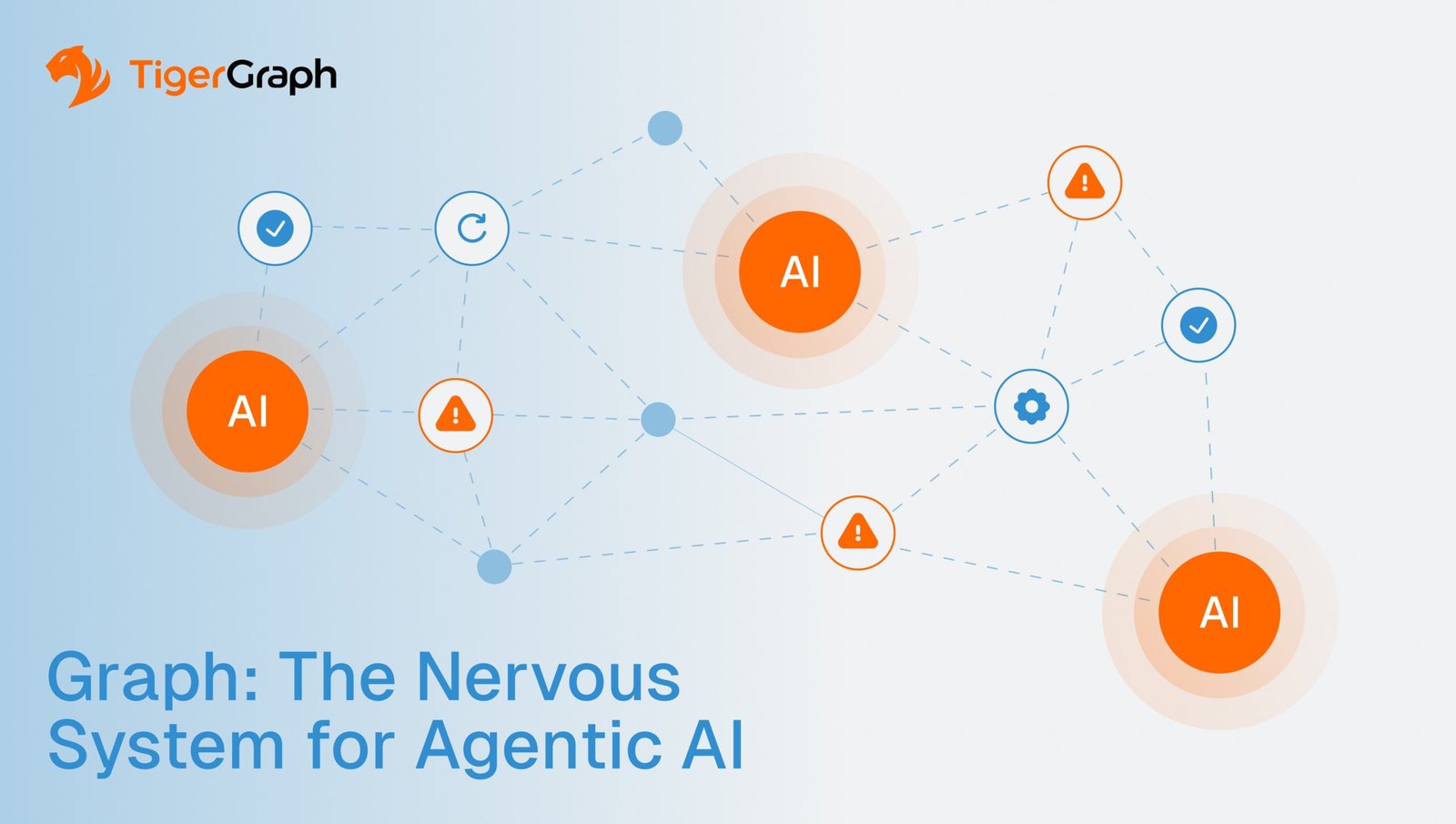
That’s why graph technology isn’t just useful, it’s foundational. In the same way a nervous system allows a living being to interpret signals, coordinate actions, and respond to change, graph acts as the operational nervous system of agentic AI. It connects the pieces, enables awareness, and turns agents from isolated actors into situated, intelligent systems.
And TigerGraph delivers that nervous system at enterprise scale.
From Prompted Output to Situated Intelligence
Most AI agents today operate like really smart assistants stuck in a loop. You give them a prompt—a task or a goal—and they respond. Maybe they follow a predefined script, maybe they chain together multiple steps with some clever reasoning. But behind the scenes, it’s still surprisingly shallow.
These agents don’t really understand where they are, what they’ve already done, or how their actions fit into a larger context. They can’t recall past interactions the way a human would. They can’t tell if two tasks conflict, or if a previous decision is shaping what’s happening now. They’re executing commands, not navigating a world.
That’s because the infrastructure powering most of these systems is still built on a foundation of flat memory, disconnected data sources, and stateless execution. It’s like trying to run a city using only sticky notes. Nothing is truly linked. Nothing is aware of cause and effect, or able to reason through messy real-world dynamics.
If we want agents to stop reacting and start reasoning, we need to give them structure.
Structure means:
- A way to connect people, systems, history, and goals—not just recognize them in isolation.
- A way to reason about what happened before, what’s happening now, and what constraints exist in the environment or organization.
- A way to adapt as relationships change, goals evolve, and new information comes in—because that’s how the real world works.
Graph is that structure.
It gives AI agents a map, not just a memory. With a graph, agents can understand relationships, navigate context, and make informed decisions grounded in their surroundings, not just their last prompt. And that’s the difference between an assistant that answers and an intelligent agent that understands.
Why Graph Is the Nervous System and Not Just a Database
Your nervous system does far more than store information. It senses the world around you. It interprets signals in real-time, coordinates your movements, adapts to changes, and helps you respond appropriately—even under pressure. It keeps you aware, connected, and functional.
That’s exactly the kind of intelligence we need to build into AI agents. Not just recall, but real awareness. Not just output, but context-driven action. And that’s where graph technology comes in.
When it’s embedded into agentic systems, graph becomes more than just a data model. It acts as the nervous system of the entire architecture—the layer that makes agents truly responsive and situationally aware. Graph is the connective tissue between:
- Memory and action – helping agents remember what’s already happened so they can act with continuity and foresight.
- Intent and impact – allowing them to understand how their decisions ripple outward through people, systems, and other agents.
- Entities and environment – giving agents a model of the world they’re in, not just the task they’re doing.
This isn’t some abstract concept. It’s the real-world difference between an LLM that spits out an answer and an agent that knows who it’s working for, why it’s taking that action, and how to adjust as conditions shift.
TigerGraph makes this real. It’s not just a backend. It’s the operational nervous system for next-generation agents enabling them to think in context, act with purpose, and function inside complex, multi-agent, multi-stakeholder ecosystems.
What the TigerGraph Graph Database Adds to the Nervous System
Many graph databases can model relationships, but few can support real-time, enterprise-grade intelligence for autonomous agents. Here’s where TigerGraph stands apart:
- Schema-first modeling: Define complex relationships up front: Roles, teams, workflows, trust layers so agents have a reliable context for decision-making.
- Parallel graph traversal: TigerGraph’s native engine lets agents query across deep relationship chains in milliseconds, without sacrificing speed or scale.
- Streaming graph updates: The graph isn’t a static map. With TigerGraph, it evolves in real time, reflecting what just happened, what’s changed, and what matters now.
- Integrated AI and GNN support: Agents can reason not only across static connections, but dynamic patterns using graph neural networks or custom ML pipelines that learn from structure, not just content.
The result? Agents that know what they’re doing, why it matters, and what to do next.
Situational Intelligence That Adapts
Imagine a network of agentic systems managing vendor onboarding for a global enterprise. One agent vets documentation, another handles compliance checks, and a third sets up access credentials.
Now imagine:
- A vendor name triggers a watchlist match.
- The compliance agent adjusts the workflow.
- The credentialing agent sees the escalation and pauses provisioning.
- A risk agent is activated and begins multi-hop investigation based on known relationships.
This is not prompt chaining. It’s real-time, situational reasoning powered by graph.
TigerGraph enables these agents to share structured context, adapt to new inputs, and coordinate behavior across the system. And that’s not just intelligence, it is system-level awareness.
Build AI Agents That Understand the World They Work In
Autonomy without structure is fragility, and prompting without context is guesswork.
If you want your agents to be more than reactive tools and understand the environment they’re acting in, they must adapt to the dynamics around them, and work as intelligent components in a larger system. Accomplishing this requires more than LLMs—you need graph.
TigerGraph is a graph database and the nervous system for agentic AI, offering the infrastructure to build agents that observe, adapt, and align.
Build AI Agents That Think, Not Just React.
Your agentic AI doesn’t just need data—it needs awareness. TigerGraph provides the connective intelligence that turns inputs into understanding, and actions into informed outcomes.
Explore TigerGraph Cloud for free and bring your agents to life with graph-native situational intelligence. https://tgcloud.io
Demystifying Black Box AI with Graph Technology
Artificial intelligence is reshaping how decisions are made—driving automation, accelerating insights, and enabling autonomy at scale. But with that power comes a growing concern: the Black Box problem.
As AI systems become more complex—especially those powered by deep learning—their decisions often lack transparency. They produce outcomes without showing the reasoning behind them. In everyday applications, this might be a mild frustration. But it’s a serious liability in high-stakes environments like finance, healthcare, and cybersecurity.
When an AI system denies a loan, flags a transaction, or recommends a treatment, the real question becomes: Why?
Why, indeed. We often don’t know, and today’s AI typically isn’t telling us.
That’s where graph technology changes the game.
The Black Box Problem: AI Without Accountability
Deep learning models are powerful tools for uncovering patterns, detecting anomalies, and making predictions. But they do so behind a wall of statistical abstraction. These models operate using millions—or even billions—of parameters, optimized through layers of training that often defy human intuition. The result is a system that can perform, but not easily explain.
This lack of transparency might be acceptable in low-stakes scenarios—recommending a movie, ranking a search result, or flagging spam. However, the stakes differ in regulated, safety-critical domains like finance, healthcare, and cybersecurity.
Opacity isn’t just a rare technical inconvenience. It’s not an “edge case” you plan for just in case something goes wrong. It’s the rule-breaking moment that regulators are already watching for.
Regulators aren’t trying to shut AI down—they’re trying to implement Responsible AI and keep it from hurting people, breaking laws, or operating without accountability. Their scrutiny is about protecting fairness, safety, and trust in an increasingly automated world. For example, in these industries:
- A flagged transaction can trigger a regulatory audit or freeze a customer’s account.
- A denied loan could impact someone’s livelihood.
- A misinterpreted medical recommendation could have life-altering consequences.
These are not theoretical concerns. They’re everyday scenarios—and each one demands explainability. Stakeholders need to know:
- Why did the system make that decision?
- What data informed it?
- Can the logic be reviewed, challenged, or improved?
In this context, a black box AI system becomes a liability. Not because it doesn’t work—but because no one can prove how it works when it matters most. That’s why building transparency and accountability into AI systems isn’t optional—it’s foundational.
Imagine a bank uses a deep learning model to detect credit card fraud. One morning, a customer’s transaction is flagged and their account is frozen. They call support, understandably upset—and the agent has no clear answer. The model scored the transaction as high risk, but can’t explain why.
Now imagine that same decision made within a graph-powered AI system. Instead of returning a cryptic risk score, the system shows a traceable path:
- The customer’s card was used from a device that’s also linked to multiple compromised accounts.
- The transaction was sent to a merchant involved in a previously detected laundering scheme.
- The pattern of usage deviates significantly from the customer’s typical behavior—traveling, transaction timing, and amount.
This layered, relational context gives the support agent an actionable explanation and gives compliance teams a defensible reason for the action taken. This is the difference between a system that acts and one that understands—and in regulated environments, that difference is everything.
Graph technology steps in to provide the missing structure and context that deep learning alone can’t deliver.
Graph as the Foundation for Explainable AI
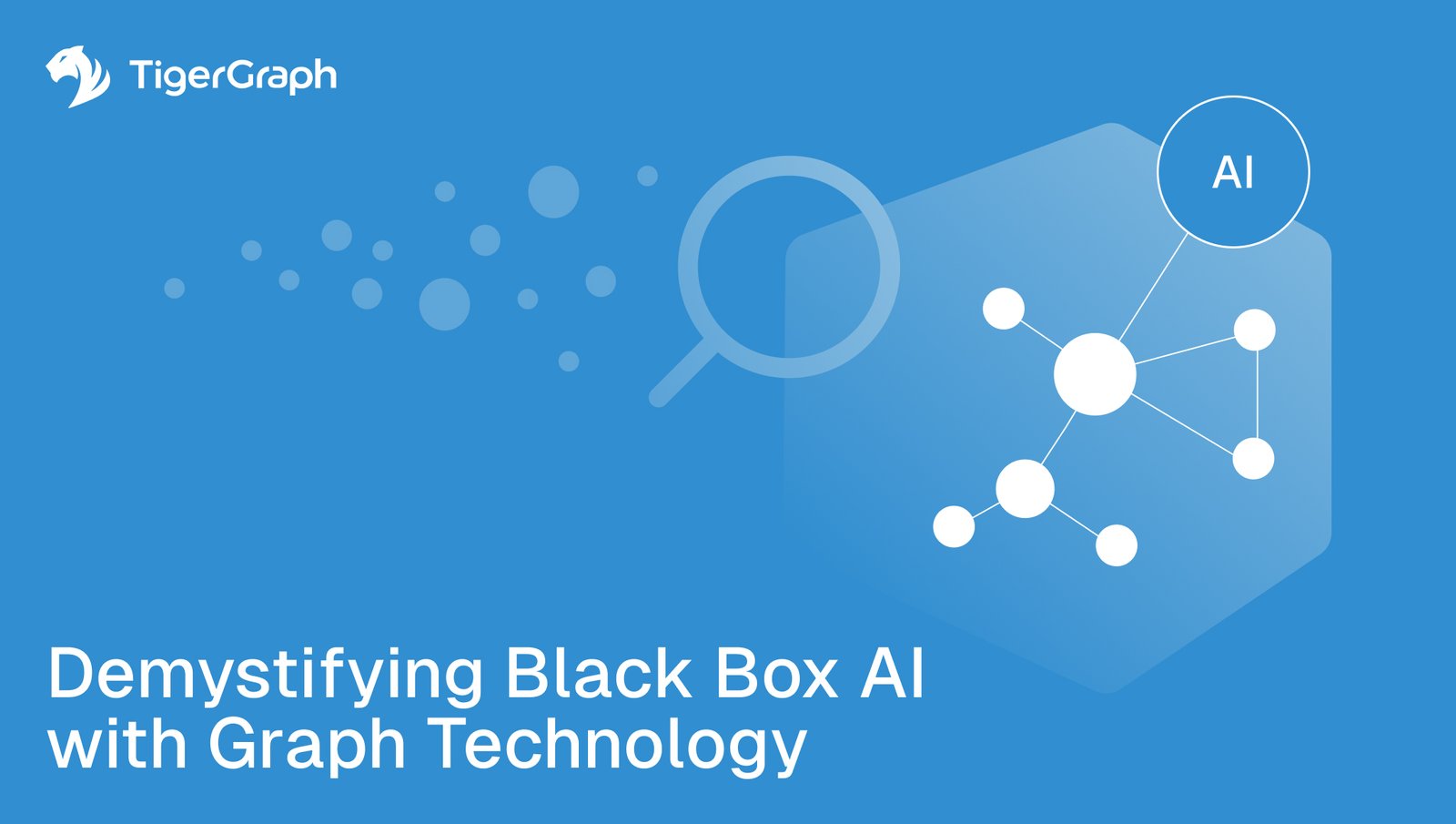
Graph databases structure data as nodes (entities) and edges (relationships). This mirrors how we naturally reason—by connecting people, events, behaviors, and time. It enables AI systems to operate in a way that’s not only intelligent but interpretable, i.e., “explainable.”
Graph gives AI memory and context, and this is what lets agents reason and act responsibly. With graph technology, AI systems can:
- Trace the logical steps behind a decision.
- Visualize how entities and behaviors are linked across time.
- Embed and enforce rules and norms directly within a knowledge graph.
This means graph doesn’t just help AI think—it helps it justify. Another example could find us working with a healthcare diagnostic system. A traditional AI model might flag a patient as high risk for a rare cardiac condition but offer little explanation beyond a confidence score. A graph-powered system, however, can walk a physician through the logic:
- The patient shares multiple biomarkers with individuals previously diagnosed with the condition.
- There’s a family history connection revealed through linked patient profiles and genetic records.
- The patient’s recent lifestyle changes—captured in wearable data and wellness logs—mirror known risk trajectories from similar cases.
Instead of a black-box label, clinicians get a reasoned narrative. They understand not only what the AI sees, but why it matters. And that traceability becomes crucial when the diagnosis informs life-altering decisions, treatments, or follow-up testing.
Graph turns opaque predictions into transparent, trustable insights—whether you’re a doctor, an auditor, or a data scientist. It transforms AI from a black box into a glass box.
Explainability Is No Longer Optional
As AI becomes more powerful and more embedded in critical systems, the demand for explainable AI has gone from a best practice to a legal requirement. Governments and regulators are enacting frameworks like the EU AI Act, GDPR, and sector-specific mandates (such as Basel III in finance or HIPAA in healthcare) that require organizations to do more than just deploy AI—they must demonstrate how and why a system made a particular decision.
This means institutions must be able to:
- Show the logic behind an AI output—not just the result but the reasoning path that led there.
- Prove alignment with policies and laws—ensuring decisions don’t violate internal governance or external compliance standards.
- Audit systems for bias, fairness, and risk—so that organizations can explain outcomes to regulators, customers, or affected individuals, and correct them when necessary.
This level of accountability is difficult—if not impossible—with traditional black-box AI models operating in siloed, tabular data environments.
TigerGraph’s architecture is purpose-built for explainable, high-performance decision-making, offering:
- Parallel, distributed processing to query large datasets in real-time,
- Real-time graph traversal to follow relationships across multiple hops (think: tracing influence through people, transactions, behaviors, or devices),
- GSQL, an expressive and extensible query language that supports reusable logic and advanced pattern matching.
With TigerGraph, it’s possible to operationalize explainability. Whether an AI agent is making a credit decision, monitoring for cyber threats, or automating clinical insights, every action it takes can be justified through the graph—step by step, edge by edge.
In short: explainability isn’t a bolt-on feature. It’s built into the fabric of how TigerGraph is powering AI systems to see and act in the world.
Solving the AI Trust Problem with Graphs
The next wave of AI innovation isn’t just about bigger models. It’s about responsible autonomy with AI systems that act and explain; adapt and align. Agentic AI isn’t just about autonomy—it’s about responsibility, and it’s also about trust.
Graph is the missing piece that makes all of this possible. It gives AI systems a knowledge index, an ethical awareness, and a map of how things relate—so they can make decisions and also defend them. In the AI-powered future, trust isn’t just earned—it’s engineered.
Graph technology turns intelligence into explainable intelligence. It makes it possible for systems to adapt, reason, and operate transparently. And that’s what today’s enterprises, regulators, and users are demanding.
The question isn’t just what AI can do—it’s can we understand what it’s doing—and why? With graph, the answer is yes—and TigerGraph is the conduit to this understanding.
TigerGraph DB Community Edition – The Most Powerful Free Graph + Vector Database for Turbocharging AI
Unlocking the Power of Graph AI for Developers, Researchers, and Startups
Graph databases have come a long way from powering social networks and recommendation systems to enabling real-time fraud detection, anti-monitoring, entity resolution, customer 360, supply chain optimization, and AI-driven decision-making. Today, with the rapid evolution of AI and retrieval-augmented generation (RAG) models, traditional databases are no longer enough. Developers need hybrid capabilities that combine graph traversal, vector search, and real-time analytics into a single system.
This is especially true for collaborative Agentic AI, where AI agents continuously learn, adapt and make informed decisions in real time. Multi-modal databases, combining graph and vector search, are critical for structuring knowledge, retrieving relevant information, and optimizing workflows dynamically.
Despite this need, most free graph databases limit their capabilities, offering only basic traversal features, low CPU limits, restricted storage, and no vector search. Developers, AI researchers, and data scientists are left searching for alternatives that provide true AI-driven graph analytics.
That’s why we’re introducing TigerGraph DB Community Edition, a fully featured, AI-ready multi-modal database that supports both structured graph analysis and unstructured vector search. It is free, allows full production use, and provides the most advanced hybrid search experience available today.
Why TigerGraph DB Community Edition Stands Out? Why Now?
Most free graph databases have strict limitations, making it difficult for AI developers and data scientists to build production-ready applications. TigerGraph DB Community Edition removes these restrictions and offers unmatched flexibility.
- More compute power – Competing free graph databases only offer 2-4 CPUs, but TigerGraph DB Community Edition provides 16 CPUs, enabling high-performance analytics, graph traversal, and AI workloads.
- Higher storage limits – Many free databases restrict users to small datasets, but TigerGraph DB Community Edition supports 200GB of graph storage and 100GB of vector storage, allowing developers to handle large-scale AI applications.
- Fully integrated graph+vector hybrid search – Other graph databases lack native vector support, forcing users to connect to external vector databases. TigerGraph provides seamless hybrid graph + vector search, making it the ideal database for AI applications.
- Multi-query language support – Developers can use GSQL, OpenCypher, and ISO GQL, allowing easy adoption without rewriting queries.
- Built for the rise of Agentic AI – AI systems are becoming autonomous, self-improving, and capable of orchestrating complex multi-agent workflows. TigerGraph Turing complete graph query language provides the ideal infrastructure for Agentic AI by enabling task dependency management, structured knowledge storage, and dynamic reasoning through hybrid search.
As AI shifts from passive models to active agents, databases must evolve to support reasoning, collaboration, and workflow orchestration. TigerGraph’s Graph + Vector Hybrid search allows AI agents to retrieve relevant information, optimize task execution, and dynamically adjust workflows – capabilities that are critical for the next generation of AI applications.
Production-ready without licensing barriers – Unlike other free graph databases that impose non-commercial restrictions, TigerGraph DB Community Edition is fully production-ready for real-world deployments.
AI developers, data scientists, and startups no longer need to choose between performance and affordability. This is the most advanced free graph database available today, designed to help teams build next-generation AI-powered applications at scale.
Who Should Use TigerGraph DB Community Edition?
TigerGraph DB Community Edition is designed for a broad range of users who need a powerful graph database with AI and vector search capabilities.
AI Developers & ML Engineers
- Build hybrid graph+vector AI models with retrieval-augmented generation (RAG), recommendation engines, and real-time anomaly detection.
- Use TigerGraph’s integrated vector search to improve AI model accuracy and search efficiency.
- Leverage multi-hop reasoning and hybrid queries to retrieve structured and unstructured data in real-time.
Data Scientists & Analysts
- Perform deep graph analytics to uncover hidden relationships in large datasets.
- Integrate structured knowledge graphs with unstructured vector embeddings for enhanced predictive modeling.
- Work with graph algorithms and ML models to improve fraud detection, recommendation systems, and entity resolution.
Startup Founders & Innovators
- Develop scalable AI-powered applications without the financial burden of enterprise licenses.
- Deploy production-ready AI solutions with 200GB of graph storage, 100GB of vector storage, and 16 CPUs.
- Quickly ingest and analyze large datasets from multiple sources, including data lakes, transactional systems, and real-time event streams.
Academic & Research Teams
- Experiment with advanced graph AI techniques, combining structured and unstructured data for deep learning applications.
- Work with cutting-edge retrieval-augmented generation (RAG) techniques for LLM research.
- Access a free, high-performance graph+vector database to support AI, NLP, and complex network analysis.
TigerGraph + Iceberg: Bringing Graph AI to Data Lakes
TigerGraph Community Edition now includes native integration with Apache Iceberg, making it easier to connect graph-powered AI with massive datasets stored in data lakes. Businesses leveraging Iceberg and Spark can now perform real-time analytics on structured and semi-structured data without costly ETL transformations.
With the TigerGraph Spark Connector, users can load data from Iceberg tables directly into TigerGraph’s graph schema. This integration enables advanced AI workflows, where historical transaction data stored in Iceberg can be combined with real-time graph analysis to detect fraud, predict customer behavior, and optimize search recommendations.
To set up Iceberg ingestion:
- Create Iceberg tables corresponding to TigerGraph’s schema.
- Use Spark SQL to load structured data into Iceberg tables.
- Connect TigerGraph to Spark and load data into the graph database.
TigerGraph’s Iceberg integration is ideal for financial fraud detection, risk analytics, and large-scale customer intelligence, where historical transaction data in Iceberg can be combined with real-time graph analysis to detect anomalies faster.
What Can You Build with TigerGraph DB Community Edition?
TigerGraph DB Community Edition provides a multi-modal approach to AI, combining structured graph data with vector search to unlock powerful real-world applications.
AI-powered knowledge graphs
- Build a real-time retrieval-augmented generation (RAG) pipeline for LLMs and generative AI models.
- Enhance AI applications by enriching vector search with structured graph insights.
Personalized search & recommendations
- Implement multi-modal search using both graph traversal and vector similarity.
- Power context-aware search that understands relationships between people, products, and events.
Fraud detection & risk scoring
- Detect fraudulent financial transactions by integrating real-time transactional data with historical risk scores.
- Use graph-based anomaly detection to uncover hidden fraud networks.
Data lake analytics with Iceberg
- Use Spark + TigerGraph to query and analyze massive datasets in a distributed, AI-ready environment.
- Combine structured enterprise data with real-time graph analytics for faster insights.
For a deeper comparison of how TigerGraph’s hybrid graph+vector capabilities surpass traditional graph solutions, check out our blog post here [link to be added].
Getting Started with TigerGraph DB Community Edition
Follow these steps to get up and running with TigerGraph Community Edition.
- Download the TigerGraph Docker Image
Visit our product download page, navigate to the Community Edition section, and request a download link. - Follow the instructions mentioned in Getting Started with Docker
- Follow this quick start guide to use:
Developers can use GSQL Shell to execute queries or GraphStudio to create and visualize data models.
What’s Next?
Once you have set up TigerGraph DB Community Edition, here’s what you can explore next:
- Write your first GSQL query – Learn how to run graph queries
- Try out vector search – Run your first hybrid graph+vector search query to see TigerGraph’s AI capabilities in action.
- Connect to an Iceberg data lake – Load real-world datasets from Iceberg into TigerGraph for large-scale AI analytics.
- Join the TigerGraph Community – Share your experiences, ask questions, and collaborate with fellow developers.
Get Started Today
The best AI applications don’t just retrieve information, they understand relationships.
TigerGraph DB Community Edition is the first free database that lets you build graph-powered AI applications without compromise.
[Download TigerGraph DB Community Edition and Start Building AI Applications Today]