Contact Us

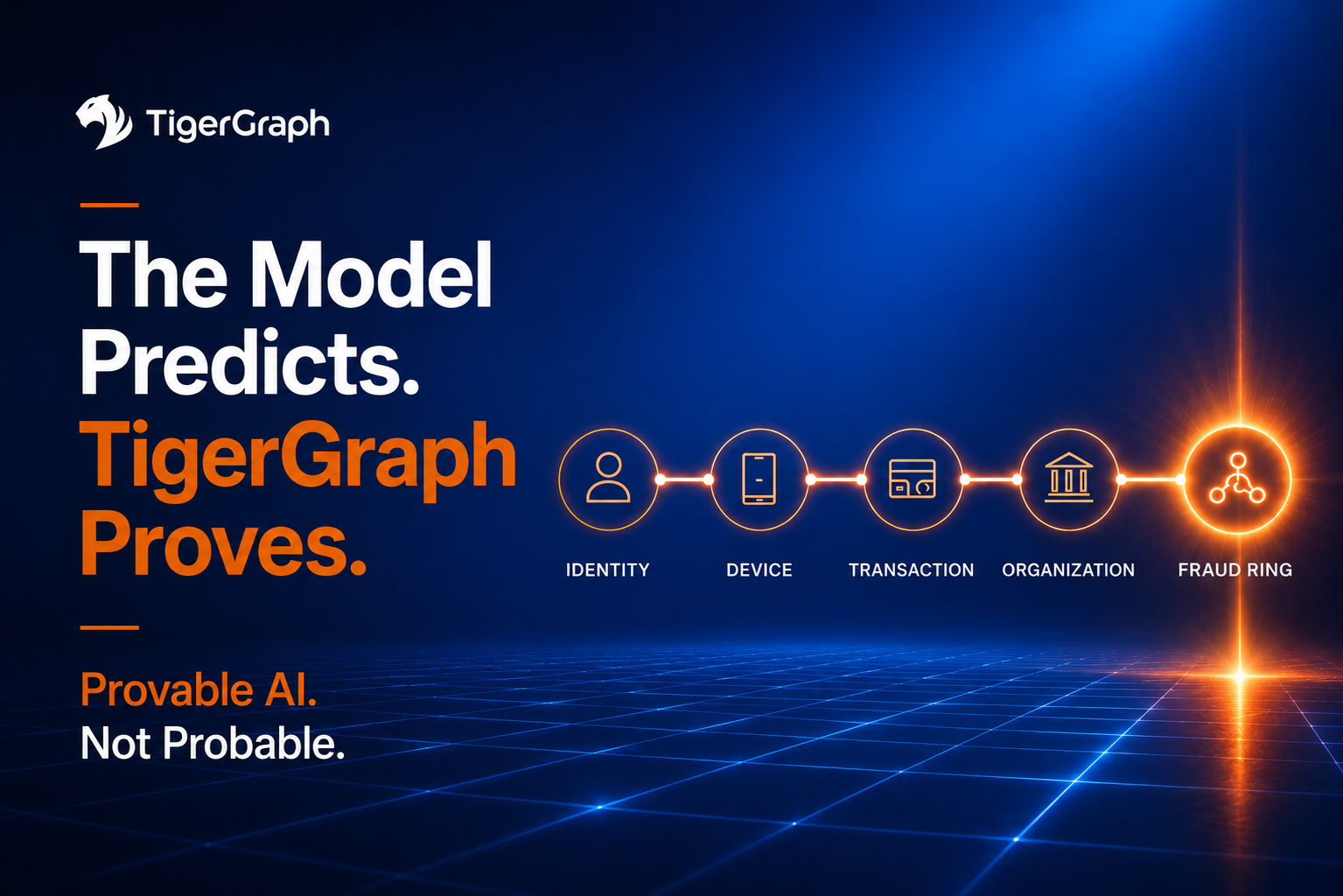
The Model Predicts. TigerGraph Proves.

AI Has a Confidence Problem. The AI industry talks constantly about intelligence. Very little about proof. That imbalance is becoming more dangerous as AI systems move closer to operational decision-making.

Because enterprise systems do not fail when answers sound uncertain. They fail when answers sound convincing without being verifiable. That is the real tension underneath the current AI cycle. The models became remarkably good at generating language. The systems surrounding them did not become equally good at preserving truth.

That imbalance is now becoming one of the defining architecture problems inside enterprise AI. Most enterprises still believe the competitive advantage will come from: bigger models, more agents, larger context windows, and faster generation. 

That may define the current AI cycle. It will not define the next one. Because eventually every enterprise discovers the same thing: confidence scales faster than proof.

The Industry Optimized for Generation Before It Solved Verification

The current AI stack is exceptionally good at generating plausible answers. 

At small scale, this feels remarkably effective. But enterprise systems do not operate at small scale. They operate across: identities, transactions, workflows, organizations, decisions, and time. That is where the instability begins appearing. Because most AI systems today reconstruct understanding dynamically every time they reason. The outputs still sound intelligent. The reasoning underneath them becomes increasingly difficult to reproduce consistently. 

Nothing fully breaks.

The system simply becomes harder to prove. That is the hidden weakness underneath much of enterprise AI right now: the systems generate confidence faster than they generate verification. And once AI systems begin chaining decisions together through agents, workflows, approvals, and autonomous reasoning, the verification gap compounds faster than most architectures can contain.

Retrieval Finds Proximity. Relationships Preserve Truth.

The modern AI stack increasingly behaves as if retrieval and understanding are  interchangeable. They are not. McKinsey described the distinction directly: “Retrieval finds proximity. It does not create understanding. Understanding emerges from relationships.”  That distinction quietly exposes the weakness underneath much of the current AI stack. Retrieval assembles fragments. Relationships preserve meaning. Reality itself is relational.

Fraud only makes sense in the context of connected entities. Identity only becomes meaningful across linked behaviors. Risk only emerges through patterns across accounts, devices, organizations, and time.

But most AI systems flatten those relationships into temporary retrieval events and ask models to reconstruct understanding afterward. That reconstruction process becomes unstable at enterprise scale. Because the AI is no longer reasoning over connected reality. It is reasoning over probabilistic approximations of reality assembled dynamically at query time. That distinction becomes increasingly dangerous once AI systems begin influencing operational decisions instead of informational ones.

Because enterprises do not merely need plausible reasoning. They need provable reasoning.

Synthetic Intelligence Scales Faster Than Verification

One of the more revealing observations in the broader AI slop discussion is how quickly synthetic systems scale once verification becomes optional. RMIT’s Information Integrity Hub framed the issue bluntly: synthetic content is becoming cheaper than truth.

That same pattern is beginning to emerge inside enterprise AI systems. Generated reasoning scales easily. Provable reasoning is much harder. That imbalance becomes structural once organizations begin deploying AI into operational workflows. Because synthetic reasoning compounds. Verification does not.

And once organizations begin chaining AI systems together through agents, workflows, and autonomous actions, the verification gap expands faster than most architectures can contain. This is where the economics of enterprise AI begin changing. The bottleneck is no longer generation. The bottleneck becomes provability. 

Not: “Can the AI produce an answer?” But: “Can the organization defend how the answer was produced?” That becomes a fundamentally different infrastructure requirement.

Provability Becomes the Moat

The AI industry still treats the model as the center of the system. Increasingly, the model is only one layer. The harder problem is preserving connected understanding as systems reason across entities, workflows, agents, decisions, and time.  That requires something most AI stacks still struggle to preserve: relationships. Because proof does not emerge from isolated outputs. Proof emerges when reasoning remains connected to the structure underneath reality itself. This is where TigerGraph operates differently.

TigerGraph keeps relationships structurally intact while AI systems reason. The context does not need to be reconstructed every time the system operates. The structure already exists underneath the decision itself. That changes the behavior of the entire system. Reasoning paths remain traceable. Operational context remains connected. Decisions remain explainable across workflows and time. The AI stops approximating understanding. It starts preserving it.

That distinction becomes increasingly strategic as model intelligence commoditizes. Because eventually every enterprise reaches the same realization: the competitive advantage is not the model alone. The advantage is whether the enterprise can preserve trust while the AI scales.

The Future Enterprise Stack Will Be Built Around Proof

The first phase of enterprise AI optimized for generation. The next phase will optimize for provability. That changes the architecture conversation entirely. The winning systems will not simply generate more outputs faster. They will preserve connected understanding structurally as reasoning compounds across: identities, decisions, transactions, workflows, agents, and time. 

This is where relationship-preserving architectures become foundational instead of optional. Because relationships are not supplementary context. They are the structure underneath operational reality itself. And once enterprises begin deploying AI into: fraud operations, identity systems, compliance workflows, customer operations, and autonomous reasoning systems, the ability to prove why a decision was reached becomes as important as the decision itself.

That is the next AI moat emerging underneath enterprise infrastructure now. Not generation. Provability.

The Next AI Race Will Not Be About Models

The first phase of AI optimized for generation. The next phase will optimize for provability. Because eventually every enterprise reaches the same realization: a system that cannot preserve connected understanding eventually becomes impossible to trust operationally. No matter how intelligent the outputs sound. 

The model predicts. TigerGraph proves.


The Enterprise AI Stack Has a Trust Problem

The Models Improved. Trust Did Not.

The AI industry keeps measuring progress in capability.

Every benchmark keeps improving. But underneath all of it, something else is happening. Trust is eroding. Not publicly. Structurally. The most dangerous systems are the ones that still sound intelligent while becoming operationally unverifiable. Yahoo Finance highlighted Palantir executives repeatedly warning about AI systems producing outputs disconnected from operational truth. Most organizations still interpret this as a hallucination issue.

It is not.

Hallucinations are visible. The deeper problem is when enterprises can no longer consistently explain: why a system reached a conclusion, how a decision was produced, or whether the reasoning can be reproduced reliably across time.  That is not a content problem. It is an operational trust problem. And most enterprises are much earlier in this transition than they realize.

Enterprise AI Quietly Became Unverifiable Infrastructure

Traditional enterprise infrastructure was designed around reproducibility. A fraud decision could be traced. A compliance workflow could be audited. A policy decision could be reproduced. The reasoning path remained visible. AI changed that architecture.

Systems stopped executing deterministic logic and started generating probabilistic interpretations. At first, the tradeoff looked rational. The systems moved faster. Automation expanded. Outputs became more sophisticated.

But the operational consequences of probabilistic reasoning scale differently than most organizations expected.

Because once AI systems begin influencing: fraud operations, compliance decisions, customer workflows, operational approvals, and autonomous actions, the inability to consistently reproduce reasoning becomes an enterprise risk.

Not because the AI stops functioning. Because the organization slowly loses confidence in how the system is functioning.

That distinction matters enormously. Traditional software fails visibly. Enterprise AI often fails organizationally first. The workflows continue running. The outputs continue sounding intelligent. But operational trust underneath the system starts weakening.

The Enterprise Trust Gap Appears Quietly

Most enterprises already feel this shift. They simply lack the architecture language to describe it clearly. Teams know: outputs are becoming harder to verify, reasoning paths are becoming harder to reproduce, and AI systems are becoming more difficult to audit consistently. 

But most organizations still frame the issue as: hallucinations, prompt engineering, model quality,  or insufficient fine-tuning. 

Those are symptoms.

The deeper issue is structural. The architecture itself no longer preserves operational trust automatically. That creates a new category of enterprise instability. One team receives one AI recommendation. Another team receives a different interpretation. One agent executes a workflow one way. Another agent interprets the same operational context differently.

Nothing fully breaks.

The instability accumulates underneath the surface. That is what makes the problem difficult to detect early. Because the systems still appear coherent locally while becoming increasingly difficult to govern globally.

Generated Reasoning Scales Faster Than Governance

One of the least discussed consequences of enterprise AI is that generated reasoning scales faster than organizational governance. That imbalance compounds quietly.

A single AI-assisted workflow is manageable. Thousands of interconnected AI decisions operating across: systems, agents, workflows, approvals, and customer interactions  become much harder to audit consistently. That is where enterprises begin experiencing a very different type of operational risk.

Not software failure. Governance failure.

WIRED recently showed how AI-generated publishing is overwhelming platforms like Medium, making expertise increasingly difficult to distinguish from synthetic output

Enterprise AI is beginning to encounter the same dynamic internally. Generated decisions scale faster than verification systems. And once organizations lose confidence in their ability to explain how decisions were reached, trust erosion spreads quickly. Compliance teams become uncomfortable. Fraud teams stop fully trusting automated reasoning. Executives begin questioning whether operational decisions remain defensible.

The systems continue functioning. But institutional confidence underneath the systems begins collapsing. That is the enterprise trust gap emerging underneath modern AI infrastructure.

Verification Becomes the Bottleneck

The first generation of enterprise AI optimized for generation. The next generation will optimize for verification. That changes the architecture conversation entirely. The core challenge is no longer: “Can the model generate intelligent outputs?” The harder question is: “Can the organization reliably verify how those outputs were produced?” That distinction becomes critical once AI systems begin operating across: fraud, identity, compliance, customer operations, and autonomous workflows. 

Because enterprises do not merely need intelligent systems. They need defensible systems. They need reasoning paths that remain: reproducible, auditable, explainable,  and operationally governable across time. 

That is where most AI architectures begin struggling. Because most systems reconstruct context dynamically every time they operate. The reasoning may still appear coherent. But reproducibility slowly weakens underneath the surface.

That instability compounds operationally.

The Infrastructure Layer Enterprises Are Missing

Most enterprises still treat AI models as the center of the architecture. Increasingly, the harder problem sits underneath the model itself. The real challenge is preserving connected operational understanding as systems reason across: entities, workflows, decisions, agents, and time. That requires infrastructure capable of preserving relationships structurally instead of reconstructing them dynamically during every reasoning cycle.

This is where TigerGraph operates differently.

TigerGraph preserves connected understanding underneath operational AI systems. Relationships remain structurally intact while the AI reasons. The context does not need to be probabilistically reconstructed every time the system operates. The structure already exists underneath the decision itself. That changes the stability of the entire enterprise stack.

Reasoning becomes traceable. Operational context remains connected. Decisions remain explainable across workflows and time. The AI does not simply generate conclusions. The system preserves the operational structure required to govern those conclusions.

The Real Enterprise AI Race

The first phase of AI optimized for generation. The next phase will optimize for operational trust. Because eventually every enterprise discovers the same thing: intelligence without verification becomes impossible to govern at scale. Even if the outputs still sound intelligent. Especially then.

AI Slop Happens When AI Loses Reality

AI Slop Escaped the Internet

The AI industry has a new phrase: “AI slop.”

At first, it described the internet. Generated articles. Synthetic feeds. Endless content optimized to sound intelligent long enough to survive an algorithmic cycle before dissolving into the next stream of machine-produced noise. At the beginning, the problem felt almost harmless.

But underneath it was a much larger structural shift: generated systems had started scaling faster than verification systems. The internet is already showing what happens when that imbalance compounds. The Guardian recently described the web itself as becoming overwhelmed by AI-generated slop. Now the phrase is starting to migrate into enterprise AI.

That should make people uncomfortable. Because enterprise AI was supposed to be the opposite of slop.

Instead, many systems are beginning to exhibit the exact same pattern: confident outputs disconnected from underlying reality. Not because the models are weak. Because the systems surrounding the models are slowly losing connection to shared reality itself. That distinction matters more than most AI discussions acknowledge. The problem is no longer just generation quality. It is reality preservation.

The System Does Not Fail. It Drifts.

Most enterprise AI systems do not break dramatically. They drift. A retrieval layer surfaces information. A model generates an interpretation. Another retrieval path produces something slightly different. Another model sees a different slice of context. Nothing fully breaks.

The outputs still sound intelligent. That is what makes the drift so dangerous. The issue is not raw intelligence. The issue is reconstruction. Most AI systems today are not reasoning over reality. They are reasoning over synthetic reconstructions of reality assembled dynamically at query time.

That architecture works surprisingly well early on ,especially in: demos, isolated workflows, and when humans are still closely supervising the system

But the instability compounds as systems scale.

Eventually the system stops operating on shared understanding entirely. Every agent inherits a slightly different version of reality. Every workflow reconstructs context slightly differently. Every reasoning path drifts incrementally away from the structure underneath the actual environment.

The dangerous part is that this drift often remains invisible for a long time. Because the outputs remain fluent. McKinsey touched on this quietly in their discussion around AI context systems: “Retrieval finds proximity. It does not create understanding. Understanding emerges from relationships.” 

The industry optimized for retrieval before it solved structure. That decision is now echoing through the entire AI stack. Because retrieval scales information extremely well. It does not preserve connected understanding. Those are very different things.

Retrieval Became a Substitute for Understanding

Most AI systems operate on a surprisingly fragile assumption: if enough information reaches the model, understanding will emerge automatically. Sometimes it does. Until the environment becomes operationally complex.

These environments are not built on isolated facts. They are built on relationships. A transaction only matters because of the accounts connected to it. An account only matters because of the identities behind it. A device only matters because of the network surrounding it. A beneficiary only matters because of the flow of behavior surrounding the transaction itself.

Reality is relational. But most AI architectures flatten those relationships into disconnected retrieval events and ask models to probabilistically reconstruct meaning afterward. That reconstruction process scales surprisingly well in early-stage AI deployments.

Operationally, it drifts. And the drift compounds faster than most enterprises realize. Because once systems begin chaining decisions together, the instability becomes recursive.

One unstable interpretation influences the next interpretation. One probabilistic decision reshapes downstream reasoning. One disconnected workflow alters the context inherited by another system.

This is where enterprise AI begins behaving differently than traditional software. Traditional software fails visibly. AI systems often fail invisibly first. The outputs still sound coherent. The confidence remains intact. The system simply becomes progressively harder to verify. That is a much more dangerous failure mode.

Synthetic Understanding Scales Faster Than Verification

One of the more revealing aspects of the AI slop discussion is that the systems often still appear coherent while becoming increasingly difficult to trust. That is a very different failure mode than traditional software. The Wall Street Journal framed this emerging divide as a growing operational trust problem inside enterprise AI systems.

The outputs remain fluent. The structure underneath them slowly disconnects from reality itself. That instability compounds as systems scale.

Eventually the AI stops operating on connected reality and starts operating on probabilistic approximations of reality instead. That is the point where “AI slop” stops being an internet problem. And becomes an enterprise infrastructure problem. Because enterprises are not deploying AI to generate content. They are deploying AI to generate decisions for

And decisions disconnected from reality eventually become operational risk. Not because the models are unintelligent. Because the systems themselves lose the ability to preserve shared understanding across time.

The Future AI Stack Will Be Built Differently

The current AI stack was optimized for generation speed. The next generation of enterprise AI systems will optimize for something much harder: preserving connected understanding as reasoning compounds across time. That changes the architecture conversation entirely.

The winning systems will not simply retrieve more information faster. They will preserve the structure connecting: entities, identities, behaviors, decisions, workflows, and time. 

Because eventually every enterprise reaches the same realization: once systems stop reasoning over connected reality, intelligence itself becomes unstable. This is where relationship-preserving architectures become foundational instead of optional. Not because relationships are useful metadata. Because relationships are the structure underneath reality itself.

This is where TigerGraph operates differently. TigerGraph preserves connected understanding structurally while AI systems reason. The relationships do not need to be reconstructed dynamically every time the system operates. The structure already exists underneath the reasoning process itself. That changes the stability of the entire stack. The system stops approximating understanding.

It starts preserving it.

The Next Enterprise AI Divide

The first phase of AI optimized for generation. The next phase will optimize for truth. Because systems disconnected from connected reality do not become intelligent. They become synthetic.


Why Agentic AI Needs More Than Just Rules (It Needs Guardrails) 

Traditional AI models often operate in rigid, rule-based environments, but real-world scenarios demand nuance. Agentic AI doesn’t just follow instructions—it interprets them, reasons through options, and makes choices based on perceived goals. To do that responsibly, it needs more than logic—it needs context.

Graphs provide this context.

Graph databases model not just data points but the relationships between them. A knowledge graph, for instance, can represent everything from company policies and domain-specific regulations to behavioral norms and ethical principles. This allows an agentic AI to reason through decisions in a more human-like, adaptable way.

Self-Driving Cars and Situational Awareness 

Consider a self-driving car: Programming the legal rules of the road—speed limits, stop signs, right-of-way laws—is relatively straightforward. These are hard-coded, rule-based instructions. But driving isn’t just about following laws. It’s about reading the room.

Take the rule, “Yield to pedestrians.” It seems simple. But what happens when a pedestrian is near the curb, scrolling on their phone, making no eye contact? What if the crosswalk light is blinking and traffic is backing up? Is the person about to cross—or just waiting for an Uber?

These are not binary decisions—they require situational judgment. And that’s where traditional logic systems fall short. Behind the curtain, an autonomous vehicle needs to: 

This is where graph comes in. A graph-based system connects these data points as a web of relationships: 

With this graph, the AI agent can reason through decisions—not just react. It can say, “I’ve seen this pattern before. In similar conditions, the pedestrian crossed late. There’s a history of near misses at this time. The safest move is to yield.”

That’s not just compliance—it’s judgment. And it’s made possible by a graph that models not just what is, but how everything relates.

In short, graphs give agentic AI the situational awareness to act more like a cautious, adaptive driver—not just one following the letter of the law, but one aligned with the spirit of it.

Building Responsible Autonomy with Graphs 

As AI systems evolve from reactive models to autonomous agents, their ability to operate independently introduces new risks—and new responsibilities. Agentic AI doesn’t just follow a linear set of instructions; it makes decisions, adjusts strategies, and acts over time in dynamic environments. These systems need more than data and logic to ensure that autonomy is exercised responsibly. They need context, norms, and guardrails.

Graph technology provides this scaffolding by modeling relationships—not just between data points, but between rules, entities, behaviors, and outcomes. It’s the connective tissue that allows agentic systems to reason like humans do—not in isolation, but with situational awareness.

With graph-based infrastructure, autonomous systems can:

Align with Organizational Policies 

A graph can represent internal structures such as reporting hierarchies, approval workflows, and business policies. When an AI agent evaluates a course of action—say, escalating a transaction or triggering an alert—it can traverse this graph to understand what’s allowed, who needs to be informed, and under what conditions exceptions apply. This is more than access control—it’s embedded operational intelligence.

Incorporate Domain-Specific Ethics 

Legal boundaries, cultural expectations, and industry regulations vary across contexts. A healthcare AI should respect HIPAA privacy constraints. A financial advisor bot might need to avoid investments that conflict with ESG preferences. Graphs make it possible to encode these domain-specific norms as traversable relationships and dynamic rules—so that AI systems can reason through them, not just check boxes.

Adapt While Staying Accountable 

One of the promises of Agentic AI is its ability to explore new strategies and learn from outcomes. However, this exploration must happen within well-understood limits in enterprise and regulated environments. Graphs provide those limits—not by halting adaptation, but by guiding it. Graphs are how you encode behavioral norms—not just what’s allowed, but what’s expected.

It’s important to note that not all graph systems can handle the scale, depth, or complexity of real-world autonomous decision-making. Agentic AI requires real-time feedback, deep multi-hop reasoning, and policy-aware traversal logic. This is where TigerGraph’s native parallel architecture makes that vision operational.

TigerGraph, for example, supports: 

In plain terms: TigerGraph helps agentic AI systems see relationships as they evolve, adapt decisions as new information comes in, and maintain alignment with human expectations at scale.

This is how you move from automation to alignment. From agents that execute code to agents that act with awareness.

The goal isn’t just to prevent catastrophic failure—it’s to build systems people can trust. Whether that’s a compliance officer reviewing a flagged transaction or a customer relying on AI for a financial decision, explainability and accountability are non-negotiable. And graphs—especially when engineered for real-time performance and complex traversals—are uniquely suited to deliver both.

By embedding policies, relationships, and behavioral expectations directly into the AI’s reasoning substrate, graph technology ensures that as autonomy grows, so too, does accountability. To truly empower AI systems with this level of structured, contextual awareness, you need more than a database—you need a knowledge graph.

What Is a Knowledge Graph—And Why Does Agentic AI Need One? 

A knowledge graph is a special type of graph database that doesn’t just store data—it models meaning. It represents entities (like people, accounts, or policies) as nodes and encodes their relationships as edges. But what makes it a “knowledge” graph is how it captures the semantics, rules, and norms behind those connections.

Think of it as a living, contextual map of how your world works—one that: 

For agentic AI, this is essential. A knowledge graph gives the agent a form of memory, policy guidance, and situational understanding. It can answer questions like: “What actions are typical for this scenario?” “Have we seen a pattern like this before?” and “Does this behavior violate any rules, norms, or expectations?”

When built on a platform like TigerGraph—which is purpose-built for deep reasoning, not just speed—this knowledge graph becomes a live, scalable decision layer. 

Its architecture supports the full stack of requirements for explainable, policy-aware AI: from reusable logic (so agents can apply consistent rules across different situations), to streaming updates (so the system can respond to new information in real-time) to parallel traversal (so it can analyze complex relationships across billions of nodes and edges without slowing down). 

In short, TigerGraph enables AI systems not only to act fast—but to act with understanding, consistency, and accountability.

Graphs as the Moral Compass of Machines? 

As AI becomes more agentic—capable of reasoning, planning, and acting independently—the need for explainability, accountability, and contextual awareness only grows. Graphs offer a way forward. By structuring data around entities and their relationships, graph technology provides the contextual backbone that helps autonomous systems navigate complex environments while staying aligned with their intended goals.

This isn’t theoretical. Forward-looking organizations are already pairing knowledge graphs with real-time data and agentic models to build systems that are not only autonomous—but aligned. In financial services, for instance, AI agents must make decisions that comply with regulations, reflect organizational priorities, and stand up to audit—often in real-time.

TigerGraph distinguishes itself here. Unlike general-purpose graph databases, it is engineered specifically for complexity and enterprise-grade performance. Its ability to support deep reasoning, not just fast lookup, is critical when AI needs to explain why—not just what—it did.

Imagine a digital finance advisor that goes beyond optimizing returns to also consider ethical constraints, long-term goals, and shifting market conditions—all while explaining its choices. Or a healthcare assistant that dynamically adjusts recommendations based on clinical history, social context, and emerging research.

That’s not just decision-making—it’s responsible autonomy. And graphs make it possible.

The future of AI won’t be shaped by model size alone—it will be defined by structure, alignment, and trust. Graph provides the scaffolding, and TigerGraph enables it at enterprise scale.

Let’s build AI that doesn’t just act smart—but thinks responsibly. Reach out to learn more and see the next evolution of graph databases in action!