Why Connections Matter More Than Ever in Data Analytics
Enterprises have never had more data. They have also never been more surprised by what they missed. Volume is not the issue. It is visibility into how things connect.
As organizations grow, data spreads across systems. Customer data sits in one platform, risk signals in another and operations data somewhere else. Each team builds dashboards, tracks performance metrics and believes it has clarity. But most enterprise risk does not originate inside a single system. It spreads across them.
Key Takeaways
- Modern enterprise challenges are network problems, not isolated metric problems.
- Aggregated dashboards often hide structural dependencies.
- Risk and disruption spread through relationships across systems.
- Explicitly modeling connections enables deeper, multi-layer analysis.
- Structural awareness, not raw data volume, defines analytics maturity.
The Illusion of Analytical Maturity
For years, analytics maturity was measured by reporting capability.
- Could the organization produce dashboards?
- Could it filter by region, product, or time period?
- Could it track trends over quarters?
Those capabilities still matter, but today’s enterprise challenges are relational. They depend on how entities connect to one another.
- Fraud spans users, devices, accounts, and transactions.
- Supply chain disruption spans suppliers, logistics providers, financial exposure, and geography.
- Sanctions risk spans indirect ownership and cross-border relationships.
- Customer journey fragmentation spans channels, devices, referrals, and communities.
If those relationships are not modeled explicitly, dependencies remain hidden. A well-designed dashboard can summarize activity. It cannot expose the full structure beneath it.
Aggregation Masks Dependency
Traditional analytics tools often summarize data into aggregates. Aggregation compresses complexity. It helps measure performance.
It does not reveal how it spreads, which is commonly referred to as propagation.
When a supplier fails, the question is not only, “Which shipments are delayed?” It is also:
- Which downstream products depend on that supplier?
- Which regions depend on those products?
- Which customers are indirectly exposed?
Answering those questions requires tracing relationships across multiple layers.
In relational databases, analysts can attempt this through “joins,” which link tables together based on shared fields. This works for simple relationships. As chains grow deeper and less predictable, queries become harder to maintain, and pre-built views fail to capture new paths of exposure.
Graph modeling treats connections as core data rather than secondary details. Instead of storing suppliers, products, and customers in separate tables and linking them only when needed, a graph stores them as connected entities from the start. The relationships between them are recorded directly.
Because those connections are preserved, the system can follow chains of dependency without losing depth or context. That difference matters. It determines whether an organization sees only the immediate impact of an event or understands how that impact spreads through the broader system.
Structural Blind Spots Grow with Scale
As organizations grow, their systems become more interconnected. New vendors are added. New markets are entered. New products, channels, and integrations are introduced.
Each addition creates new points of dependency.
At first, these connections seem manageable. Over time, they form a web that is difficult to see clearly. Most of those links are never examined unless a disruption forces the organization to trace them manually.
This is where structural blind spots emerge.
When relationships are not modeled explicitly, hidden dependencies accumulate quietly. A supplier may serve multiple critical products. A single device may connect several high-risk accounts. An ownership chain may link indirectly to a sanctioned entity.
Without a way to explore these connections systematically, risk remains latent until it surfaces unexpectedly. Graph analytics addresses this by making connections directly searchable and measurable. Instead of asking only “How many?” or “How much?”, organizations can ask structural questions such as:
- Which entities are highly connected and influence many others?
- Which groups of entities are tightly linked and may share risk?
- What is the shortest chain of relationships between this supplier and that sanctioned entity?
- Which accounts behave similarly because they share devices, addresses, or transaction patterns?
To answer these questions, graph systems use structural analysis techniques. For example:
- Centrality measures identify entities that sit at important positions within a network.
- Community detection identifies clusters of closely connected entities.
- Shortest path analysis reveals indirect exposure across relationship chains.
- Similarity analysis highlights entities that behave alike across shared connections.
These methods focus on how influence, exposure, and behavior move through connected systems rather than simply counting records. That shift in perspective is critical.
It allows organizations to identify vulnerabilities before they spread and to understand systemic exposure before it becomes operational impact.
Cross-Domain Reality
The complexity described earlier is not confined to a single team or system. Modern enterprises operate as interconnected ecosystems.
- Customer analytics intersects with fraud detection.
- Supply chain risk intersects with financial reporting.
- Compliance intersects with vendor networks.
What appears as a customer issue may also be a risk issue. What appears as a supply disruption may also be a financial exposure. When each domain analyzes only its own slice of data, leadership sees partial views. Each team may be accurate within its boundary, yet the broader picture remains fragmented.
Graph-based modeling introduces a shared structural layer across domains. Entities such as customers, vendors, accounts, and products can be connected explicitly, even if they originate in different systems. This allows organizations to explore relationships without predefining every possible question in advance.
When a new risk signal appears, it can be traced across connected systems. Indirect effects can be evaluated without rebuilding the data model or creating new reporting pipelines.
That flexibility becomes increasingly important in fast-moving environments where new risks emerge faster than dashboards can be redesigned.
The Competitive Divide
This shift from isolated analysis to structural awareness creates a meaningful divide. Two companies can possess similar datasets and similar reporting tools. One treats data primarily as records to summarize and report. The other treats data as a network of relationships to examine and understand.
The difference affects more than analytics sophistication. It influences how quickly systemic risk is detected, how effectively resources are allocated, and how resilient operations remain under stress.
As digital systems become more interconnected, dependencies deepen. The cost of overlooking structural connections rises accordingly. Analytics maturity is no longer defined by how many dashboards an organization can produce or how much data it stores. It is defined by how well it understands the relationships within that data.
In a connected economy, organizations that analyze their connections gain a structural advantage over those that measure isolated metrics.
Building Analytics on Connected Structure
If modern risk is relational, analytics must reflect that reality.
TigerGraph provides a distributed graph platform designed to model entities and their relationships at enterprise scale. By storing connections explicitly, organizations can analyze layered dependencies, trace indirect exposure, and uncover structural risk that traditional aggregation may overlook.
As enterprise systems grow more interconnected, a connected analytical foundation becomes increasingly important.
Learn how TigerGraph supports relationship-aware analytics and deeper structural insight across your enterprise.
Frequently Asked Questions
1. Why are Connections More Important Than Data Volume in Modern Analytics?
Connections are more important because risk, influence, and disruption spread through relationships, not isolated data points—making structure critical to understanding outcomes.
2. How do Hidden Relationships Create Risk in Enterprise Systems?
Hidden relationships create risk by linking entities across systems, allowing issues like fraud, disruption, or exposure to propagate unnoticed until they impact operations.
3. What is The Limitation Of Aggregated Dashboards in Understanding System-Wide Risk?
Aggregated dashboards summarize data but fail to show how dependencies connect, making it difficult to identify how risk spreads across interconnected systems.
4. How does Modeling Relationships Improve Visibility Across Disconnected Data Systems?
Modeling relationships connects data across systems, enabling organizations to trace dependencies, uncover indirect exposure, and analyze multi-layer interactions.
5. What Defines True Analytics Maturity in Highly Connected Enterprise Environments?
True analytics maturity is defined by the ability to understand and analyze relationships within data, not just measure and report on isolated metrics.
What Airline Routes Teach Us About Graph Analytics at Scale
Airline networks offer one of the clearest real-world examples of how connectivity shapes performance and resilience.
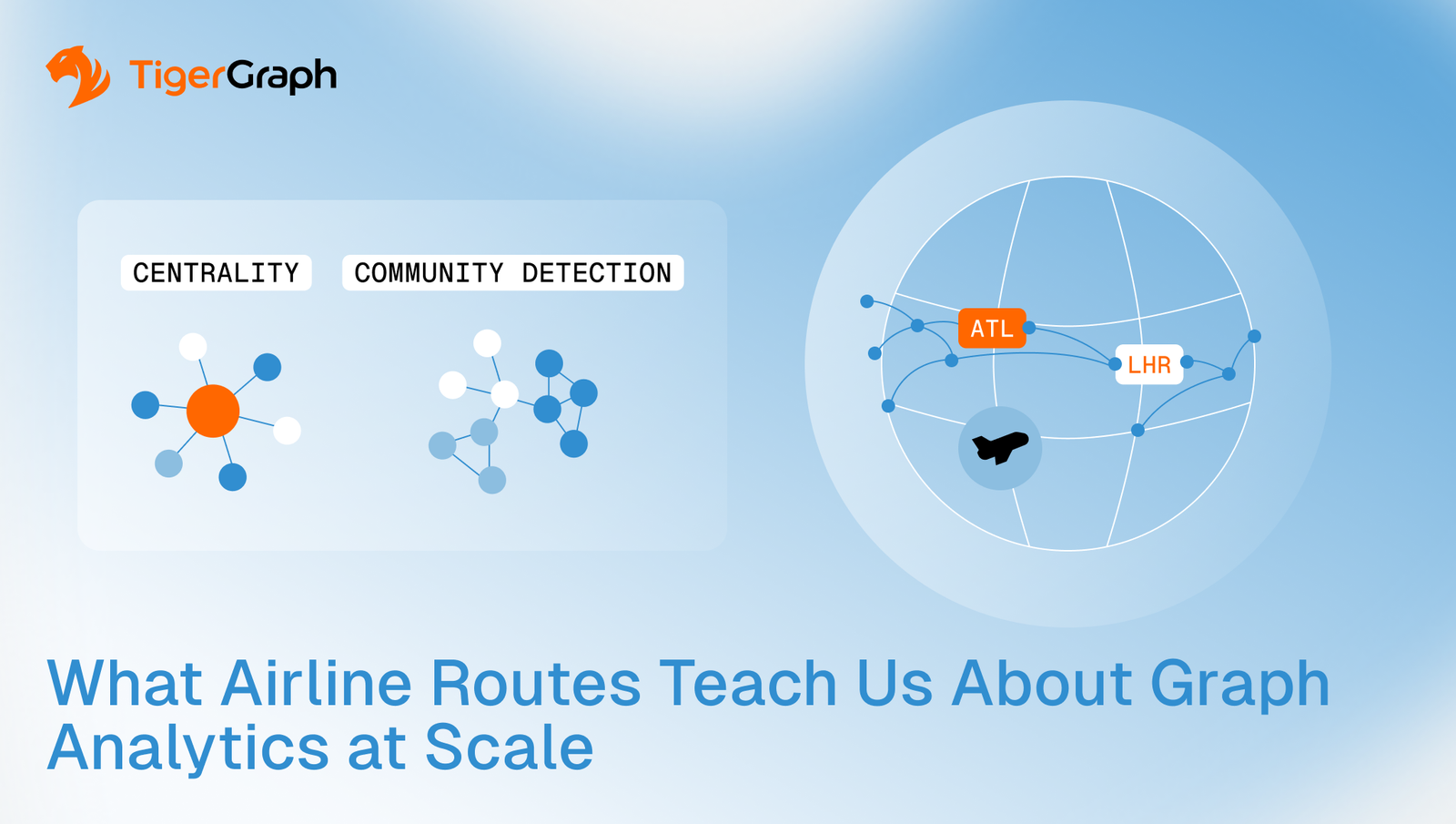
When you look at a global flight map, you are not just seeing cities connected by lines. You are seeing a structure. Some airports handle a small number of routes. Others serve as major hubs, connecting dozens or even hundreds of destinations.
In graph terms, airports are called nodes. A node simply represents a point in the system. In this case, it is an airport. The routes between airports are called edges. An edge represents a connection between two nodes. The arrangement of those nodes and edges is known as the network’s topology. Topology describes the overall shape of the network and how its parts are connected.
That structure determines how the system behaves.
If a small regional airport shuts down, the impact may be limited. If a major hub like Atlanta or Heathrow experiences delays, the effects ripple across multiple routes and regions. Delays cascade along connected paths because flights, crews, and passengers are all interdependent.
The disruption does not spread randomly. It follows the network’s structure. Enterprise systems operate the same way.
Key Takeaways
- Network topology determines resilience and influence.
- Centrality measures structural importance, not just volume.
- Shortest-path analysis reveals reachability and exposure.
- Community detection surfaces hidden clusters.
- Graph analytics demonstrates its value under real-world scale and complexity.
Organizations often think of data as a collection of records. But at scale, performance, risk, and influence are determined by how entities connect. A failure in a central system can affect multiple applications. A compromised identity can open pathways across environments. A supply chain disruption can impact downstream partners.
The airline network makes this structural reality visible, and graph analytics makes it measurable. Several graph metrics help quantify how structure influences system behavior. One of the most important is centrality.
Centrality is Not the Same as Traffic
Some airports process massive passenger volumes. Others may handle fewer passengers but serve as essential bridges between otherwise disconnected regions. Structural importance is not identical to raw throughput.
Graph centrality algorithms quantify that distinction. Measures such as betweenness centrality identify nodes that sit on critical paths between clusters. When such a node fails, disruption cascades across the network.
In enterprise environments, the equivalent may be a clearing institution in financial services, a core API gateway in a digital platform, or a supplier in a manufacturing chain. These nodes may not generate the highest transaction counts, but they hold structural leverage.
Volume measures activity. Centrality measures influence. Understanding the difference changes how risk is evaluated. Influence is only one dimension of structural analysis. Graph algorithms also reveal how risk, information, or disruption travels through a network.
Shortest Path is About Exposure, Not Distance
In airline systems, the shortest path between two cities is determined by connectivity, not geography. A city may be geographically close but require multiple hops due to limited routes. Another may be farther away but reachable in a single direct flight.
In graph analysis, moving across these connected routes is called multi-hop traversal. A traversal simply means following edges from one node to another. Multi-hop traversal follows several connections in sequence to understand how two entities are linked across the network.
Graph algorithms compute these paths instantly.
In enterprise systems, shortest-path analysis reveals how quickly risk propagates. A compromised vendor may connect indirectly to a sensitive system through several intermediaries. A supply chain disruption may ripple across tiers in non-obvious ways.
Shortest path analysis transforms abstract exposure into measurable structural reach. It answers the question: how many steps separate risk from impact?
Connectivity patterns also reveal how entities naturally group together within a network.
Community Detection Reveals Natural Clusters
Airline networks naturally form regional clusters. Dense connections exist within geographic regions, while cross-regional routes connect clusters to each other. Graph community detection algorithms identify these groupings based purely on connectivity density.
The same principle applies to fraud rings, customer segments, vendor ecosystems, and infrastructure zones. Clusters emerge from structure rather than predefined categories.
When clusters are identified algorithmically, organizations gain visibility into how activity concentrates. Fraud clusters reveal coordinated schemes. Customer clusters reveal shared behavior. Infrastructure clusters reveal segmentation weaknesses.
Structure defines grouping. Once clusters and pathways are visible, the next question becomes how resilient the overall structure is to disruption.
Resilience is a Function of Topology
When a major hub closes due to weather or operational failure, delays cascade. Flights are rerouted. Some destinations become unreachable. The impact depends on the network’s topology.
Graph modeling allows the simulation of node or edge removal. Organizations can model the impact of removing a supplier, shutting down a data center, or isolating a financial intermediary.
Resilience is not a reporting metric. It is a structural property. Understanding topology transforms contingency planning from speculation into simulation.
Understanding structure is valuable. Maintaining that visibility at real-world scale is what determines whether graph analytics becomes operational.
Scale is the True Test
Airline networks operate at global scale with constant change. Thousands of nodes and tens of thousands of edges shift daily. Graph analytics must maintain performance under that density. Traversal, centrality computation, clustering, and simulation must remain efficient.
If graph can model global air traffic networks, it can model complex enterprise ecosystems. The lesson is not about aviation. It is about structural reasoning at scale.
When systems grow interconnected, tabular abstractions become insufficient. Structure governs behavior.
Applying Graph Analytics to Enterprise Systems
Airline networks demonstrate how structure shapes performance, risk, and resilience. Enterprise environments operate under the same principles. Systems, identities, transactions, suppliers, and services form interconnected networks whose behavior depends on topology.
Graph analytics allows organizations to analyze these structures directly rather than reconstructing relationships through repeated joins.
Connect with TigerGraph to explore how graph analytics can help model complex enterprise networks, uncover structural risk, and analyze connected systems at real-world scale.
Frequently Asked Questions
1. What do Graph Analytics Reveal About Risk and Influence in Complex Networks?
Graph analytics reveal how risk and influence spread by analyzing relationships between entities, identifying critical nodes, pathways, and clusters that drive system behavior.
2. Why are Traditional Data Models Ineffective for Analyzing Interconnected Systems?
Traditional data models are ineffective because they treat data as isolated records, while interconnected systems require analysis of relationships and structure to understand behavior.
3. How can You Identify the Most Critical Nodes in a Network Using Graph Analytics?
You can identify critical nodes using centrality algorithms, which measure how much influence a node has based on its position within the network.
4. What does Connectivity Tell You About Risk Exposure Across a Network?
Connectivity reveals how risk propagates by showing how entities are linked across multiple steps, exposing indirect relationships and hidden dependencies.
5. How do Graph Analytics Improve Decision-Making in Complex Enterprise Environments?
Graph analytics improve decision-making by enabling organizations to model relationships, simulate disruptions, and analyze system-wide impact in real time.