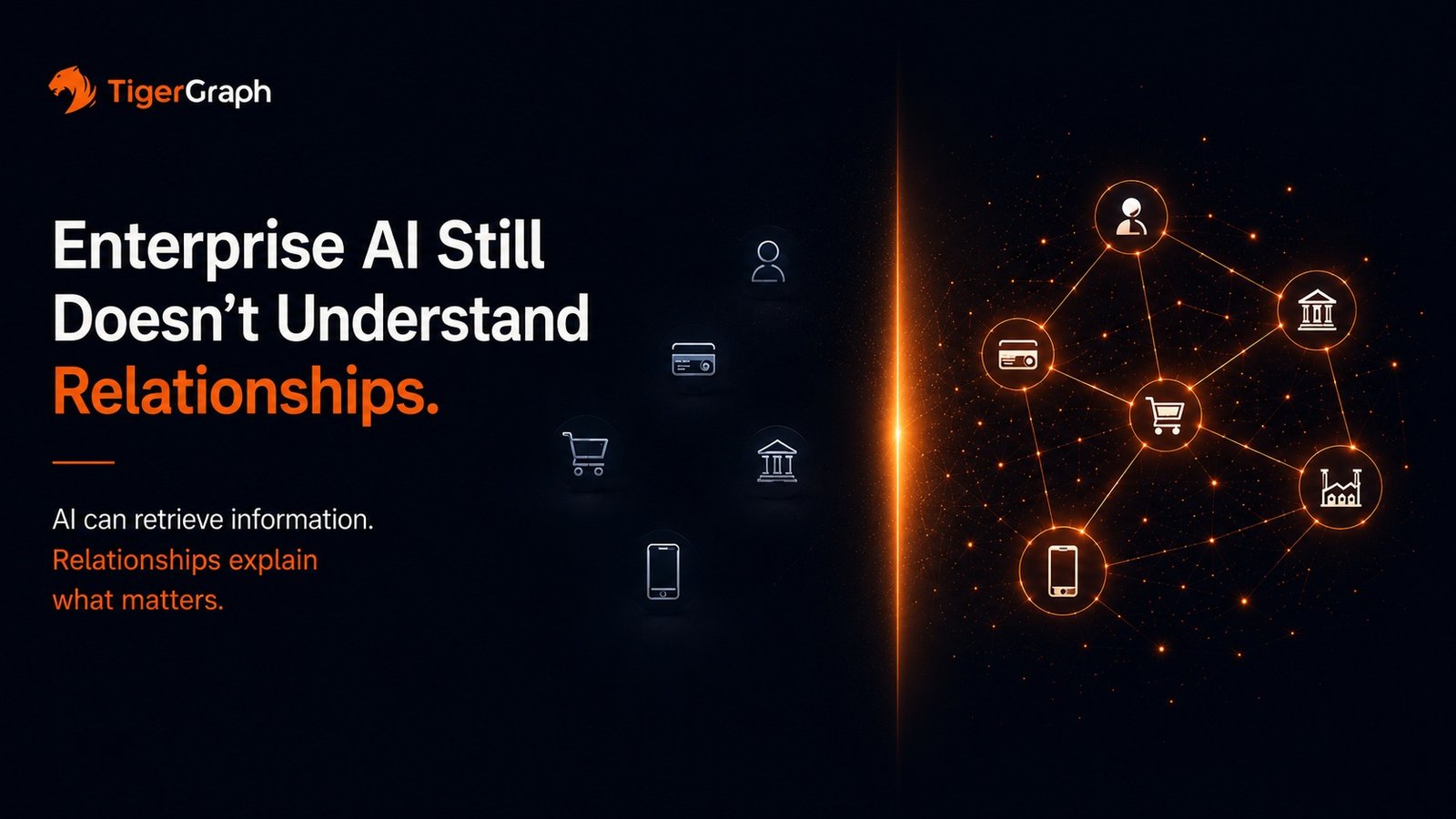
Enterprise AI Still Doesn’t Understand Relationships
AI systems have become very good at retrieving information. They can summarize documents, generate answers, classify content, write code, search across large knowledge bases, and reason through complex instructions with remarkable speed. That progress is real.
But as enterprises move AI closer to production decision-making, a harder problem is becoming visible. AI can retrieve information. It still struggles to understand how the enterprise actually works. That distinction matters because enterprises are not collections of isolated records. They are networks of customers, accounts, devices, identities, transactions, organizations, behaviors, dependencies, and trust relationships.
Most important business decisions do not come from one record or one document. They come from understanding how things connect over time. That is where many current AI architectures remain incomplete. They can retrieve relevant information. They can assemble context. They can generate fluent answers. But retrieval is not the same as understanding. And in operational environments, that gap becomes increasingly difficult to ignore.
Enterprises Do Not Operate as Isolated Records
A large part of the AI stack still treats enterprise context as something that can be assembled at query time. Retrieve the closest documents. Pull the most relevant records. Pass the context into the model. Generate an answer. For many informational tasks, that works well.
But production systems are different. A fraud investigation is not just a set of transactions. A risk decision is not just an account record. An identity decision is not just a customer profile. A cybersecurity event is not just an alert. The meaning comes from how those signals relate to one another.
Who is connected to whom. Which device appears across multiple accounts. Which behavior changed over time. Which transaction is connected to which merchant, organization, identity, location, or prior decision. That is the structure underneath operational reality. And it is relational.
This is why enterprise AI often performs well in controlled tasks but becomes harder to trust in production environments. The system may retrieve useful information, but it may not preserve the relationships that make that information meaningful. That is not a small limitation.
It is an infrastructure problem.
Retrieval Finds Information. Relationships Explain Meaning.
The modern AI stack has made retrieval central to how systems reason. That is understandable. Enterprises have enormous amounts of information, and AI systems need a way to find what matters.
But retrieval has limits. Retrieval can find proximity. It can surface similar documents. It can identify relevant fragments. It can reduce the amount of information passed into a model.
What it does not automatically do is preserve the connected structure of the enterprise. That structure matters.
A transaction by itself rarely explains fraud. A network often does. An account by itself rarely explains risk. Relationships often do. A document by itself rarely explains identity. Connected behavior over time often does. This is the difference between retrieving information and understanding the relationships underneath it. For enterprise AI, that difference becomes critical.
Because once AI systems begin participating in operational decisions, organizations need more than plausible answers. They need reasoning that is grounded in how the business actually operates. They need context that persists across workflows. They need decisions that can be explained. They need systems that can understand not only what information is relevant, but why it matters in relation to everything else.
That is where relationship intelligence becomes foundational.
The Most Important Enterprise Problems Are Relationship Problems
Many of the highest-value AI use cases in the enterprise are not isolated data problems. They are relationship problems.
Fraud detection is a relationship problem. Fraud rarely appears as a single obvious transaction. It emerges through connected behaviors across identities, devices, accounts, merchants, channels, and time.
Anti-money laundering is a relationship problem. Suspicious activity often becomes visible only when transactions, counterparties, accounts, entities, and patterns are connected.
Identity resolution is a relationship problem. A customer, device, household, business, account, and behavioral history may each exist in separate systems, but the decision depends on understanding how they connect.
Cybersecurity is a relationship problem. Threats rarely exist as isolated alerts. They move through systems, privileges, users, devices, and access patterns. Operational risk is a relationship problem. Risk propagates across dependencies, workflows, organizations, vendors, and decisions.
These are precisely the environments where AI is becoming more important. They are also the environments where isolated retrieval is least sufficient. Because the important question is rarely, “What information is similar to this?” The better question is, “How is this connected to everything else we know?” That is the question most enterprises need AI to answer in production.
Agentic AI Makes the Relationship Problem More Important
This problem becomes even more important as organizations move toward agentic AI.
A single AI assistant answering a question is one thing. A network of AI systems retrieving information, making recommendations, escalating issues, updating workflows, and triggering actions across an enterprise is something very different. In that environment, relational grounding becomes essential.
If autonomous systems operate without a durable understanding of entity relationships, they begin making decisions from partial views of reality. One system may evaluate a transaction. Another may assess an identity. Another may review a customer profile. Another may trigger an action. Each step may look reasonable on its own.
But if those systems do not share an understanding of how the underlying entities connect, the enterprise loses coherence. The problem is not that the AI is incapable of reasoning. The problem is that the reasoning is not grounded in the connected structure of the business. That is where risk enters.
An AI system can sound confident while missing the relationship that changes the meaning of the decision. It can retrieve the right document while missing the network around the entity.
It can summarize the record while failing to see the pattern. That is why relationship intelligence is not a technical enhancement at the edge of the architecture. It is becoming part of the foundation.
Vectors Are Powerful. They Are Not Enough.
Vector search has become an important part of modern AI infrastructure. It is powerful for similarity. It helps systems find relevant content. It makes large knowledge bases more accessible. It plays an important role in retrieval-augmented generation and enterprise search.
But similarity is not the same as relationship understanding. Two documents can be semantically similar without explaining how entities connect. Two transactions can look similar without belonging to the same fraud ring. Two customer records can appear separate while representing the same person, household, or business relationship. Two alerts can look unrelated until the underlying device, account, credential, or behavior pattern connects them.
This is where relationship intelligence changes the system. It gives AI a way to reason over connected reality rather than isolated fragments. Not because graphs replace vectors. Not because relationships replace models. Because enterprise AI needs both. Vectors help retrieve relevant information.
Relationships help explain how that information fits into the operational structure of the enterprise. That combination becomes increasingly important as AI systems move from answering questions to supporting decisions.
TigerGraph Preserves the Structure AI Needs
This is where TigerGraph operates differently. TigerGraph is built to preserve relationships structurally, at enterprise scale, in real time. That matters because the context does not need to be reconstructed from scratch every time an AI system reasons. The relationships are already part of the operational foundation.
Entities remain connected. Decision paths become easier to trace. Multi-hop context becomes accessible. Patterns across accounts, devices, transactions, identities, and behaviors can be evaluated as part of the system itself.
That changes how AI behaves. The system is no longer reasoning only over temporary fragments assembled at query time. It can reason over the connected structure of the enterprise. For fraud, that means seeing the network behind the transaction. For identity, it means understanding the relationships behind the profile. For risk, it means evaluating how signals propagate across entities and time. For operational AI, it means preserving context as decisions move across workflows.
This is the infrastructure layer many enterprises will need as AI becomes more autonomous, more persistent, and more deeply embedded in production environments. The value is not simply that the data is connected. The value is that the system can preserve connected understanding while AI operates. That is the difference between information retrieval and operational intelligence.
The Future Enterprise Stack Will Include a Relationship Layer
The first phase of enterprise AI focused heavily on models. The next phase is becoming more architectural. Enterprises will still need powerful models. They will still need retrieval. They will still need orchestration, governance, and security.
But those layers will not be enough on their own. As AI moves into operational environments, enterprises will increasingly need a relationship layer: infrastructure that preserves how entities, behaviors, decisions, and risks connect in real time. That layer will be especially important in high-stakes environments where decisions must remain explainable, auditable, and defensible.
Because in those environments, the question is not simply whether AI can produce an answer. The question is whether the system can understand the context behind the answer. That context is rarely flat. It is connected.
The future of enterprise AI will not be defined only by systems that retrieve more information. It will be defined by systems that understand how information relates. That is the next infrastructure shift. The first generation of enterprise AI connected models to data. The next generation will connect AI to relationships. Because in production environments, isolated information is rarely enough.
What matters is whether the system understands how everything connects.
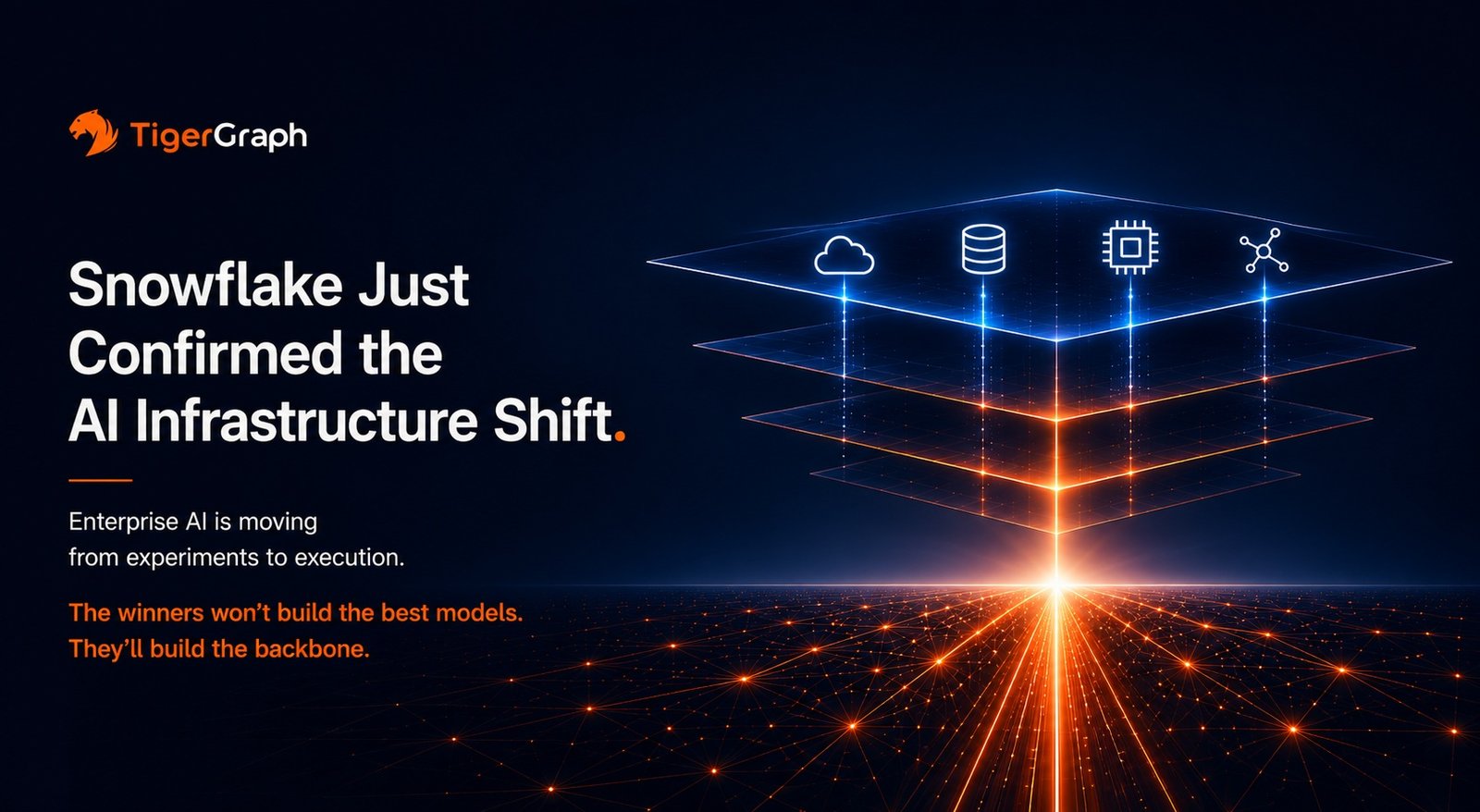
Snowflake Just Confirmed the AI Infrastructure Shift
For the last several years, most of the AI conversation centered on the model. Which company had the largest model. Which system generated the best answers. Which platform produced the most impressive demos. That phase of the market created enormous momentum. It also shaped how many organizations thought about enterprise AI. The assumption was that as models improved, enterprise systems would naturally become more intelligent too.
But production environments are beginning to expose a different reality. The problem is no longer whether AI can generate convincing outputs. In many cases, it clearly can. The problem is whether enterprises can operate AI reliably once those systems become part of live workflows, customer decisions, risk environments, and institutional processes. That is a much harder challenge. And it is why Snowflake’s recent earnings mattered beyond the numbers themselves.
The market was not simply rewarding growth. It was rewarding infrastructure positioning. Increasingly, investors and operators alike are recognizing that enterprise AI is moving out of the experimentation phase and into the operational phase. That changes what matters. The first phase of AI rewarded model innovation. The next phase will reward the infrastructure required to run AI coherently at enterprise scale. Those are not the same thing.
AI Systems Are Starting to Encounter Operational Reality
In controlled environments, modern AI systems can appear remarkably capable. They summarize documents. Generate code. Answer questions. Retrieve information. Produce sophisticated reasoning. But enterprises do not operate in controlled environments. They operate across fragmented systems built over years — sometimes decades — where customer records, identity systems, transaction data, policies, workflows, and risk signals rarely exist in one place at one time. This is where the conversation around AI infrastructure starts becoming more serious.
Because once AI moves into production systems, the challenge shifts from generating intelligence to maintaining coherence. A customer interaction affects a fraud workflow. A fraud workflow affects a compliance decision. A compliance decision affects downstream operational systems. The reasoning chain does not stay inside a single prompt. It moves across environments, teams, systems, and time. Most organizations are only beginning to encounter how difficult that becomes operationally. Especially once multiple AI systems begin interacting with the same underlying workflows.
One system retrieves information. Another evaluates risk. Another updates state. Another triggers action somewhere else. The outputs may still look intelligent individually. But preserving shared understanding across the system becomes dramatically harder. That is the infrastructure problem now emerging underneath enterprise AI.
Retrieval Alone Does Not Preserve Understanding
A large part of the current AI stack still treats context as something temporary. Retrieve information. Assemble context. Generate an answer. That works surprisingly well for many informational tasks. Operational systems are different. In production environments, understanding rarely comes from isolated pieces of information alone. It comes from how events, behaviors, identities, accounts, devices, and decisions relate to one another over time. Fraud works that way. Risk works that way. Identity works that way. Trust works that way too.
This is where many organizations begin discovering the limitations of retrieval-centric architectures. Retrieval can surface relevant information. It does not necessarily preserve operational continuity. And continuity matters once AI systems begin participating in real decisions. A fraud investigation is not just a collection of transactions. A cybersecurity event is not just a sequence of alerts. A customer relationship is not just a collection of records.
The meaning emerges from the relationships between them. That distinction becomes increasingly important as organizations move from informational AI into operational AI. Because operational systems require something stronger than plausible reasoning. They require durable understanding.
The Market Is Starting to Shift Toward Infrastructure
This is the larger signal underneath the recent surge in AI infrastructure spending. The market is beginning to understand that enterprise AI is not just a model problem. It is an architectural problem. How do systems maintain context across fragmented environments? How do autonomous workflows coordinate decisions consistently? How do organizations preserve explainability once AI systems become persistent across production workflows? How do enterprises maintain trust when reasoning moves across multiple systems and operational states? These are infrastructure questions. And they become more important as AI systems move closer to production decision-making.
This is especially true in industries where decisions must remain explainable long after they are made. Financial services. Insurance. Healthcare. Cybersecurity. Government. In these environments, a system that produces convincing answers without preserving traceability eventually becomes difficult to trust operationally. That is one of the biggest shifts happening underneath enterprise AI right now. The conversation is slowly moving away from: “Can the model generate intelligence?” Toward: “Can the system preserve understanding as intelligence scales?”
Those are fundamentally different requirements.
Why Relationship Intelligence Matters
One of the reasons this transition matters so much is that enterprise systems are inherently relational. Fraud rarely appears as a single isolated event. It emerges across connected behaviors, identities, devices, accounts, and networks. The same is true for risk. The same is true for trust. Even basic operational decisions often depend on understanding how entities connect over time. This is where relationship intelligence becomes strategically important. Not because relationships are supplementary context. Because relationships often provide the structure underneath operational reality itself. That distinction changes how AI systems behave in production environments.
Most systems today reconstruct context dynamically at query time. TigerGraph approaches the problem differently. TigerGraph preserves connected operational context structurally so AI systems can reason against live enterprise relationships instead of rebuilding temporary approximations of context every time the system operates. That difference becomes increasingly important as organizations move toward persistent AI systems operating across fraud environments, customer workflows, compliance systems, operational intelligence platforms, and autonomous decision architectures. Because eventually enterprises discover that scaling AI is not simply about connecting models to more data. It is about preserving connected understanding while the system operates continuously in the real world.
The Infrastructure Race Is Already Underway
Snowflake did not create this shift. The company validated where the market is heading. AI is becoming operational infrastructure. And operational infrastructure has very different requirements than experimental AI systems do. The companies that succeed in the next phase of the market will not necessarily be the companies with the most impressive demos. Increasingly, they will be the companies capable of maintaining coherence, traceability, and connected understanding as AI systems scale across fragmented enterprise environments. That is where the infrastructure race is moving now.
The first phase of enterprise AI focused on connecting models to information. The next phase will focus on whether systems can preserve understanding across relationships, workflows, decisions, and time. Because in production environments, isolated information is rarely enough. What matters is whether the system understands how everything connects.