Repeat Investigations Signal Entity Resolution Failures That Inflate Casework
When the same cases keep coming back, the problem is identity continuity. Repeat investigations often signal that entity resolution is not stable enough to carry decisions forward across workflows or over time. Prior outcomes cannot be reused with confidence, so the same exposure is reviewed again under different records.
This post explains how entity resolution failures create repeat casework and how connected, reviewable identity context reduces these redundant investigations.
Key takeaways
- Repeated investigations often indicate fragmented or inconsistent entity resolution, not new risk.
- When identity context does not persist, prior outcomes cannot be reused with confidence.
- Graph-based resolution helps connect past cases, shared entities, and repeated exposure patterns into a single, reviewable context.
Why Repeat Investigations Happen
In a well-functioning program, investigations build on one another. Prior outcomes inform future decisions and review efforts help build institutional knowledge.
When entity resolution degrades, that continuity breaks.
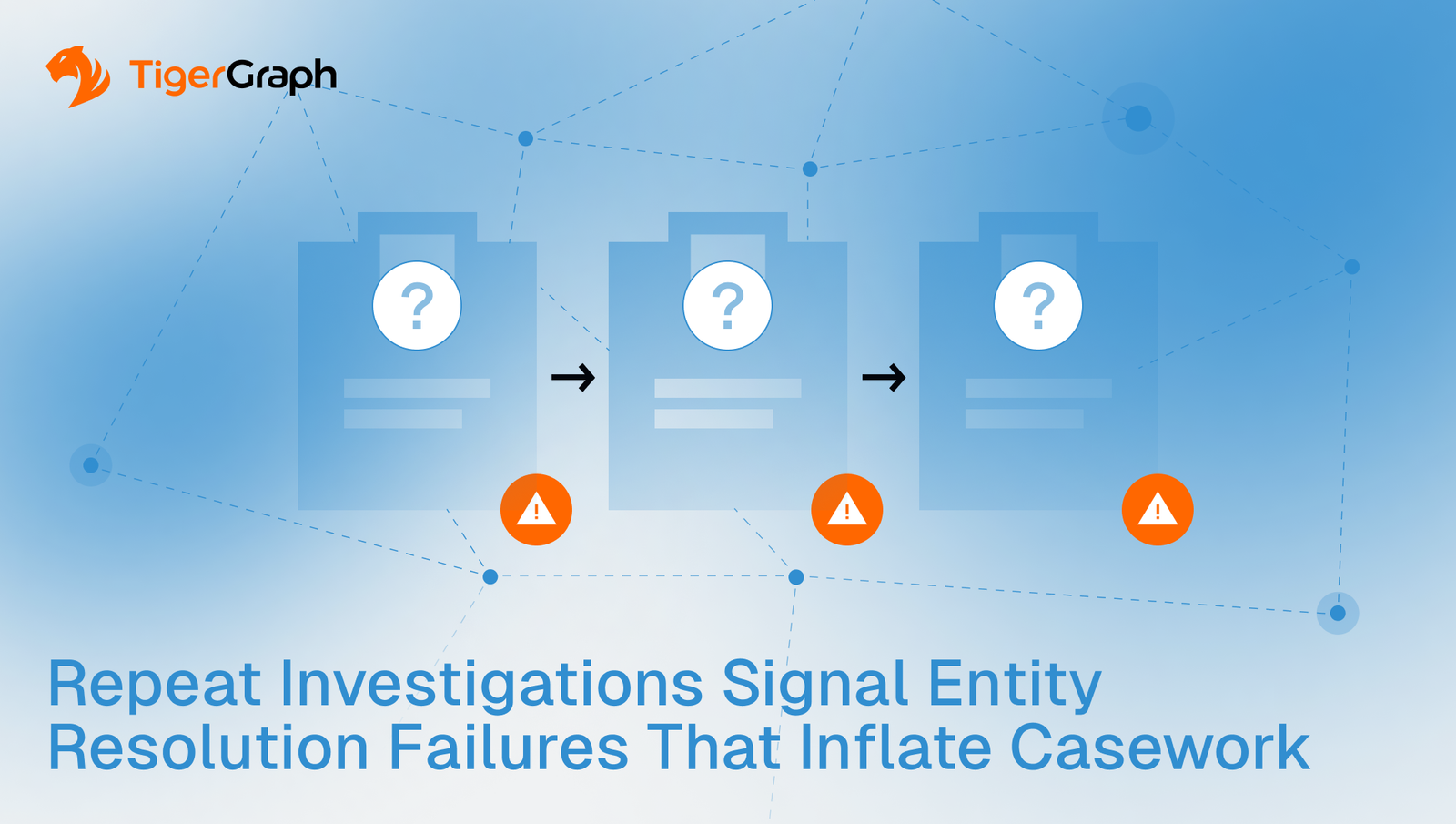
The same real-world entity may appear under slightly different records across systems. Ownership links may resolve in one workflow but not another. Devices, addresses, or identifiers may connect during one investigation and disappear in the next. Each variation forces the program to treat the case as new, even when it is not.
Over time, this creates an operational loop where teams repeatedly investigate the same underlying identity surface without gaining new insight.
What Repeat Investigations Usually Indicate
When teams step back and examine repetition across time and cases, the same failure patterns tend to appear.
Fragmented identity views
One real-world entity is represented by multiple records that are not consistently resolved together. Each record triggers its own monitoring, alerts and review, even though the entity has already been investigated elsewhere.
Unstable link logic
Identity relationships resolve differently across workflows or over time. Links appear in some investigations but not others, preventing prior conclusions from carrying forward reliably.
Disconnected case history
Investigation outcomes are not attached to the resolved entity or its surrounding network. Reviewers cannot see what was previously reviewed, what evidence supported prior decisions, or whether conditions have materially changed.
None of these conditions implies that controls are failing. They indicate that identity context is not durable enough to support reuse, leading to more casework.
Why this Inflates Casework
Casework inflation happens quietly. Each investigation appears reasonable on its own. The issue only becomes visible when viewed across time and across related entities.
Teams spend effort revalidating facts that were already established. Reviewers lose confidence in prior outcomes because they cannot see how those outcomes relate to the current case. Escalation criteria drift because historical context is fragmented.
The result is more work, slower throughput, and inconsistent decisions, even when risk levels remain stable.
This impact becomes visible only when investigations are viewed together rather than in isolation.
What Connected Analysis Adds to Repeat Investigations
Addressing repeat investigations requires making those connections explicit rather than relying on memory, intuition, or manual cross-checking. Once repetition becomes visible, the challenge shifts from alert volume to identity continuity. Connected analysis helps by making repetition explicit.
Instead of treating investigations as isolated events, teams can examine how cases relate through shared entities, attributes and networks. This allows programs to:
- Identify when multiple investigations involve the same underlying entity
- Link past decisions to current reviews through shared context
- Distinguish genuinely new behavior from repeated manifestations of known issues
The goal is not to suppress alerts. It is to ensure effort is applied where it adds new information.
Making repetition visible is only useful if that context can be preserved and reused in future reviews.
How Graph-based Workflows Support Reuse
This is where workflow design becomes operationally important. Graph-based workflows support repeatability by preserving resolved identity relationships and prior decision context as reusable, queryable evidence.
Relationships are stored explicitly rather than reconstructed ad hoc. Investigation outcomes can be associated with the resolved entity and its surrounding network. When new activity appears, reviewers can see how it connects to what was previously reviewed.
This allows conclusions to be reused responsibly while still allowing new evidence to change the picture. Reuse becomes defensible when grounded in documented connections, not assumptions.
Translating this into practice requires only a few structural changes rather than wholesale process redesign.
Operational checklist
- Track investigations at the resolved-entity level, not only the record level
- Link outcomes to identity networks, not isolated identifiers
- Monitor repeat investigations as a quality signal, not just a workload metric
- Prioritize remediation where repetition is highest and least informative
How TigerGraph Fits the Workflow
Supporting this kind of reuse depends on whether identity context can persist across cases without manual reconstruction. The operational requirement is stable identity context that persists across cases.
TigerGraph supports this by enabling:
- Persistent modeling of identities, attributes and relationships
- Traversal that connects current cases to prior investigations through shared context
- Explainable paths that show why two cases are related and where they differ
Traversal, in this context, means following relationships step by step across connected entities to understand how records, cases and decisions relate. This allows reviewers to expand analysis as needed without predefining how many steps a review must include.
The system does not decide whether a prior outcome applies. It provides the evidence needed to make that determination consistently.
Conclusion
Repeat investigations are expensive because they consume effort without increasing clarity. Fragmented views force programs to relearn what they already know.
By connecting investigations through durable identity relationships, teams can reduce redundant work, improve consistency, and focus attention on cases where something has truly changed.
Reach out today to learn more about how connected entity resolution can reduce repeat investigations while preserving reviewability, consistency, and audit-ready evidence.
Frequently Asked Questions
1. What Causes Repeat Investigations in Fraud and Compliance Workflows?
Repeat investigations are caused by fragmented or unstable entity resolution, where the same real-world entity appears as separate records across systems.
2. Why do Investigation Teams Re-Review the Same Risk Without Gaining New Insight?
Teams re-review the same risk because identity context does not persist, preventing prior decisions and evidence from being reused effectively.
3. How does Poor Identity Continuity Increase Operational Costs and Case Volume?
Poor identity continuity increases costs by forcing teams to revalidate previously investigated entities, inflating case volume without adding new information.
4. How can Organizations Connect Past and Current Investigations to Improve Efficiency?
Organizations can connect investigations by linking cases through shared entities, relationships, and historical context, enabling reuse of prior outcomes.
5. What is the Role of Persistent Identity Context in Reducing Redundant Casework?
Persistent identity context ensures that relationships and prior decisions remain accessible, allowing teams to focus only on new or changed risk signals.
Why Temporal Conflicts in Entity Resolution Cause Chaos
Entity resolution often assumes that identity becomes more stable over time. As more data arrives, records are expected to converge, links are expected to strengthen, and confidence is expected to increase. But in reality, time can be disruptive.
Many entity resolution failures do not stem from missing data or weak matching logic alone. They emerge when changes over time are ignored, misinterpreted or collapsed into a single static view. The result is an identity representation that looks coherent on paper but no longer reflects reality.
This is where temporal conflicts appear.
Key takeaways
- Identity resolution breaks down when time is treated as background metadata instead of core evidence.
- Temporal conflicts arise when outdated attributes and relationships remain active in a resolved entity.
- Static “single customer views” can hide drift, lifecycle mismatches and stale links that affect downstream decisions.
- Time-aware, relationship-based analysis improves reviewability, remediation targeting, and audit defensibility.
Why Time Creates Risk in Entity Resolution
Entity resolution answers a practical operational question: “Which records represent the same real-world entity right now?”
That question changes continuously. People move, businesses restructure, accounts open and close, and behavior shifts across channels and over time.
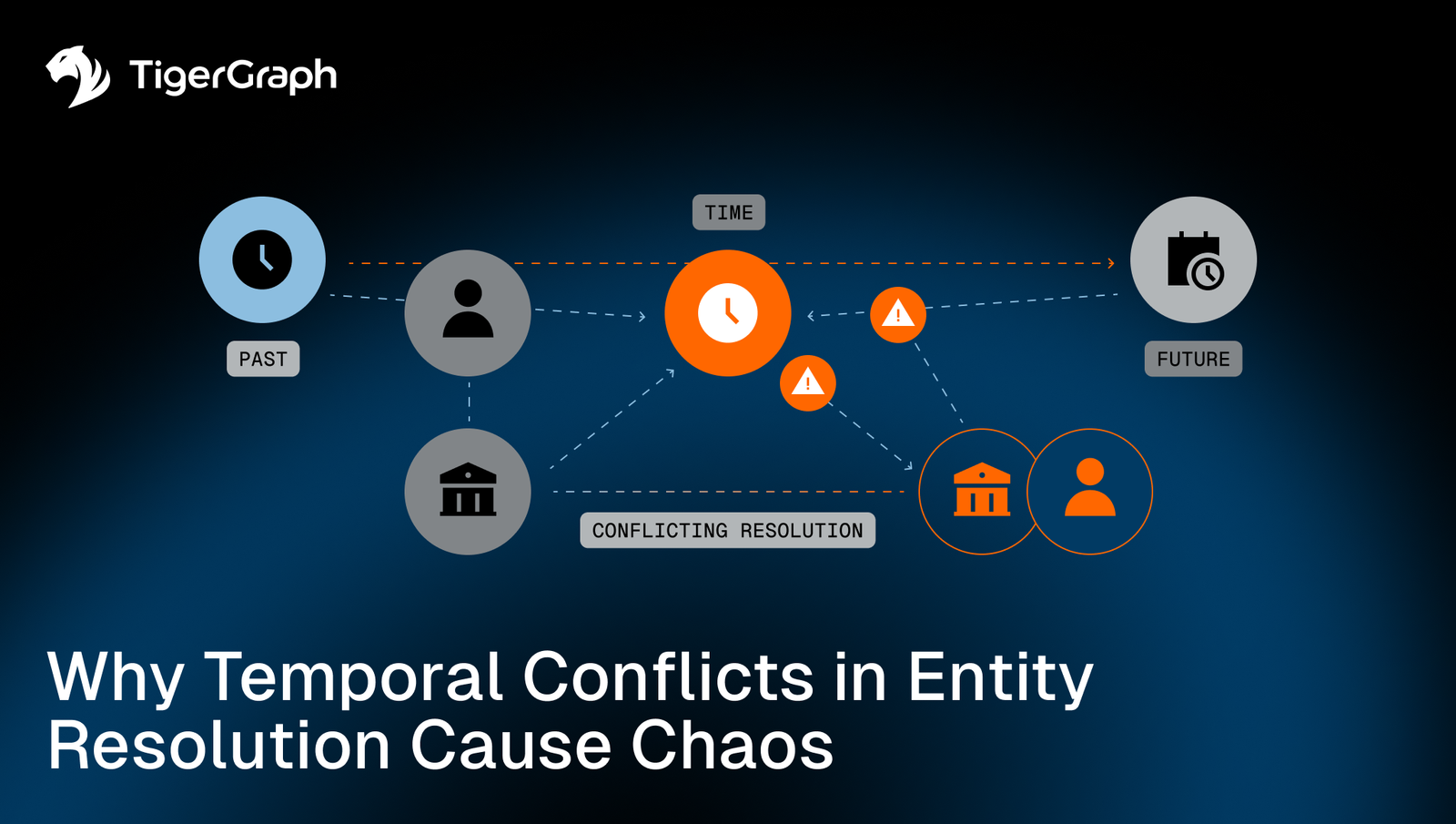
Most resolution pipelines are designed to link records based on similarity at a point in time. They are far less effective at evaluating whether those links remain valid as conditions change. When time is treated as secondary metadata rather than as part of link validity, outdated relationships persist longer than they should.
This creates tension between historical truth and current truth. Both may be accurate in isolation. The risk emerges when they are treated as equivalent.
The tension becomes operationally visible in a small number of repeatable failure patterns.
Where Temporal Conflicts Show up in Practice
These conflicts do not appear randomly. They tend to surface in a small number of recurring patterns.
Incompatible attributes within a resolved entity
Attributes that should not coexist appear together because they were correct at different moments. Address histories overlap incorrectly, device usage patterns conflict and behavioral timelines no longer align.
Identity change without resolution update
Records update, but resolution does not. New identifiers are added while old ones continue to dominate linkage logic. The resolved entity stops evolving even as the underlying evidence changes.
Lifecycle stage mismatches
Records from incompatible stages are merged because they share attributes, even though their timing makes the merge questionable. Onboarding data collapses into previously closed profiles and dormant relationships persist as active ones.
In each case, the issue is that time is not being evaluated when determining whether links still make sense. When these conflicts persist, their impact extends beyond resolution accuracy into downstream decision-making.
Why Static Resolution Breaks Downstream Workflows
A static “single customer view” creates operational confidence. Teams assume that once records are resolved, identity context is settled.
When that assumption is wrong, downstream systems inherit the error.
Detection models train on outdated identity groupings, and risk scores blend evidence that should no longer be combined. Investigations struggle to reconcile current behavior with historical attributes that still influence decisions.
Explanations become harder as well. When reviewers ask why records are linked or why a risk score changed, the answer often depends on evidence that is no longer relevant but remains structurally present.
This is how time-related resolution failures turn into operational friction rather than obvious data defects. Addressing this requires a way to evaluate identity structure as it changes, not just how it appears at rest.
What Connected Context Adds to Time-aware Resolution
Connected data makes temporal conflicts visible because it allows teams to evaluate identity structure over time, not just attributes at rest.
Instead of asking whether two records match, teams can ask whether the relationships that justified the match still hold given when the evidence occurred.
Graph traversal supports this by allowing reviewers to follow relationships step by step across time-stamped connections. Traversal simply means walking through related entities and relationships to understand how they connect and how those connections change over time.
Some links strengthen as evidence accumulates. Others weaken, expire or diverge as behavior changes. Evaluating relationship paths rather than static pairwise similarity makes it easier to detect drift before it cascades downstream.
This approach does not infer intent or predict behavior. It preserves time as evidence and evaluates whether identity structure remains coherent as the network evolves.
Making temporal structure visible changes how teams review, validate and correct resolution outcomes.
How this Supports Review, QA, and Remediation
Time-aware resolution improves reviewability. Investigators can see when links were formed, what evidence supported them at the time and what has changed since.
Quality assurance teams can identify recurring failure modes where resolution freezes too early or updates too slowly. Remediation becomes more targeted because teams can focus on links that no longer align with current evidence instead of reworking entire identity clusters.
Most importantly, decisions become easier to explain. Resolution outcomes can be justified based on how identity evolved, not just how it was matched at a single point in time.
Supporting this consistently depends on whether the underlying platform can treat time as part of relationship logic.
How TigerGraph Fits the Workflow
The operational challenge is not detecting change. It is determining whether existing identity links still hold given when the supporting evidence occurred.
TigerGraph supports this workflow by enabling teams to treat time as part of relationship context rather than background metadata. Relationships can be evaluated alongside timestamps so reviewers can understand when links were formed, how they evolved, and whether they remain relevant.
In practice, this supports:
- Traversal across time-aware relationships to follow identity evolution
• Consistent re-evaluation of links as new evidence arrives or old evidence ages out
• Preservation of relationship paths and timing as reviewable evidence for QA and audit
Resolution logic, thresholds and remediation decisions remain program-defined. TigerGraph provides the connected, time-aware context that allows those decisions to be applied consistently and explained clearly.
Conclusion
Temporal conflicts reveal where resolution logic has stopped keeping pace with reality. Addressing them doesn’t mean abandoning existing approaches, but it does require evaluating whether identity links still make sense given when the evidence occurred.
Use these patterns to assess whether your resolution process can detect identity changes, lifecycle mismatches, and stale linkages before they surface as inconsistent decisions, degraded models or investigation dead ends.
A stable customer view is not defined once; it has to be maintained over time, and TigerGraph helps teams facilitate that capability. Reach out today to learn more about this and other entity resolution features that graph models offer.
Frequently Asked Questions
1. What are Temporal Conflicts in Entity Resolution and Why do They Matter?
Temporal conflicts occur when identity links remain active despite changes over time, causing outdated or conflicting data to distort the current view of an entity.
2. Why does Treating Identity as a Static View Create Risk in Data Systems?
A static view creates risk because it ignores how identities evolve, allowing outdated relationships and attributes to persist and impact decisions.
3. How do Outdated Relationships Impact Fraud Detection and Risk Analysis?
Outdated relationships introduce incorrect signals, leading to inaccurate risk scores, flawed models, and misleading investigation outcomes.
4. How can Organizations Detect and Resolve Identity Drift Over Time?
Organizations can detect identity drift by analyzing time-aware relationships, tracking how connections evolve, and re-evaluating links as new evidence emerges.
5. What Role does Time-Aware Relationship Analysis Play in Improving Data Accuracy?
Time-aware analysis improves accuracy by validating whether relationships remain relevant, ensuring identity reflects current reality rather than historical assumptions.
Entity Resolution is Broken & Here’s How Graph Fixes it
Most enterprises believe they have a data quality problem. In reality, they have an entity problem.
Names change, addresses change, and emails are reused. Companies restructure, and customers open multiple accounts. Beyond that, records fragment across CRM systems, billing platforms, compliance databases, and operational tools. Then analytics teams attempt to “clean” the data.
The outcome is usually one of two extremes:
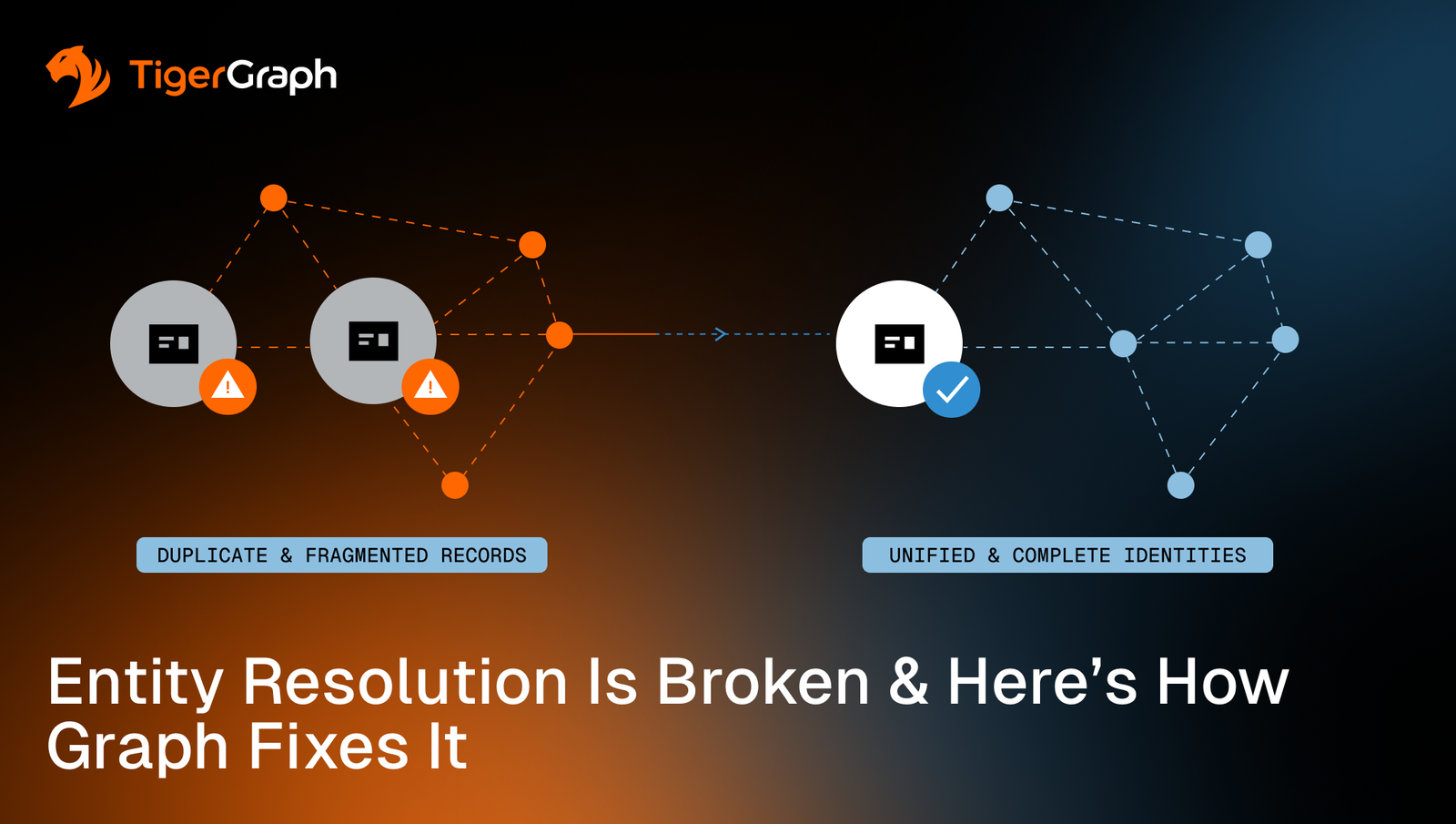
- Overly aggressive merging that collapses distinct entities
- Overly conservative matching that leaves duplicates everywhere
Either way, downstream analytics degrade.
Entity resolution is not failing because teams lack better string-matching algorithms. It is failing because identity is being treated as an attribute problem instead of a structural one.
Key Takeaways
- Attribute matching alone cannot stabilize identity.
- Identity is relational, not isolated.
- Structural similarity strengthens merge confidence.
- Relationship-aware merging provides built-in validation.
- Stable identity improves every downstream analytic.
Why Entity Attribute Matching Fails
Traditional entity resolution relies on attribute similarity.
- Do the names match?
- Do the phone numbers match?
- Is the address close enough?
- Does the email look similar?
Scoring rules assign confidence. Thresholds determine whether two records should be merged. On paper, that logic seems straightforward. In real systems, it breaks down quickly, because attributes are fragile.
People move, change phone numbers and use shortened names in one system and formal names in another. Data entry errors introduce small inconsistencies, too. And there can be different systems that store information in different formats. For example, one application may separate middle names, another may truncate them, and a third may reorder them.
The same person can legitimately appear under multiple variations without any malicious intent.
At the same time, two different individuals can share remarkably similar attributes. Common names overlap or apartment buildings can house unrelated tenants. Businesses operate from shared addresses. Phone numbers are reassigned, and sometimes email domains are reused.
In summary: Similarity does not guarantee identity.
In adversarial environments, the limitations become even clearer. Fraudsters deliberately manipulate fields, introducing minor variations to bypass exact matching. They reuse partial identifiers to blend in with legitimate records and exploit the predictability of attribute-based rules.
When identity is evaluated only through isolated fields, ambiguity is inevitable.
- Two records may look alike but represent different entities.
- One entity may look different across systems yet represent the same real-world person or organization.
Without relational context, confidence scores are educated guesses.
Attribute comparison asks, “Do these records look similar?” It does not ask, “Do these records participate in the same web of relationships?”
- Looking similar is superficial.
- Operating within the same network is structural.
That difference determines whether entity resolution remains a fragile data-cleaning exercise or becomes a stable foundation for analytics.
Entity is a Network
In data systems, an entity is any distinct thing you track. It may be a person, a company, an account, a device, or a financial instrument. Entities do not exist alone.
A person connects to accounts, devices, transactions, email addresses, physical addresses, and other individuals. A company connects to executives, subsidiaries, financial institutions, shared board members, and ownership structures. In both cases, identity is embedded in relationships.
When you model identity in a graph, you shift the question. Instead of asking whether two records look similar, you ask whether they are connected in similar ways.
- Do these records share neighbors?
- Do they connect to the same devices?
- Do they transact with the same cluster of entities?
- Do they sit within the same structural neighborhood?
Similarity becomes structural rather than cosmetic.
Entity Attributes Are Mutable. Structure is Harder to Fake.
A name can be changed, an address can be updated and an email can be discarded. But shared devices, repeated transaction paths, overlapping counterparties, and persistent relationship patterns are harder to fabricate consistently.
Two accounts that share multiple devices, payment instruments, and counterparties demonstrate structural similarity, even if minor attributes differ.
Conversely, two records that share a name but have completely different relationship neighborhoods may represent distinct entities. Structure adds evidence and evidence increases confidence.
Structural Similarity Changes Confidence
Graph-based entity resolution evaluates overlap in connections. Confidence becomes cumulative, with each shared relationship strengthening the case for merging. Each conflicting relationship weakens it.
Instead of relying on a single threshold score, entity resolution becomes an evidence-based evaluation process.
Merging is no longer a binary decision driven by fuzzy string matching. It becomes a structural assessment supported by relational context.
Ambiguity does not disappear. It becomes measurable.
Relationship-Aware Merging
In a graph, merging entities is not simply collapsing rows in a table. It means reconciling relationships.
When two nodes are merged, their connections combine. That combined structure can validate the merge or expose contradictions. For example:
- If merging two users produces inconsistent transaction paths that cannot logically coexist, the merge warrants caution.
- If merging reveals consistent shared neighbors across multiple layers, confidence increases.
The graph itself becomes part of the validation mechanism. That feedback loop does not exist in flat tables, and this oversight puts companies at a huge disadvantage downstream.
Why This Matters Downstream
Entity resolution is not a preprocessing task. It is foundational. Unstable identity contaminates everything built on top of it:
- Fraud detection models train on fragmented signals.
- Risk scores underestimate coordinated exposure.
- Customer 360 views misrepresent behavior.
- Sanctions screening misses ownership overlaps.
- Community detection produces distorted clusters.
If identity is unstable, every analytic layer inherits that instability.
Graph-based entity resolution strengthens the entire analytical stack by ensuring that each node in the graph accurately represents a real-world entity.
In graph terminology, a node is simply a distinct thing in the system. It could be a person, a company, an account, or a device. Nodes are connected to one another through relationships, which show how those things interact.
When entity resolution is stable, each node reflects a coherent real-world entity with consistent relationships. When identity resolution is unstable, nodes fragment, duplicate, or merge incorrectly, distorting the structure of the network.
Downstream analytics depend on that structure being accurate.
Making Entity Ambiguity Manageable
Entity ambiguity will never disappear, but it becomes manageable when connectivity informs confidence. A graph-based approach enables:
- Confidence scoring grounded in structural overlap
- Incremental merging as new evidence accumulates
- Transparent reasoning based on relationship paths
Entity resolution stops being a brittle, one-time data cleanup exercise and instead becomes an ongoing structural discipline. And when identity stabilizes, every downstream analytic becomes more trustworthy.
Graph does not eliminate ambiguity, it manages ambiguity structurally.
Strengthen Entity at the Structural Layer
If entity resolution remains attribute-driven, every downstream analytic inherits instability. Fraud detection fragments. Risk models underperform. Compliance exposure increases. Customer intelligence becomes inconsistent.
TigerGraph enables organizations to incorporate structural similarity, relationship-aware merging, and multi-hop validation directly into their entity workflows. By modeling entities as connected structures rather than isolated records, teams can stabilize identity across systems and improve confidence at scale.
Contact TigerGraph to explore how graph-based entity resolution can strengthen the foundation of your analytics, risk, and compliance programs.
Frequently Asked Questions
1. What is Graph-Based Entity Resolution and How does it Improve Identity Accuracy?
Graph-based entity resolution uses relationships between entities to validate identity, improving accuracy by analyzing shared connections rather than relying only on attribute similarity.
2. Why do Attribute-Based Matching Methods Fail in Real-World Identity Resolution?
Attribute-based methods fail because names, addresses, and emails change or overlap, making similarity unreliable for determining true identity.
3. How does Relational Context Increase Confidence in Entity Matching Decisions?
Relational context increases confidence by evaluating shared connections—such as devices, transactions, and counterparties—providing stronger evidence than isolated attributes.
4. What Makes Identity Resolution a Foundational Layer For Fraud, Risk, and Compliance Analytics?
Identity resolution is foundational because inaccurate or fragmented identities distort all downstream analytics, including fraud detection, risk scoring, and compliance monitoring.
5. How can Organizations Manage Identity Ambiguity Without Over-Merging or Missing Matches?
Organizations can manage ambiguity by using graph-based approaches that accumulate evidence from relationships, enabling incremental and more precise matching decisions.