Contact Us

High-Impact Graph Database Project Ideas for Modern Data Teams

Modern data teams do not need more abstract diagrams or theoretical exercises. They need graph projects that help them understand what is really happening inside their systems. 

When a graph is modeled cleanly, the relationships stop being guesswork and start acting like a diagnostic instrument. Suddenly, the behavior, risks, and dependencies are visible. And once you can see the structure, questions that relational systems were never designed to answer become straightforward.

What follows are graph project ideas that strike that balance. They’re approachable enough to build, substantial enough to matter, and aligned with multi-hop reasoning in real time.

Why Graph Ideas for Project Planning Matter?

The most successful graph initiatives begin with clarity, not with a massive dataset. The central question is always the same: what are we trying to understand? 

When the model reflects that intent, graphs reveal the forces shaping a system. We can see customer behavior, process delays, identity overlap and supplier exposure. Relational tables can store facts, but graphs explain the connections that make those facts meaningful.

Teams that shift to connected insight can now see cause and effect instead of scattered facts. They surface root causes faster and make sharper predictions. Decision paths become explainable instead of mysterious and operational blind spots shrink with a structure that is visible.

TigerGraph works well here because it treats relationships as real data. They don’t have to be reassembled by the system on demand. 

Instead of rebuilding connections through layers of joins, the platform stores edges directly and evaluates multi-hop paths as part of its native execution model. The graph can follow real structure in real time, which is exactly what these projects depend on. 

The graph structure is consistent across queries, workloads and client applications. Developers and analysts rely on the same vertex and edge definitions. They’re no longer interpreting relationships ad hoc. That consistency reduces the modeling drift that usually creeps into long-running projects and keeps graph behavior aligned with the actual business logic.

With this foundation, graph projects move from “interesting prototype” to “we actually rely on this” much faster.

Beginner-Friendly Knowledge Graph Project Ideas

These early projects help new practitioners understand how nodes, edges, direction, cardinality, and traversal behave. The schemas are simple, with one or two node types and edge types. For example,

Person -[can]-> Skill

is a relationship between a Person node and a Skill node. They’re simple on purpose, but they lay the groundwork for the larger enterprise models that come later.

Building a Skills Knowledge Graph

Skills modeling is one of the easiest ways to understand why graphs matter. The relationships already exist in your mind: people learn skills, skills map to roles, roles require training, and courses teach skills. A graph simply makes that structure explicit. 

Once the model is in place, you can trace development pathways, map experience patterns, and prototype matching or recommendation logic with very little effort. It’s usually the point where beginners realize they’re no longer looking at a list, but an ecosystem.

Modeling a Social or Community Network

Social graphs produce insight faster than almost any other beginner project. A handful of “follows” or “friend” edges, and patterns start revealing themselves. There are clusters you didn’t expect, influence paths you didn’t plan and weak ties that never show up in a table. 

Because directionality, neighborhoods, and many-to-many relationships all matter, this is often the first time people understand why graphs outperform relational systems for connected data. The “aha” moment happens pretty quickly.

Workflow & State Transition Graphs

Every organization has a process that looks orderly on paper and behaves nothing like that in practice. Modeling workflows as graphs makes this visible. 

Suddenly, the slow stages become obvious, and the places where work dies in a queue no longer require guessing. It is one of the cleanest ways to show executives why a graph is not just another visualization tool. Graph becomes a mirror of how the organization actually operates.

Enterprise Projects That Demonstrate Real Value

Once the fundamentals are in place, more complex models start to resemble actual enterprise problems. These require multi-hop reasoning, schema discipline, and the ability to evaluate structure at scale.

Fraud, Risk, and Transaction Networks

Fraud is rarely about a single transaction. It emerges in the relationships. One device tied to several different accounts, transfers that form a pattern only when seen together or merchants that reappear in irregular paths. 

Graph modeling captures this structure directly, with customers, devices, accounts, and merchants connected in ways a relational model cannot express. TigerGraph evaluates these relationships in parallel, making it significantly easier to detect risk patterns early.

Supply Chain Dependency Mapping

Supply chains fail in the quiet places, like the second-tier supplier no one tracked, the shared facility that creates an unexpected bottleneck or the component dependency hidden three hops upstream. A graph brings those connections into view. 

Once modeled, the hidden exposure and potential points of failure become uncomfortably clear. Production planning and scenario modeling both improve because the structure is no longer a mystery.

Identity and Access Relationship Graph

Identity data is scattered across most enterprises. It is contained in different systems, with different identifiers, conflicting attributes and partial profiles. 

Graph modeling resolves this by showing how accounts, behaviors, attributes, and roles connect. Duplicate profiles, misuse patterns, and access anomalies become visible without relying on fragile rules. 

It’s a natural extension of Customer 360 and one of the most useful applications of multi-hop reasoning.

Workflow Bottleneck Detection and Optimization

At scale, workflows stop behaving politely, and escalation paths loop. 

Tasks bounce around. People route things in ways the process diagram never predicted. A ticket gets escalated, sent down again for more information, escalated again to someone different, and then kicked back to where it started. That circular motion is a loop, and it hides perfectly inside spreadsheets and dashboards.

Ticket queues are similar. They develop patterns, ping-ponging between teams, stalling at one handoff, dying completely in a certain state. And none of that shows up when all you can see is timestamps and status codes.

Approval chains are even worse. Something gets “sent for approval,” denied, edited, resubmitted, denied again, forwarded sideways, and eventually approved by someone who wasn’t even in the original chain. No table will ever show that structural mess.

A graph transforms a state into a node and a handoff into an edge. Each cycle becomes a visible pattern. 

With a defined structure, you know exactly where things happen. It reveals where work slows and where it loops. And this, in turn, reveals where you’re losing time. It enables organizations to fix what they can now see, instead of guessing where the problem might be.

Multi-Domain Knowledge Graph

When information sprawls across teams, formats, or continents a knowledge graph becomes the connective tissue that makes the whole picture coherent. 

Documents, topics, people, entities, and events form a model that supports enterprise search, contextual AI and cross-domain exploration. I’s a great example of how a graph becomes more valuable the more you add to it.

Table: Project Types and Their Goals

Project TypeSkill LevelPrimary GoalBest For
Skills GraphBeginnerBuild recommendationsHR, Education
Social GraphBeginnerExplore communitiesApps, Gaming
Workflow GraphBeginnerMap processesOperations
Fraud GraphEnterpriseDetect multi-hop riskBanking, FinTech
Supplier GraphEnterpriseMap dependenciesManufacturing
Identity GraphEnterpriseUnify entitiesHealthcare, Finance
Knowledge GraphAll LevelsContextual searchEnterprise Search

Why TigerGraph Strengthens Every Project?

TigerGraph is built for real reasoning, not simulated joins. Its engine evaluates multi-hop paths and scales without losing structural clarity.

Solution kits and tooling shorten the path from idea to prototype, and from prototype to something that actually runs. TigerGraph gives modern teams the speed, scale, and clarity required to build graph systems that work under real workloads.

Ready to move from exploration to execution?

Explore the platform or speak with our team to identify the right next steps for your graph project ideas and enterprise use cases.

Summary

Good graph ideas for project work turn relationship problems into insight. Beginner projects teach the fundamentals. Enterprise models uncover patterns that relational systems can’t see. TigerGraph supports both, with a graph engine built for connected data, real-time reasoning, and scale.

Frequently Asked Questions

1. What Problem Should a Graph Database Project Solve?

A graph database project should answer questions that depend on relationships, paths, or dependencies between entities rather than isolated records.

2. When does it Make Sense to use a Graph Instead of Tables?

A graph makes sense when understanding connections, multi-step interactions, or cascading effects is more important than reporting on individual rows.

3. Do Graph Projects Require Large or Complex Datasets?

No. Graph insight comes from structure and relationships, not data volume. Even small datasets can produce valuable results when modeled correctly.

4. What Determines Whether a Graph Project Succeeds?

Success depends on clear domain modeling, stable relationship definitions, and traversal logic that reflects real-world behavior.

5. Why do Graph Projects Scale Well to Real Systems?

Graph projects scale because relationships are stored and evaluated directly, allowing systems to reason over growing complexity without rebuilding connections at query time.


High-Performance Graph Database Schema Design for Connected Data | TigerGraph

A graph database schema defines the structure of data, including the entities in the domain, the connections between them, and the rules that shape those connections. It acts as the blueprint for how information is stored and how traversal should behave. 

A clear schema makes it easier to answer complex questions because the relationships do not need to be rebuilt through joins. The graph already stores each link as an edge. This approach improves speed, accuracy, and scalability, especially as data grows. 

TigerGraph extends this model to enterprise workloads with high-performance traversal, parallel execution and real-time analytics, creating a strong graph database schema.

Why a Well-Thought-Out Graph Database Schema Matters

A schema defines the structure of a graph and it controls how information flows through it. Instead of splitting data across tables and reconnecting it through joins, a graph model records links directly as edges. This design shortens query paths, reduces processing cost, and produces clearer results.

A graph schema answers three core questions:

QuestionSchema Component
What is represented?Vertex types/ entities
How do those entities connect?Defined graph relationship types
What supports fast analysis?A well-thought-out graph database structure

TigerGraph uses this approach to deliver high-performance graph workloads, real-time exploration, and scalable analytics across large datasets.

Defining Nodes and Entities in a Graph Model

When designing a schema, the first stage is to identify the core objects in a domain. In node graphs, these objects become nodes. Each individual node belongs to a node type. Examples of node types include:

Each graph node stores attributes that describe the entity. Each node type has its characteristic attributes. For example, a Customer has a street address, but a Device doesn’t. Tips for defining nodes:

Designing Graph Relationship Types

A relationship type is a definition in the schema that describes how two node types can connect and what that connection means. This stage is critical because it is what sets a graph apart from other data structures. Relationships, also called edges of a graph, often correspond to verbs, both action verbs like “purchases” and existential verb phrases like “owns” and “is located at”. The relationship type sets the rule; the edge is the real instance of that rule.

A clear definition of a relationship helps both users and the database software interpret the relationship properly. Two aspects are the node types being connected and the directionality of the edge. The edge type’s definition should state what are the semantically valid types of nodes that may be at each end. Moreover, not every relationship is two-way. While friendship is typically a bidirectional relationship, some connections move in a single direction because the business meaning is not symmetrical.

Examples of well-defined relationship types:

These definitions tell the graph how traversal should behave. This way, analysts get consistent results when exploring patterns, dependencies or anomalies.

Designing relationship types:

Understanding Joins vs. Edges 

In a relational database, a join scans two sets of data and compares fields to rebuild a connection. This process slows and becomes harder to reason about as the data grows.

A graph model eliminates this overhead. Edge instances are stored directly. 

A graph avoids:

Edges let traversal follow real paths. This difference drives the speed and performance gains in modern graph database architecture.

Modeling Edges with Clarity and Purpose

Edges represent the actual connections defined by relationship types. In a graph, these edges form the backbone of analysis.

A schema can include:

Edges form the patterns analyzed by algorithms. This includes similarity, proximity, community detection, and shortest-path logic—areas where TigerGraph’s parallel compute engine performs at scale.

Using Node Graph Theory for Better Schema Design

Node graph theory provides a full framework for describing and analyzing any graph. Practitioners need to leverage that framework to design schemas that behave the way real data behaves. Graph theory offers powerful concepts for how entities connect, how information flows, and which paths matter for analysis. These principles help teams design schemas that stay clear as they grow and remain predictable during traversal.

Building on these principles creates a graph database schema that is easier to extend, tune and govern. The model remains stable as new node types or relationship types appear, and traversal stays efficient even when data volume grows. It also improves explainability because every connection follows rules the schema defines explicitly.

Structuring a High-Performance Graph Database

A good graph database structure is essential. It supports fast query execution and clear interpretation. TigerGraph’s architecture stores edges directly, and evaluates multi-hop patterns in parallel, which increases performance across large datasets.

Key components:

A clean structure improves explainability. This helps analysts trace paths and understand why results appear.

Building a Graph Database Architecture for Scale

A graph database architecture should support:

TigerGraph extends this with native parallel processing, high-performance storage, online updates and support for AI and ML workflows.

When architecture, schema design, and modeling practices align, a graph system is easier to maintain. And it is significantly faster than relational models.

Building a Strong Schema:

How TigerGraph Accelerates Schema-Based Workloads

TigerGraph is built for real-time, high-performance graph workloads. It offers:

TigerGraph supports enterprise-scale workloads in finance, supply chain, healthcare, manufacturing and customer intelligence. Its design supports billions of edges with millisecond-level query performance. And it can power yours too.

Reach out today to join thousands of developers and data scientists using TigerGraph’s leading graph analytics platform to solve complex problems with connected data. And start experimenting and prototyping at no cost, with a free TigerGraph Savanna.

Summary

A strong graph database schema provides the structure needed to model real-world connections. By defining nodes, relationships, and architecture clearly, enterprises gain a system that is fast, accurate, and easy to scale. With its high-performance engine and proven capabilities, TigerGraph delivers a platform designed for modern, connected workloads in every major industry.

Frequently Asked Questions

1. What is a graph database schema?

A graph database schema defines how data is structured in a graph, including node types (entities), relationship types (edges), their direction, and properties. It serves as the blueprint that determines how data is connected and how traversal behaves during queries.

2. Why is graph database schema design important?

Schema design directly impacts performance, accuracy, and scalability. A well-designed graph schema stores relationships natively as edges, eliminating costly joins and enabling fast, multi-hop traversal as data volume and complexity grow.

3. How is a graph database schema different from a relational schema?

Relational schemas rely on tables and joins to reconstruct relationships at query time. Graph schemas store relationships directly as edges, allowing queries to follow real-world connections efficiently and making them better suited for highly connected data.

4. What are nodes and relationships in a graph database?

Nodes represent real-world entities such as customers, accounts, devices, or transactions. Relationships define how those entities connect and what those connections mean. Together, nodes and relationships form the structure that enables graph traversal and analysis.

5. How do graph databases handle scale and performance?

Graph databases scale by storing relationships natively and executing traversals in parallel. Platforms like TigerGraph are designed to analyze billions of nodes and edges in real time, supporting high-performance enterprise workloads.

Time Series Database Fundamentals in Modern Analytics

A time series database organizes data by timestamp and captures how values evolve across continuous intervals. It is a core component of monitoring, forecasting, and large-scale operational analysis. 

This article describes how time series databases function, where they perform best, and where they require additional context, and it explains how TigerGraph’s graph architecture strengthens temporal insight in modern digital environments.

What Is a Time Series Database?

A time series database (TSDB) is optimized for collecting, indexing, and querying data points that arrive in chronological order. It is designed to handle high-ingest workloads, time-based queries, and continuous measurements such as sensor data, financial metrics, and application logs. 

The purpose of a TSDB is to deliver efficient storage, predictable query performance, and rapid retrieval of recent values.

Time-oriented workloads are common across industries, and TSDBs provide stable indexing mechanisms for timestamp-based operations. They also offer compression strategies, retention policies, and functions for downsampling or aggregating large time windows. 

A time series db succeeds when the primary question concerns rate, frequency, patterns of change or anomalies over time.

Time Series Database Architecture

A time series database architecture is built for speed, order and predictability. Its core design centers on writing data as fast as it arrives and keeping everything aligned by time. Most systems share a few common components. 

They use a write-ahead log to protect data integrity and break storage into time-partitioned segments. This way, queries can scan only what they need. They rely on in-memory buffers to handle bursts of incoming measurements and they also maintain index structures designed specifically for time-based filtering. 

Together, this architecture supports metrics at scale and enables queries that filter by temperature ranges, throughput trends, or event frequency during specific intervals.

A well-designed time-series database can maintain performance even as data volumes rapidly increase.

What Is Time Series Database Logic Used For?

Understanding how time series database logic behaves is essential for analysts responsible for workloads in which the primary signal is change over time. A time series database supports several core functions that appear across modern operational systems:

  1. Monitoring continuous system activity where each measurement must be recorded, compared, and queried in chronological order.
  2. Forecasting recurring or seasonal patterns where historical sequences provide the basis for predictive models.
  3. Alerting on threshold breaches by evaluating real-time metrics against baselines, service-level requirements or anomaly bands.
  4. Capturing and contextualizing historical performance so teams can analyze degradation, peak load behavior, and long-term operational trends.

A TSDB is effective in environments where measurements arrive at high frequency and where the time dimension dictates both the meaning of the data and the correct analytical method. 

Common examples include:

These systems depend on accurate timestamp ordering, efficient ingestion, and rapid retrieval of recent and historical values, which a time series database is designed to handle.

Comparing Time Series Databases and Relational Systems

Traditional relational systems can store historical values but are not optimized for sequential writes, retention management, or high-volume ingest of temporal data. A database for time series data avoids index contention and provides purpose-built aggregation functions.

Key distinctions include:

CapabilityRelational DatabaseTime Series Database
Write optimizationGeneral purposeSequential, high-ingest
Time indexingSecondary featurePrimary design
CompressionRow-basedTime-based
Retention policiesManualAutomatic and native

Each system plays a role. A database for time series analysis functions best when time itself is the dominant query dimension.

Common Time Series Database Use Cases

A time series database is applied across a wide range of operational and analytical workloads because many modern systems generate high-frequency, time-dependent measurements. These environments depend on accurate temporal ordering, efficient storage of sequential data, and rapid retrieval of both recent and historical values. 

Representative time series database use cases include:

Taken together, these time series database use cases demonstrate why TSDBs remain fundamental to modern digital operations. They provide a reliable substrate for systems facing continuous change, and where observations need to happen at scale. The time dimension defines both the structure of the data and the meaning extracted from it.

When do Graph Databases Add Essential Context?

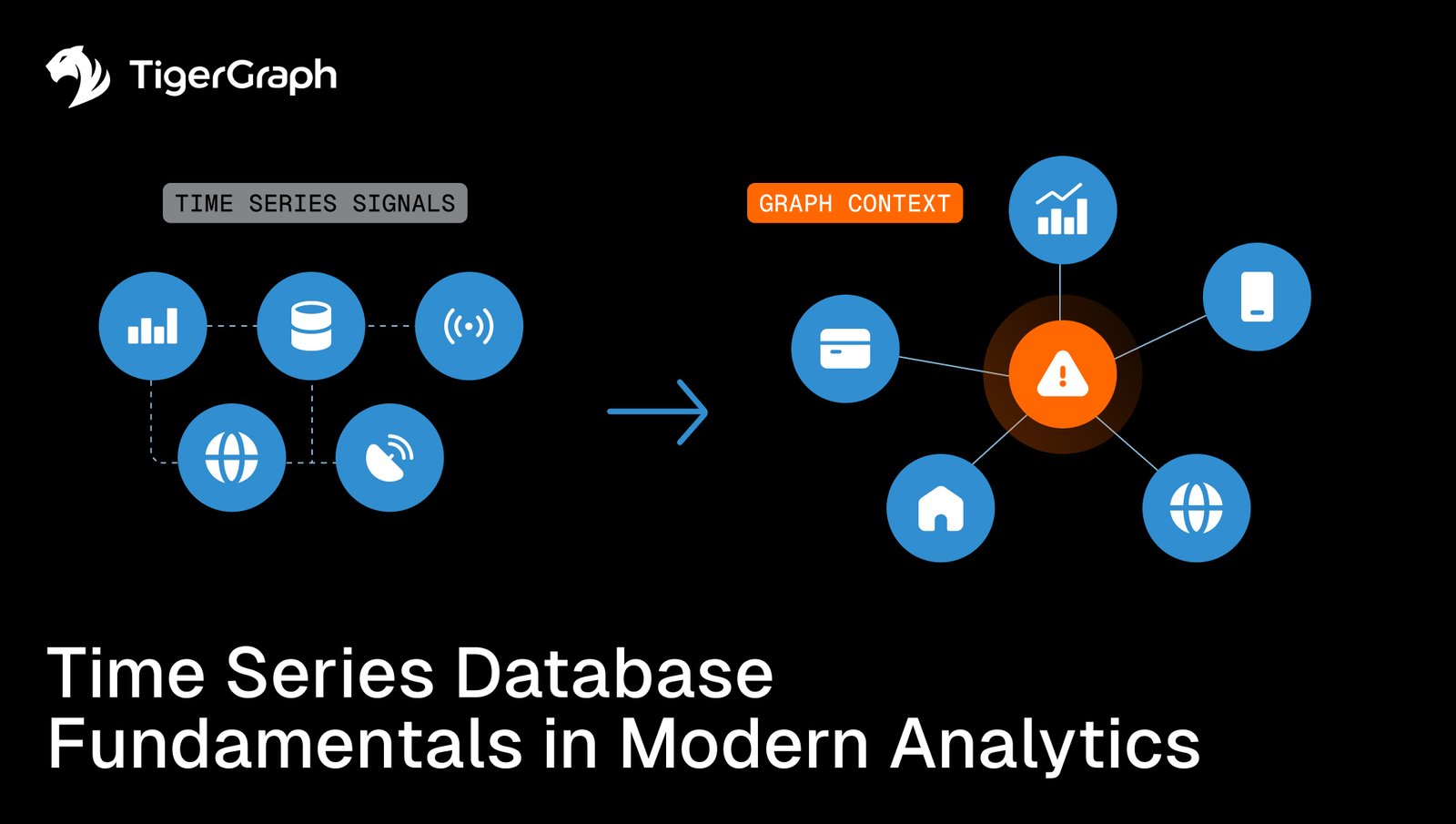
A TSDB excels at “when” something happened, but not “why.” Relationships across devices, accounts, equipment or systems often determine the root cause of temporal spikes. Graph databases reveal these dependencies.

TigerGraph supports enterprise workloads that require structural insight around time-indexed data. 

The graph captures entities, their relationships and their propagation pathways. Influences that cannot be extracted from sequential metrics alone are revealed when it’s paired with temporal values.

When these patterns depend on both time and relationships, TigerGraph’s architecture provides a complementary layer of reasoning. 

The platform processes multi-hop paths in real time. It allows analysts to integrate chronological trends with structural insight and produce explanations that reflect the full system rather than a single sequence of readings.

Time Series Data Management in Graph-Integrated Environments

Many organizations pair a time series database with a graph system so they can see both the sequence of events and the structure behind them. This combination improves forecasting and makes root-cause analysis more precise. 

To get the best results, teams should consider these steps when planning:

This keeps the time dimension and the relationship dimension in balance, which is essential for understanding how complex systems behave.

How to Choose the Best Time Series Database Strategy?

Analysts selecting the best time series database strategy evaluate ingestion rate, retention requirements, compression techniques and analytical workloads. A TSDB should handle the temporal dimension, while TigerGraph complements it with reasoning across connected entities.

When evaluating the best database for time series data, enterprise teams may want to prioritize consistent ingest at high volumes, efficient range queries and clear retention controls. Interoperability with graph systems is also important.

The architecture should support historical measurement and connected insight.

Time Series Database Examples

Common time series database examples include:

They illustrate how sequential measurements support observation. TigerGraph then provides the structural framework that explains how these sequences influence one another.

Benefits of a Hybrid Graph and Time Series Model

Pairing TSDBs with graph reasoning delivers a unified analytical model. Time series engines show change. Graph engines show dependency. Together they form a complete workflow for anomaly detection, forecasting, and operational intelligence.

TigerGraph is a database graph provider that supports high-load enterprise workloads, provides industry-specific solutions, and offers the performance required by modern digital businesses. Its architecture evaluates multi-hop structure in real time and maintains schema clarity across applications. This makes it a strong complement to TSDB environments.

Summary

A time series database is essential for measuring change over time, but structure determines why those changes occur. Time-oriented metrics gain interpretive power when combined with TigerGraph’s high-performance graph capabilities. 

Together they provide the chronology, dependency analysis, and operational insight required for modern analytics across finance, supply chain, manufacturing, energy, and digital platforms.

Ready to strengthen your time-series analytics?

Explore how TigerGraph complements your existing time series database strategy with real-time multi-hop reasoning, high-performance traversal, and schema clarity designed for complex enterprise environments. 

Visit TigerGraph to evaluate solutions, review industry use cases, and determine the next step for your architecture.

Frequently Asked Questions

1. Why do organizations struggle to get full insight using only a time series database?

Many organizations find that while a TSDB tells them when changes occur, it cannot explain why they occur. Time-ordered metrics lack relational context—such as upstream dependencies, cross-entity interactions, or multi-step behaviors—which are often the true cause of anomalies, spikes, or unusual trends. This is why enterprises increasingly combine TSDBs with graph analytics to reveal hidden connections behind temporal patterns.

2. How does combining graph analytics with time series data improve root-cause analysis?

Graph analytics maps relationships across systems, devices, transactions, and users. When paired with timestamped data, this offers a 360° view of incident propagation. Instead of analyzing isolated events, teams can trace multi-hop dependencies, discover cascading failures, detect correlated risks, and identify the real point of origin behind time-based anomalies—something TSDBs cannot do alone.

3. What should enterprises evaluate when choosing a long-term strategy for time series intelligence?

Beyond ingest rate and query performance, enterprises must consider interoperability with contextual data sources, support for relationship reasoning, multi-hop traversal capabilities, and flexibility in handling hybrid analytical workloads. The best long-term strategy includes both temporal insight (from a TSDB) and structural insight (from a graph platform such as TigerGraph).

4. How do time series data and graph data complement each other in operational systems?

Time series data captures sequential change, while graph data captures interconnected structure. When combined, they enable richer analytics such as behavioral journey mapping, dependency-aware forecasts, coordinated anomaly detection, and system-wide intelligence. TSDBs answer “what changed and when,” while graph systems answer “how components interact and why the change occurred.”

5. What industries benefit the most from integrating graph analytics with their time series platforms?

Industries with complex, interconnected systems benefit most—including finance, manufacturing, energy, telecom, logistics, and digital platforms. These environments depend on continuous measurement, but also require visibility into relationships like supply dependencies, account linkages, device hierarchies, customer journeys, or sensor networks. Graph + time series integration delivers real-time insights, faster diagnosis, and more accurate prediction across these sectors.

Graph for LLM Observability is The Missing Layer in Agentic AI Systems

Today’s large language models (LLMs) aren’t just responding to prompts; they’re taking action. As these models evolve into autonomous agents capable of making decisions, adapting to new information, and chaining complex tasks together, the stakes get higher.

This new generation of agentic AI systems generates text, but it also interacts with users, retrieves data, calls APIs, and even reasons across workflows. And with that power comes a pressing question for every enterprise deploying them: How do we keep these systems accountable?

Traditional metrics aren’t enough. You can’t rely on surface-level outputs when an AI agent is making critical decisions on your behalf. What you need is insight into the why and how behind each action, not just the what.

In other words: How do I understand what my agents are doing? How do I make their behavior traceable, explainable, and safe?

That’s where graph comes in.

Graph technology gives enterprises the structure they need to track, model, and make sense of LLM-driven behavior. It provides the memory, context, and relational insight that agentic AI requires to be both powerful and accountable.

The Rise of Agentic AI

Traditional LLM use cases, including summarization, translation, and classification, are giving way to agentic workflows where AI agents dynamically retrieve information, make decisions, and interact with external systems. These agents increasingly power:

But autonomy introduces complexity. 

The same LLM that fetches a document today might revise a strategy tomorrow. And when the agent takes a wrong turn and outputs biased results, leaks sensitive data, or contradicts a prior decision, businesses need to understand what happened, and why?

The LLM Observability Gap

Traditional observability tools fall short. Logs may show that a prompt was issued and a response returned, but they don’t explain:

This is the “black box” problem in a new form: not just why the model said what it did, but how it reasoned across time, interaction, and role.

Without a deeper structure, enterprises are left with surface-level snapshots that are disconnected, decontextualized, and difficult to audit.

Graph as the Solution

When it comes to making sense of LLM-driven behavior, few technologies are better suited than graph. By storing relationships between data points, graphs can both hold the knowledge and ground rules to provide better standard LLM responses, but also record the step-by-step progress to provide observable steering for agentic AI.

Graphs let you represent and query the relationships between people, data, actions, intentions, and outcomes. Instead of asking, “What did the AI say?” you can ask, “What did it know, why did it say it, and how did it get there?”

But not all graph systems are created equal.

This is where TigerGraph comes in. Built for performance at scale, TigerGraph delivers a combination of context persistence, behavioral traceability, and dynamic relationship modeling that goes beyond what most graph solutions offer.

You don’t just want to know what the LLM said. You want to understand the full stack of context, timing, intent, and interaction. That’s what graph reveals.

How TigerGraph Powers Observability in Practice

TigerGraph was purpose-built to handle the real-time, high-complexity needs of modern enterprises. Its native parallel traversal engine and schema-first approach allow it to operate at the speed and scale that agentic AI demands.

Here’s how that plays out in practice:

This level of observability transforms AI from a black box to a transparent, auditable system. You’re not just reacting to what the model spits out, you’re understanding why it behaved that way in the first place.

Graph as Guardrail: Building Safer Agentic AI

Observability is only part of the story. Graphs also enable agentic AI to behave more responsibly from the start.

By encoding policies, norms, and relational awareness into the graph itself, you’re giving AI systems a set of embedded guardrails rather than just after-the-fact fixes.

Here’s what that looks like in action:

This is proactive intelligence—the kind that helps AI systems act with awareness, alignment, and nuance.

Don’t Just Prompt — Observe

The move toward autonomous AI is already happening. But autonomy without oversight is a risk few enterprises can afford.

Agentic AI needs observability. That means knowing not just what your models are saying, but how they got there, and where they might go next. It means building systems that can adapt, explain, and operate within guardrails you can trust.

Because prompting without observability is like flying blind, and graph gives agents memory, context, and accountability. So, if you’re building agentic systems, don’t rely on guesswork or static logs. Start with the graph and give your AI the structure it needs to stay intelligent and aligned. 

Ready to future-proof your organization with agents that do more than guess? Start observing. 

Let’s talk about how graph can help you stay ahead of inevitable shifts.

Every enterprise needs to track, model, and make sense of system behavior. Graph fills that gap, bringing memory, context, and relational insight into every decision. It’s time to experience agentic AI systems acting with awareness rather than focusing solely on output.

Try TigerGraph Savanna for free at tgcloud.io.

Using Graph to Ground Agent Reasoning in Real Time

Autonomous AI agents don’t just need instructions—they need context to reason. As AI systems grow more agentic, taking initiative, coordinating tasks, and acting independently, the question becomes not just what they’re doing, but how they decide what to do.

This context-grounded reasoning isn’t a bonus feature. It’s a necessity. 

Customer preferences shift, network behavior changes, and business rules evolve, and this means that rigid agents quickly become brittle. They follow yesterday’s logic into tomorrow’s mistakes.

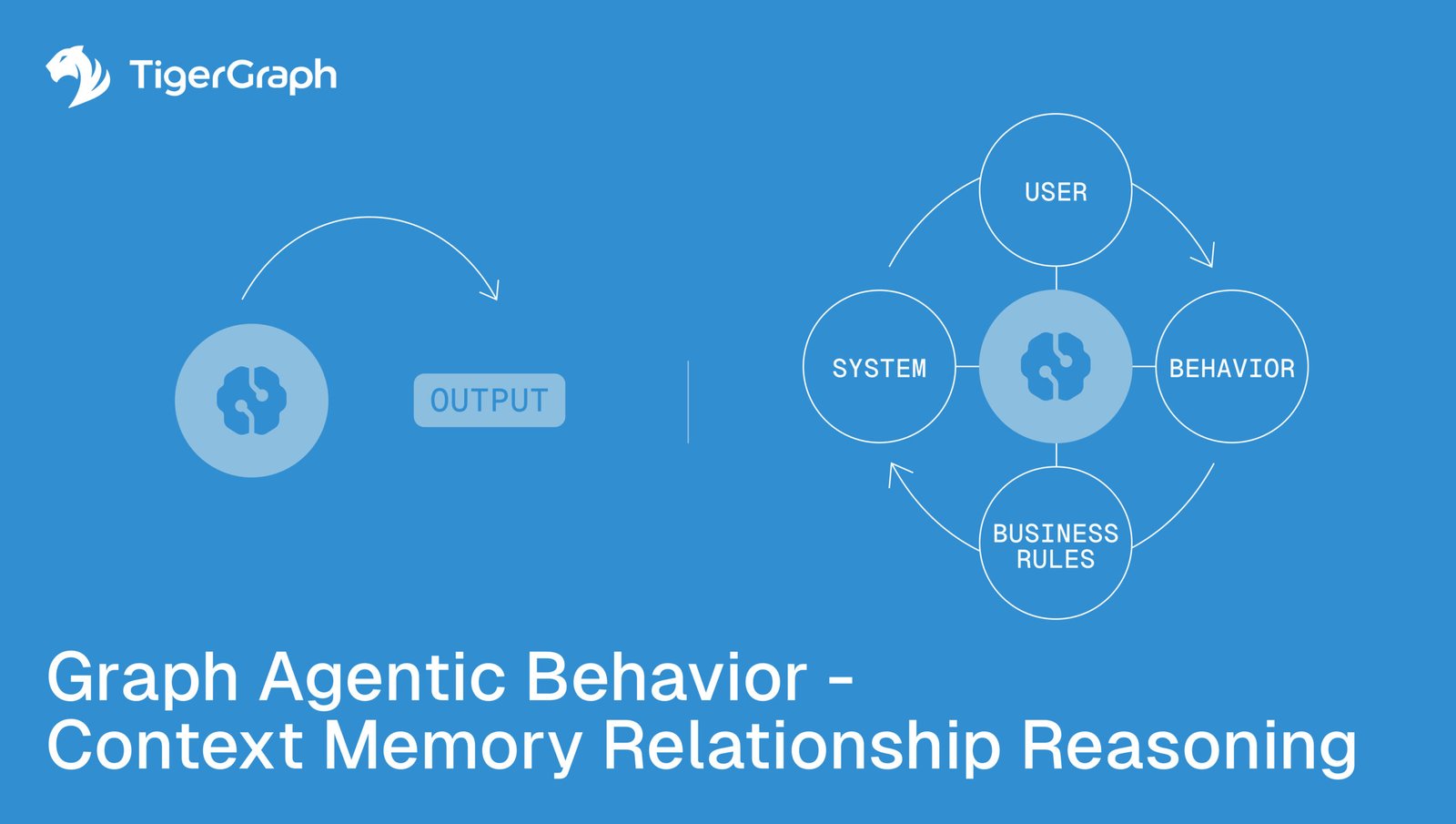
What separates brittle agents from resilient ones is the richer, governed feedback loop. They need the ability to sense changes, understand ripple effects, and modify future behavior accordingly. And the architecture that powers this kind of feedback isn’t just more prompts or clever APIs. It’s graph.

TigerGraph makes adaptive intelligence operational by modeling relationships, behavioral signals, and evolving context in real time. This is where static agents become context-aware decision makers,and where graph becomes the control layer.

Why Agentic AI Needs Context, Not Just Feedback

Language models can generate responses and even self-critique with enough scaffolding. But ask them to recall the impact of a decision made five steps earlier or adjust based on shifting dynamics across a network and the limitations become clear. Without structured memory and situational awareness, their adaptation remains superficial.

To adapt wisely, agents need a feedback system grounded in context and continuity. That means understanding:

  1. Current State: What’s happening right now? What’s changed in the environment—among users, systems, or inputs?
  2. Historical Memory: What happened last time a similar scenario played out? What worked? What failed?
  3. Relational Feedback: How does a single action affect the web of connections around it—from user sentiment to inter-agent dependencies?

This trifecta of awareness, memory, and feedback isn’t something stateless LLMs can handle on their own. But it’s exactly what graph databases are designed to do.

And TigerGraph doesn’t just make it possible—it makes it performant, enabling agents to tap into these signals at enterprise scale and in real time.

How Graph Enables Contextual Reasoning for Agents

Imagine an agent responsible for customer outreach. One of its tasks is to send follow-up messages after product updates. It seems simple. But what if, after one outreach cycle, support tickets spike? What if users start disengaging, or sentiment drops on connected social accounts?

A traditional AI pipeline might never notice. It operates in silos with an endless “prompt in, action out” functionality. But with TigerGraph, modeling the relational context, those signals don’t disappear—they surface.

Using TigerGraph’s real-time graph traversal, the agent can:

These aren’t pre-programmed responses. They’re live decisions based on the changing structure of relationships and signals in the graph. This is what turns rigid prompt chains into adaptive systems.

Building Smarter, Safer Agents with Graph Feedback Loops

Let’s break down how a feedback loop actually works in a graph-powered environment:

  1. The agent takes an action, say, recommending a financial product to a user.
  2. The network responds, other users ask questions, support tickets rise, or conversion drops.
  3. The graph updates and new relationships are formed, weights shift, and alerts are triggered.
  4. The agent sees the new picture and adjusts their strategy, revising their messaging, escalating to a human, or pausing outreach entirely.

Now imagine that loop happening not every week or day, but every minute, across millions of nodes and edges, all updating in near real time.

That’s not just automation. That’s autonomous systems learning how to behave better. And it’s only possible when agents operate in a live, structured, relational context. In other words: a graph.

Why TigerGraph Is Built for This

While any graph database can model relationships, TigerGraph is purpose-built to turn those models into operational systems that support AI at scale.

What makes TigerGraph stand out?

Together, these features allow organizations to move beyond hardcoded logic and into systems that evolve safely, responsibly, and in alignment with business goals.

From Rules to Responsiveness: Building AI That Listens, Learns, and Evolves

Autonomous systems are being asked to make decisions, influence outcomes, and interact with real people; and static rules are no longer enough. Responsiveness grounded in context, history, and relational understanding is what defines whether agentic AI will succeed or spiral out of control.

To move from brittle automation to intelligent adaptation, we need more than smarter prompts or faster models. We need infrastructure that understands change as it happens, that retains memory across interactions, and that reasons through the ripple effects of every choice an agent makes.

Graph offers that infrastructure. It doesn’t just connect data—it reveals how actions flow through networks, how behavior unfolds over time, and how intent, influence, and outcome intersect in dynamic systems.

TigerGraph operationalizes this for real-time environments. But the broader shift is what matters most: a move away from reactive logic and toward systems that truly learn from their impact.

If you’re building agentic AI for the enterprise—systems that must evolve responsibly, reason transparently, and adapt to the world around them—this is the moment to embed the right foundation.

Not more rules, but smarter responsiveness. Not more control, but deeper awareness. And not just intelligence—relational intelligence.

The future of autonomy isn’t scripted. It’s situational. And that means it starts with graph. 

Your Agents Can’t Adapt Without Feedback

Scripted responses won’t cut it in dynamic environments. TigerGraph gives your AI agents the real-time context, behavioral feedback loops, and adaptive reasoning they need to evolve safely and intelligently.

Try TigerGraph Cloud for free and start building agents that learn as they go. https://tgcloud.io