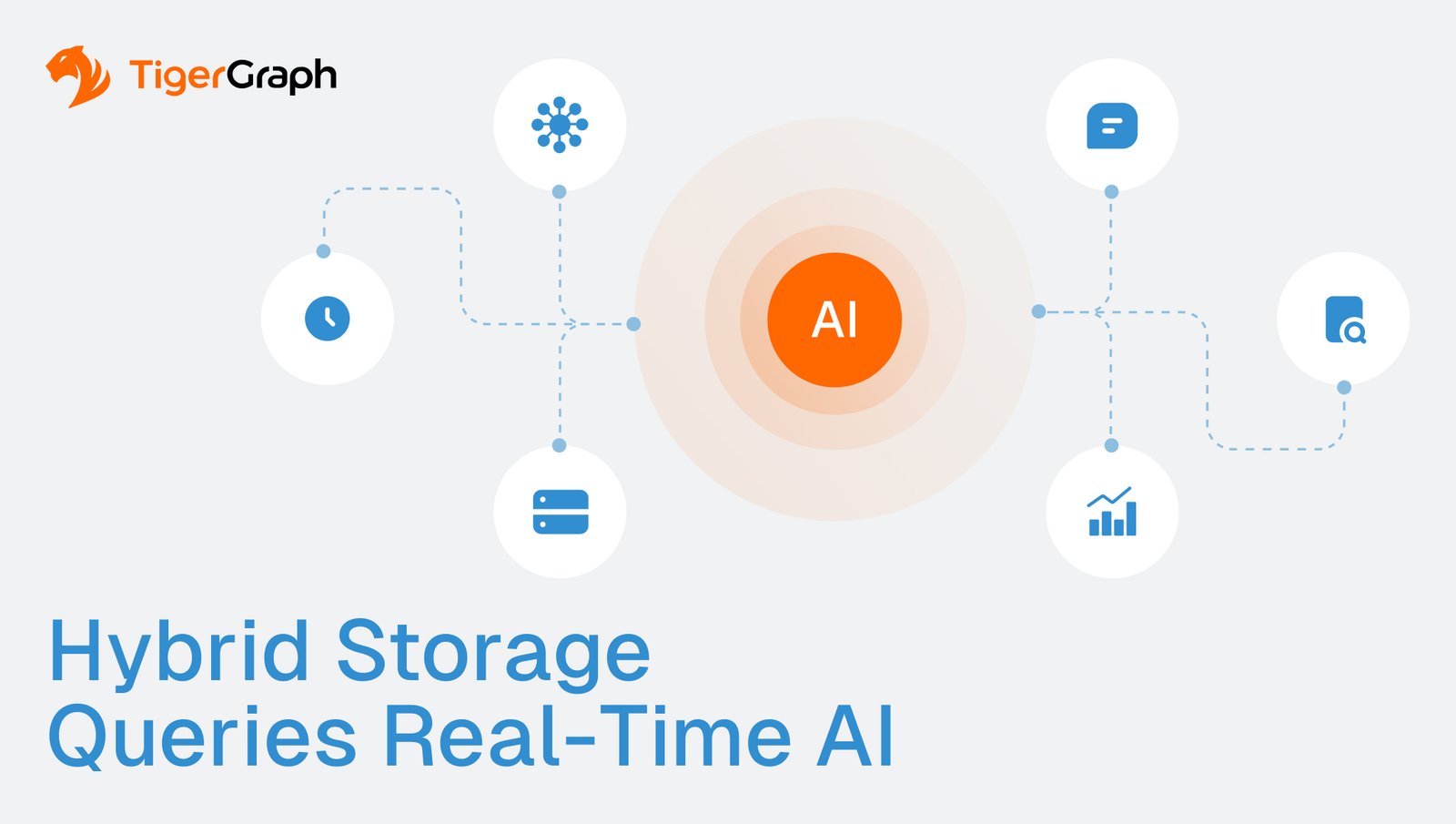
How Hybrid Storage and Queries Power Real-Time AI
“Fast” isn’t enough. In today’s enterprise environment, real-time AI doesn’t just mean low-latency—it means delivering the right answer based on what’s happening right now. That includes knowing what matters, who’s involved, and how one event might trigger another across your systems.
This level of intelligence requires data that’s not only fresh but also rich in structure and meaning. It’s not enough to query a flat table or rank based on similarity. You need the ability to explore relationships, infer intent, and react to change—all in the same moment. Real-time AI needs real context.
That’s where hybrid storage and querying make the difference. TigerGraph is built to support both structured graph logic and fast vector similarity search, so your AI can adapt in real time, reason across relationships, and surface answers you can trust.
The Problem with Single-Mode Systems
Most systems force you to choose between deep, explainable structure with graph databases or fast matching with vector search. But real-world AI isn’t binary and you need both.
Enterprise workloads involve live signals, changing relationships, and overlapping behaviors. Whether you’re trying to detect fraud, personalize recommendations, or route logistics in real time, the complexity of these systems defies simple modeling. For example:
- Anomaly detection: Vectors can flag an event as statistically unusual. But only graph can tell you why by exposing who or what that entity is connected to, and whether it mirrors known behavioral patterns.
- Customer intelligence: You may know which users are similar, but can you tell who they influence, or who influences them? Graph shows the hidden communities, peer networks, and pathways that define behavior.
- Real-time decision making: In use cases like dynamic pricing or supply chain rerouting, understanding cascading effects across systems is essential. Graph captures these dependencies. Vectors help identify relevant comparables fast.
Flattening this complexity into static queries—or relying solely on similarity scores—misses the big picture. Speed without understanding leads to brittle systems that fail when the unexpected happens.
TigerGraph’s Hybrid Engine
TigerGraph removes the tradeoff. It brings together the best of both worlds in a single engine designed for real-time, contextual prediction. TigerGraph supports:
- Graph-native queries to uncover how things are connected, influenced, or impacted—not just through direct links, but across multi-hop relationships that reflect real-world complexity.
- Vector-linked search to instantly surface semantically similar items based on high-dimensional embeddings. These embeddings, generated by LLMs or other AI models, capture things like user behavior, sentiment, or risk level. TigerGraph allows you to retrieve these similar entities in context, bridging intent and influence.
- Massively parallel processing to enable real-time responsiveness, even as your data grows in size and complexity. TigerGraph’s distributed, high-concurrency architecture is designed to handle deep graph traversal and hybrid search operations at scale, without dropping performance.
What makes TigerGraph different: vector search isn’t bolted on—it’s integrated directly into TigerGraph’s native GSQL query language as a callable function. That means you don’t have to switch engines or orchestrate separate pipelines to blend similarity and structure. You write one query, and TigerGraph handles both the semantic matching and the multi-hop reasoning.
This functionality isn’t just technically elegant—it’s practical. Developers can build, test, and deploy hybrid queries without context switching or maintaining synchronization between disparate systems. Data teams can iterate faster, and decision-makers can trust that what they’re seeing is grounded in both statistical similarity and structural reality. You can:
- Execute semantic similarity search inside a graph-native GSQL query
- Combine scoring with multi-hop traversal and filter logic
- Incorporate embeddings from LLMs or external AI models without compromising performance or transparency
Standalone vector systems are great at saying “this looks like that.” TigerGraph goes further and answers: “How are they connected? What patterns do they share? Why does it matter?”
That’s what we mean by enabling better predictions—not by replacing your ML stack, but by making it smarter, more contextual, and easier to trust.
Real-Time AI in Action
TigerGraph’s architecture is designed for speed and intelligence:
- Streaming ingestion: In many systems, incoming data must be pre-processed, batched, or synced before it’s available for analysis. TigerGraph supports native streaming ingestion, meaning data can be ingested, indexed, and queried in near real time.
- Multi-hop traversal: Explore indirect relationships across massive networks in milliseconds, uncovering dependencies that flat systems miss.
- Vector similarity search: Retrieve the most semantically similar items to a given input using high-dimensional embeddings. TigerGraph lets you specify how many matches to return, like the 10 most similar, and use that result set within a broader graph query.
This hybrid capability can power real-world applications in fraud detection, logistics optimization, real-time recommendations, and dynamic customer engagement. Enterprises can use TigerGraph to unify insight and speed, enabling systems that react quickly and think critically.
Why Hybrid Wins
Speed is table stakes. What sets real-time AI apart is its ability to reason, adapt, and explain.
With TigerGraph’s hybrid search, you’re not just querying data—you’re connecting the dots. You’re surfacing hidden signals, contextualizing behavior, and delivering timely answers that business teams can trust and act on.
That’s what today’s enterprises need: AI that understands the moment and the network behind it.
Ready to go beyond fast and start thinking smart? Try fully managed TigerGraph with native graph + vector search today.
Explore Savanna for free at https://tgcloud.io
TigerGraph DB Community Edition – The Most Powerful Free Graph + Vector Database for Turbocharging AI
Unlocking the Power of Graph AI for Developers, Researchers, and Startups
Graph databases have come a long way from powering social networks and recommendation systems to enabling real-time fraud detection, anti-monitoring, entity resolution, customer 360, supply chain optimization, and AI-driven decision-making. Today, with the rapid evolution of AI and retrieval-augmented generation (RAG) models, traditional databases are no longer enough. Developers need hybrid capabilities that combine graph traversal, vector search, and real-time analytics into a single system.
This is especially true for collaborative Agentic AI, where AI agents continuously learn, adapt and make informed decisions in real time. Multi-modal databases, combining graph and vector search, are critical for structuring knowledge, retrieving relevant information, and optimizing workflows dynamically.
Despite this need, most free graph databases limit their capabilities, offering only basic traversal features, low CPU limits, restricted storage, and no vector search. Developers, AI researchers, and data scientists are left searching for alternatives that provide true AI-driven graph analytics.
That’s why we’re introducing TigerGraph DB Community Edition, a fully featured, AI-ready multi-modal database that supports both structured graph analysis and unstructured vector search. It is free, allows full production use, and provides the most advanced hybrid search experience available today.
Why TigerGraph DB Community Edition Stands Out? Why Now?
Most free graph databases have strict limitations, making it difficult for AI developers and data scientists to build production-ready applications. TigerGraph DB Community Edition removes these restrictions and offers unmatched flexibility.
- More compute power – Competing free graph databases only offer 2-4 CPUs, but TigerGraph DB Community Edition provides 16 CPUs, enabling high-performance analytics, graph traversal, and AI workloads.
- Higher storage limits – Many free databases restrict users to small datasets, but TigerGraph DB Community Edition supports 200GB of graph storage and 100GB of vector storage, allowing developers to handle large-scale AI applications.
- Fully integrated graph+vector hybrid search – Other graph databases lack native vector support, forcing users to connect to external vector databases. TigerGraph provides seamless hybrid graph + vector search, making it the ideal database for AI applications.
- Multi-query language support – Developers can use GSQL, OpenCypher, and ISO GQL, allowing easy adoption without rewriting queries.
- Built for the rise of Agentic AI – AI systems are becoming autonomous, self-improving, and capable of orchestrating complex multi-agent workflows. TigerGraph Turing complete graph query language provides the ideal infrastructure for Agentic AI by enabling task dependency management, structured knowledge storage, and dynamic reasoning through hybrid search.
As AI shifts from passive models to active agents, databases must evolve to support reasoning, collaboration, and workflow orchestration. TigerGraph’s Graph + Vector Hybrid search allows AI agents to retrieve relevant information, optimize task execution, and dynamically adjust workflows – capabilities that are critical for the next generation of AI applications.
Production-ready without licensing barriers – Unlike other free graph databases that impose non-commercial restrictions, TigerGraph DB Community Edition is fully production-ready for real-world deployments.
AI developers, data scientists, and startups no longer need to choose between performance and affordability. This is the most advanced free graph database available today, designed to help teams build next-generation AI-powered applications at scale.
Who Should Use TigerGraph DB Community Edition?
TigerGraph DB Community Edition is designed for a broad range of users who need a powerful graph database with AI and vector search capabilities.
AI Developers & ML Engineers
- Build hybrid graph+vector AI models with retrieval-augmented generation (RAG), recommendation engines, and real-time anomaly detection.
- Use TigerGraph’s integrated vector search to improve AI model accuracy and search efficiency.
- Leverage multi-hop reasoning and hybrid queries to retrieve structured and unstructured data in real-time.
Data Scientists & Analysts
- Perform deep graph analytics to uncover hidden relationships in large datasets.
- Integrate structured knowledge graphs with unstructured vector embeddings for enhanced predictive modeling.
- Work with graph algorithms and ML models to improve fraud detection, recommendation systems, and entity resolution.
Startup Founders & Innovators
- Develop scalable AI-powered applications without the financial burden of enterprise licenses.
- Deploy production-ready AI solutions with 200GB of graph storage, 100GB of vector storage, and 16 CPUs.
- Quickly ingest and analyze large datasets from multiple sources, including data lakes, transactional systems, and real-time event streams.
Academic & Research Teams
- Experiment with advanced graph AI techniques, combining structured and unstructured data for deep learning applications.
- Work with cutting-edge retrieval-augmented generation (RAG) techniques for LLM research.
- Access a free, high-performance graph+vector database to support AI, NLP, and complex network analysis.
TigerGraph + Iceberg: Bringing Graph AI to Data Lakes
TigerGraph Community Edition now includes native integration with Apache Iceberg, making it easier to connect graph-powered AI with massive datasets stored in data lakes. Businesses leveraging Iceberg and Spark can now perform real-time analytics on structured and semi-structured data without costly ETL transformations.
With the TigerGraph Spark Connector, users can load data from Iceberg tables directly into TigerGraph’s graph schema. This integration enables advanced AI workflows, where historical transaction data stored in Iceberg can be combined with real-time graph analysis to detect fraud, predict customer behavior, and optimize search recommendations.
To set up Iceberg ingestion:
- Create Iceberg tables corresponding to TigerGraph’s schema.
- Use Spark SQL to load structured data into Iceberg tables.
- Connect TigerGraph to Spark and load data into the graph database.
TigerGraph’s Iceberg integration is ideal for financial fraud detection, risk analytics, and large-scale customer intelligence, where historical transaction data in Iceberg can be combined with real-time graph analysis to detect anomalies faster.
What Can You Build with TigerGraph DB Community Edition?
TigerGraph DB Community Edition provides a multi-modal approach to AI, combining structured graph data with vector search to unlock powerful real-world applications.
AI-powered knowledge graphs
- Build a real-time retrieval-augmented generation (RAG) pipeline for LLMs and generative AI models.
- Enhance AI applications by enriching vector search with structured graph insights.
Personalized search & recommendations
- Implement multi-modal search using both graph traversal and vector similarity.
- Power context-aware search that understands relationships between people, products, and events.
Fraud detection & risk scoring
- Detect fraudulent financial transactions by integrating real-time transactional data with historical risk scores.
- Use graph-based anomaly detection to uncover hidden fraud networks.
Data lake analytics with Iceberg
- Use Spark + TigerGraph to query and analyze massive datasets in a distributed, AI-ready environment.
- Combine structured enterprise data with real-time graph analytics for faster insights.
For a deeper comparison of how TigerGraph’s hybrid graph+vector capabilities surpass traditional graph solutions, check out our blog post here [link to be added].
Getting Started with TigerGraph DB Community Edition
Follow these steps to get up and running with TigerGraph Community Edition.
- Download the TigerGraph Docker Image
Visit our product download page, navigate to the Community Edition section, and request a download link. - Follow the instructions mentioned in Getting Started with Docker
- Follow this quick start guide to use:
Developers can use GSQL Shell to execute queries or GraphStudio to create and visualize data models.
What’s Next?
Once you have set up TigerGraph DB Community Edition, here’s what you can explore next:
- Write your first GSQL query – Learn how to run graph queries
- Try out vector search – Run your first hybrid graph+vector search query to see TigerGraph’s AI capabilities in action.
- Connect to an Iceberg data lake – Load real-world datasets from Iceberg into TigerGraph for large-scale AI analytics.
- Join the TigerGraph Community – Share your experiences, ask questions, and collaborate with fellow developers.
Get Started Today
The best AI applications don’t just retrieve information, they understand relationships.
TigerGraph DB Community Edition is the first free database that lets you build graph-powered AI applications without compromise.
[Download TigerGraph DB Community Edition and Start Building AI Applications Today]
Unleashing AI’s Potential: Why Graph Databases are the Secret Weapon
Artificial intelligence is rapidly transforming industries, but its biggest challenge remains: understanding relationships within data at scale. Traditional databases fall short, but graph databases, especially TigerGraph, bridge this gap, unlocking AI’s full potential
Graph Databases: The Foundation for Smarter AI
Traditional databases often struggle to represent and analyze the complex connections that exist in real-world data. Graph databases, on the other hand, are designed to excel at this. They model data as nodes (entities) and edges (relationships), allowing AI algorithms to navigate and understand the interconnected nature of information.
Why Graphs are Essential for AI Training and Inferencing:
- Enhanced Understanding: Graph databases provide a richer context for AI models, leading to more accurate and insightful results. By capturing relationships, AI can better understand the “why” behind data patterns.
- Improved Reasoning: AI models trained on graph data can reason more effectively, making them ideal for tasks like fraud detection, recommendation systems, and knowledge graph analysis.
- Agentic AI and Task Workflows: The rise of Agentic AI, where AI agents autonomously perform complex tasks, demands a sophisticated understanding of relationships. Graph databases are essential for managing the workflows and dependencies within these agentic systems. An agent needs to understand the relationships between tasks, resources, and actors, and graphs are perfect for this.
TigerGraph: Supercharging AI with Graph Power
TigerGraph stands out as a leader in the graph database space, offering unique capabilities that empower AI development:
- Blazing-Fast GNN Training and Inference: Graph Neural Networks (GNNs) are a powerful class of AI models that leverage graph data. However, training GNNs at scale has historically been a challenge. Thanks to the collaboration between NVIDIA and TigerGraph, this is no longer the case.
- Significant Speed Improvements: As the only truly scalable graph database TigerGraph + Nvidia GPUs harness deep parallel processing and GPU acceleration to train GNN 200x faster. This breakthrough enables developers to train larger, more complex models in a fraction of the time, unlocking new possibilities for AI at scale.
- GNN at Scale Breakthrough: Prior to the joint Nvidia and TigerGraph development, GNN at scale was a “big problem.” Meaning, scaling to meet time requirements for answers was not possible. The joint effort has created a high-performance, massively scalable GNN architecture that is used for both training and inference.
- Vector as an Attribute: TigerGraph’s ability to store vectors as attributes within its graph database is a game-changer. This allows for seamless integration of vector search and similarity analysis with graph analytics, enabling powerful applications like semantic search and personalized recommendations.
- NVIDIA & TigerGraph high-performance, massively scalable GNN architecture used for both training and inference: This point cannot be overstated, the ability to train and run inference at scale, is a key component to real world applications. Scalability improves not just performance but also prediction accuracy, as richer datasets enable AI models to capture deeper relationships and make more precise predictions.
The Future of AI is Graph-Powered
As AI continues to advance, graph databases will become indispensable for driving deeper intelligence and more accurate predictions. By providing a foundation for understanding complex relationships, graph databases like TigerGraph empower AI to reason, learn and scale like never before. Whether you’re building a fraud detection system, a recommendation engine, or an agentic AI platform, graph databases are the key to unlocking the true potential of your AI initiatives.
TigerGraph Hybrid Search: Graph and Vector for Smarter AI Applications
AI Search is Broken. Let’s Fix It.
AI-powered search is evolving beyond traditional methods. You’ve probably seen it firsthand. You ask an enterprise chatbot, “What’s our latest sustainability report?” and instead of a useful document, it pulls up a random marketing PDF from five years ago.
Or worse, an AI-powered fraud detection system flags a legitimate transaction because it “looks similar” to previous fraud cases without considering real-world connections that prove it’s actually safe.
Why does this happen? Because AI systems today rely on vector search alone, which finds things that look similar but doesn’t understand relationships.
This is where Hybrid Search comes in to redefine AI retrieval. It is a powerful approach that merges graph traversal with vector embedding search to deliver more accurate, context-aware results.
TigerGraph now supports native vector search, enabling seamless graph + vector hybrid queries in a single system. Even better, this capability is also available in TigerGraph DB Community Edition – free to use, even for production workloads.
This blog explores:
- What is Hybrid Search and why does it matter?
- How Graph + Vector Hybrid Search enhances AI-powered applications
- Key features of TigerGraph’s Hybrid Search
Let’s dive into why Hybrid Search is a game-changer and how TigerGraph enables it at scale.
What is Hybrid Search?
Hybrid Search is the integration of two complementary retrieval techniques:
- Graph Search – Finds results based on relationships and structures. It is used to identify multi-hop connections, discover communities, and enhance contextual understanding.
- Vector Search – Finds similar entities based on numerical representations (embeddings). This is commonly used in LLMs, recommendation systems, and image/text similarity search.
Together, they create a hybrid search architecture capable of both reasoning and relevance, retrieving not just “what looks right” but “what’s truly connected.” Hybrid Search delivers results that are both semantically relevant and relationally meaningful. This is critical for applications that require explainability, deeper insights, precise filtering, and contextual depth.
Why Hybrid Search Matters?
AI-powered retrieval is no longer just about fetching documents or matching keywords. It’s about intelligently selecting the most relevant and useful information in the given context. This is why Hybrid Search is not just an optimization. It’s a necessity for building reliable, explainable, and intelligent AI-powered applications that are contextually aware.
Let’s say you’re searching for research papers on renewable energy policies in Europe:
- A graph search will identify papers authored by the same researchers, cited within the same community, or linked to a specific policy group.
- A vector search will return papers with similar semantic meaning, based on textual embeddings.
- Graph + Vector Hybrid search retrieves semantically relevant documents while ensuring they are factually connected, providing more accurate and explainable AI retrieval.
This dual-layer precision is what separates hybrid search from every prior generation of enterprise search.
Hybrid Search Improves Agentic AI
Agentic AI systems are changing the way AI interacts with data. Agentic AI represents a shift from static AI models to dynamic, decision-making AI agents – models that can reason, optimize workflows, and adapt autonomously.
But for Agentic AI to work, it needs more than just vector search or keyword retrieval. It needs a structured way to manage tasks, dependencies, and context-aware retrieval.
- Graph search enables adaptive, contextual decision-making – AI agents need a graph-based memory system to store their learnings, track interactions, and recall previous decisions.
- Vector search allows fast, semantic-based retrieval – AI agents require instant access to similar examples, past actions, and relevant external data sources.
- Graph + Vector Hybrid search makes AI reasoning possible – AI systems don’t just retrieve information; they understand relationships, infer context, and execute complex workflows dynamically.
Hybrid Search combines both. It gives AI the ability to infer relationships, understand context, and reason over multi-modal data.
How Graph+Vector Hybrid Search Enhances AI Applications?
- Improving LLM Retrieval with GraphRAG
Large Language Models (LLMs) rely on retrieval-augmented generation (RAG) to fetch relevant context before generating responses. However, pure vector search in RAG can return results that lack contextual accuracy. This leads to:
- Missing key relationships between retrieved documents.
- Inconsistencies in retrieved facts, causing AI-generated responses to be misleading.
- Lower retrieval precision, resulting in more API calls and increased computational costs.
GraphRAG (Graph + Retrieval-Augmented Generation) improves LLM workflows by:
- Using Graph Search to ensure those results are contextually connected and factually linked.
- Using Vector Search to retrieve semantically relevant documents.
In short, GraphRAG is the natural evolution of RAG, powered by hybrid search for verifiable, context-rich retrieval.
For example, in an enterprise AI search system:
- Graph traversal ensures the retrieved documents belong to the same legal framework or precedent group.
- Vector search finds relevant documents for a legal case.
This ensures more relevant AI-generated responses, reducing hallucinations and false correlations.
- Fraud Detection with Hybrid Search
Fraud detection in banking and e-commerce involves analyzing transaction patterns and behavioral similarities. Traditional fraud detection relies on rule-based graph analytics, but this alone misses cases where fraudsters adapt their strategies.
Hybrid Search enables multi-layered fraud detection:
- Graph Search identifies suspicious transaction networks (e.g., accounts linked to known fraud rings).
- Vector Search finds accounts with similar transaction behaviors, even if they have no direct connection to known fraudsters.
This fusion of vector semantics and graph reasoning reveals previously unseen fraud patterns invisible to either method alone by comparing behavioral embeddings within detected fraud rings.
- Personalized Recommendations with Graph + Vector Hybrid Search
Recommendation engines power streaming services, e-commerce platforms, and social media applications. However, pure vector-based recommendations lack personalization:
- Graph search alone finds user-item relationships but may not generalize well to unseen items.
- Vector search alone can suggest similar items but doesn’t capture user context (e.g., a customer’s past purchases or social network influence).
Hybrid Search enhances recommendations by:
- Using graph-based filters to tailor results based on user preferences, purchase history, or social network proximity.
- Using vector embeddings to rank items by similarity.
For example, in an e-commerce platform:
- Graph Search ensures results match the user’s brand preferences or price range.
- Vector Search finds products similar to past purchases.
This results in recommendations that feel intuitive, relevant, and explainable.
- Enterprise AI Search with Knowledge Graphs
Enterprises use AI-powered search to connect employees with relevant internal knowledge. However, traditional search struggles with:
- Understanding relationships between internal documents, reports, and expert contacts.
- Ensuring the credibility of retrieved information in large organizations.
Hybrid Search solves this by:
- Using Graph Search to ensure results come from verified sources, trusted expert authors, or approved corporate documents.
- Using Vector Search to retrieve similar knowledge base articles.
This enables more reliable and explainable enterprise search applications.
- Supply Chain Optimization with Graph + Vector Hybrid Search
Supply chains are complex networks with suppliers, manufacturers, logistics hubs, and distribution points. Traditional supply chain analytics rely on graph modeling for network optimization, but vector search enhances predictive insights:
Supplier Risk Analysis:
- Graph Search identifies supplier dependencies and potential bottlenecks.
- Vector Search finds suppliers with similar risk profiles (e.g., based on historical performance, geopolitical risks, or financial health).
Logistics Route Optimization:
- Graph Search models transportation networks, warehouse locations, and shipment paths.
- Vector Search retrieves historically similar shipping delays and disruptions, helping optimize routes dynamically.
Demand Forecasting and Inventory Management:
- Graph Search identifies relationships between products, suppliers, and seasonal trends.
- Vector Search matches historical demand patterns to current market conditions for better inventory planning.
By combining graph relationships with vector-based similarity analysis, Hybrid Search allows supply chain leaders to make smarter, data-driven decisions while adapting to real-time disruptions.
Key Features of TigerGraph’s Hybrid Search
Multi-Modal Graph + Vector Analytics
- Store vector embeddings alongside graph vertices.
- Build GraphRAG, fraud detection, and supply chain optimization applications with a single query engine.
- Retrieve semantically relevant results while filtering by graph relationships.
High-Performance Vector Search
- 5.2X faster vector searches with 23% higher recall than competitors to rapidly uncover the most similar items while using 22.4X fewer resources and reducing operational costs.
Native Hybrid Querying
- Filter vector search results using graph-based constraints.
- Combine graph algorithms with vector similarity ranking.
- Run multi-hop traversals with vector search for knowledge graphs and fraud detection.
Real-Time Vector Indexing
- 6X Faster Indexing – Vectors are indexed on ingestion, eliminating manual reindexing.
- Incremental Index Updates – Supports real-time updates to keep retrieval accurate.
Free, Production-Ready in Community Edition
- 200GB of graph data and 100GB of vector data at zero cost.
- Full hybrid search capabilities for real-world AI workloads.
TigerGraph’s Hybrid Search enables faster, more accurate, and explainable AI applications. It bridges the gap between graph reasoning and vector similarity, making it a must-have for LLMs, fraud detection, supply chain optimization, and personalized recommendations.
Frequently Asked Questions (FAQ)
1. What is Hybrid Search and why is it better than vector search alone?
Hybrid Search combines graph search (relationships, context, explainability) with vector search (semantic similarity).
Unlike vector-only systems—which often return irrelevant or hallucinated results—Hybrid Search retrieves items that are semantically relevant AND relationally connected, making AI outputs more accurate, trustworthy, and grounded in real-world context.
2. How does Hybrid Search improve LLM and RAG performance?
Most RAG pipelines rely only on vector embeddings, which can surface “similar” content but miss crucial relationships—leading to hallucinations.
Hybrid Search strengthens LLM performance by:
Using vector search to locate semantically related documents
Using graph traversal to validate factual relationships and ensure contextual accuracy
This produces higher-precision retrieval, fewer hallucinations, and more explainable AI responses.
3. Why do AI search systems fail without Hybrid Search?
Pure vector search can’t understand structure, relationships, dependencies, or provenance.
This causes:
Irrelevant or outdated document retrieval
False positives in fraud detection
Conflicting or duplicated knowledge in enterprise search
Hybrid Search fixes these gaps by merging semantic relevance + connected context, allowing AI to reason, not just match.
4. What are the top real-world use cases for Graph + Vector Hybrid Search?
Hybrid Search powers high-value, context-critical applications, including:
LLM retrieval / GraphRAG for accurate enterprise search
Fraud detection using behavioral similarity + graph-based risk networks
Personalized recommendations with both user context and content similarity
Supply chain optimization using dependency graphs + predictive similarity
Knowledge graph–powered enterprise search with verified, explainable results
These are all use cases where relationships and semantic similarity must coexist.
5. How does Hybrid Search support Agentic AI?
Agentic AI requires both memory and reasoning. Hybrid Search provides:
Graph-based memory for tracking tasks, decisions, and dependencies
Vector-based retrieval for pulling similar examples or historical context instantly
Together, they enable adaptive, explainable, multi-step reasoning—which pure vector or keyword search cannot achieve.
6. What makes TigerGraph’s Hybrid Search different from other solutions?
TigerGraph provides native graph + vector capabilities in one engine, offering:
Real-time vector indexing (6× faster)
5.2× faster vector search with 23% higher recall
Multi-modal analytics across structured + semantic signals
One unified query model for GraphRAG, fraud detection, supply chain, and recommendations
A free, production-ready Community Edition supporting 200GB graph + 100GB vector data
This makes TigerGraph the most scalable, enterprise-ready hybrid search system.
7. When should enterprises adopt Hybrid Search over traditional AI search?
Hybrid Search is essential when:
Accuracy matters more than speed
Explainability is required (finance, healthcare, government)
Data is highly connected (customers, transactions, suppliers)
LLMs need to avoid hallucinations
Fraud, risk, or compliance rely on understanding relationships
If context determines correctness, Hybrid Search is the right choice.
8. Is TigerGraph Hybrid Search suitable for production AI workloads?
Yes. TigerGraph offers production-grade Hybrid Search with:
High-performance vector indexing
Distributed graph analytics
Real-time updates
Enterprise security and scalability
A free Community Edition that includes full hybrid capabilities
Download TigerGraph DB Community Edition
Try it today and unlock a new level of AI-powered retrieval.